
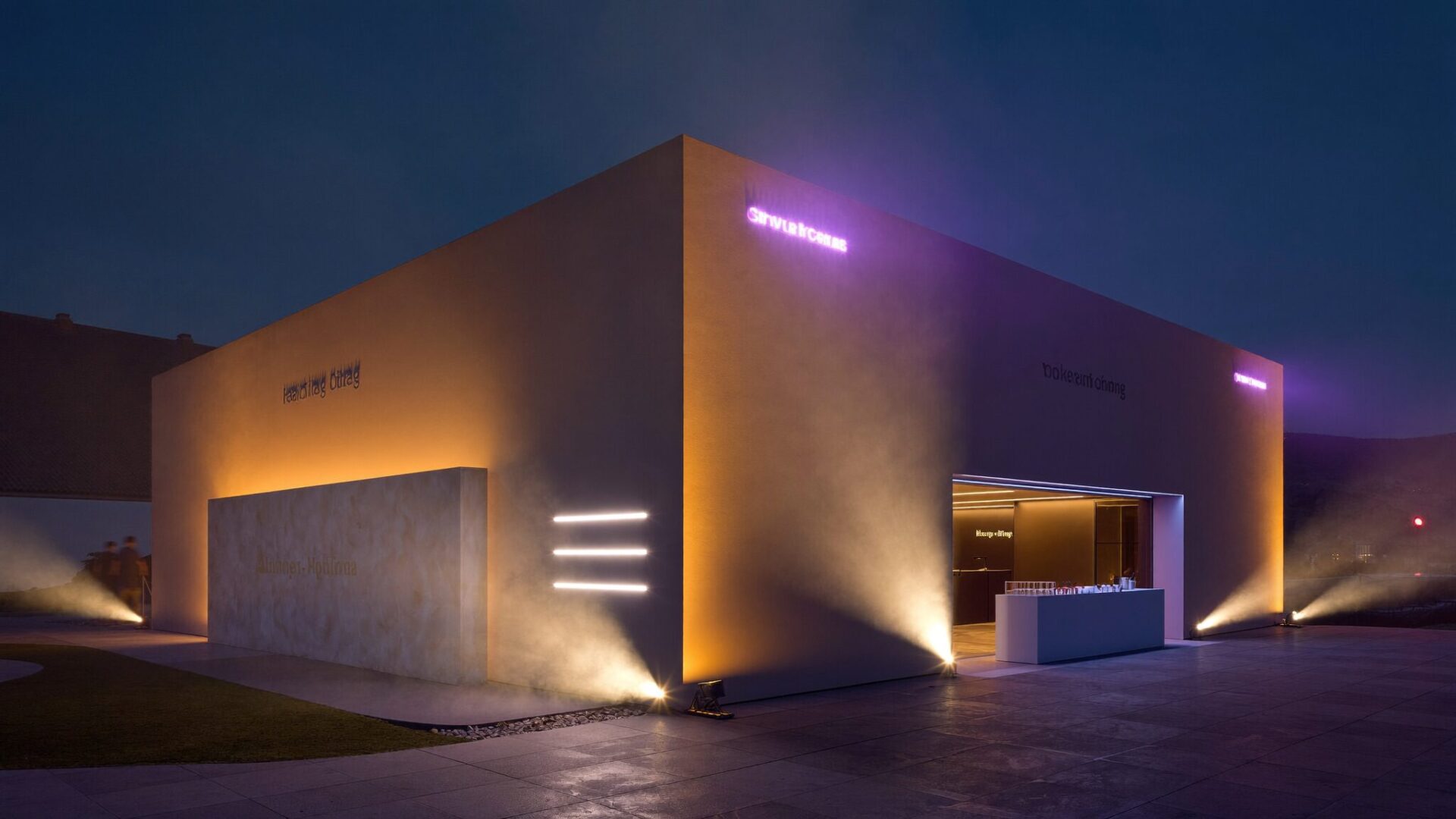
Sponsorship activation is the work a sponsor does to turn the rights it bought into something an audience can walk into, taste or photograph. The rights say what you may do. The property’s rulebook says how, where and by when.
Most guides to sponsorship activation start with ideas. This one starts with the rulebook, because the footprint, the height, the set-up window and the approvals are fixed before the first render is drawn. We write it from the build side: we fabricate and install into other people’s venues, so we read the fine print of a sponsor’s agreement and the property’s regulations before we draw a single panel.
The property rules quoted below are examples, read on November 15, 2026 from three public pages. They vary by property, and your own agreement and event manager always come first. What carries over is the shape of the rules: every property publishes numbers on size, time, power, product and fixings, and every one of those numbers is a drawing constraint.
What is sponsorship activation, and what do your rights actually let you do?
A sponsorship is a fee, paid in cash or in kind, for access to a property’s commercial value; activation is everything the sponsor does to use that access. Wikipedia’s entry on commercial sponsorship gives the fee-for-access definition and adds that sponsorship cannot stand alone: it needs support elements such as hospitality, promotions and PR. The property is the thing being sponsored, such as a festival, a venue, a team or a conference, and the rights holder is the party that controls what can be sold.
A sponsorship consultancy’s glossary of sponsorship terms defines activation as any activity bringing the sponsorship to life, and lists activation space among the assets a sponsor can be sold. It separates sample rights, the right to sample a product but not sell it, from sell rights, the right to sell but not sample. An entitlement is any right or benefit the sponsor receives under the agreement, from logo use to product sampling. Category exclusivity, which a 2015 Bonham/Wills article defines as the sponsor being the only company in its category with a relationship to the property, often applies to one area of a property rather than all of it. These two sources are a consultancy glossary and a blog post, so we use them for definitions only.
The rights fee and the activation budget are separate decisions. What matters for the build is how each right in the agreement turns into a physical constraint:
| Right in the agreement | What it means on the ground | What the build needs to know |
|---|---|---|
| Activation space | A footprint with a size, a location and a height limit | Dimensions and sightlines before design starts |
| Sample rights or sell rights | What may leave the footprint in a guest’s hand, and whether money can change hands | Counter, handoff point and back of house sized to the right you hold |
| Category exclusivity | No competing brand inside the sponsor’s area | What the neighbors may show, and what you may not cover or block |
| Logo and IP rights | Which marks you may use, and who approves each use | Artwork approvals written into the schedule |
| Hospitality | Access for guests and clients, often a defined space | Seating, service path and privacy |
If you are still working out what separates an activation from an exhibit or an ad, start with what a brand activation is. Our brand activations service page covers how we scope the build itself.
Who has to say yes? The rights holder, the venue and the city
Three layers can approve or stop a build: the rights holder (the promoter or event organizer), the venue, and the city. They keep separate deadlines, and none of them reads the others’ paperwork. A sponsor who clears only one layer can still lose the build to another.
Three public pages show how this looks in practice. All were read on November 15, 2026:
- Camping World Stadium in Orlando. Its activation requests page is written for radio stations that activate at events, and it carries no date. It says activation requests must be authorized by the event promoter, and that the form goes to the venue’s marketing director no later than 10 business days before the show. Requests needing special consideration go in at least three weeks ahead. A third party’s activation needs the promoter’s approval before the venue will consider it.
- San Diego Convention Center. Its regulations page says the licensee, meaning the show management that books the hall, must give the center a list of contractors at least 30 days before the first move-in day.
- IFPA Foodservice Conference, Monterey, July 23 to 24, 2026. The association’s product sampling page asked exhibitors who wanted alcohol in a booth to file an approved request form before July 2, and required all alcohol to be bought through, and served by, the convention center’s catering company.
Where to look differs by layer. The rights holder’s rules sit in your sponsorship agreement and the promoter’s exhibitor or sponsor manual. The venue’s sit on its regulations page and with your event manager. The city’s sit with its special events and fire offices; our NYC outdoor permit guide and permits and insurance overview show how that layer works. Venue-exclusive services are the other thing that surprises sponsors. We cover two in our venue guides: the Georgia Aquarium’s 85-decibel sound limit and its exclusive audio-visual partner in our Atlanta venue guide, and the Moscone Center’s list of exclusive services in our San Francisco venue guide. None of this says what the rules are at your property. It says what to ask for at any property: who approves, by when, and on what form.
Pro Tip: Put the rights schedule in front of your fabricator on day one. Activation space, sample rights and approvals decide the drawing, and a fabricator who sees them late redraws everything.
How do you read a property rulebook as a design brief?
Pull eight lines out of the rulebook before anyone draws: footprint, set-up window, power, sound, sampling, giveaways, attachment and signage, and cleaning and waste. Each one has a number or a yes-or-no rule behind it, and each one changes what you can build.
| Rulebook line | Published example (sources linked, read November 15, 2026) | What it does to the build |
|---|---|---|
| Footprint | Camping World Stadium: one vehicle and one 10 by 10 footprint is a standard request; anything larger is a special request needing promoter authorization | Sets the drawing envelope before any concept exists |
| Set-up window | Camping World Stadium: set-up no earlier than two hours before gates open; staging areas identified about 48 hours before the show | The build must be assembled, not made, on site |
| Power | Camping World Stadium: must be self-contained; no cords across walkways, and all cables covered and secured | Lighting and displays sized to a self-contained supply |
| Sound | Camping World Stadium: levels set by venue management under the city noise ordinance; one station in breach can get all stations asked to leave | Audio is a shared risk, so it is designed conservatively |
| Sampling | IFPA: food samples of 4 ounces or less, non-alcoholic drinks of 8 ounces or less, single portions, no self-serve, electric hot plates only. San Diego: 2 ounces of solid product and 4 ounces of a non-alcoholic drink; cannabis and CBD sampling prohibited | Counter, handoff and portion tools sized to the limit; two properties, two limits |
| Giveaways | Camping World Stadium: promoter and venue approve every item, listed on the form; stickers and other adhesive items, CDs, t-shirts and pens may not be distributed | The giveaway list is a design input, not a late addition |
| Attachment and signage | Camping World Stadium: banners may not be affixed to the venue without property-owner approval. San Diego: helium balloons only when permanently affixed to approved displays; mylar balloons prohibited | Free-standing structures with ballast, not fixings |
| Cleaning and waste | San Diego: the center is the exclusive in-house cleaning service; crate storage on the floor limited to areas no larger than 10 by 50 feet and eight feet high, with Fire Marshal approval | Crate sizes, storage and strike planned into the footprint |
Designing first has a predictable result: the brand approves the render and the venue rejects it. That is why we start from the rulebook, not the room. Our event site survey checklist covers the technical read of a space once the rules are in hand.
If you have a rulebook and a date and are not sure what it allows, send it to us. We read the document, not a summary of it.
Pro Tip: Send the fabricator the rulebook itself, not a summary of it. Summaries drop the numbers, and the numbers are the brief.
What format fits the rights you hold?
Choose the format from the rights, not the other way around. Hospitality rights point to a lounge, activation space to a branded structure or photo moment, sample rights to a bar, exhibit space to a show-floor presence, and naming or presenting rights to a stage or a session.
| Format | Rights it needs | What the build has to solve | Where we cover it |
|---|---|---|---|
| Lounge or hospitality space | Hospitality rights, ideally exclusivity inside the area | Seating, service path, privacy, finish that holds up at arm’s length | Hotel brand activations |
| Branded structure or photo moment | Activation space and logo rights | Sightlines, wind and ballast outdoors, throughput at the photo | Outdoor structures and designing for the camera |
| Sampling bar | Sample rights, not sell rights | Service positions, queue, back of house | Sampling activations and the beverage playbook |
| Show-floor presence | Exhibit or activation space | Height rules, freight handling, labor jurisdiction | Convention center activations and custom vs modular booths |
| Named stage or session | Naming or presenting rights | Scenic, screens, sightlines, a show caller | Set and stage design |
Our own work shows the formats. On a show floor, the Netflix booth at the Meadowlands was a 22 by 22 foot custom build from the client’s existing CAD package, and Café de Colombia at the San Diego Convention Center was a 40 by 20 foot space with a coffee bar and two tasting areas for more than 3,000 attendees. Each is a case study of a build, and neither is described on its page as a sponsorship deal. Our page on trade show builds covers that format in more depth.
Festivals are a property with a rulebook of their own, and the same eight lines apply. If your rights are a festival footprint, read the festival’s exhibitor manual the way you would read a stadium’s.
How do you build into someone else’s venue without looking bolted on?
Build total enough that the sponsor owns the frame of the photograph, restrained enough that the venue’s own language still reads, and make every piece free-standing, shop-built and reversible. The venue is not yours, so every piece has to earn its place against the venue’s own materials.
The brief for White Claw Sessions at The Surf Lodge in Montauk put it in nearly those words: a takeover total enough that the brand owns the frame of every photo and restrained enough that nothing looks bolted onto a beach club. We built four pieces for one property: mirror-finish letters on the sand at Fort Pond, an oversized photo frame on the waterfront deck, custom surfboards, and a reclaimed-wood entrance sign. Each was resolved in our New York shop, so the work on site was placement and alignment, not construction. That is the answer to a short set-up window like the two-hour one in the rulebook above: the build is finished before the truck leaves.
For NYLON Nights at The Surf Lodge in July 2025, we worked with Bluarch Architecture to fabricate and install a series of branded activations at key touchpoints, and the case study describes the aim as integration, not imposition. Both projects were takeovers and activations on a working property. Neither page presents them as sponsorship agreements, and we do not.
The engineering follows from the rulebook. Free-standing pieces on weighted bases leave no mark on the property; our guide to builds that leave no mark covers the method, and our event fabrication page describes how the shop works. Outdoors, wind and ballast are part of the drawing, not an afterthought.
When does each deadline land against the build calendar?
The property’s deadlines are minimums for paperwork, not for the build. Count back from the open date, and give the build its own weeks before the first form is due.
Our own lead times come from the FAQ on our brand activations page, read November 15, 2026: 6 to 8 weeks from approved concept to launch for a focused activation with custom-built environments, and 10 to 16 weeks for large architectural activations with complex fabrication, technology and multi-venue logistics. Put them beside the property deadlines:
| What has to be true | Example lead time | Source |
|---|---|---|
| Contractor list delivered to the venue | At least 30 days before first move-in | San Diego Convention Center regulations |
| Activation request filed with the venue | No later than 10 business days before the show | Camping World Stadium activation requests |
| Special request filed with the venue | At least three weeks before the show | Camping World Stadium activation requests |
| Alcohol request form filed | Before a fixed date three weeks ahead of the show (July 2 for a July 23 event) | IFPA Foodservice Conference sampling page |
| Drawings and engineering review | First 48 hours of a two-week build | Netflix booth case study: engineering review in the first 48 hours of a two-week build |
| Fabrication, finish and test fit | 6 to 8 weeks focused; 10 to 16 weeks large | Geo brand activations page |
A sponsor who signs rights three weeks before the open date can be on time on paperwork and late on the build. Some of the schedule compresses and some of it does not. Fabrication runs in parallel: Café de Colombia was designed, built, branded and delivered in fourteen days. Decisions and approvals do not compress, and neither does freight. Our custom build timeline and the pop-up shop construction timeline show where the slack really sits.
Pro Tip: When the rights are signed, ask the rights holder and the venue for every form and every deadline in one list, and date the list. Rules get updated, and the date tells you which version you built to.
How do you measure a sponsorship activation?
Pick the one outcome the rights were bought for, build the capture points into the floor plan, and agree who reads the numbers and when. An activation can be measured only as well as it was built to be measured, so the survey spot, the sign-up point and the camera positions belong in the drawing, not in a follow-up email.
We run the post-event survey and deliver a results report; what it asks is agreed at the start. Our guide to designing an event so it can be measured sets out how those capture points are placed. Where they appear as cues, the run of show is the document that carries them.
What belongs in the brief?
The rights, the rulebook, the approvals and their dates, the footprint, the service target, the capture points, the strike and reuse plan, and the person who owns each. If one of those lines is blank, the schedule has a hole in it.
| Brief line | What production builds from it |
|---|---|
| Rights schedule | The assets and entitlements the build has to carry |
| Property rulebook | The eight lines: footprint, set-up window, power, sound, sampling, giveaways, attachment, cleaning |
| Approvals | Who approves, on which form, by which date |
| Footprint and height | The drawing envelope |
| Service target in guests per hour | Counter length, queue shape and back of house |
| Capture points | Survey spot, sign-up point and camera positions in the floor plan |
| Strike and reuse | Joint design, crate sizes and where the build goes next |
| Owner and date for the readout | Who reads the results report, and when |
Why work with a full-service production company on a sponsorship?
A sponsorship has a fixed date and a rulebook, and a team that designs, fabricates, ships, installs and strikes the build can answer both without a handoff. When design, shop and install sit with three companies, the property’s rules reach each of them second-hand.
Geo Events brings more than 15 years in event production and more than 200 events built in-house. Our brand activations process begins by defining success metrics and experiential objectives before a single sketch is drawn. We design and build in our New York studio, from the brand activation fabrication shop through install and strike, and we work as the design and production arm for agencies as well as directly with brand teams. Each build is purpose-built for its program rather than pulled from stock inventory. For product launches and retail-style builds, see product launch and pop-up production. Our full-service event production covers the run and the strike, and our New York team ships to the property.
Tell us the property, the rights you hold and the date you open. We respond within one business day with a production scope and next steps.
Sponsorship activation questions we hear often
What are examples of sponsorship activation?
Six formats cover most of them: a hospitality lounge, a branded structure, a photo moment, a sampling bar, a show-floor presence and a named stage or session. Our case studies show several of these as builds, including the White Claw Sessions takeover and the Café de Colombia activation.
What is the difference between a sponsorship and an activation?
The sponsorship is the fee, in cash or in kind, for access to a property. The activation is what the sponsor does with that access: the lounge, the structure, the sampling bar, the signage and the program around them.
How much does a sponsorship activation cost?
Estimates depend on the rights, the footprint and the finish, and they are never set in advance. Our brand activations page says we provide detailed scoping within 48 hours of a brief, and that scope is the starting point for any estimate.
How far ahead should a sponsor start?
For the build, 6 to 8 weeks from approved concept for a focused activation, and 10 to 16 weeks for a large one. The property’s own deadlines are separate and listed in the section on deadlines above.