
What is a brand activation? It is a live, physical experience that invites people to step into a brand and act on it: a pop-up, an installation, a launch environment or a venue takeover, designed to get an immediate response rather than passive awareness. Most definitions stop there. This guide is written by the people who build them, so it goes further: what actually gets built, who builds it, in what order, what drives the cost and how much lead time you need.
If you have just been handed “do an activation” for a launch, a season or a sponsorship, read this before you write the brief. You will come away knowing what to ask for, what to plan the budget around and what kind of partner can deliver it.
What is a brand activation, and what is it not?
A brand activation is a built environment that gives a brand physical form for a specific moment, and asks the guest to do something inside it: taste, try, photograph, register, buy. Three things define it. There is participation, not just exposure. There is a place someone made on purpose. And there is a moment, such as a product launch, a summer season, a repositioning or a cultural event, that gives the whole thing a reason to exist now.
That definition rules a lot out. A billboard is an ad: people see it, but they do not enter it. A logo on a sponsorship banner is exposure without participation. A folding table with samples is a tactic, not an environment. A standard trade show booth can become an activation, but only when it is designed around what the visitor does rather than what the brand displays.
People often use “brand activation” and “experiential marketing” as if they were the same thing. They are related, but they sit at different levels. Experiential marketing is the discipline. A brand activation is one execution within it. If you are planning a broader program of live experiences, experiential event design is where strategy and space come together; the activation is the single built moment inside that program.
| Experiential marketing | Brand activation | |
|---|---|---|
| What it is | A strategic discipline: marketing through direct, interactive experiences | A specific execution: one built experience tied to one moment |
| Time frame | Ongoing program across a year or a campaign | A night, a weekend, a season |
| Main output | A plan, an audience strategy, a calendar of touchpoints | A physical environment people walk into |
| Who owns it | Brand marketing team or agency strategist | Designers, fabricators and producers working to that strategy |
What are the main types of brand activation?
Most activations fall into seven types. Each one puts different demands on design, fabrication and the site, so it helps to know which one you are planning before anyone draws anything.
Pop-up and retail experiences. A temporary store or branded space where guests can browse, try and buy. The build is closer to retail fit-out than to event decor: fixtures, lighting, storage, a point of sale and finishes that survive weeks of traffic. Our product launch and pop-up production team builds these to that standard.
Venue and hotel takeovers. The brand moves into a property that already has an audience, such as a beach club, a rooftop or a hotel bar, and makes it its own for a season. The challenge is restraint: total brand presence without anything looking bolted on, and no damage to the host’s surfaces.
Launch reveals. A product or campaign introduced inside a built environment, often with a single staged moment of reveal. Lighting cues, AV and scenic movement are timed to a run-of-show, the minute-by-minute script that the production team calls live.
Outdoor and beach installations. Dimensional letters, sculptural pieces and photo frames placed in open air. These are engineered for wind, sun, salt and sand, and they often need permits and ballast, the weight that holds a freestanding structure down without anchoring into the ground.
Photo-moment builds. Structures designed first for the camera: an oversized frame, a mirror wall, a set piece with a backdrop the guest wants to share. We cover how to design these in our guide to activation ideas built to be photographed.
Convention-floor activations. An activation inside a trade show or conference, where the build has to stand out from hundreds of booths and work within the hall’s rules for height, rigging and labor.
Multi-room immersive environments. A sequence of spaces with a guest journey from entry to exit, each room with its own scenic, lighting and sound. These are the largest and most technically demanding builds.
Pro Tip: Choose the type from the action you want the guest to take, not from what a competitor did last season. If the goal is product trial, plan a tasting bar. If it is social reach, plan a photo moment. If it is sales, plan a pop-up with a till. The action decides the build.
What does a real brand activation look like? White Claw Sessions at The Surf Lodge
A real activation is usually several coordinated builds across one site, each placed for a sightline and a photograph. Here is what we built for White Claw Sessions at The Surf Lodge, the brand’s summer takeover of the Montauk beach club.
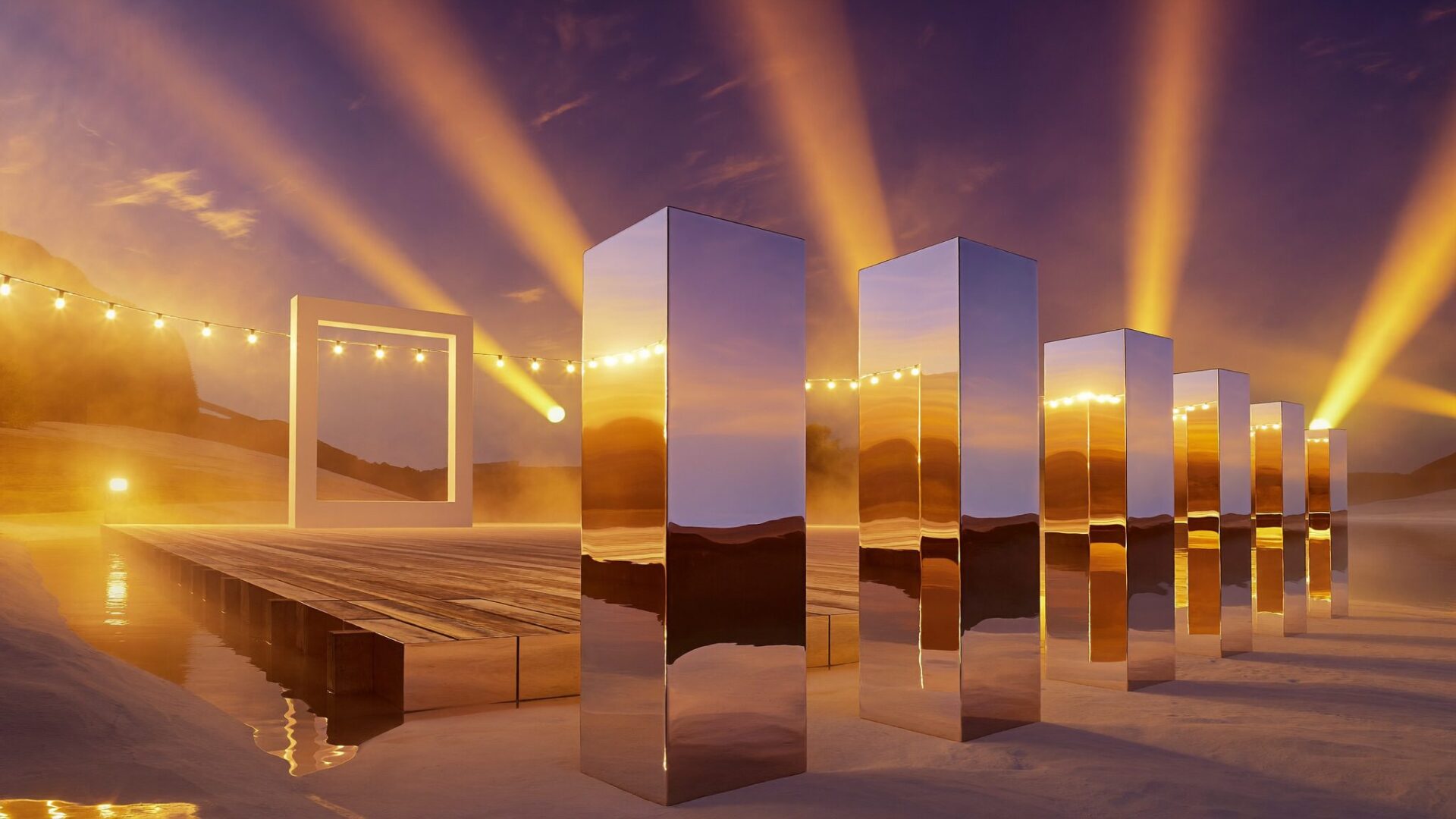
The property was treated as one composition with four installations. At the entrance off Edgemere Street, a reclaimed-wood sign on the gateway greeted guests in the venue’s own material language. Custom White Claw Sessions surfboards on freestanding mounts appeared at the entrance and along the beach, a visual thread that repeated down to the water. On the sand at the edge of Fort Pond, nine oversized dimensional letters in a polished mirror finish spelled the brand name on a low plinth. And on the waterfront deck, an oversized white photo frame covered in the brand’s colored can-tab graphics framed the pond behind anyone who stepped inside.
The mirror finish was a deliberate choice. It reflected the water, the sky and the string lights overhead, so the wordmark looked different every hour from afternoon into sunset. Printed signage reads the same in every photo. Polished metal gives the brand a new image each time the light changes.
Conditions shaped every decision. Each piece would live outdoors for the run of the program in sand, salt air, direct sun and wind off the pond, on an operating venue where install windows are short and nothing can interrupt service. So every element was built in our New York fabrication shop, engineered for transport roughly 120 miles east from Manhattan, and sized to be carried across the beach by hand. On site, the work was placement and alignment, not construction.
The lesson for anyone planning an activation: it is rarely a single object. It is a set of sightlines and photographs arranged across a site, and each piece has to survive the conditions it lives in.
Who builds a brand activation: agency, fabricator or producer?
Three kinds of company can answer an activation brief. An experiential agency owns the idea: the strategy, the narrative and the renders that win internal approval. A fabricator owns the object: shop drawings, engineering, materials, finish and crating. A production company owns the site: the schedule, the crews, the load-in, the run and the strike, which is the takedown and removal after the event.
Most activations that go wrong do not fail because one of these parties is bad at its job. They fail in the handoffs between them, where a drawing changes hands and nobody is accountable for what that costs the schedule. We cover those handoffs in detail in our guide to choosing an agency, fabricator or production company.
Geo Events works as a full-service brand activation agency with all three functions under one roof. Our architects, scenic fabricators, lighting designers and production managers work together in New York City. The environment we render is the environment we build, and the environment we build is the one your guests walk into. We work as the design and production arm for creative agencies, consultancies and PR firms, and directly with brand marketing teams who want one accountable partner.
How does a brand activation get made, step by step?
Every activation we produce moves through four stages. The names vary between companies, but the logic does not: decide why, show what, build it, then install, run and remove it.
1. Strategic immersion. We start with the brand: its positioning, its audience, its competitive context and the moment it is entering. We define the activation’s purpose, the action we want from guests and how success will be judged, before anyone sketches.
2. Spatial concept and visualization. The design team develops the spatial concept, the material palette and photorealistic 3D renderings. You see the activation on screen, with materials, finishes, lighting conditions and sightlines, before anything goes into production. This is also when engineering review should begin. A render can show a bar top floating with no visible support; the shop has to work out what actually holds it up.
3. Fabrication and production. Scenic carpentry, metalwork, CNC routing, scenic painting, large-format graphics, lighting integration and AV infrastructure run at the same time in the shop. CNC routing is computer-controlled cutting that turns a drawing into precise parts in wood, foam or plastic, so curves and lettering come out identical every time. Every element is then pre-assembled and inspected before it leaves. That test fit is the single most valuable day in the schedule: problems found in the shop cost hours, problems found on site cost the event. Our brand activation fabrication team runs this stage.
4. Installation, run and strike. The crew manages delivery, assembly in sequence, lighting and technology commissioning (testing every fixture, cue and screen so it behaves as designed) and final detailing. We stay on site through the run, then manage strike, venue restoration and the return or reuse of materials.
For the long version, with renders, design development and the engineering checkpoints, read the full design process, from brief to build.
Pro Tip: Bring the people who will build and install the work into the conversation before the concept is locked, even for an hour. A site walkthrough costs a morning and prevents a wall that will not fit the freight elevator.
How much does a brand activation cost?
A brand activation costs whatever its scope requires, and every serious quote is an estimate built from that scope, not a fixed price list. Two activations with the same footprint can land far apart because of materials, site conditions and run length. What you can control is which of these drivers you commit to, and when.
| Cost driver | Why it moves the number |
|---|---|
| Scale and footprint | More square footage means more structure, finish, lighting and crew hours. |
| Custom vs modular | A fully custom piece is engineered from zero. Modular systems reuse proven structure and can be refinished for the next program. |
| Materials and finish | Mirror-polished metal, hand-textured paint and solid hardwoods take more shop time than printed panels. |
| Indoor vs outdoor | Outdoor builds need weatherproofing, wind engineering, ballast and often permits. |
| Technology and AV | LED walls, interactive surfaces, spatial audio and lighting control add equipment, programming and technicians. |
| Venue rules and labor | Union halls, short install windows and overnight load-ins change labor rates and crew size. |
| Run length | A one-night reveal and a summer-long takeover need different durability and on-site support. |
| Transport and logistics | Distance, crating, trucks and storage between dates. |
| Strike and venue restoration | Removing everything and returning the venue to its original condition is real labor and belongs in the quote. |
Two habits keep a budget honest. First, separate the fixed brand elements from the open ones in your brief, so the shop can propose a simpler structure where the design allows it. Second, carry a contingency line from the start, larger for outdoor and complex custom builds. Our article on where an event budget actually goes shows how the line items usually split. For your own project, a detailed scope built from your brief is where any estimate starts.
How long does a brand activation take to produce?
For a focused brand activation with custom-built environments, plan on 6 to 8 weeks from approved concept to launch. Large-scale architectural activations with complex fabrication, technology integration and multi-venue logistics need 10 to 16 weeks. Those are the timelines we publish for our own work, and the clock starts at concept approval, not at the first meeting.
Timelines can be compressed. Our activation for Café de Colombia in San Diego, a 40-by-20-foot space at the San Diego Convention Center, was designed, built, branded and delivered in fourteen days. It included retail-grade finishes, a full-service coffee bar built to retail operating standards, two tasting environments and concealed back-of-house storage, and the crated build was stood up on the show floor in under a day.
Fourteen days was not a matter of working faster. It came from design, engineering, purchasing and install sequencing happening in one conversation instead of four separate email threads. Compression has a price, though: rush labor, fewer material options and less room for revisions. If your date is fixed and close, decide early which design elements are non-negotiable and let the rest flex.
Where do brand activations happen, and what does the site demand?
Brand activations happen in hotels, rooftops, restaurants, outdoor sites, convention centers and landmark venues, and the site shapes the build as much as the concept does. Each kind of venue brings its own rules.
Hotels, rooftops and restaurants give a brand an audience it would otherwise have to recruit. In return they demand operator approvals, reversible fabrication that leaves no mark, service paths that keep staff moving and install windows that fit around a working business. Our guide to hotel and hospitality takeovers covers how to partner with a venue on a branded season.
Outdoor sites bring weather and paperwork. In New York City, an outdoor activation can involve separate approvals for street use, parks, temporary structures, fire safety, amplified sound and sampling, each with its own lead time. Start with our map of NYC permits for outdoor activations.
Convention centers have their own labor rules, height limits, rigging policies and fixed move-in schedules. The Café de Colombia build worked within those rules on a fourteen-day clock.
Landmark venues such as Cipriani protect original surfaces, so every element has to stand on its own or attach without touching the building.
We design and fabricate in New York City and produce across 15 markets, from Miami and Los Angeles to Dallas and Chicago. Seasonal markets have their own rhythm: brand activations in the Hamptons run on a short summer calendar with tight install windows at busy properties, which is exactly the environment the White Claw build was engineered for. Our production guide for Montauk and the East End covers that calendar in detail.
Pro Tip: Before the design is final, ask the venue for three things in writing: the install window, the freight entrance and elevator dimensions, and its surface-protection rules. Those three answers set more design limits than any brand guideline.
Brand activation questions we hear often
Is a trade show booth a brand activation?
It can be. A booth that displays products and hands out brochures is exhibiting. A booth designed around something visitors do, such as tasting, testing or creating something to take home, works as an activation on the show floor.
Can a brand activation run for a whole season?
Yes. White Claw Sessions at The Surf Lodge ran as a summer program. Season-long builds need more durable materials, mounts the venue can re-stage and a plan for maintenance during the run.
Do you work with agencies or directly with brands?
Both. We serve as the design and production arm for creative agencies, consultancies and PR firms, and we work directly with brand marketing teams who want a single partner from concept through strike.
Why work with a full-service production company?
An activation involves design decisions, shop decisions and install decisions that depend on each other. Split across three companies, those decisions get made one after another, and the last company in the chain inherits whatever the first two made impossible. Under one roof, they get made together.
The Barbie Dream House at Cipriani shows why that matters. It was a two-story structure engineered as a modular, self-supporting steel and wood frame, pre-fabricated in our New York shop and test-assembled before delivery. The scenic panels, branded surfaces and interior vignettes were drop-in components that attached without touching the venue’s floors, walls or ceiling. Our crew assembled it in a single load-in day, and strike was finished in under eight hours. That was a design decision about what guests walk through, a shop decision about modularity and an install decision about protecting a landmark, all made at the same table.
Geo Events brings more than 15 years in event production and more than 200 events built in-house. One team carries your activation from strategy through strike, and one phone number answers when something changes in week three.
Planning an activation? Tell us about your activation: the date, the place and the action you want guests to take. We respond within one business day with a project scope and next steps.