
NYC activation permits are not one permit. They are a set of separate approvals held by separate offices, and the only question that matters in week one is which of those offices has authority over the patch of ground you intend to build on. Get that right and the paperwork is routine. Get it wrong and you discover, ten days out, that the agency you have been emailing was never the agency that could say yes.
We build outdoor brand environments for a living, and the permitting layer fails in a predictable way: a producer treats it as a single administrative step near the end of the schedule rather than as a design input at the beginning. It is a design input. Whether a structure can be two stories or must stay under a threshold, whether it can be staked or must be ballasted, whether amplified sound is possible at all — these are answers that come from an agency, and they change the drawings.
What follows is a map of who to ask and roughly when, for brand activations built outdoors in the five boroughs. Confirm current requirements with each office before you file; the city updates its thresholds and lead times, and a guide is not a filing.
Start by Asking Who Owns the Ground
Every conversation about NYC activation permits should begin here. Before you name an agency, name a landlord. In New York the permitting path follows property control, not the look of the space, and the four categories behave completely differently.
- City street, sidewalk, or pedestrian island. The Mayor’s Street Activity Permit Office, SAPO, sitting inside the Mayor’s Office of Citywide Event Coordination and Management.
- City parkland. The Department of Parks and Recreation, through its own special events permitting.
- A park with its own authority. Brooklyn Bridge Park and Hudson River Park each issue their own permits, independent of Parks.
- Private property. No street permit, but the building code, the fire code, and the owner’s own rules all still apply.
This is why a site walk is a permitting exercise as much as a measuring exercise. A plaza that reads as public space may be a privately owned space with a license agreement, and a stretch of waterfront that reads as a park may answer to a nonprofit conservancy rather than to a city agency. Our teams settle this at the venue walkthrough, because the answer determines who receives the drawings.
Streets, Sidewalks, and Plazas: SAPO
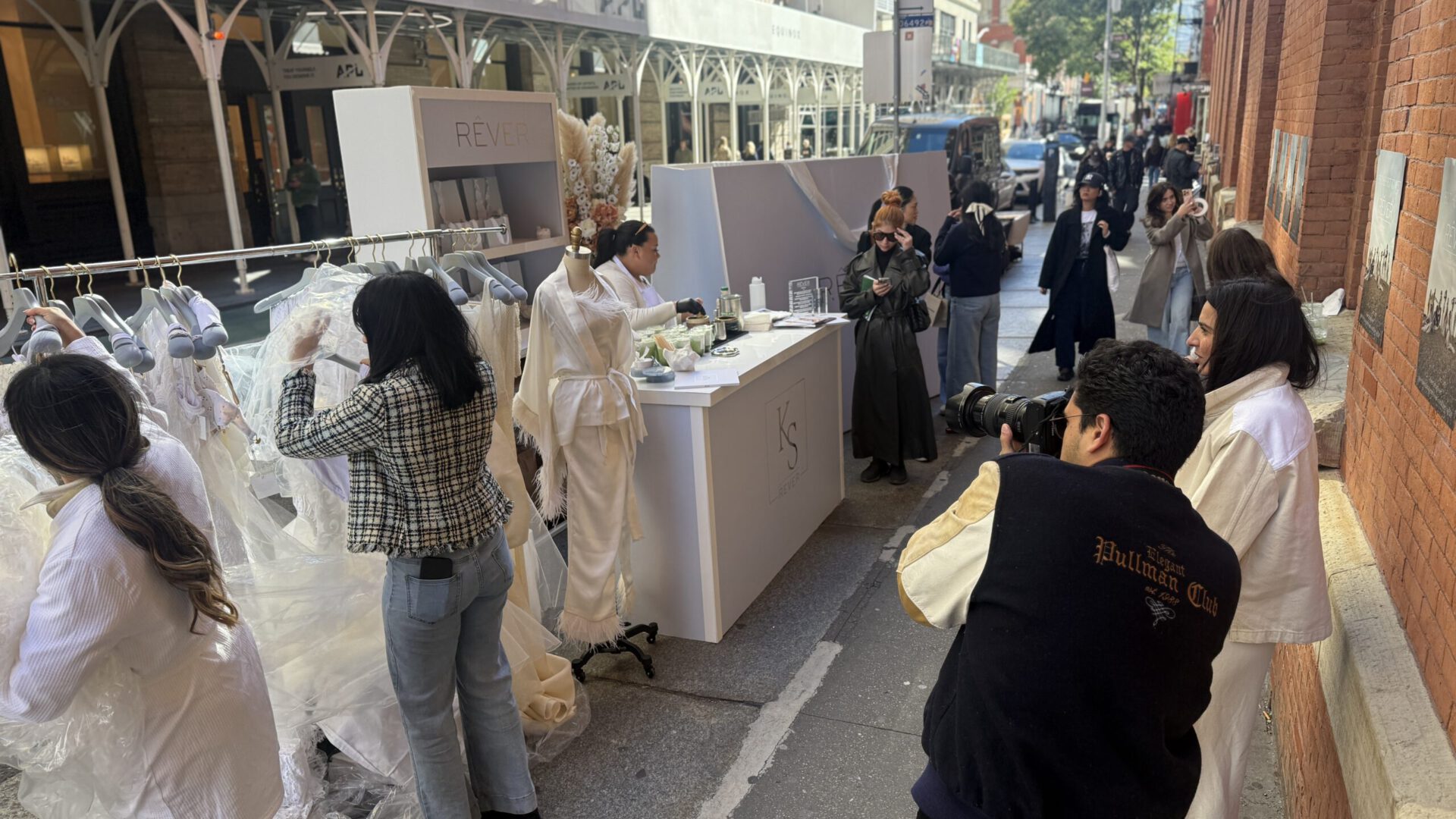
SAPO is the front door for anything a brand does on a city street or sidewalk — commercial and promotional events, street fairs, block parties, and the smaller footprints that consist of nothing more than stanchions, a carpet, or a banner. The city is explicit that laying a red carpet, setting rope and stanchions, placing tables, hanging a banner, or raising a tent on a street requires a street event permit. “It is only a few tables” is not a category.
Two things about SAPO consistently surprise first-time applicants. The first is that the filing window scales with the size of the event: the published lead time for a special event is thirty days before the date, and larger street events are expected further out than that. The second is that the community board is part of the process. An application is reviewed locally, which means a build that affects a residential block is being considered by people who live on it, and a plan that acknowledges that fact fares better than one that does not.
Insurance sits inside the same conversation. The city sets a minimum coverage requirement for street events, and the certificate has to name the right entities in the right way. That is a document the production company should already have on file, not something to request in the final week.
Parks and the Waterfront Have Their Own Front Doors
Parks property is not street property. The Department of Parks and Recreation runs its own special events permitting covering general, promotional, commercial, and private events, with requirements written around turf, trees, root zones, and paved surfaces that were never designed to carry a forklift.
Anchoring is where park builds and street builds diverge most sharply. You can rarely drive a stake into parkland, which pushes an outdoor structure toward ballast — weight placed on the surface rather than fixing into it. Ballast changes the engineering, the activation footprint, and the load-in: water barrels, steel plate, and concrete all have to arrive, get positioned, and leave again, and the route they take across a lawn is itself part of the permit conversation.
Then there are the parks that are not Parks. Brooklyn Bridge Park and Hudson River Park issue permits through their own organizations, each with its own calendar, its own house rules, and its own view of what a branded structure may look like on their waterfront. Treat them as venues with permitting powers, and start the conversation the way you would start it with any venue — early, with a concept and a rough footprint rather than a finished design.
The Build Itself Is a Buildings Department Question
Here is the distinction that catches the most producers: the permit to hold an event is not the permit to erect a structure. Those are two different filings with two different agencies, and the Department of Buildings handles the second one.
DOB’s thresholds are worth committing to memory, because they are the numbers that shape a design. A Temporary Place of Assembly is required for temporary premises where seventy-five or more members of the public gather indoors, or two hundred or more gather outdoors, and a TPA covers events running less than thirty days. Separately, an alteration permit is triggered by a tent or canopy larger than roughly four hundred gross square feet, by a platform or stage more than two feet high covering one hundred twenty square feet or more, by a prop or truss standing over ten feet, or by anything of the sort left in place for thirty days or longer.
Read that list again as a designer rather than an administrator. A hero structure at ten feet and a hero structure at eleven feet are different projects. A stage riser at eighteen inches and one at twenty-six inches are different projects. None of that is a reason to build small — it is a reason to know, at concept stage, which side of each line you are on, so the choice is deliberate.
Where temporary structures are involved, DOB expects a separate work permit filing supported by technical reports carrying statements of responsibility signed by a registered design professional. And in the city’s own language, the event producer or sponsor is considered the owner on these filings. That is a real transfer of responsibility, and it is the clearest argument for keeping design, event fabrication, and production under one roof: the party that signs is the party that holds the drawings.
Fire, Sound, Food, and Drink Are Four Separate Conversations
An activation rarely stops at a structure, and each additional layer has its own office. NYC activation permits are organized by subject matter, not by event, so a single afternoon can require four unrelated approvals.
Fire safety belongs to the FDNY. Open flame, pyrotechnics, fuel-fired equipment, and how people get out of a temporary enclosure are fire department questions, and they arrive alongside a place of assembly rather than instead of it. A design that funnels a crowd through a single opening will be examined on exactly that point, so egress deserves a line on the floor plan from the first sketch.
Amplified sound belongs to the NYPD, and specifically to the precinct where the event will take place. Sound device permits are issued locally, with an application filed in advance of the date, and city rules restrict amplified sound near schools, houses of worship, courthouses, and hospitals during their operating hours. A soundtrack is not a technical detail you can add on site.
Food and beverage sampling is a health question. A temporary food service establishment permit is what covers serving at a temporary event, event sponsors are expected to submit their vendor list to the health department well ahead of the date, and supervision requirements apply on site during service. Alcohol is not a city matter at all: it runs through the New York State Liquor Authority, usually by way of the venue’s existing license or a temporary permit, and the state’s timeline has no obligation to match yours.
Film and photography is its own front door too. The Mayor’s Office of Media and Entertainment handles production permits, which matters the moment a capture crew becomes part of the plan rather than an afterthought.
Private Property Is Not a Permit Exemption
Much of the best outdoor work in this city happens on private ground — a rooftop terrace, a restaurant’s own frontage, a hotel deck — and producers sometimes read that as permission to skip the layer entirely. The street permit, yes. The code, no.
When we transformed Magic Hour, the West Terrace rooftop bar at the Moxy Hotel in midtown, into an Aspen-inspired après-ski environment eighteen floors up, the faux log cabin walls were shop-built and installed without modifying the rooftop. That approach is partly aesthetic and substantially practical: a free-standing, self-supporting build keeps you out of a conversation about altering a structure, and it keeps the venue’s own surfaces intact. The same logic produced the two-story Barbie Dream House inside Cipriani as a modular, self-supporting steel and wood structure, pre-fabricated in our shop and test-assembled before it ever reached the venue.
Public-facing buildings add a second layer on top of the first. Our “One Love” Pride Month photo activation at One World Observatory — a laser-cut acrylic sculpture twelve feet wide and eight feet high — stood for a full month in a building with security protocols, its own life-safety plan, and a daily visitor flow that does not pause for an install. Those requirements come from the venue, they are usually stricter than the code minimum, and they are not negotiable in week six.
And the geography cuts both ways. The mirror-finish WHITE CLAW letters we fabricated, produced, and installed on the sand at the edge of Fort Pond for White Claw Sessions in Montauk sat outside the five boroughs entirely, under a different set of town offices. Nothing about a New York City permit path transfers to the East End — only the discipline of identifying the authority before the design is locked.
Put the Permit Path in the Production Schedule
The practical fix for all of this is unglamorous: NYC activation permits get their own line on the production schedule, with the filing dates working backwards from the event and the drawings those filings require working backwards from them again.
That sequencing has a useful side effect. Nothing a city agency asks for is exotic — a dimensioned plan, an elevation, a structural approach, a sign-off from someone qualified to give it. It is the same package a fabricator needs to build from and a venue needs to approve. A project that produces proper drawings early is a project that files on time, and a project that improvises its drawings is usually late on both fronts at once.
Three habits carry most of the weight. Identify the controlling authority during the site survey, not after the concept presentation. Treat each agency’s published lead time as the latest acceptable date rather than the target. And route every permitting question through a single accountable party, so nobody assumes the fabricator filed what the planner thought the venue was handling.
If you are scoping an outdoor activation in New York and want the NYC activation permits path mapped against the build before the design is locked, our full-service event production team does this work alongside the drawings rather than after them. Tell us the site, the dates, and the ambition, and we will tell you which offices need to hear from you and what they will want to see. Start a conversation with us and we will walk the ground with you.