
A hotel brand activation is the only kind of build that opens inside a business that is already serving guests. The rooms are sold, the bar has covers, and the restaurant has a service path its staff walks a few hundred times a night. None of it pauses because a brand booked a takeover. That one condition shapes everything that follows: what gets fabricated, how it attaches, when it goes in, and how quickly it can disappear.
Hospitality venues are the most appealing canvases in experiential work and the most constrained. A rooftop bar or a waterfront restaurant arrives with atmosphere no raw space can buy — a view, a crowd, a reason people are already standing there. It also arrives with an operator who is accountable for that atmosphere long after the campaign ends. Getting a hotel brand activation right means building for the brand’s story and the operator’s business at the same time, and knowing which one wins when the two disagree.
The Operator Is Your Second Client
The brand writes the brief. The operator can stop the truck at the loading dock. In a hotel brand activation, approval runs through people who were not in the creative meeting: a general manager, a food and beverage director, an engineering lead, sometimes a banquet manager who owns the floor plan you are about to change.
Their concerns are consistent and worth learning before the first render. They want to know what the build touches, how many seats it takes out of service, whether their staff can still reach the back of house, and what the space looks like at 6 a.m. the morning after strike. They are not obstacles. They are the people who know where the floor drains, where the power actually comes from, and which doorway the dish pit depends on.
The practical move is to put the operator in the walkthrough early, with drawings rather than mood boards. A venue walkthrough where the GM points at a wall and says “not that one” saves a week of shop time. Bringing elevations to that conversation, instead of discovering the constraint during load-in, is the difference between a fast approval and a redesign.
Reversibility Is the Price of Entry
Almost no hospitality operator will let a brand modify the building. No new penetrations in the deck, no anchors in a finished wall, no paint on anything permanent. That restriction is usually read as a limitation. It is better understood as a specification, and it pushes the work toward free-standing fabrication that carries its own structure.
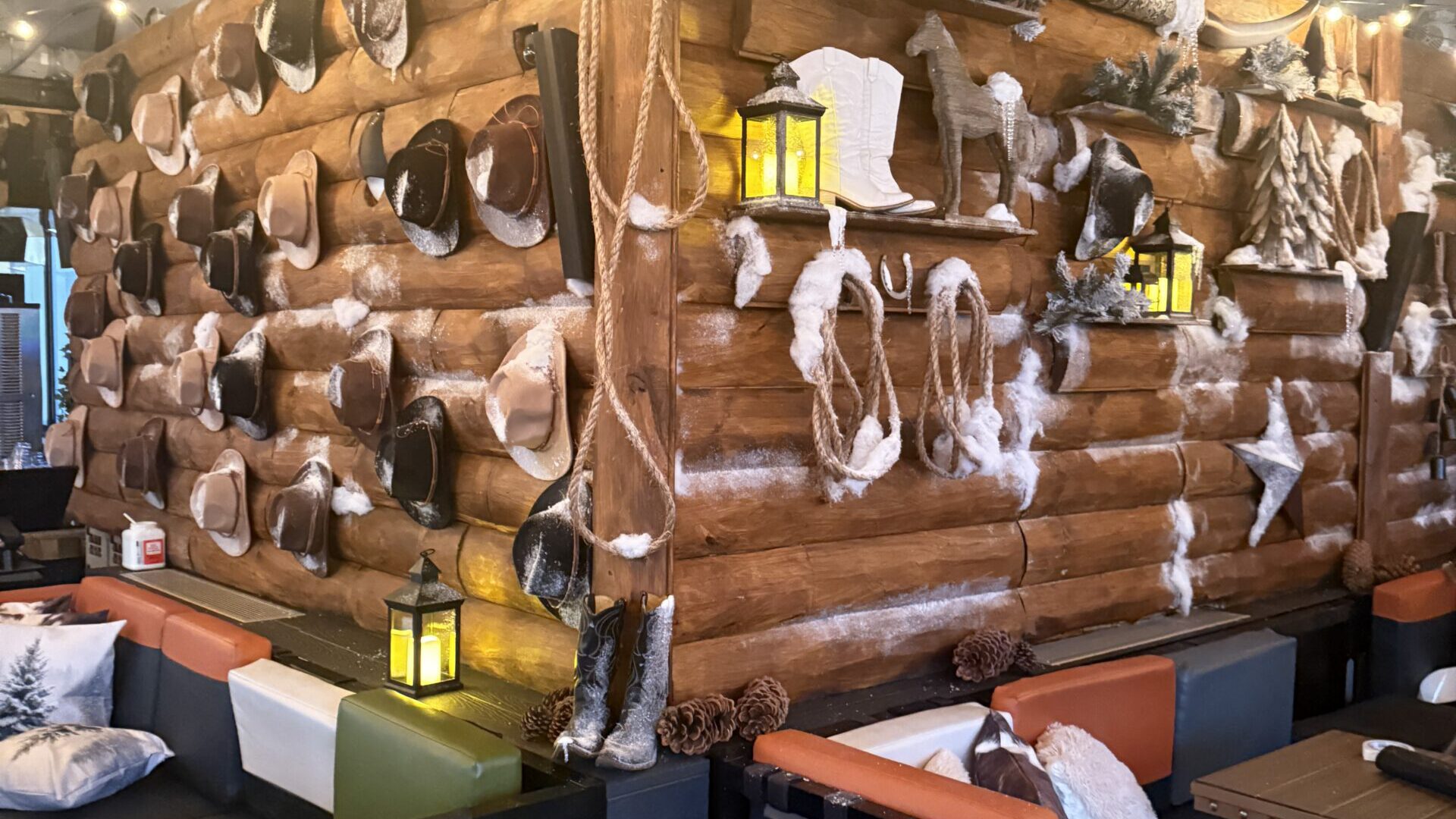
When we transformed Magic Hour, the West Terrace rooftop bar at the Moxy Hotel in midtown Manhattan into an Aspen-inspired lodge environment, the faux log cabin walls that wrapped the dining tables were shop-built and installed without modifying the rooftop. The walls stood on their own. That is the whole trick: the environment reads as architecture and behaves as furniture, so the venue gets its terrace back intact.
Designing for reversibility changes the fabrication logic. Elements get built as self-supporting assemblies with concealed ballast rather than fixed frames. Scenic panels become drop-in components that attach to the structure you brought, not to the surfaces you found. Standoffs hold a graphic wall a short distance off the venue’s own finish so nothing bears against it. Each of these decisions costs weight and shop hours, and each one is what makes the brand environment possible at all.
Build Around Service, Not Across It
A takeover that blocks service will be quietly dismantled by the staff who have to work around it. Servers find the shortest path to the bar within one shift, and if a photo moment sits in that path, it gets moved, leaned on, or used as a tray stand.
So the floor plan has to be read twice: once for guests and once for the people working. Where does the expo window sit. Which doors swing into the room. Where do the bussers stage. On the White Claw Sessions takeover of The Surf Lodge in Montauk, the pieces we fabricated, produced, and installed stand where guests naturally stop — mirror-finish letters standing on the sand at the edge of Fort Pond, an oversized white photo frame on the waterfront deck, custom surfboards at the entrance and around the property. Spreading the moments out keeps a crowd from forming in one place, which is as much a service decision as a design one.
Throughput deserves the same attention. A branded bar that slows pours costs the operator covers all night. Build the back bar with the bottles where the bartender expects them, give the ice a home, and keep the brand’s graphics above the working surface rather than across it.
Seasonality Sets the Calendar
Hospitality activations run on the venue’s season, not the brand’s campaign calendar, and the two are rarely aligned. A seasonal waterfront property has a summer during which it cannot afford a single dark night, which means the install window is measured in hours and sits outside service. A midtown rooftop has the opposite problem: it needs a reason to be occupied in the cold, which is why a winter transformation can take a terrace that would otherwise sit empty and give it a full season of use.
That seasonality also decides materials. An outdoor build in Montauk is a wind and salt problem before it is an aesthetic one; a rooftop lodge eighteen floors up is a weight and exposure problem. Montauk has two short shoulder seasons and one very busy middle, so brands competing for the same weekends are competing for the same crews and the same freight runs out of the city. Planning a Hamptons activation in February is not early. It is on time.
For NYLON Magazine’s Fourth of July celebration at The Surf Lodge, we fabricated and installed a series of premium branded activations at key touchpoints across the property, working with the project’s architecture partner. The approach was integration rather than imposition — pieces placed into the venue as it already worked, instead of a set dropped on top of it. On a property running at capacity in July, that is the only approach that survives.
Finish Thresholds in a Room That Already Works
Hospitality interiors are designed by people who care about them. A brand element that reads as temporary in a space with real finishes does more damage than no element at all, because the contrast is the first thing a guest notices.
This is where finish thresholds matter more than material honesty. The log walls at the rooftop lodge were finished to read as timber from phone-camera distance, which is the distance that actually matters — the range at which guests photograph each other. Knowing that threshold tells the shop where to spend its finishing hours and where to stop.
Mirror is the other reliable instrument, because it borrows whatever is already good about the venue. For the Delilah pop-up in Montauk, the entire street-facing façade of an existing restaurant was clad in a mirror paneling system fabricated in our shop and installed over the exterior, with a ground-up new entrance built alongside it. Treating the building as a single re-skin, rather than a collection of installed pieces, is what let a familiar storefront read as a different address entirely. Mirror also demands honesty about maintenance: it shows every fingerprint, and someone on the venue’s staff will be wiping it down daily.
Install and Strike Happen on the Venue’s Clock
The schedule is where hospitality builds are won or lost. Load-in generally happens overnight or between services, through a service entrance sized for food deliveries rather than scenic, and often up a single freight elevator shared with housekeeping. The elevator’s interior dimensions, not the truck’s, set the maximum size of any finished assembly.
That constraint belongs in the shop drawings, not in a conversation on the sidewalk at 2 a.m. Panels get sized to the elevator, labeled by install sequence, and crated in the order they come off the truck. Crew calls get written against the venue’s actual quiet hours, which the operator knows and the brand usually does not.
Strike deserves equal planning, and it is the part most often underestimated. The venue needs its space back on a specific morning, in its original condition, with nothing left behind. A build designed for reversible install strikes fast almost automatically — the assemblies that went in without touching anything come out the same way. Our event fabrication process treats strike as a design input, because a piece that cannot come apart in the dark is a piece that was engineered for a photograph and nothing else.
Where These Partnerships Earn Their Keep
The reason brands keep returning to hotels, rooftops, and restaurants is that these venues supply something an empty space cannot: people who are already there, already relaxed, and already inclined to stay. A brand activation in a working hospitality property inherits an audience instead of recruiting one.
The reason operators keep saying yes is that a well-run takeover gives them a season, a story, and a room that photographs. That exchange only holds when the build respects the business underneath it. A successful hotel brand activation leaves the operator with a better property than they had and no repairs to make.
If you are planning a takeover of a hotel, rooftop, or restaurant and need a partner who can carry it from drawings through shop build, install, and strike without leaving a mark on the venue, start a conversation with our team. We will ask about your operator’s constraints early, because that is the conversation that determines what is actually buildable.