CASE STUDY NO. 11
Netflix Trade Show Booth at the Meadowlands
- Client
- Netflix
- Location
- Meadowlands Complex, New Jersey
- Guests
- 2,000+
- Category
- Audio / Visual
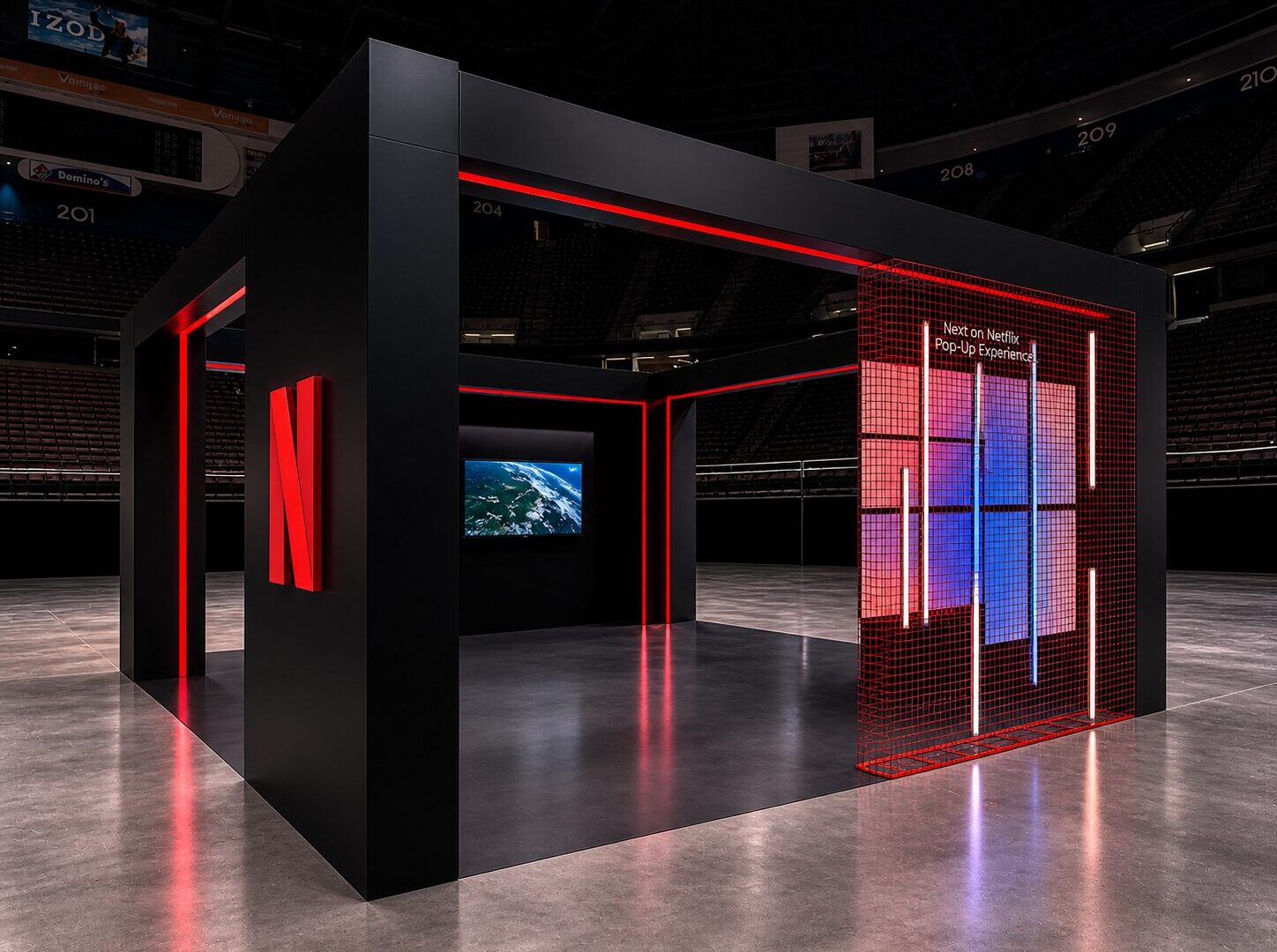
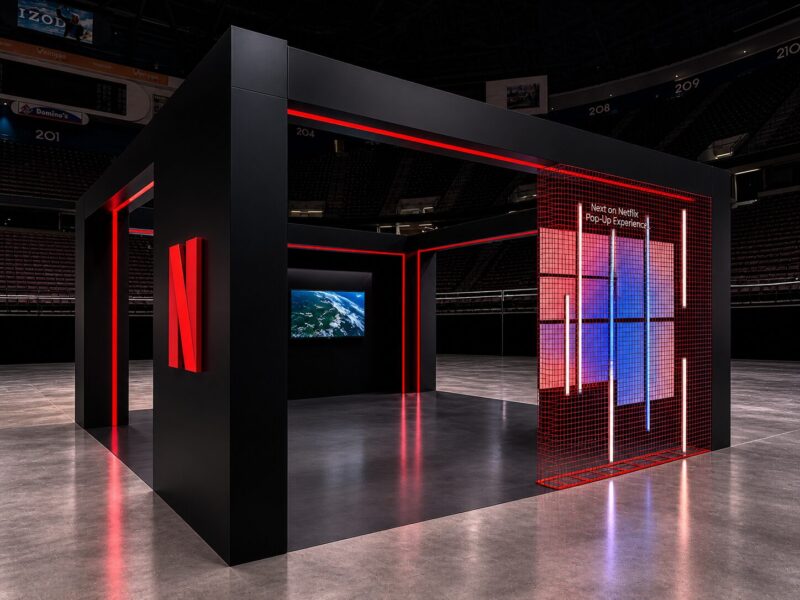
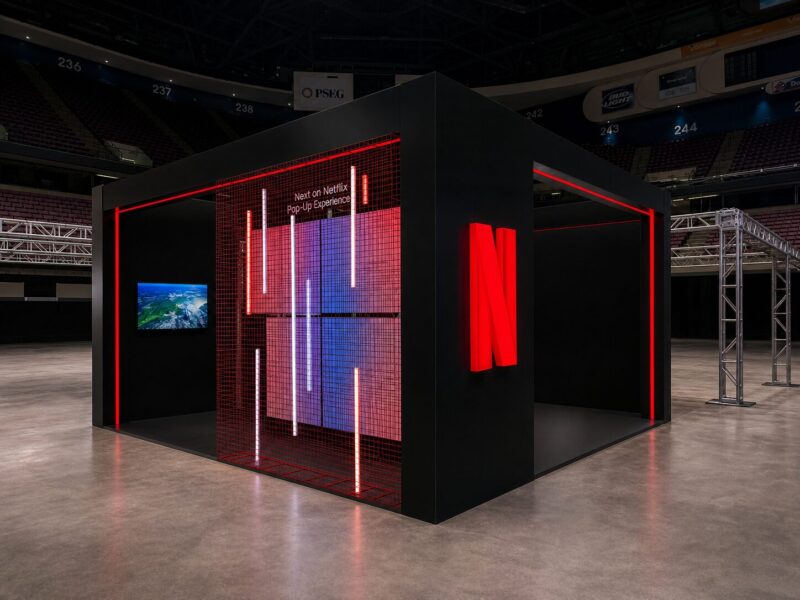
A 22×22 custom-fabricated trade show booth built for Netflix at the Meadowlands Complex in New Jersey, designed and produced from the brand’s existing CAD drawings on a two-week build cycle. The footprint included custom lighting fixtures, custom display fixtures, flush-mount televisions integrated into wall pockets, and a branded LED Netflix logo as the centerpiece. The booth anchored a trade show with more than 2,000 attendees — a high-traffic environment that demanded the finished product look identical to the renders Netflix had approved internally, and hold up to a full event run without a single visible flaw.
Netflix arrived with the design already locked. The brief was not to originate concept work — it was to translate an approved CAD package into a flawlessly fabricated, production-ready booth in two weeks. That sequence inverts the usual creative timeline: every dimension, finish callout, and lighting position was already specified, and any deviation from the drawings would read as a defect. The build had to match what was approved, exactly, on the first attempt.
The technical envelope was tight. A 22×22 footprint leaves no slack for a booth carrying custom millwork, lighting, integrated displays, and a hero LED logo — every square foot had to absorb a designed function. Flush-mount televisions required wall sections engineered to exact depth and rigidity tolerances so the screens would sit perfectly recessed without cabling visible behind them. The custom Netflix LED logo had to be sized to brand standards, color-matched to Netflix red under variable trade show lighting, and powered cleanly inside the booth’s electrical envelope.
The two-week turnaround compressed everything. Trade show fabrication on this scope typically runs four to six weeks across drawings review, shop fabrication, finish, electrical integration, and pre-build dry fit. Cutting that to fourteen days meant every fabrication trade — millwork, metal, finish, lighting, electrical, AV — had to run in parallel rather than sequence, with no margin for a single missed handoff.
We treated the existing Netflix CAD package as the source of truth and built our production schedule backward from the trade show’s load-in window. Engineering review happened in the first 48 hours — every drawing was checked against fabrication realities (flush-mount TV depth, lighting fixture mounting, LED logo wiring routes) so any conflict surfaced before material was cut rather than during install. By day three, shop drawings matched Netflix’s approved package exactly, and event production kicked off across every trade simultaneously.
The booth’s wall sections were fabricated as modular panels in our shop, finished to Netflix’s specified material callouts, and engineered with internal channels for the flush-mount television pockets so cabling routed cleanly behind the wall surface. Each TV pocket was built to the exact bezel tolerance Netflix’s drawings called for — a flush-mount that’s even a sixteenth of an inch off reads as sloppy, and the brand had specified the appearance precisely. Custom display fixtures were built in matching finishes, integrated into the wall geometry rather than added as afterthoughts.
The custom Netflix LED logo was the booth’s center of gravity. We fabricated it to the brand’s exact dimensional standards, color-matched the LED output to Netflix red under tested trade show lighting conditions, and routed power through the booth’s primary electrical envelope so the logo carried no visible cabling. Custom lighting fixtures throughout the booth were fabricated to match the design package, with a color temperature and beam pattern selected to read consistently across booth surfaces and on guest cameras — every brand activation on a trade show floor lives or dies on how it photographs, and Netflix’s booth had to perform on screen as flawlessly as in person.
Parallel-tracked fabrication kept the two-week clock viable. Millwork, metal, finish, and electrical/AV ran simultaneously rather than waiting on each other, which is only possible when the design is fully locked at kickoff. We pre-built and dry-fit the booth in shop ahead of load-in to confirm every panel, fixture, and TV pocket aligned to the drawings — so the on-site build at the Meadowlands was an assembly operation rather than a problem-solving one. The booth opened to its 2,000-plus attendees identical to the experiential event design package Netflix had approved two weeks earlier.
By the Numbers
Visual Archive
The Gallery
On Camera
The Recap
- Custom Booth Footprint
- 22×22
- Design-to-Install Timeline
- 2 Weeks
- Trade Show Attendees
- 2,000+
- Custom Netflix LED Logo
- 1
Common Inquiries
Case Details
Why was the two-week turnaround the central constraint?
Trade show booth fabrication at this scope — custom millwork, custom lighting, integrated AV, brand-spec LED — typically runs four to six weeks. Compressing that to fourteen days required running every fabrication trade in parallel rather than sequence, with engineering review fully resolved within the first 48 hours so shop work could start without waiting on revisions.
How was Netflix's existing CAD package handled?
The drawings were treated as the locked source of truth. Our engineering pass checked every dimension and finish callout against fabrication realities — flush-mount TV depth, lighting fixture mounting, LED logo wiring — so conflicts surfaced before material was cut. The booth that loaded into the Meadowlands matched the approved Netflix renders exactly.
What made the flush-mount televisions a fabrication challenge?
Flush-mount integration leaves zero tolerance for visible bezel offset or exposed cabling. Wall sections were engineered with internal channels for cable routing and TV pockets sized to the exact bezel dimensions Netflix's drawings called for. A sixteenth of an inch out of square reads as sloppy at trade show distance — the tolerance had to be tighter than that.
How was the custom Netflix LED logo produced?
Fabricated to Netflix's exact dimensional and brand-color standards, with the LED output color-matched to Netflix red under tested trade show lighting. Power routed through the booth's primary electrical envelope so no cabling was visible from any guest sightline. The logo functioned as both architectural element and primary photo target for the activation.
What does a parallel-tracked fabrication schedule look like?
Millwork, metalwork, finish, electrical, and AV all run simultaneously rather than in sequence. It only works when the design package is fully locked at kickoff — any late revision blows up the dependency chain. For Netflix, the design was locked before we engaged, which is what made the two-week timeline possible.
Start the Conversation
Let's discuss how we can elevate your next landmark event into a cinematic experience.