
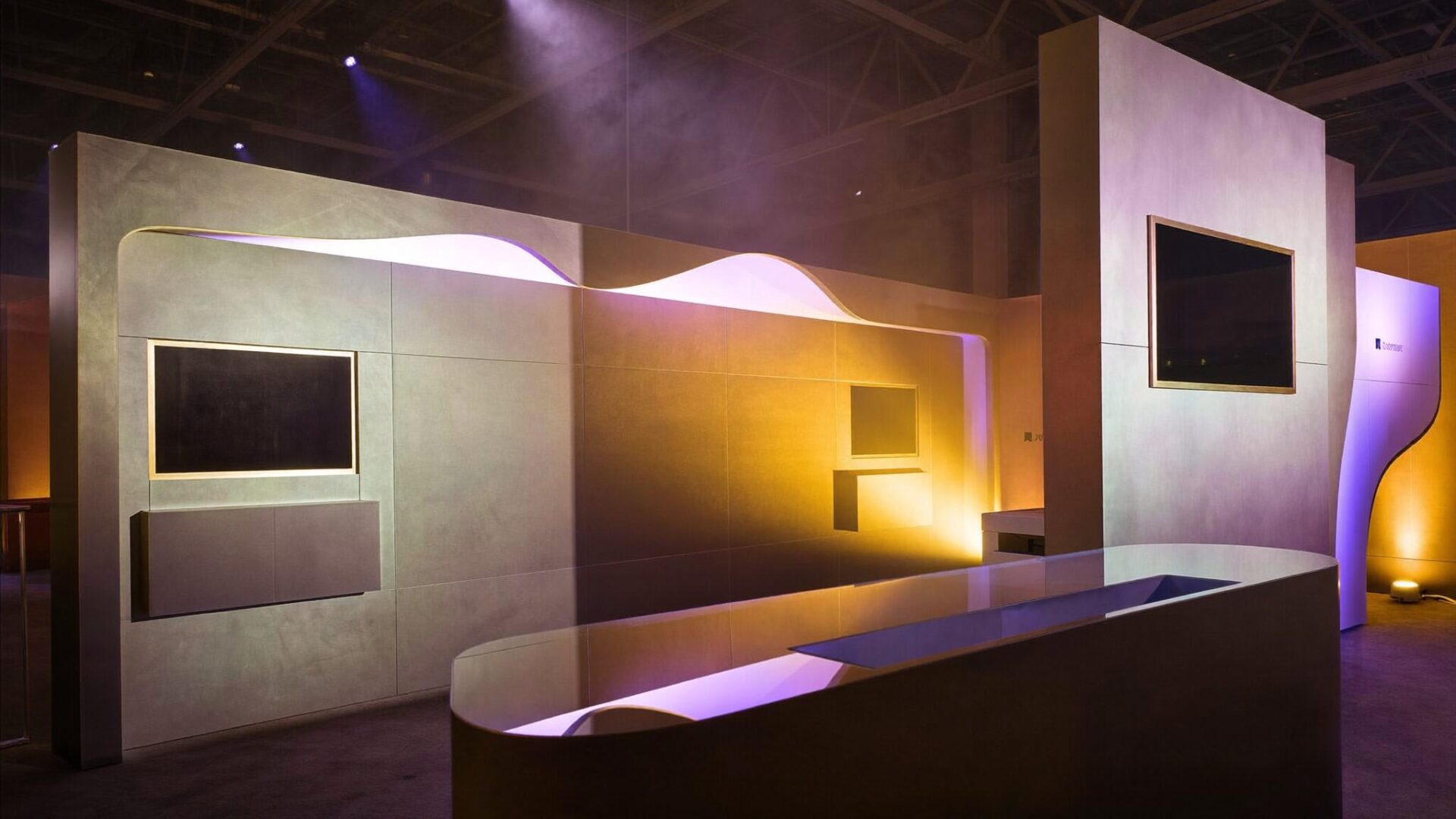
Choose a custom trade show booth when one anchor show carries the year and the booth has to do something a standard system cannot. Choose a modular system when you exhibit at several shows in different booth sizes. And if your calendar has both, which most real calendars do, build a hybrid: a reusable core designed for your brand, plus one or two custom hero pieces for the show that matters most.
The choice is usually framed as impact against cost. On the show floor it is decided by four less glamorous things: the show calendar, the booth type each show assigns you, what the booth weighs every time it ships, and how fast it goes up inside a fixed install window. We build both kinds of exhibit as custom exhibits and booths built in our New York shop, so this is the view from the shop floor rather than from a product catalog.
What is the difference between a custom and a modular trade show booth?
A custom trade show booth is designed and built for one brand and usually one footprint. A modular booth is a system of standardized, interchangeable components that reconfigures across booth sizes and layouts, show after show. The first is a single object. The second is a kit of parts with rules for how the parts connect.
“Modular” hides two very different things, and most comparisons blur them. The first is a catalog frame system: aluminum extrusion with tension-fabric graphics, bought largely as standard parts and dressed with your artwork. The second is a custom-designed modular system: panels, headers, counters and AV walls drawn for one brand, with standardized connections so the same pieces build a 20×20 island for an anchor show, a 10×20 inline for secondary shows and a 10×10 for regional events. That second kind is the one we design and fabricate. It belongs to the client, travels in its own crates and carries the brand’s own materials and finishes.
The line between custom and modular also blurs inside the shop. A well-built custom booth is often panelized so it can ship and assemble quickly. For the Netflix booth at the Meadowlands, a 22×22 custom build, the wall sections were fabricated as modular panels with internal channels for cabling. The booth was one-off; the construction method was modular. Parts like these are often CNC-cut so every panel matches its drawing to the same tolerance.
| Custom one-off booth | Custom-designed modular system | Catalog frame system | |
|---|---|---|---|
| Design freedom | Any form the hall rules allow | High, within a set of repeatable parts | Limited to the frame profiles on offer |
| Footprint flexibility | Built for one size and shape | Designed to scale across sizes | Reconfigures easily |
| Typical materials | Wood and steel millwork, solid surface, metal, acrylic | Panel goods and aluminum framing on standard connections | Aluminum extrusion and tension fabric |
| Weight | Heaviest, unless engineered light | Moderate, set in design | Lightest |
| Install labor | Skilled crew, longer install | Small crew, tool-light connections | Small crew, fast |
| Finish ceiling | Retail grade, inspected at arm’s length | Retail grade on the surfaces that matter | Printed fabric and graphics |
| AV integration | Screens and light built into the structure | AV walls designed as standard modules | Screens mounted to the frame |
| Refresh path | Rebuild or rework | Swap graphics and hero pieces | Swap graphics |
| Best fit | One anchor show, a hero moment | A multi-show calendar in mixed sizes | A first show or a market test |
Why should you start with your show calendar, not the booth?
The calendar decides most of it. One anchor show a year favors a custom build sized to that floor, while several shows in different booth sizes favor a system designed to reconfigure between them. Before anyone draws a wall, list every show you expect to exhibit at in 2027.
For each show, write down four things: the dates, the booth size, the booth type (inline, peninsula or island, explained in the next section) and how important it is to the year. One show almost always stands out. That is your anchor show, and the design should start there. Our own planning rule, published on our trade show exhibit design and fabrication page, is that brands exhibiting at three or more shows a year with similar booth sizes usually do better owning an exhibit built for them than starting over each time.
| Calendar pattern | Lean | Why |
|---|---|---|
| One anchor show, same footprint every year | Custom one-off | The booth only has to work in one envelope, so every design choice can serve that floor and that audience. |
| Three or more shows in mixed sizes | Custom-designed modular system | The same parts build each footprint, so the brand looks identical everywhere and nothing is built twice. |
| One anchor show plus several regional shows | Hybrid: modular core plus custom hero pieces | The core travels to every show; the hero pieces come out for the anchor. |
| A first show, or testing a new market | A catalog frame system with strong graphics may be enough | Learn what the floor rewards before committing to a build, then put the investment into the anchor show. |
If your calendar doesn’t fit one row, send it to us; most don’t.
Pro Tip: Design the system around the largest booth you expect to take in the next two years, then subtract for smaller shows. Scaling a system down is easy. Scaling up a system that was designed for a 10×10 rarely works, because the structure, the AV and the graphics were never drawn for the bigger envelope.
How do booth type and height rules shape the choice?
Before design starts, the show’s booth type sets the envelope. Under the International Association of Exhibitions and Events (IAEE) guidelines, an inline booth is capped at an 8-foot back wall with a 4-foot limit in the front half, while an island can usually use its full space up to 16 to 20 feet, signage included. Those limits decide what a booth can physically be at each show.
Here is how the common booth types work under IAEE’s display guidelines (the 2019 edition on IAEE’s site; the 2023 North American update, as distributed by show organizers, carries the same values):
- Inline (also called linear): a booth in a row with neighbors on one or both sides. The back wall can reach 8 feet in the rear half of the space; anything in the front half, toward the aisle, stays at 4 feet.
- Perimeter: an inline booth along the outside wall of the hall, which can usually run a 12-foot back wall.
- Peninsula: a booth open on three sides. Where it backs onto inline booths, it stays at 4 feet within 5 feet of each aisle, and can rise to 16 to 20 feet at the center of the back wall.
- Island: a booth open on all four sides, typically 20×20 or larger, which can use its full cubic content up to 16 to 20 feet, including hanging signs.
Those front-half limits exist to protect line of sight: the rule that keeps your booth from blocking your neighbors’ view down the aisle. Organizers set their own rules, and some allow different heights, so the exhibitor manual for each show always governs.
What this means for the decision is direct. Inline booths are where modular systems shine, because the envelope is close to identical at every show. Islands, two-story structures and hanging-sign moments are where a custom build earns its cost, because the envelope is large and the brand has room to make a statement. A modular system meant to move between an inline space and an island has to be designed for both envelopes from the first sketch. Bolting an island’s worth of height onto parts drawn for an 8-foot back wall is how systems end up looking improvised.
What does weight do to the cost of every show?
Material handling at most US shows is billed by weight, per 100 pounds with a minimum charge, and at a higher rate for uncrated freight. Every pound a booth carries is paid for again at every show, so weight is a running cost of the design, not a one-time shipping line.
Material handling, often called drayage, is the service the show’s general contractor provides to move your freight from the loading dock or the advance warehouse to your booth space, and back again after the show. Each show’s manual says what, if anything, you may carry in by hand; everything else moves through the contractor at its rates.
Published contractor forms show how the billing works. Freeman’s material handling information for a 2024 Anaheim show prices freight per hundredweight (CWT, meaning 100 pounds), with a 200-pound minimum per shipment and weights rounded up to the next 100 pounds. Crated freight is charged at a lower rate than uncrated, loose or pad-wrapped freight. GES’s exhibitor services manual for one show notes that a shipment mixing crated and uncrated pieces can be billed as special handling, and both contractors add surcharges for handling outside straight-time hours. Each show publishes its own rates and rules, so check yours before you lock the design.
That turns material choice into a calendar question. Aluminum and fabric systems are lighter than wood and steel millwork. A custom build can be engineered lighter with honeycomb panels and aluminum framing, but finish and rigidity trade against weight, and a panel that flexes when a guest leans on it does not read as premium. The crates matter too. When crates are designed as part of the booth, as our guide on how a booth moves from CAD files to the show floor explains, they protect the finish and keep the shipment in the crated category.
Pro Tip: Ask for the crate list and the total shipping weight with the design, not after fabrication. That number repeats at every show on your calendar, and it is far easier to change while the booth is still a drawing.
How do install labor and the install window change the answer?
A modular system is designed to go up quickly with a small crew and few tools. A custom booth asks for more skilled install time. Because the show fixes the install window and often the labor rules too, both belong in the design brief from day one, not in a conversation with the crew on move-in morning.
Move-in schedules are set by show management, often to the hour, and the aisle carpet goes down on a published timetable. Many halls also have labor rules that decide who may do which work, from unloading to electrical connections, so read the exhibitor manual before you assume your own crew can do everything. A system with tool-light connections fits those constraints easily. A custom booth with integrated screens, lit logos and millwork needs a lead who knows the build and a sequence written for the hall.
The way to make a custom booth install like a system is to do the problem-solving in the shop. Our fabrication crews install what they built, and complex exhibits are assembled in the shop before they ship. For Netflix, the booth was pre-built and dry-fit, a term for a full test assembly, so that every panel, fixture and TV pocket was checked against the drawings. As the case study puts it, the on-site build at the Meadowlands “was an assembly operation rather than a problem-solving one.” Our guide to install and strike covers how that sequence runs on site, and the guide to exhibiting at the Meadowlands shows how one venue’s rules shape it.
Where does a custom trade show booth earn its cost?
Custom earns its cost when the booth has to do something a system cannot: operate as a café or bar, carry a two-story or architectural form, hold screens and light as part of the structure, or reach a retail-grade finish that guests inspect from arm’s length. If none of those apply, a well-designed system will usually serve the show as well.
Two of our builds show where that line sits. For Café de Colombia at the San Diego Convention Center, the footprint was 40 by 20 feet, or 800 square feet, and it had to work as an operating coffee bar, two tasting zones and concealed back-of-house storage at once. Every visible surface was built to a retail-grade finish, meaning it had to pass close inspection by guests waiting at the counter, with proper joinery at every edge. It was designed, built, branded and delivered in 14 days for more than 3,000 attendees. No frame system would have carried a working bar to that standard.
Netflix was a different kind of case. The booth carried flush-mount televisions, meaning screens recessed into wall pockets so they sit level with the surface, with no bezel shadow and no visible cable. Each pocket was built to the exact bezel tolerance in Netflix’s drawings. The centerpiece was a branded LED logo color-matched to Netflix red under tested trade show lighting. The case study notes that fabrication at that scope “typically runs four to six weeks”; we delivered it on a two-week build because the design was locked at kickoff. Work like this is covered in more depth in our pieces on LED built into the structure and retail-grade builds on a show schedule.
Lighting is part of the finish. Color temperature, measured in Kelvin, describes how warm or cool white light looks: lower numbers read amber, higher numbers read blue. A custom booth can specify one color temperature across every fixture, so the structure reads as a single object on the floor and on guests’ phone cameras. Hall lighting is flat and outside your control; the light built into the booth is the only light you own.
Why is a modular core with custom hero pieces the best answer for most brands?
For most brands with a real show calendar, the strongest answer is a hybrid: a reusable, reconfigurable core designed for the brand, plus one or two custom hero pieces built for the anchor show. The core carries the brand to every show. The hero pieces make the anchor show unmistakable.
The core is the working structure: back walls, counters, AV walls and storage, all on standardized connections, finished in the brand’s own materials. It is drawn once, for the largest envelope on the calendar, and it is built to be crated and reinstalled across markets. The hero pieces are where the custom work goes: a dimensional logo or header, a bar, a product reveal, a sculptural element that becomes the photo everyone takes. Between shows, the structure carries over and the graphics and hero pieces change.
Café de Colombia shows the client side of this idea. The case study states that “the build is modular. The same design language can be reconfigured for different footprints, shows, and markets.” That is a custom booth designed with a second life in mind, which is the hybrid in practice.
The return on a hybrid depends on how the booth is treated at strike, the teardown after the show closes. In our experience, a booth that is handled carefully at strike goes out five or six times with nothing more than graphics changes, while a booth thrown into crates in the last hour becomes a rebuild.
Pro Tip: Photograph and log any damage at every strike, that night, while the crew still remembers what happened. Refurbishment between shows then gets scheduled instead of discovered the week before the next move-in.
How long does each path take?
Plan about 10 to 16 weeks from brief to install for a custom exhibit. Add 2 to 4 weeks when a modular system is built to tour, so it can be prototyped and checked. Allow 6 to 8 weeks to modify a booth you already own. These are the ranges we publish for our own trade show work.
The extra time for a touring system is not padding. A system has to be proven before it travels: the connections assembled and taken apart, the parts checked in each footprint they will build, and the crates tested against the full kit. A flaw found in the prototype costs an afternoon; the same flaw found at the second show of the year costs the install window. For a comfortable schedule, we suggest 3 to 4 months for a custom exhibit, and 5 to 6 months for a large island or a first-time build.
| Path | Typical lead time (Geo Events) | What drives it |
|---|---|---|
| Custom exhibit | 10 to 16 weeks, brief to install | Design, engineering, fabrication, packing and shipping |
| Large island or first-time build | 5 to 6 months is comfortable | More design rounds, more structure, more decisions |
| Modular system built to tour | Custom timeline plus 2 to 4 weeks | Prototype and validation before the first show |
| Modifying a booth you own | 6 to 8 weeks may be enough | Depends on the scope of changes |
Compressed builds are possible. Netflix ran on two weeks and Café de Colombia on 14 days, but both worked because the design was fully locked at kickoff and every trade ran in parallel. Treat them as proof of what a shop can do under pressure, not as a plan. Count back from your first move-in date, not from the show’s opening day, and remember that early-year shows put the holidays in the middle of the build, as our guide to CES week in Las Vegas shows. Our custom build timeline breaks down each stage.
Custom and modular booth questions we hear often
Can a modular booth look custom?
Yes, when the system is designed for the brand rather than picked from a catalog. Finish, material choice and light built into the structure do most of the work; the connections stay hidden.
Can you add to a modular system later?
Yes, if the connections were standardized from the start. That is a design decision made on day one, which is why the system should be drawn for the largest booth you expect to take.
What booth size suits a modular system?
Any size. A system pays off most when booth sizes vary across your calendar, because the same parts build each footprint.
Why work with a full-service production company for your exhibit?
A full-service production company keeps design, engineering, fabrication, testing, crating, shipping, install and strike with one team, whether the answer is custom, modular or a mix. Across a calendar of shows, that means one party accountable for how the booth looks, ships and goes up at every one of them.
When design and build sit with different companies, the seam between them is where schedules slip. We have produced more than 200 events with in-house fabrication over more than 15 years, from our New York shop. The crew that builds a booth is the crew that installs it, and we deliver, install and strike nationally, including in Chicago and Las Vegas. If you are comparing trade show booth design companies, our guide on how to choose a fabrication company lists the questions worth asking each one. You can see the full scope of our trade show and exhibition work, from custom exhibits to modular systems, and our event fabrication service.
Send us your show calendar, booth sizes and any drawings you have, and we will come back within one business day with a recommendation on custom, modular or a mix, and an honest schedule from your first move-in date.