
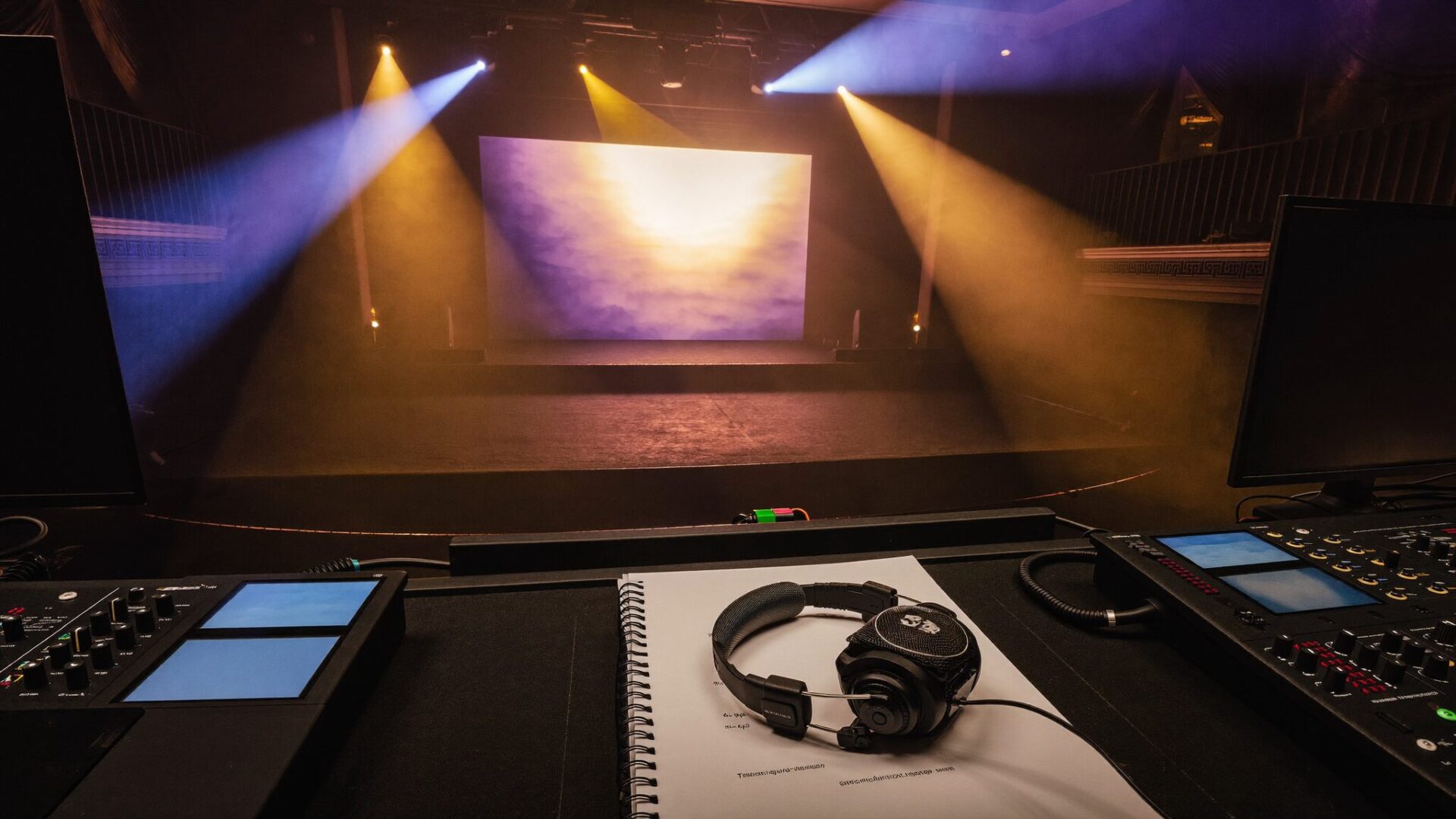
A run of show is the minute-by-minute script for a live event: every segment with its start time and length, and every lighting, audio, video and stage cue, each with a number and an owner, so one show caller can call the whole event from one document. An agenda-level template does not tell a crew when to fire a cue. This guide builds the version a production crew actually calls from, with two worked examples you can copy: a general session opening and an awards segment.
We write and call these documents as part of full-service event production, so what follows is the working method, not a theory. If a venue, an AV team or your own leadership has asked you for “the run of show” and you are holding an agenda, this is how to turn one into the other.
What is a run of show?
A run of show is the document that turns an event plan into a sequence of numbered, timed and owned actions. The trade term is “run of show”, usually shortened to ROS; you will occasionally hear “run of the show”, but on production paperwork it is almost always ROS. It answers one question for every person on headset: what happens next, when, and who makes it happen.
There are two levels of the same document. The client-facing version lists segments, start times and speakers, and it is what most people picture. The crew version adds a row or a column for every cue: each lighting change, every sound effect, each video roll, every camera shot on the screens. A meeting with one microphone and a slide deck can live with the first. Anything with a lighting design, playback video or an awards block needs the second, and that is the version this guide builds.
Planners often mix up the run of show with four other documents that sit next to it. Keeping them separate saves a lot of version confusion later.
| Document | What it covers | Who uses it |
|---|---|---|
| Agenda | Sessions and times for attendees | Guests |
| Production schedule | Hour-by-hour load-in, rehearsal, show and strike | Crew, venue |
| Script | Every spoken word: host, VOG, presenters | Talent, teleprompter operator |
| Run of show | Every segment and every cue, numbered, timed and owned | Show caller and every department |
| Technical rider | Power, rigging and equipment needs | Venue, production |
The last row has its own guide: our technical rider explainer covers what the venue needs to know before anyone writes a cue.
What columns does a run of show need?
A working run of show needs a cue or item number, a clock time, a duration, the segment and what happens on stage, one column per department (lighting, audio, video and camera), the owner, and notes. Each column exists because someone on headset needs to find their line without reading anyone else’s.
- ROS number. The row number the whole crew uses when the show caller speaks. “Standing by on 7” has to mean the same row to every department.
- Clock and duration. Use both. Duration shows the caller when a segment is running long; clock time ties the show to the venue’s hard stops, the catering service and the doors.
- Segment and stage action. A short line on what the audience sees: who walks on, from which side, what is on stage.
- LX. The lighting cue number from the console, not a description. “LX 4” is enough; the lighting programmer knows what it looks like.
- Audio. Which microphones are live and what plays. A lav is the small clip-on microphone a presenter wears; VOG, short for voice of God, is the off-stage announcer.
- Video and IMAG. Playback is pre-made video and audio, fired from a playback machine. IMAG is the live camera feed of the presenter on the side screens, so the back of the room can see a face.
- Owner. One name per row. If two people own a row, nobody does.
- Notes. Warnings, backups and anything the caller must remember, such as a time card to the presenter or what the confidence monitor shows. The confidence monitor is the screen at the stage lip that shows a presenter their next slide and a clock.
House lights, a term you will see in every example below, means the room’s own lighting over the audience, as opposed to the stage lighting. “House to half” is the classic signal that the show is about to start.
If the event is streamed, add a stream column for the broadcast director: what the online audience sees while the room is on a break or a walk-in. Our guide to hybrid event production covers when that second audience needs its own show. Finally, every page carries a header with the event name, show date, version number, time of issue and who issued it. That header matters more than any column, for reasons we cover in the section on locking the document.
How do cue numbers work in a run of show?
Each row gets a run of show number that the whole crew uses, and each department also keeps its own cue list: the lighting console’s cues, the video operator’s playback list. The run of show lists both side by side, so a single call can fire several departments at once and every operator knows which of their own cues it means.
The lighting column is the clearest case. A lighting console controls fixtures through DMX, the standard control protocol for stage lighting, published as ANSI E1.11 through the ESTA Technical Standards Program, with a 2024 edition. One DMX line, called a universe, carries up to 512 control channels, which is why larger shows run several universes. None of that belongs in your run of show. What belongs there is the console’s cue number, because the programmer has already stored every level, color and movement inside it.
Rehearsal always adds moments nobody planned. A presenter decides to play a short clip in the middle of a keynote; the lighting designer wants the stage dimmed for it. On the console, that new state goes between cue 4 and cue 5 as cue 4.5. ETC’s Eos console documentation shows exactly this: cues can be whole numbers or decimals, and entering “.5” after cue 5 records cue 5.5. That decimal is called a point cue.
Use the same convention in the run of show. When a row is added between row 6 and row 7, it becomes row 6.5, and nothing downstream moves. There is no single industry standard for cue numbering; conventions vary by console manufacturer and by crew. What matters is that the run of show and every department follow the same rule for the length of the show.
Pro Tip: Once the first rehearsal has started, avoid renumbering the run of show. Every department has already marked scripts, cue sheets and console notes against the old numbers. Insert point cues instead, and let the numbering look untidy. Untidy numbers cost nothing; a renumbered show costs a missed cue.
Run of show example: a general session opening
The table below is an illustrative model, not a client’s show. It opens a single-day summit in a hotel ballroom of several hundred guests: walk-in, an opening video, a CEO keynote, then a moderated panel. It is the template in practice. Copy the columns, change the rows.
| ROS # | Clock | Dur. | Segment and stage action | LX | Audio | Video / IMAG | Owner | Notes |
|---|---|---|---|---|---|---|---|---|
| 1 | 8:30:00 | 28:00 | Doors open, walk-in | LX 1 house full, stage preset | Walk-in playlist, low | Holding loop | Stage manager | Doors on producer’s call |
| 2 | 8:58:00 | 2:00 | VOG: take your seats, phones silent | Hold | VOG mic live, music under | Holding loop | Show caller | Script v3, page 1 |
| 3 | 9:00:00 | 0:10 | House to half | LX 2 house 30% | Music fades out | Hold | Show caller | |
| 4 | 9:00:10 | 2:30 | Opening video | LX 3 house out, stage dark | Audio from playback | PB 1 opening video; backup PB 2 rolling in sync | Video op | Redundant playback |
| 5 | 9:02:40 | 0:15 | CEO walks on, stage left | LX 4 stage up, presenter special | Walk-on sting; lav 1 live | Logo to IMAG camera 1 | Stage manager cues talent | Talent standing by stage left from 9:00 |
| 6 | 9:02:55 | 18:00 | CEO keynote | Hold | Lav 1 | Slides from final deck; IMAG camera 1 on side screens | Presenter, show caller | Confidence monitor: next slide plus clock; 2-minute card at 9:18:55 |
| 6.5 | 9:10:00 | 1:00 | Product clip inside the keynote (added at rehearsal) | LX 4.5 stage dim 50% | Audio from playback | PB 1 clip 2 | Video op | Point cue; runs inside row 6 |
| 7 | 9:20:55 | 0:20 | Moderator and three panelists walk on | LX 5 panel look, four chairs | Walk-on music; lavs 2 to 5 live | IMAG camera 2 two-shot | Stage manager | Chairs preset before doors |
| 8 | 9:21:15 | 25:00 | Panel | Hold | Lavs 2 to 5 | Cameras 2 and 3 cut by director | Moderator | 5-minute card at 9:41:15 |
| 9 | 9:46:15 | 1:30 | Panel walks off, sponsor video | LX 6 stage dark | Lavs out; playback audio | PB 1 sponsor video | Video op | |
| 10 | 9:47:45 | 20:00 | Break: VOG, house up, walk-out | LX 7 house full | VOG, walk-out playlist | Break countdown 20:00 | Show caller | Next block starts 10:07:45 |
Every clock time is the previous clock time plus its duration, with one exception: row 6.5 runs inside the keynote’s 18 minutes, so it does not move the clock. That is the point cue from the section above in practice, numbered 6.5 in the run of show and 4.5 on the lighting console.
Three things are worth copying. The opening video runs on two playback machines in sync, so a frozen file costs a button press rather than the opening. Every row has one owner. And talent is standing by at the side of the stage two and a half minutes before their walk-on, not being fetched from the green room when the cue arrives.
The same structure scales up for executive meetings and summits with breakouts, a second stage or a streamed session; each room simply gets its own run of show and its own caller. For a sense of the room, our VTEX event at The Glasshouses hosted more than 350 attendees, with one staging configuration that supported both keynote presentations and breakout conversations in a single open-plan space. If the equipment behind the LX, audio and video columns is new to you, start with our guide to event AV production.
Run of show example: an awards segment
Awards are the most unpredictable part of any run of show, because nobody on headset knows the winner in advance. One block of rows repeats for every category, and every winner walk-up has to be cued before anyone knows which table the winner will rise from. The answer is to build one tight block, rehearse it, and repeat it exactly.
| ROS # | Clock | Dur. | Segment and stage action | LX | Audio | Video / IMAG | Owner | Notes |
|---|---|---|---|---|---|---|---|---|
| 101 | 19:30:00 | 1:00 | Host introduces category 1 | LX 101 host special | Host lav | Category title graphic | Host | Prompter page 12 |
| 102 | 19:31:00 | 1:30 | Nominee video | LX 102 stage dim | Playback audio | PB nominee package 1 | Video op | |
| 103 | 19:32:30 | 0:10 | Winner announced | LX 103 audience light up on nominee tables | Winner sting | Winner graphic | Show caller | Graphic fired only on producer’s confirmation |
| 104 | 19:32:40 | 0:25 | Winner walk-up, stage right steps | Follow spot picks up winner | Music under | IMAG camera 2 follows | Runner at the winner’s table | Walk-up path rehearsed |
| 105 | 19:33:05 | 1:00 | Acceptance | LX 105 podium special | Podium mic | IMAG camera 1 | Winner | Timer on confidence monitor |
| 106 | 19:34:05 | 0:10 | Play-off, only if over time | Hold | Play-off music | Hold | Show caller, on producer’s word | Standby only, not automatic |
| 107 | 19:34:15 | 0:20 | Photo at centre-stage mark | LX 107 photo look | Music under | Hold | Photographer | |
| 108 | 19:34:35 | 0:20 | Walk-off stage right to photo wall; host returns | LX 101 host special | Music out; host lav | Category 2 title | Stage manager | Rows 101 to 108 repeat per category |
Notice the numbering: the awards block starts at 101, so category 2 can start at 201 and the crew always knows which category they are in from the first digit. Row 106 is written in, but it is a standby, not an automatic cue; it fires only if the producer says so. The one-minute acceptance follows the guidance in our awards ceremony production guide, where 60 seconds is the length we recommend. That guide covers the format itself: the host, the trophies, the green room. This one covers the paper the show runs on.
The walk-up row is where awards nights go wrong. The follow spot operator, the camera operator and the runner all need to know which table the winner is sitting at before the name is read, which is why the producer confirms the winner to the caller privately and the graphic waits for that confirmation. For the full scope of corporate galas and award ceremonies, the run of show is one deliverable among many, and the one that decides whether the evening feels rehearsed. On the Roivant holiday gala at the New York Public Library, more than 400 guests and a full AV production were held together by on-site direction, and the evening flowed with what the project write-up calls “the precision of a theatrical performance”.
Pro Tip: Write the awards block once, then copy it for each category and change only the names, the video file and the graphics. A run of show where every category is built a little differently is a run of show where one category will go wrong, usually the one with the most important winner.
Who writes the run of show, and when does it lock?
The producer builds the run of show in pre-production from the client’s agenda. The show caller takes it over once rehearsals start. After the final rehearsal, every change goes through the show caller and nobody else. That handover is the single most important rule in the document’s life.
Our team keeps version control simple. Every page header carries the version number and the time it was issued. There is one master copy, held by one person. Changes from the previous version are highlighted. And when a new version goes out, old printed copies are collected from the tech table, because the most dangerous document at any show is last night’s run of show in someone’s back pocket.
The cue columns can only be filled when the client delivers the material they describe. The list is always the same:
- the final agenda, with hard stops for meals and room changes
- every speaker’s name, title and walk-on side
- scripts for the host and the VOG
- final slide decks and every video file, in the formats the playback operator asked for
- music for walk-ins, walk-ons and play-offs
- award categories, with winners sealed and confirmed to the producer only
- VIP seating, so camera and follow spot know where to find people
Slides are the item that slips most often. In our sales kickoff production guide we set the slide deadline at one week before load-in, the day the crew starts building in the venue, and the same deadline works for any general session.
The countdown below is a planning model, not a fixed rule; a small meeting compresses it and a multi-day conference stretches it.
| Stage | When (planning model) | What goes in | Owner |
|---|---|---|---|
| 1. First draft | Once the agenda is approved | Segments, clock times, durations, speakers | Producer |
| 2. Cue columns filled | After the design locks | LX, audio, video and camera cue numbers from each department | Producer with department heads |
| 3. Rehearsal version | Before the first rehearsal | Scripts, decks and video files placed against their rows | Producer hands to show caller |
| 4. Final | After the last rehearsal | Point cues added, timings corrected | Show caller |
| 5. Show copy | At crew call on show day | Locked; any change is made by the show caller only | Show caller |
Where these stages sit against the wider calendar is covered in our corporate event planning timeline, and, for events with a scenic build, in the custom event build timeline. The short version: the run of show cannot lock before the design does, so a late design decision is also a late run of show.
How does a show caller use the run of show live?
The show caller, sometimes called the stage manager, reads the run of show over headset and gives every department a warning, a standby and a go, so each cue fires on one word from one person. Operators do not act on what they see on stage; they act on the call.
The pattern comes from theatre, and the stage management handbooks university theatre programs publish describe it in much the same way. The warning is optional and comes well ahead. The standby tells the operator to put a finger on the button, and the operator answers that they are standing by. Then the go. Central Connecticut State University’s stage management handbook gives the classic form: “Standby Light Cue 50”, then “Light Cue 50, Go”. How early the standby comes varies by handbook and by crew, so agree on the timing with your caller and operators at rehearsal rather than assuming a standard.
On a corporate show, one row often fires several departments together, which is why the run of show puts them in one line. Row 5 in the general session example would be called something like: “Standby lights 4, sound sting, IMAG camera 1.” Each operator confirms. Then: “Lights 4, sound, camera: go.” Three departments, one word, one moment on stage.
The chain of command is just as fixed. The producer talks to the show caller; the show caller talks to the crew. A client who wants to cut a segment tells the producer, never the lighting operator, a point our awards guide makes from the stage side. What the LX column looks like in the room is the subject of our piece on lighting design, and the IMAG column has its own logic, set out in our guide to designing for the camera.
Pro Tip: Keep the headset quiet between standby and go. It is one of the habits stage management training stresses most, and it is the one that protects a reveal. A side conversation in that window is how a confetti cue fires on the wrong word.
Why work with a full-service production company to run your show
A run of show only works if the people who built the stage, programmed the lighting and loaded the video are the people calling it. When the document is written by one company, the scenic built by a second and the show called by a third, every hand-off is a place where a cue number means something different to someone.
We work the other way. The same team writes the run of show, installs what our fabricators built, runs the tech rehearsal and calls the live show: the team that built it runs it. For corporate meetings, scenic, LED, audio, lighting and broadcast elements are built and tested in our studio before installation, so problems surface in the studio rather than at the tech table on show day.
That continuity is what we have built over more than 15 years in event production and more than 200 events built in-house, from set and stage design to the last cue of the night. Shows are planned and fabricated from our New York studio and travel to the markets our clients work in. If you already have a run of show, we will read it with you. If you have an agenda and a date, we will build the run of show from it and call it on the night.
Run of show questions
Is it run of show or run of the show?
Run of show is the trade term, shortened to ROS. “Run of the show” means the same thing, but crews, venues and production companies write it without the “the”.
What is the difference between a run of show and an agenda?
The agenda is for guests: sessions, rooms and times. The run of show is for the crew: every segment broken into numbered cues, each with an owner, timed to the second where it needs to be.
How detailed should a run of show be?
Cue level for anything with a lighting design, playback video, cameras on screens or an awards block. Segment level is enough for a meeting with one microphone and a screen. When in doubt, write the cue level; it is easier to ignore a column than to invent one during the show.
Planning a general session, gala or awards night? Send us your agenda, date and venue. A senior producer replies within one business day with a production scope and next steps.