
A beverage brand activation is judged by two numbers nobody writes into the brief: how many people walked away holding the product, and how many of them photographed themselves doing it. Everything else — the scenic, the signage, the bar, the lighting — exists to move those two numbers. When a build forgets that, it becomes a handsome structure that guests walk past on their way to the other bar.
Beverage is the most operationally demanding vertical we build for, and the reason is simple: it is the only category where the brand asset is consumed on site, in volume, under a clock. A fashion activation can be beautiful and static. A beverage brand activation has to pour, chill, restock, ice, drain, and clear trash for hours while staying photogenic in the background of every guest’s phone. That is a service environment wearing a brand environment’s clothes, and it has to be engineered as both.
What follows is how we approach these programs in the shop and on site: what the build is actually for, how seasonal takeovers differ from show-floor work, and the decisions that have to land early because they cannot be fixed on install day.
What the Build Is Actually For
Start by separating the two jobs a beverage brand activation performs, because they compete for the same floor area. The first is throughput: getting cold product into a hand with as little friction as possible. The second is attribution: making sure that when the guest looks at the photo three days later, they know whose party it was.
Throughput wants a long service edge, short queues, and wide clearance behind the bar. Attribution wants height, color, reflection, and a place to stand that is not the service line. Programs that try to solve both with the same object end up with a bar that people photograph while the line stalls behind them.
The fix is almost always spatial: pull the photo moment off the service path entirely, give it its own approach and its own exit, and let the bar be a bar. That single decision — made during activation footprint planning, before anything is drawn — resolves more on-site problems than any amount of clever fabrication later.
Seasonal Takeovers: Building Into Someone Else’s Season
Most beverage work is seasonal, and seasonal work usually means a takeover: the brand borrows a venue that already has a crowd, a staff, and a reason to exist. The brand is not building a room. It is re-skinning one that is already running, without stopping it.
That constraint drives every material choice. Fixings have to be reversible. Structures have to be free-standing or venue-approved. Finishes have to survive salt air, sunscreen, spilled product, and a strike that happens on the venue’s schedule, not yours. And the work has to install in the narrow window between the venue’s last service and its next one.
We saw the whole shape of this on White Claw Sessions, the brand’s summer takeover of The Surf Lodge in Montauk, which we fabricated, produced, and installed: mirror-finish WHITE CLAW letters standing on the sand at the edge of Fort Pond, a reclaimed-wood entrance sign, custom White Claw Sessions surfboards at the entrance and around the property. Every piece went from drawings through shop build, transport, on-site production, and installation — because on a takeover, nothing gets built at the venue that could have been built in the shop.
The same logic applies to a venue partnership that runs for a season rather than a weekend. When we transformed the West Terrace rooftop bar at the Moxy Hotel into Magic Hour Mountain Lodge, the faux log cabin walls around the dining tables were shop-built and installed without modifying the rooftop — an environment that reads as permanent and leaves as cleanly as pipe and drape. Reversibility is not a compromise on a takeover. It is the product.
Seasonality also decides your calendar. Summer programs in the Hamptons compete for the same crews, the same trucks, and the same venue install windows as every other brand chasing the same weeks. The build schedule is set by freight and venue access long before it is set by creative.
Sampling Flow: The Pour, the Line, and the Restock
Sampling is a queueing problem with a brand wrapped around it. Guests arrive in waves, tolerate a line for about as long as they can see the front of it, and abandon anything that looks slower than the nearest alternative. The build either helps or it does not.
Three things govern the pour. The service edge — how many guests can be handed product simultaneously. The prep depth — how much room the staff has behind that edge to work without colliding. And the restock path — how product, ice, and empties move in and out without crossing the guest line.
That third one is where most beverage programs come apart, and it is invisible in every render. If a runner has to cross the queue with a case of product every twenty minutes, the queue stops every twenty minutes. Solving it means designing guest flow and back-of-house flow as one diagram, then fabricating the bar with concealed access built in rather than added later.
Our Café de Colombia activation at the San Diego Convention Center was built around exactly that idea: a 40-by-20-foot footprint with an integrated full-service coffee bar built to retail operational standards, two dedicated tasting environments separated from the service line, and concealed back-of-house storage inside the structure. Retail-grade finishes matter on a show floor, but the tasting environments and the hidden storage are what let the thing actually run for an audience of more than 3,000 attendees.
Note the structural choice there: tasting was separated from serving. Sampling programs that want people to linger and taste should not make those people stand in the same line as the ones who want a drink and a photo. Two intentions, two zones.
Sightlines: Getting Found Before You Get Tasted
Nobody samples what they do not see. At a festival, a beach, or a show floor, your build is competing with everything in the guest’s peripheral vision, and the competition is happening at a distance of a hundred feet or more, over the heads of a crowd.
That means brand identification has to live above head height. Letters, logos, and structures sized for a render at eye level routinely disappear at the event, because the render never showed the four hundred people standing between the camera and the build. Set your sight line from the approach path, at crowd height, and size the identification from there.
Material does real work at that range. Mirror finishes read from far away because they pick up sky, water, and movement rather than sitting flat. On the Montauk sand, mirror-finish letters catch the light off the pond and change all afternoon; the same letters in matte paint would go quiet by two o’clock. Height, reflectivity, and contrast against the actual background — not the background in the rendering — are the three levers.
The Photo Moment Belongs to the Service Design
A photo moment in a beverage program is not decoration, it is a second service station with its own throughput. Guests approach, stage themselves, shoot two or three frames, and leave. If the approach and exit are the same path, you have built a clog.
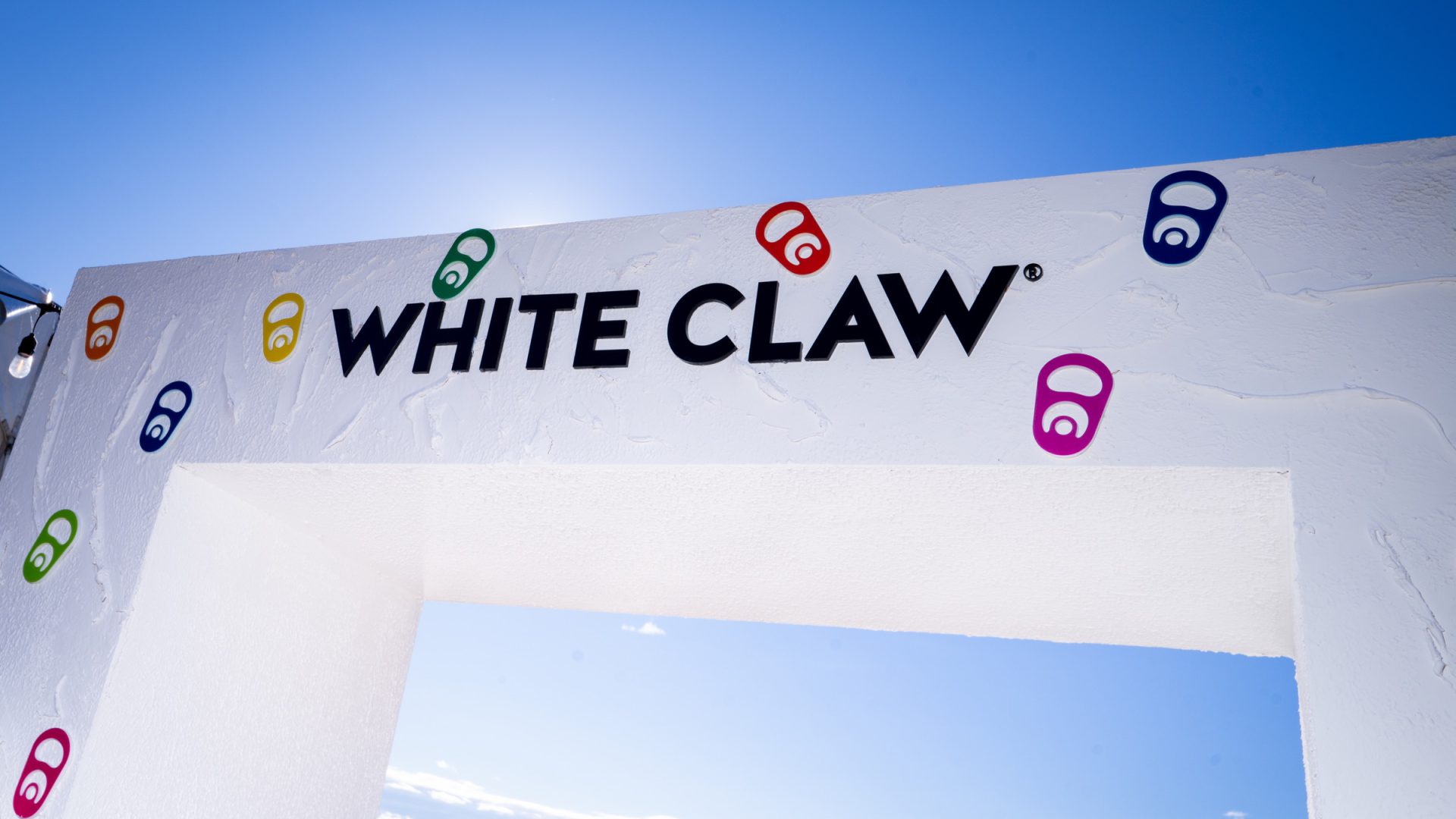
The strongest beverage photo moments are objects the guest can hold or stand inside while holding the product, which is why framing devices work so reliably. On the White Claw Sessions waterfront deck, an oversized white photo frame scattered with the brand’s colored can tabs did the job: the frame composes the shot, the tabs put the brand in it, and the guest’s own can completes the picture without a single instruction from staff.
Durability is the unglamorous half. Anything within arm’s reach at a beverage event will be touched with wet hands, leaned on, and climbed on at least once. Edges get radiused, finishes get specified for cleanability, and bases get weighted for someone’s full body weight, because that is the load case whether or not it is in the brief. Think about content capture conditions too: phone cameras need light on faces, not just on the structure, and a beautiful build lit only from behind produces a night of silhouettes.
If a guest needs a staff member to explain how to use your photo moment, the photo moment is a diagram, not a design.
Outdoor Builds: Sand, Wind, Ballast, and Permits
Outdoors is where beverage programs live and where builds get hurt. Wind is the governing force on any vertical surface, and every large letter, frame, arch, or banner is a sail. Loads have to be carried into the ground or into ballast, and on sand or turf that means spreading the load rather than driving an anchor and hoping.
Sand deserves specific respect. It shifts under foot traffic, it moves with the tide and the weather, and a base that is level on install morning may not be level by evening. Structures that sit on sand get wider footprints, adjustable feet, and a plan for someone to re-level them mid-event. Salt air also rules out a range of hardware that would be fine inland.
Permitting is the other outdoor reality, and the honest guidance is procedural rather than specific: the authority that controls the ground you are building on is the authority you need, and it is rarely the person who signed the venue contract. Beaches, sidewalks, parks, and parking lots each have their own approving body, temporary structures above a certain size usually pull a separate review, and anything serving alcohol adds a licensing layer on top. Identify those bodies during site survey, not during load-in, because approval timelines are the one part of the schedule that does not compress.
Build a rain plan while you are at it. Outdoor beverage programs rarely get cancelled for weather — guests still come, they just come inside — so the question is which pieces migrate under cover and which are built to get wet.
How to Brief the Build
The briefs that produce a good beverage brand activation share a shape. They state the service target in guests per hour, name the venue and its access constraints, define the strike condition the venue requires, and say plainly which elements are meant to be photographed. They give the fabricator the operational facts, then let the shop solve the structure.
Bring the people who will actually run the bar into that conversation early. Brand and agency teams describe how the activation should look; the operations team knows that ice arrives in a specific quantity, that empties fill faster than anyone plans for, and that a bar with no landing surface on the guest side leaves people holding three things at once. Those details change drawings. They are cheap to solve on paper and expensive to solve on site.
Finally, be honest about lead time and let the sequence do its work. Drawings and engineering review come first, fabrication follows, finishes and test fit come before the truck. Compressed schedules are survivable — the San Diego build was designed, built, branded, and delivered in fourteen days — but they survive because decisions land on day one, not because the shop works faster. When we fabricated and installed NYLON’s Fourth of July activations at The Surf Lodge, the work sat at key touchpoints and was integrated into the venue rather than imposed on it, which is a design intention that has to exist before anything is cut.
Beverage programs reward the teams that treat event fabrication and service operations as one discipline instead of two. If you are planning a takeover, a sampling program, or a festival footprint and want the structure and the pour designed together, tell us what you are building and when it has to open. We will tell you what the schedule really looks like, and what we would change about the brief. You can also see how we approach brand activations across formats, or browse more activation work for reference.