
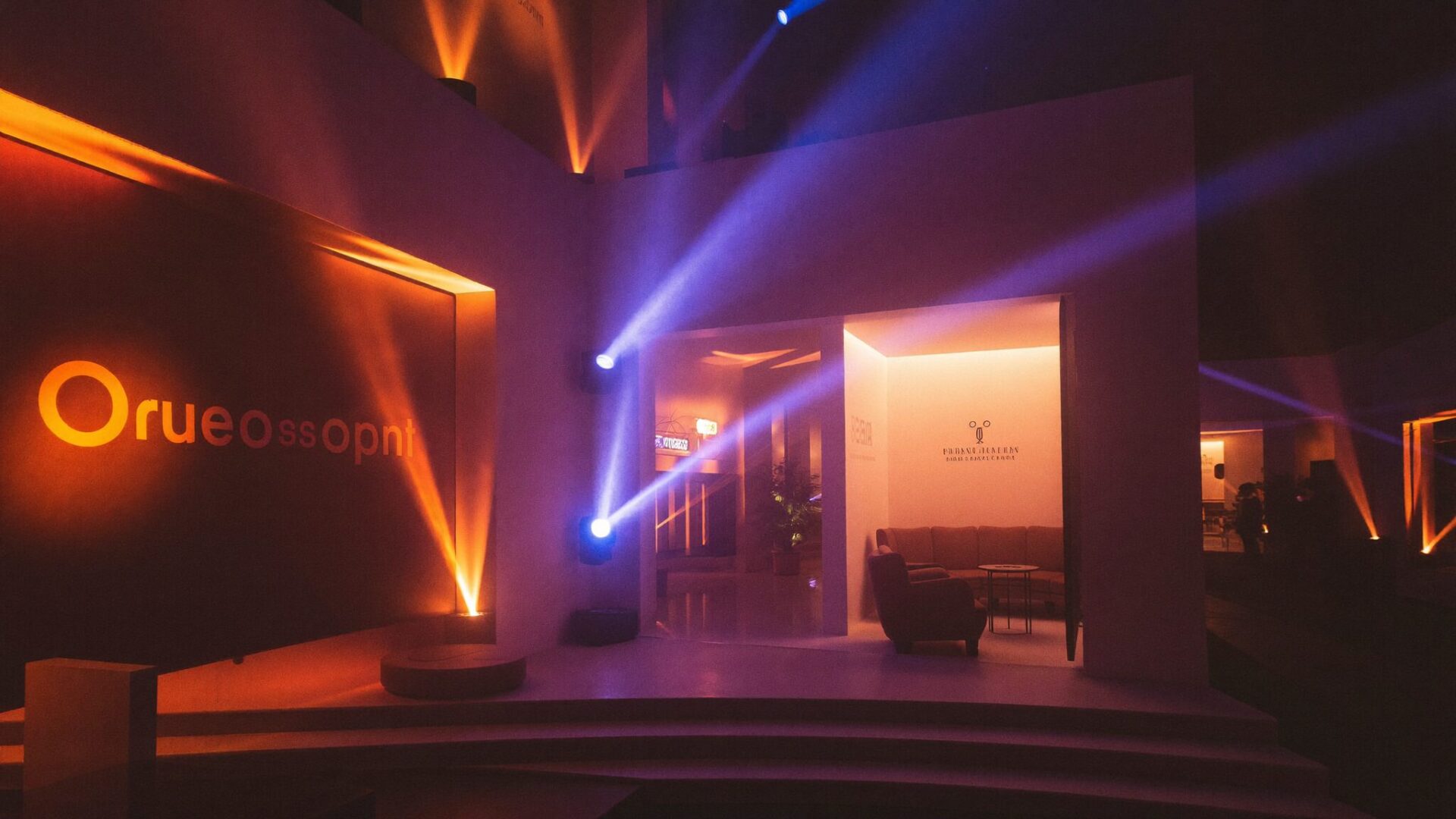
Event ROI is often worked out after the event, from a spreadsheet nobody planned for. By then the survey spot, the sign-up point and the camera positions are fixed, or they never existed. This guide starts earlier, at the drawing, because those are floor-plan decisions and they are made long before anyone opens a report.
It leans on published guidance from the Event Marketing Measurement Association (EMMA), the industry body working on shared standards for event measurement, and on how we build. We are producers. This post is about what production has to build so that the numbers exist at all.
What is event ROI, and why can’t most events show it?
Event ROI is what an event returned against what it cost. For most brand and corporate events the return is a change in what the audience does or thinks, so the event has to be built to capture that change before anyone can measure it.
In words, the formula is the return, minus the cost, divided by the cost. It works when an event sells something that can be traced, such as ticketed admission or a booked order. Most events do not. A product launch, a summit, an activation or a milestone dinner returns a change in behavior or perception, and that change is judged against what the event was for.
The pressure to show that change is rising. Skift reported on September 21, 2026 that EMMA’s founder, Dax Callner, said budget owners are scrutinizing event budgets and that events “need to step up, or they’re going to get cut.” Whatever you think of that warning, the practical answer is the same. Decide what the event is for, then build it so that outcome can be counted.
What do EMMA’s three core metrics measure?
EMMA’s standards name three core metrics: value to the audience, anticipated behavioral change and brand perception shift. Together they ask whether guests valued their time, whether they are likely to act, and whether they think better of the brand.
According to Event Marketer’s report on the release, EMMA’s Core Event Metrics and Survey Standards guide covers B2B and B2C external events and activations, includes vetted survey questions that can be dropped into a post-event survey, and adds guidance on Net Promoter Score and Event Net Promoter Score. EMMA’s standards page hosts the free PDF. We have read the announcement and EMMA’s own pages, not the wording of the questions, so we do not paraphrase them here. Download the guide for the questions.
The middle column below follows Event Marketer’s description of each metric. The right-hand column is our reading, as a production team, of what each one asks of the build. A baseline, used in the last row, is a reading taken before the event so a later reading has something to be compared with.
| Metric | What it covers (EMMA, per Event Marketer) | What the production has to provide (our reading) |
|---|---|---|
| Value to the audience | The quality of the attendee experience | A calm spot at the exit to answer, enough staff to ask, a way to answer on a phone |
| Anticipated behavioral change | The behaviors that matter to the business | One clear action, a physical place to take it, a link or code that records it |
| Brand perception shift | Whether the experience contributes to positive perceptions of the brand | A baseline asked before, the same question asked after, and a reason for guests to stay for it |
Pro Tip: Pick one metric to lead with. The brief should say which of the three the event is for, and what result would count as success, before any renderings are approved.
Where does the survey go, and what should it ask?
Put the survey where guests are already finishing, at the exit, and keep it short enough to answer standing up. A long form does not suit a guest who has a coat to collect and a car waiting.
EMMA’s guidance on measuring product sampling, published on July 10, 2025, says quick polls, QR code ratings or a single open question can generate insight at scale, and that fewer participants will complete a survey after a fleeting experience than after an event with a more engaged audience, so acceptable sample sizes should be much lower. That advice is written for sampling. Apply it to short interactions on a floor, not to a seated dinner where a longer conversation is possible.
For production, that turns into a short list of things to draw into the plan:
- An exit pocket set out of the circulation path, so a guest who stops to answer does not block the guest behind.
- Somewhere to answer: a ledge, a seat or a charging point, so people have a reason to pause.
- Staff who greet and ask, placed at the exit and briefed on the one question they are there to put.
- A code at eye level on the way out, so a guest can answer on a phone without a form or a login.
- A small thank-you, so the pause feels like hospitality and not an interruption.
An exit survey is a throughput problem like any other: guests approach, wait, act and leave. Our guide to immersive photo experience design covers how a single point on a floor handles that sequence without a queue.
Net Promoter Score, or NPS, deserves a careful word because it is often misused. EMMA’s April 2024 post describes it as a question, “how likely are you to recommend” a brand or product, answered from 0 to 10. People who answer 9 or 10 are promoters, people who answer 0 to 6 are detractors, and the score is the share of promoters minus the share of detractors, so it runs from -100 to +100.
EMMA says it is a customer loyalty measure, not a brand perception measure, and so is meant for existing customers rather than prospects. It suggests asking customers before and after an event to see whether the event moved their loyalty, and an optional follow-up asking why. It also says that asking all attendees whether they would recommend the event itself can be a credible indicator of event loyalty and future attendance. EMMA’s new guide adds NPS guidance we have not read, so treat that 2024 post as the earlier view.
We do not publish a question list. The EMMA guide gives vetted wording for the three metrics, and using one shared set is the point of a standard. We also give no expected response rate, because no source we trust gives one.
Why is dwell time a weak measure?
Time spent in an experience does not show impact. In “Clocked Out: Rethinking Dwell Time,” June 28, 2023, EMMA says dwell time for in-person events does not reflect engagement unless you can show that more time correlates with greater impact, and that it should be paired with other goals.
Dwell time is how long a guest stays in a space. The EMMA post suggests a better use: set a target time for each part of an experience, then check whether people are moving through it too fast or too slow. Its trade show example has four time dimensions, each with its own job: a 5-second impression from the aisle, a 2-minute pitch, a 5-minute demonstration and a 30-minute consultation. More time suits some of those, and less suits others.
EMMA also takes on a looser word. In “The Trouble With Engagement,” July 27, 2023, EMMA says it cannot endorse engagement as a credible metric because it has no shared definition. If you have to use it, the post suggests breaking it into discrete counts, such as one-to-one interactions, social shares, website visits and video views, and setting a target for each.
For a producer, that is a design instruction: zone the floor by target time, not by square footage. A quick-look zone, a conversation zone and a long-stay zone are sized and furnished for their own length of stay. The Café de Colombia activation at the San Diego Convention Center was resolved, according to the case study, into three programmed zones inside a 40 by 20 foot footprint: a full-service coffee bar, two tasting display areas and a concealed storage and prep zone, for more than 3,000 attendees. That is a structure that lets guests stay for varied lengths of time. The case study does not report any measurement, and we do not claim one.
A word on cameras. In “The Facial Analysis Problem,” August 28, 2023, Callner argues that camera-based facial analysis can misread people and report attributes such as age and gender, and says he generally ignores that data in business-to-business work. We do not build a floor around it.
Pro Tip: Before paying to count how long guests stay, ask what a longer stay would prove. If the answer is nothing you could act on, spend the effort on the exit question instead.
If the zones themselves are the open question, our notes on experiential event design show how a brief becomes a floor plan.
How do you design a call to act people can complete?
Choose one action, place it where the guest’s attention already is, and make it take under a minute. A behavior that cannot be done on the floor cannot be counted.
The action belongs on the guest’s path, not beside it. As design options, not past results, that can be a sign-up at the end of a tasting, a booking code at a launch, a code printed on the takeaway, or a staffed demo with a lead card. A pop-up with a point of sale carries the action in its counter, and our product launch and pop-up production is where that gets built. A brand activation without a point of sale needs the code on the way out.
If the behavior is a lead, count carefully. EMMA’s August 2024 post on lead analysis separates three stages. A contact is only someone’s contact details. A lead is a person with purchase authority or influence. Lead prioritization ranks a qualified lead by how soon they intend to buy. EMMA says quantity should be paired with qualification.
Be equally careful with credit. The same EMMA post says attribution almost always involves several touchpoints, so the coalition does not suggest tying a specific sale only to an event, and suggests a potential revenue projection instead. Report the event as a contribution, not as the sole cause.
One more production detail: ask only for the data a guest is willing to give, say how it will be used, and make the sign-up work without staff nearby, so a busy hour does not break the count.
What can content and press capture tell you?
Content and press capture show reach and what guests chose to share, not whether anyone changed their mind. Count what is visible, and keep it separate from the three core metrics.
Our brand activations page lists “Content-Native Design” among its capabilities: sightlines calibrated for vertical video, lighting optimized for phone cameras, and spatial compositions that frame naturally as shareable moments. Our guide to designing events for the camera explains how those are drawn.
A photo moment is also a capture point. A place guests choose to post from is a place to ask them to scan or tag. The case study for One Love at One World Observatory describes a 12 foot by 8 foot photo activation that stayed in place for a month-long public installation. The White Claw Sessions build at The Surf Lodge included an oversized photo frame on the waterfront deck. Both are examples of how a photo moment is built, not of measured results.
One thing we leave out on purpose: any modeled value for press coverage. If a client wants one, the method has to be agreed in writing before the event, and we do not put a number on it here.
What goes in the brief so the report can be written?
Five lines go in the brief: the one outcome, the one behavior, the baseline, the capture points on the floor plan, and the person who owns the data and the date it is read.
| Brief line | What production builds from it |
|---|---|
| The one outcome (one of the three core metrics) | The zone that carries it, and where it sits on the guest path |
| The one behavior | The action point, and the code or form that records it |
| The baseline | The question asked before the event and the same question at the exit |
| Capture points | Marked on the floor plan and written into the run of show |
| Owner and date | Who reads the results, when, and what decision they change |
The last row matters most. In the same Skift piece, Callner is quoted as saying, “You use measurement data to change what you’re going to do next time.” A result that nobody has to act on rarely gets collected well.
The run of show is the cue-by-cue script the crew works from. Capture points belong in it as cues, with an owner, so the exit survey opens when doors close and not when someone remembers. Our guide to writing a run of show sets out the columns.
Pro Tip: Put the capture points on the same sheet as the guest flow. Then nobody has to choose later between a clear walkway and a sign-up point.
How does this change by event type?
The lead metric changes with the event. A launch leads on behavior, a summit on value to the audience and behavior, an internal event on alignment, and a private dinner on almost nothing visible.
| Event | What usually leads | Where the capture sits |
|---|---|---|
| Brand activation or pop-up | Behavior, then perception | The action point on the path, and the exit |
| Product launch with a sales path | Behavior | The booking code or point of sale |
| Trade show or convention floor | Qualified leads | The demo and its lead card |
| Corporate summit | Value to the audience, then behavior | The session exit and a decision log |
| Internal kickoff or all-hands | Behavior and alignment | Questions before and after, and the session exit |
On a show floor, space is the constraint. Our Netflix booth at the Meadowlands was a 22 by 22 foot build whose case study says the footprint left no slack for custom millwork, lighting, integrated displays and a hero logo. A lead-capture counter in that footprint has to be in the drawing before the walls are.
For internal events, EMMA’s former name, the Experiential Marketing Measurement Coalition, published guidance on employee events on November 11, 2024. It names five areas to measure: behavioral impact, business alignment, cultural impact, participant value and event performance. Our guides to sales kickoff production and executive summit production show where those sessions end and where an exit question fits. Our corporate meetings and summits work follows the same logic.
There is one case where the right answer is to measure very little. A private or executive dinner depends on privacy, and visible capture changes the room. Decide that in the brief and say so, as we describe in our guide to executive dinner production.
Why work with a full-service production company on a measurable event?
Capture points are drawings before they are data. When one team draws the floor plan, builds the zones and runs the show, the survey spot, the action point and the camera positions are in the drawings from the first sketch.
Our brand activations page says we define the strategic purpose, success metrics and experiential objectives before a single sketch is drawn. That is the habit this post describes, applied to the brief. We design and fabricate in our New York studio, with more than 15 years in event production and more than 200 events built in-house. We run the post-event survey and deliver a results report; what it asks is agreed at the start, so the questions match the outcome in the brief.
The same team that builds the exit pocket and the action point is the team that runs the show on the night, which is how a capture point survives a busy hour. Explore brand activations, full-service event production and our New York team to see how the work is organized.
Tell us the event, the one action you want guests to take and the date. Start the conversation here, and we respond within one business day with a production scope and next steps.
Common questions about event ROI
How do you calculate event ROI?
Subtract the cost from the return, then divide by the cost, when the event sells something that can be traced. When it does not, measure the behavior or perception the event was for, and report it against the target set in the brief.
What is a good event ROI?
There is no single benchmark. Event Marketer reports that EMMA is working toward global event benchmarks. Until they exist, compare an event with its own earlier results and with the targets in its brief.
What should a post-event survey ask?
It should cover three themes: how much the guest valued their time, what they are likely to do, and how they now see the brand. Use the vetted wording in EMMA’s free standards, not questions written from scratch.