Corporate Event Venues in Atlanta: A Producer’s Guide
Atlanta's corporate event venues sorted by what a production team can build inside them: published capacities, vendor rules, load-in windows, sound limits and a pre-contract checklist.
Where Strategic Content Meets World-Class Production
Corporate conferences and summits are the most complex events in the production landscape—multi-day, multi-format gatherings where content delivery, networking facilitation, technology infrastructure, and brand experience must operate in seamless concert. When produced at the highest level, they become the defining touchpoints of an industry's annual calendar.
A conference is not a large meeting. It is an ecosystem of experiences—general sessions that inspire, breakout tracks that educate, exhibition halls that connect, and networking environments that catalyze relationships. Each of these components demands its own production vocabulary, and the challenge of conference production lies in orchestrating all of them simultaneously while maintaining a cohesive attendee experience from registration to closing remarks.
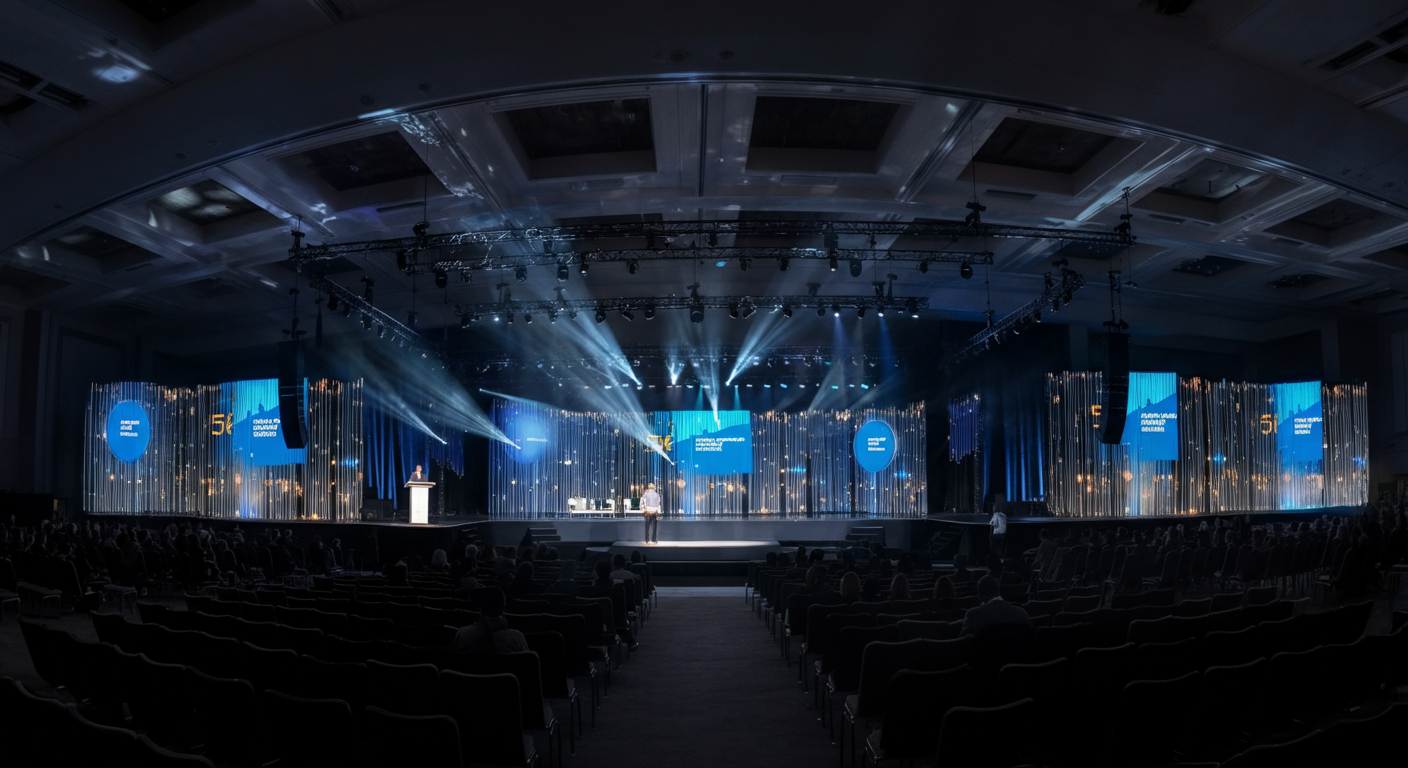
The general session is the conference’s signature moment—the shared experience that unifies all attendees and establishes the event’s intellectual and emotional tone. General session staging for audiences of 500 to 5,000+ requires broadcast-quality production: large-format LED walls (increasingly curved or wrap-around configurations), professional lighting design that balances stage illumination with audience ambiance, line-array audio systems engineered for speech intelligibility across large rooms, and IMAG camera systems that ensure every seat feels close to the action. Confidence monitors, teleprompters, and presenter support are essential—keynote speakers, no matter how experienced, perform better with professional production infrastructure.
Breakout sessions are where conferences deliver their deepest value, yet they are often under-produced. Each breakout room requires its own AV system—at minimum, a projector or display, wireless microphone, and audio reinforcement. For premium conferences, breakout rooms should include confidence monitors for presenters, recording capability for on-demand content, and environmental design that differentiates each track visually. Room turnover management—the logistics of moving hundreds of people between sessions efficiently—requires clear wayfinding, adequate corridor width, and strategic break scheduling.
The hybrid conference is now a permanent fixture, not a pandemic accommodation. Producing a truly effective hybrid event means designing two parallel experiences: an in-room experience optimized for physical presence, and a digital experience with its own pacing, engagement mechanics, and production values. This requires dedicated cameras and switching for the livestream (not simply capturing the room feed), a virtual event platform with interactive features, remote audience engagement tools like live polling and Q&A, and a production team that manages both audiences simultaneously. Hybrid should be planned from inception rather than bolted on.
Networking is consistently rated as the primary reason professionals attend conferences, yet most events leave it entirely to chance. Strategic networking design involves creating purpose-built environments that facilitate connection: structured networking lounges with conversation-starting design elements, hosted roundtable discussions, speed-networking formats, and digital matchmaking tools that connect attendees with complementary interests before they arrive. The physical environment matters enormously—standing-height tables encourage brief, energetic exchanges; comfortable seating areas invite deeper conversations; bar-style environments signal informality and openness.
Exhibition halls are revenue centers and value-delivery mechanisms. Modern exhibition design has moved beyond rows of pipe-and-drape booths toward curated marketplaces with distinct neighborhoods, experiential sponsor activations, and integrated programming—demo theaters, product showcases, and innovation zones that draw attendees into the exhibition space throughout the event. Sponsor integration extends beyond the exhibition hall into every conference touchpoint: branded lounges, sponsored sessions, mobile app presence, and experiential activations that deliver measurable engagement rather than passive logo exposure.
The registration experience sets the operational tone for the entire conference. Modern registration systems use QR codes, facial recognition, or RFID to eliminate queues and capture attendance data. The technology stack extends to event apps for scheduling and networking, digital signage for wayfinding and real-time updates, lead retrieval systems for exhibitors, and analytics platforms that measure session attendance, exhibition traffic patterns, and engagement metrics. Backstage, the operational infrastructure includes a production office, speaker ready room, technical operations center, and security command post—each staffed by specialists who keep the conference running invisibly.
Multi-day conferences introduce logistical complexities that single-day events do not face: overnight security for equipment and scenic, daily room resets for changing programming, catering service across multiple meal periods and break schedules, and the sustained energy management required to keep both crew and attendees performing at their best across two to five days. Venue management involves constant coordination with facility teams on HVAC, power, internet bandwidth, freight access, and fire marshal compliance. The production manager’s job at a conference is essentially running a temporary small city.
Discover GEO Events’ approach to conference production through our corporate meetings and summits services, or learn how corporate gala production techniques can elevate your conference’s evening programming.
GEO Events produces conferences where production quality matches content quality. Our conference production team manages the full spectrum of multi-day event complexity: general session staging, breakout AV, exhibition design, hybrid production, registration systems, and the operational infrastructure that keeps everything running across multiple days and venues.
We approach conferences as integrated systems rather than collections of independent elements. Our production design ensures visual consistency from the general session stage to the smallest breakout room, from the registration experience to the closing reception. We deploy dedicated technical directors for each production zone, coordinated through a central operations team that manages timing, logistics, and real-time problem resolution.
Our experiential design capabilities bring creative ambition to conference environments that are too often treated as purely functional. We design general session stages that command attention, networking environments that genuinely facilitate connection, and exhibition experiences that sponsors and attendees find equally valuable.
Engage our conference production team to discuss your next summit, convention, or multi-day corporate event.
Define the conference format, audience profiles, content tracks, networking objectives, and hybrid requirements through strategic planning sessions.
Evaluate and secure venues based on capacity, breakout room availability, exhibition space, technical infrastructure, and logistical access.
Design general session staging, breakout AV packages, exhibition layout, signage and wayfinding, and hybrid production infrastructure.
Create sponsor activation packages, design exhibition neighborhoods, develop lead retrieval systems, and produce sponsor collateral.
Deploy registration systems, event apps, digital signage, livestream platforms, and analytics tools. Develop comprehensive operations and staffing plans.
On-site production management with dedicated technical directors, daily resets, real-time operations coordination, and post-event reporting.
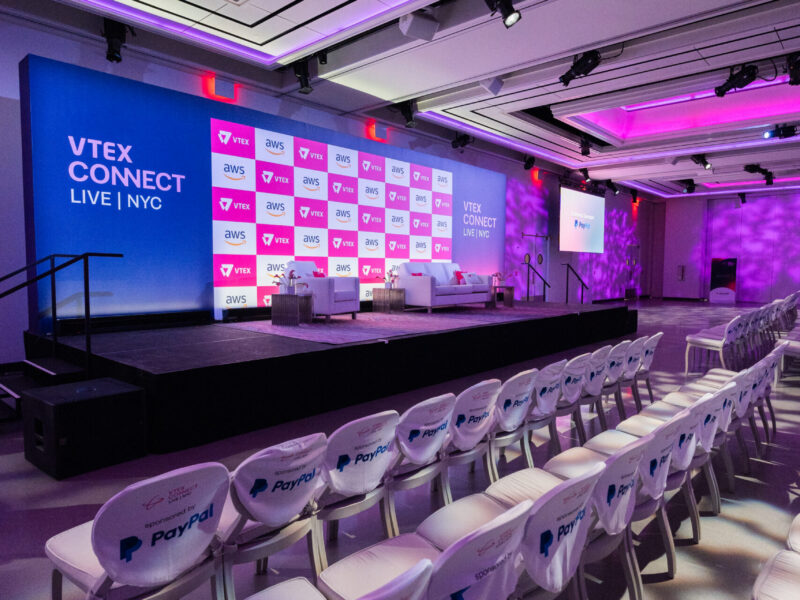
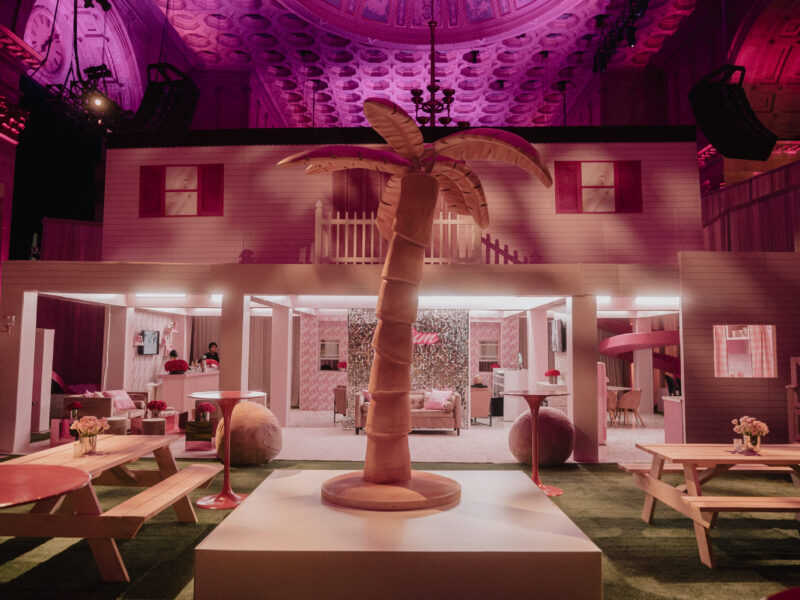
Atlanta's corporate event venues sorted by what a production team can build inside them: published capacities, vendor rules, load-in windows, sound limits and a pre-contract checklist.
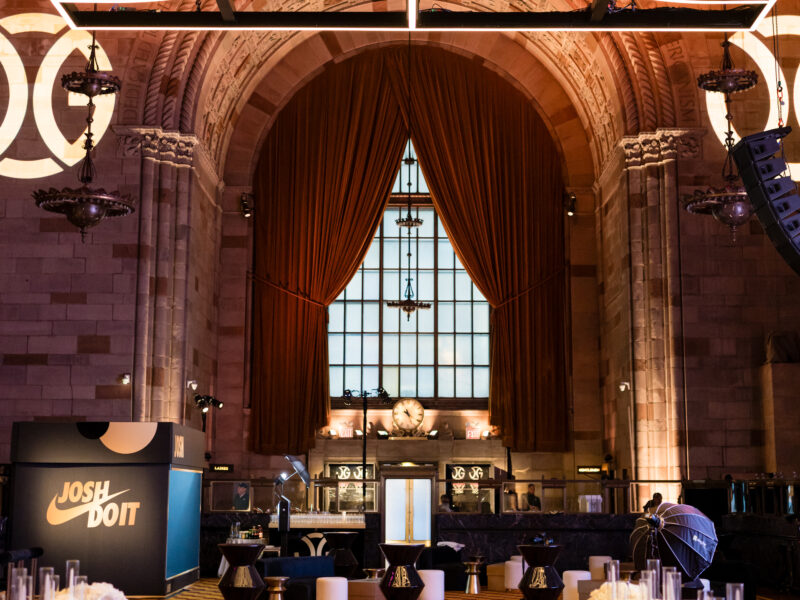
The camera sees a narrower room than the eye does. How sightlines, contrast, lighting, and finish thresholds change when most of your audience will meet the event as a vertical clip.
A brand activation is a live, built experience that invites people to step into a brand and act on it. Here is what gets built, who builds it, what drives the cost and how long it takes, from the team that designs and fabricates them.
Tell us about the event or build you have in mind. We respond within one business day with a project scope and next steps.