
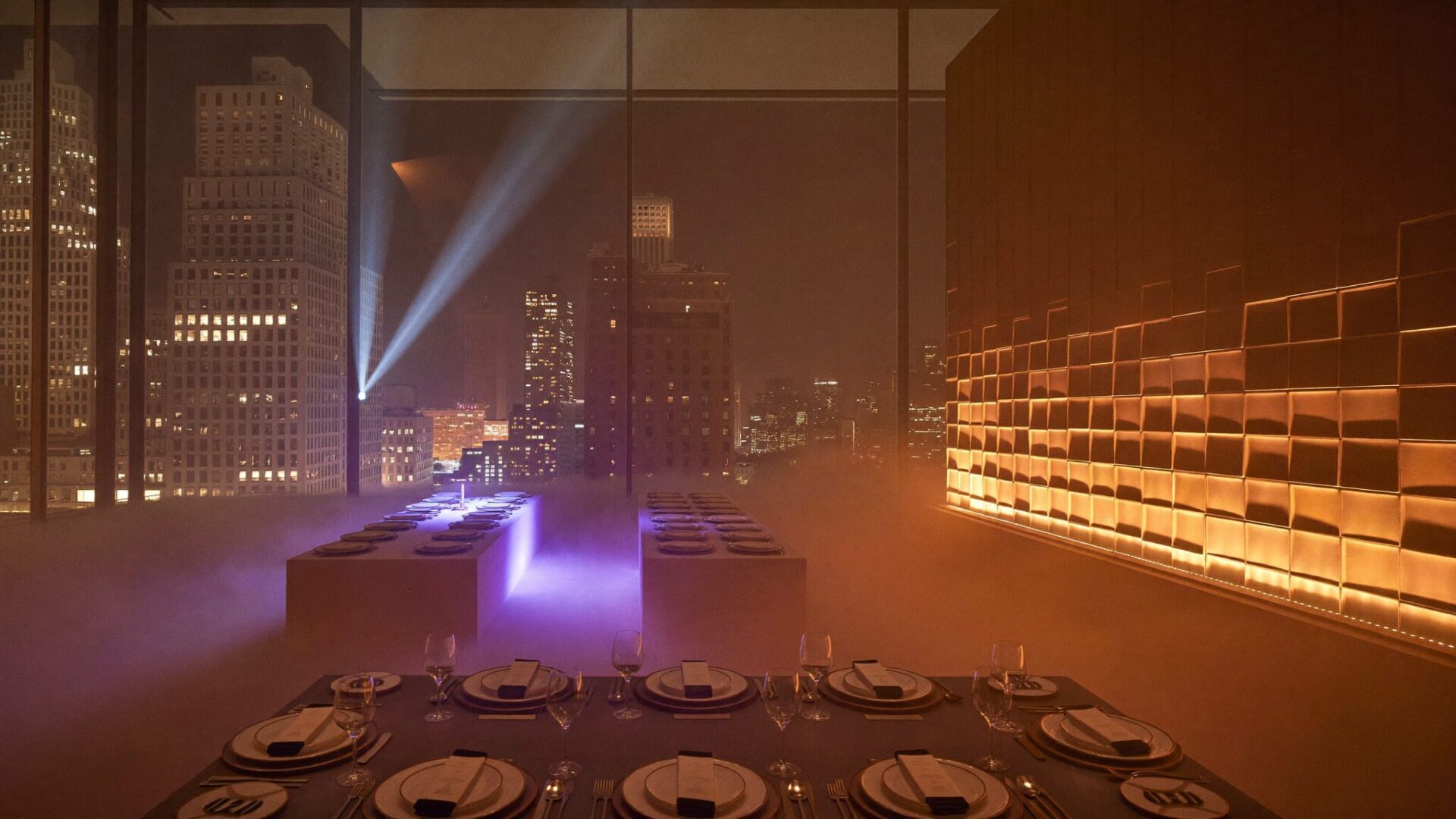
NRF 2027: Retail’s Big Show fills the Javits Center from January 10 to 12, 2027, and for many retail brands the most useful hours of that week happen somewhere else: a seated dinner for top accounts, or an evening in their own flagship after the doors close. This guide is written from the side of the team that builds those rooms in Manhattan: how NRF’s own week is laid out, what NRF’s published rules mean for an event outside your booth, which format fits which goal, and a dated countdown that gets a custom build through the December holidays.
The booth itself is a different job, and we keep it out of this piece. If you are building on the floor as well, our guide to trade show booth fabrication covers that side.
When is NRF 2027, and what does the whole week look like?
NRF 2027 runs January 10 to 12, 2027 at the Jacob K. Javits Convention Center, but NRF’s own programs start on Friday, January 8, so the off-floor week for a retail brand in New York really runs from January 8 through January 12. NRF says the show brings more than 41,000 retail industry professionals to Javits each year, and its expo page describes access to retail decision-makers from more than 100 countries.
Before you choose a night, look at what NRF already runs. The table below comes from the NRF 2027 agenda and expo pages as we read them on October 27, 2026. It lists the programs that compete for your guests’ evenings, not every session.
| Day | What NRF runs | Where | What it means for your event |
|---|---|---|---|
| Friday, January 8 | The NYC VIP Awards Event, 6:00 to 10:00 PM | Gotham Hall, 1356 Broadway | Senior guests may be committed for the whole evening |
| Saturday, January 9 | Commerce Media Saturday, 8:30 AM to 6:30 PM; retail store tours through the day; NRF 2027 Opening Party, 5:30 to 7:00 PM | Lavan Midtown, 641 W 42nd St; Marriott Marquis, Times Square | A dinner seated after the opening party can follow it rather than compete with it |
| Sunday, January 10 | Expo 9:00 AM to 5:00 PM; Supply Chain Sunday 3:00 to 7:30 PM; Expo happy hour 4:00 to 5:00 PM; Retail’s CIO Party 5:30 to 7:30 PM | Javits; Lavan Midtown | The busiest evening for NRF-run networking; technology buyers are spoken for early |
| Monday, January 11 | Expo 9:00 AM to 5:00 PM | Javits | Check the agenda for evening programs before you lock a date |
| Tuesday, January 12 | Expo 9:00 AM to 4:00 PM, the shortest day | Javits | Many guests travel home; a late-afternoon slot suits local buyers |
The pattern is clear enough to plan around. Friday, Saturday and Sunday evenings already carry NRF programs, so a brand event on those nights either starts after them or accepts that part of the guest list will arrive late. Several agenda slots still read “session details are to come”, and NRF adds programs as January approaches, so check Monday evening again before you sign a venue. This is planning advice, not a rule: a dinner for twenty top accounts can sit on any night if the invitation goes out early enough.
New York is our home market. Our studio is in Manhattan, and most of what we know about event production in New York comes from building inside its venues, docks and freight elevators week after week.
What do NRF’s rules mean for an event outside your booth?
NRF does not publish a rule specifically about private dinners or hospitality suites away from Javits, as far as we could find in October 2026. Its published rules and regulations still shape what an off-floor event can do, mostly in how guests are invited and how the show is referenced.
These are the points that matter most for an off-floor plan, paraphrased from NRF’s page:
- Solicitation outside contracted exhibit space, which NRF calls suitcasing, is not permitted unless NRF approves it in writing.
- Attendees, exhibitors, sponsors and other participants may not solicit business or promote products and services except through NRF-approved channels and activities.
- Non-exhibitors cannot solicit sales or leads on the show floor.
- Presentations, postings and messages outside approved spaces need NRF’s approval, and NRF says it may remove them, flyers included.
- Photographing, videotaping or transmitting the event, or any part of it, needs NRF’s written approval.
- Requests to use NRF event logos must be made in writing.
In practice, that reads as a short list of habits. Invite guests through your own channels: your sales team, your account managers, your own email. Don’t hand out invitations or recruit guests on the floor. Keep the NRF logo off your invitation unless NRF has approved it, and name the show in plain text. If your plan touches the show in any way, such as a shuttle from Javits or a sign near the entrance, ask your NRF contact in writing first. The Exhibitor Service Manual is the place to check details for exhibitors. This is planning context, not legal advice, and a specific plan deserves a specific answer from NRF.
Las Vegas works differently. CES publishes a detailed policy on events held outside the show, which we covered in our CES 2027 off-floor guide. At NRF the published rules are shorter, which makes asking in writing more important, not less.
Pro Tip: Put “how will guests hear about this?” on the agenda of the first planning call. At NRF the invitation path is where the rules bite, not the build. Settle it before the design starts and the rest of the plan has nothing to unpick later.
Which off-floor format fits your goal?
Choose the format by who must be in the room and what they should leave with, then choose the room. A buyer who needs to touch the product and an analyst who needs a clear story want very different evenings, even if both are on the same guest list.
| Goal | Format | Typical room | What production solves |
|---|---|---|---|
| Deepen top accounts and partners | Seated client dinner | A private dining room or a transformed restaurant | A designed table, light that flatters food and faces, one brand moment |
| Show buyers the product | Showroom or flagship evening | Your own store or showroom after close | Product lighting, a merchandising freeze, guest flow through a working store |
| Brief press and analysts | Timed preview with a short program | A gallery, loft or hotel event space | A reveal sized for cameras, clean audio, a tight run of show |
| Hold daytime meetings near Javits | Hospitality suite | A hotel suite or meeting floor in Midtown West | A meeting-grade build, demo power and dedicated data |
| Sell technology to retailers | Built store set | Any space with the floor load and power to take it | A convincing aisle, checkout or fitting room where the product actually runs |
| Reach a wide slice of attendees | Reception or after-party | A venue large enough for walk-in traffic | Arrival, bars, sound; the highest risk of clashing with NRF’s own evenings |
The seated dinner is the format most retail brands reach for, and it is where design does the most with the least. For a private dinner at One World Trade Center, we built custom black acrylic dining tables sized to the room, designed the seating chart alongside the tables to balance visibility and sightlines, laser-cut the signage and place cards, and suspended a hand-carved foam Earth as the photo moment. That was a private dinner, not an NRF event, but the brief is the one an NRF host faces: an evening that feels made for the room and the guests, not dropped into it.
For a reception or preview built around the brand, our brand activations team handles the environment from concept to strike. Where the evening is really about unveiling something, our product launch and pop-up production service covers the reveal, the security around an unreleased product and the content capture. If the dinner suits an existing room, our guide to private dining rooms in New York is a good place to start the shortlist.
Can you use your own store or showroom as the venue?
Yes, and for a retailer it is often the most convincing room available during NRF week. It is also the hardest to hand over to an evening event, because the store is usually still trading that day and has to trade again the next morning.
The production plan starts with time. Load-in, the period when the build and equipment arrive and are installed, can only begin once the store closes. Strike, the removal of everything that was brought in, has to finish before opening. That leaves a window of a few hours on each side of the event, and every task in it needs an owner.
Then the store itself. A merchandising freeze is an agreement with store operations that the floor, fixtures and displays will not change between the walkthrough and the event, so the design fits what is actually there. Floors and fixtures need protection under bars, risers and heavy pieces. Daytime store lighting is designed for shopping, not for an evening, so product and faces need their own light. In January, arrival needs a coat check that does not queue onto the sidewalk. Add security, stock control and the building’s own rules on deliveries and freight elevators, and the store becomes a venue with a long list of house rules written by your own company.
The model to follow is a takeover that is complete on the way in and invisible on the way out. For the Delilah x Chase takeover in Montauk in August 2026, we took over an operating restaurant: the full street facade was clad in shop-built mirror panels, an entirely new entrance was built, the interior was transformed, and the building went back to its own identity when the pop-up closed. A flagship evening asks for the same discipline at a smaller scale. Our pieces on restaurant takeover events, venue protection and install and strike go deeper on each part.
How do you build a store set for a retail-tech demo?
Retail-tech buyers want to see a product working in a store, so the strongest off-floor demo is a built fragment of one: an aisle, a checkout, a fitting room or a shelf edge, made to retail finish and wired for the product. It answers the buyer’s real question, which is not “what does it do?” but “what will it look like on my floor?”
Four things decide whether a store set convinces. Fixtures are built to the dimensions the product expects: shelf depths, counter heights and sightlines that match a real store. Finish holds up at arm’s length, because buyers lean in and touch. Power and data are mapped to every station, with a dedicated internet connection rather than the venue’s guest Wi-Fi. And the set is built knock-down, in modular sections that come apart, travel in crates and go back together, so it can serve a hotel suite this week and the next show in another market.
Retail finish on a show schedule is work we do often. At the San Diego Convention Center, we designed, built and delivered the Café de Colombia activation in fourteen days: a 40 by 20 foot build with a full-service coffee bar engineered to retail operational standards, two tasting zones and concealed back-of-house storage, for more than 3,000 attendees. For Netflix at the Meadowlands, we built a 22 by 22 foot booth from the brand’s approved CAD drawings on a two-week cycle, with flush-mount televisions set into wall pockets and a custom LED logo, for a show of more than 2,000 attendees. Neither was a store set, but both met the same standard: a build that reads as permanent and survives a full event run.
An unreleased product adds one more layer. Our product launch work runs on closed-studio fabrication and NDA-protected processes, which matters when the demo shows something the market has not seen. Our event fabrication team builds these sets in-house, and our piece on building the reveal explains how a shop stages the moment a product appears.
Pro Tip: Design the demo set to break down into crates that fit a Manhattan freight elevator. Check the elevator’s door and cab dimensions at the walkthrough. The same set can then work the hotel suite, the showroom and the next show without a rebuild.
What does New York in January change about the plan?
During NRF week, the city’s hotels, private dining rooms and production crews are also serving everyone else at the show, and January adds cold, early dark and the chance of snow to any arrival plan. Both push the important decisions earlier.
Rooms first. NRF’s opening party is at the Marriott Marquis in Times Square, and two of its special programs sit at Lavan Midtown on West 42nd Street, a short walk from Javits. It is reasonable to expect competition for Midtown West rooms that week, so hold yours early. Manhattan venues also bring their own limits: tight load-in windows, shared loading docks and freight elevator restrictions, which our production plans account for down to dock times and vehicle staging.
Then permits, if anything leaves the building. A lit facade, an entry canopy or a branded moment on the sidewalk falls under the Street Activity Permit Office (SAPO), and the published lead time for a special event is thirty days, as our guide to NYC activation permits explains. A temporary structure can trigger a separate Department of Buildings filing. Amplified sound outdoors is a permit from the local police precinct. Requirements change, so confirm each one with the office that issues it. In January, indoors is the sensible default; anything outside needs ballast, the weight that holds a structure down without fixing into the ground, plus a weather plan, both covered in our piece on outdoor activation structures.
Time matters more than usual, too. A dinner that has to fit between an NRF program ending at 7:30 and guests leaving for an early expo morning needs a tight run of show: the minute-by-minute script of the evening, listing every cue, who triggers it and when, which the producer calls live. Arrival, the welcome, the brand moment, service, the close. Each one gets a time and an owner, so the evening lands in the two hours you have.
Winter can also be the design. For the Magic Hour lodge at the Moxy, eighteen floors above Midtown, we built faux log cabin walls in our shop and installed them around the dining tables without modifying the rooftop, then layered in a Western decor wall and faux snow for a single-season run. Our story on that seasonal venue transformation shows how a January room can lean into the weather instead of hiding from it.
What does the NRF 2027 countdown look like?
Counted back from Friday, January 8, a focused custom build needs its concept approved by mid-November, fabrication finished before the December holidays, and load-in in the first week of January. On our product launch service page we give 6 to 10 weeks from approved concept to launch day for focused launch experiences with custom-built environments, and 10 to 16 weeks for large multi-room builds. From late October, January 8 is about ten weeks away. A focused dinner, suite or store set still fits. A large, multi-room build is already tight, and the honest options are to narrow the scope or lock every decision now.
| When | What gets decided or done |
|---|---|
| Now to November 13 | Venue or store hold, walkthrough, concept, guest list, invitation path checked against NRF’s rules |
| November 16 to 25 | Design lock, shop drawings, venue paperwork (floor plan and certificate of insurance), any street permit filings |
| December 1 to 18 | Fabrication, graphics, test fit in the shop, crating |
| December 10 | NRF’s deadline for a full refund on registration cancellations, useful when deciding who travels |
| December 21 to January 1 | Holiday stretch: many shops, carriers and venue teams run reduced schedules, so the build should already be finished |
| December 30 | The last day of NRF’s current Retail Expo Pass rate for retailers, worth flagging if your guests are retailers still to register |
| January 4 to 7 | Load-in, lighting focus, technical rehearsal, presenter run-through |
| January 8 to 12 | Event window |
A certificate of insurance is the document from the production company’s insurer that proves coverage and names the venue as additional insured; most venues want it before they approve load-in. A test fit means assembling the build in the shop before it travels, so problems are found where the tools are. Our custom event build timeline walks through each stage, and our pop-up construction timeline covers the store-format version in more detail.
Pro Tip: Book the strike crew when you book the load-in. During NRF week a hotel room or venue often has another client booked the next day, and a store opens the next morning. The schedule out of the room deserves the same attention as the schedule into it.
If your date is closer than the table allows, talk to us anyway. What changes on a short timeline is how early the decisions have to land.
NRF 2027 questions we hear often
When and where is NRF 2027?
January 10 to 12, 2027 at the Jacob K. Javits Convention Center in New York, according to NRF. NRF’s own programs start on January 8, including the NYC VIP Awards Event that Friday evening.
How many people attend NRF?
NRF says Retail’s Big Show brings more than 41,000 retail industry professionals to the Javits Center every year.
Can you host an event during NRF if you are not exhibiting?
NRF’s rules bar non-exhibitors from soliciting sales or leads on the show floor and bar all participants from promoting products except through NRF-approved channels. A private event elsewhere in the city is a separate matter, but check your invitation plan with NRF in writing and take legal advice on the specifics.
Why work with one full-service production company for NRF week?
One team that designs, fabricates in Manhattan, installs, runs the evening and strikes it keeps every decision on one set of drawings. That matters most in a schedule where December takes two weeks out of the calendar and the room may only be yours for a few hours on each side of the event.
Our fabrication studio is in Manhattan, and scenic travels by truck to any New York venue in under an hour, so changes, repairs and day-of additions happen in real time rather than by overnight freight. Scenic construction, metalwork, CNC routing, laser cutting, large-format print, scenic painting and finishing all happen under one roof. On site, the same team runs the technical rehearsal, calls the show and manages the strike. It is the model behind all of our full-service event production, and the reason our New York production team can hold a January date when the decisions land on time.
Tell us your dates, your guest list size and the room you have in mind, and we’ll come back within one business day with a scope and a schedule that fits NRF week.