
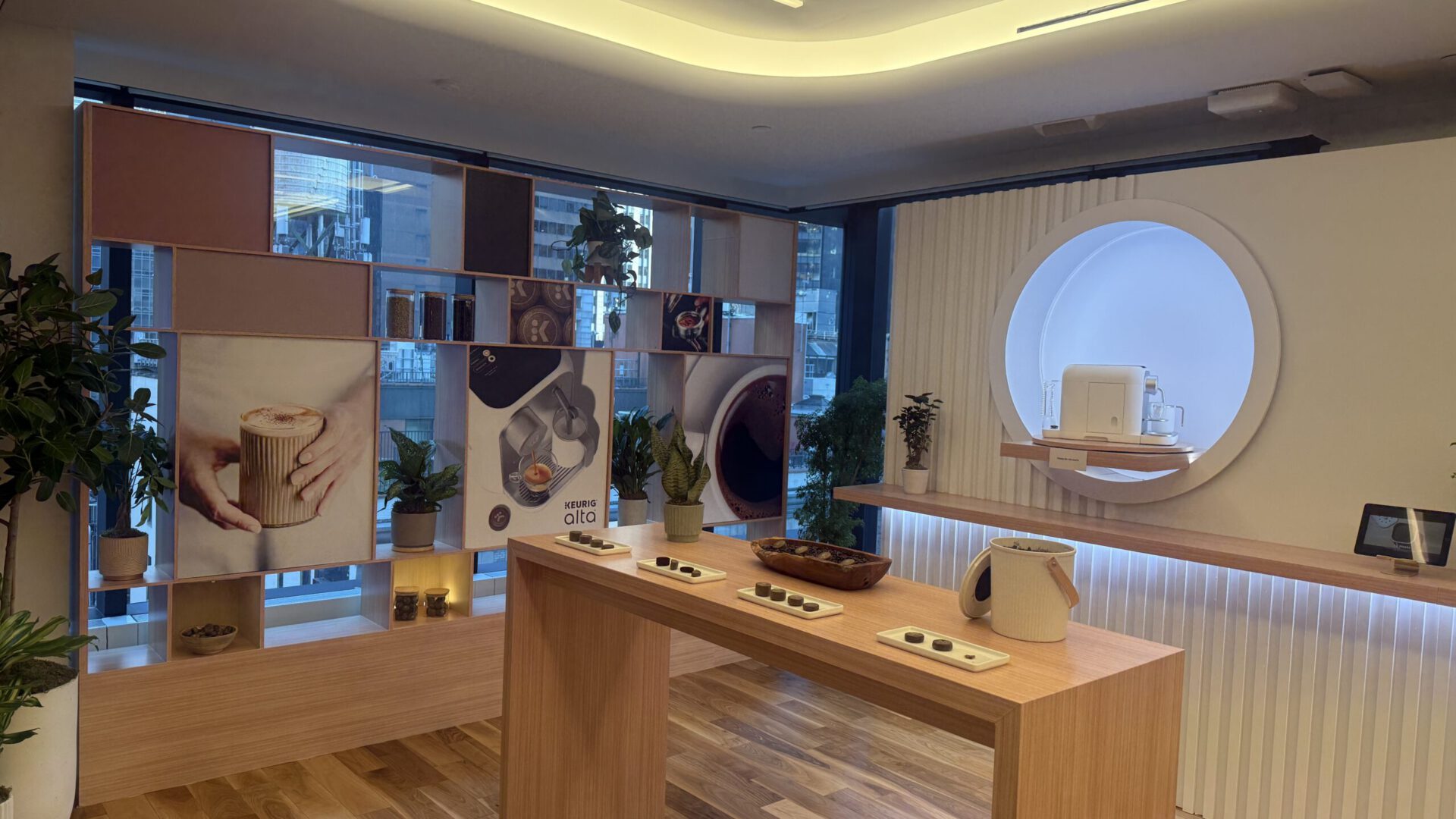
Product launch fabrication is the work of building the handful of objects a launch actually depends on: the surface the product sits on, the structure that conceals it until the moment arrives, and the environment that frames every photograph taken afterward. Everything else in the room is hospitality.
That narrowness is the point. A launch has one job, which is to move a specific feeling about a specific object into a room full of people who will describe it to everyone who was not there. The build either serves that transfer or competes with it, and which one happens is usually settled in shop drawings weeks before anyone sees a finished panel.
What follows is how our shop thinks about the reveal itself — the mechanism, the pedestal, the screens, the light, and the rehearsal — across product launches and pop-ups where the object in the room is the entire reason for the evening.
A Reveal Is a Sequence, Not an Object
The most common briefing error is to describe the reveal as a thing: a box that opens, a curtain that drops. A reveal is four beats, and the build has to serve all four. Guests approach, the room holds, the product appears, and then people walk up to it. Only the third beat is dramatic. The other three decide whether the third one lands.
The hold is the beat most often under-built. It is the minute or two when something is obviously about to happen and nothing has, and it has to be interesting to look at from every seat in the room. A shrouded form reads as anticipation; a shapeless pile of soft goods reads as a loading dock. We draw the silhouette of the concealed state with the same care as the revealed state, because that silhouette is what guests photograph while they wait.
The fourth beat is where most launches lose their value. After the applause, two hundred people want to stand next to the product, and a plinth designed only for the reveal collapses into a queue problem. Approach paths, standing room, and a defined place to photograph from belong in the ground plan, not in the run-of-show.
The Pedestal Is Structural, Not Decorative
A display pedestal looks like the simplest piece on the drawing set and behaves like the most demanding. It carries a point load with a center of gravity well above its base, it is touched constantly at hand height, and it usually has to swallow power and data without showing a cable.
We build them as structures first, the way any load-bearing piece of event fabrication gets built. An internal frame takes the load and the overturning moment, the skin is a separate layer that can be refinished or re-branded, and the base is weighted or footprint-widened so that a guest leaning on an edge changes nothing. Leveling feet matter more than anyone expects: venue floors are rarely flat, and a product that sits two degrees off plumb looks wrong in every photograph without anyone being able to say why.
Access is the detail that separates a shop-built pedestal from a prop. Somewhere there is a concealed panel a technician can open in the dark, reach into, and close without tools, because the product will be placed and re-placed several times before doors open. Cable paths get drawn, not improvised. Finish at hand height gets specified for fingerprints as well as for light, which is why product launch fabrication so often lands on matte, low-sheen surfaces rather than the piano gloss the render suggested.
Choose the Simplest Mechanism That Tells the Story
Reveal mechanics come in four families: something drops, something lifts, something slides, or the light changes. They are listed in rising order of reliability and falling order of hardware. A drape release is a rigging and soft-goods problem. A lift is a motion-control problem with a safety case attached. A slide needs track, tolerance, and a crew member hidden somewhere. A lighting reveal — a scrim lit from the front that becomes transparent when the light moves behind it — has no moving parts at all and fails the most gracefully.
The honest question in pre-production is which family the story actually needs, and product launch fabrication earns its keep by answering it before anything is cut. Scale arguments favor a drop, because the fall itself is the gesture. Precision arguments favor light, because nothing swings. Transformation arguments favor a slide or a rotation, since the audience sees one state become another in place.
Whatever the choice, it gets one mechanism, not two. Every additional moving element multiplies the ways a thirty-second moment can go sideways, and a reveal that half-works is worse than a reveal that was never promised. A single suspended object can carry an entire room on its own: at our private dinner at One World Trade Center, a hand-carved foam Earth hung at the heart of the room anchored the whole environment without a single moving part.
Screens Belong Inside the Scenic, Not Beside It
Most launches need a screen, and most screens arrive on a stand that makes the carefully built environment look like a conference room. Integration is a fabrication decision made early, because the pocket has to be in the drawing before the panel is cut.
Flush-mounting a display means building a pocket sized to the exact chassis with tolerance for mounting hardware, a service route behind it, and ventilation that does not become a visible grille on the face. We did exactly this for the Netflix booth we fabricated at the Meadowlands, where televisions sat flush in wall pockets and a branded LED logo worked as the centerpiece rather than as applied signage. Those pockets came out of the client’s own CAD files, and every drawing went through engineering review in the first forty-eight hours of a two-week build.
Light-emitting surfaces behave differently from lit ones. An LED wall or an illuminated logo sets its own color temperature and will fight whatever is washing the scenic around it unless both are specified together. Cameras add their own constraint: refresh rates and shutter speeds have to be reconciled before the first content capture, not discovered in the edit. When the brand mark itself is the hero, dimensional signage with internal illumination usually photographs better than a logo pushed onto a screen.
What Happens to the Build After the Applause
A launch environment has a second, longer life as a place where people handle things, and that life is what the fixtures are really for. Display cases, tasting counters, demo stations, and service bars take the crowd that the reveal created and give it somewhere to go.
The standard here is retail, not event. A fixture that guests touch for three hours needs edges that survive bag straps, finishes that clean with a cloth, and hardware that does not loosen under use. Our Café de Colombia activation at the San Diego Convention Center was built to that standard end to end: retail-grade finishes, an integrated full-service coffee bar built to retail operational standards, two dedicated tasting environments, and concealed back-of-house storage, designed, built, branded, and delivered in fourteen days for a crowd of more than three thousand.
Back-of-house is the part clients rarely ask for and always need. Cases, packaging, spares, and the hundred items a product team brings have to disappear somewhere within a few steps of the fixture, or they end up stacked in the frame of every photograph. We draw that storage into the build the same way we draw the hero.
Light the Object, Not the Room
A product reads as important when it is brighter than its surroundings, and that contrast is a lighting plot, not a wish. The ambient level in the reveal zone usually comes down so the key light on the object can come up, which means the surrounding scenic has to look intentional in low light rather than merely dim.
Material choices follow the light. Gloss and polished metal produce specular highlights that can blow out a phone camera and hide the product’s form; matte and satin surfaces hold detail. Glass and clear acrylic need light raked across an edge or thrown behind them, because front light simply passes through. Deep color on a surrounding wall will cast onto the product, which is fine when it is a brand color and a problem when it turns a white object green.
Then there is the audience’s actual camera. Phones meter for the brightest region in frame, so a product lit much hotter than the people around it produces a photograph of a bright blob in a dark room. Fill on the approach side, matched in color temperature to the key, keeps both the object and the guest standing next to it legible — and that photograph is the one that travels.
Test Fit, Rehearse, Then Plan the Strike
Product launch fabrication is judged in thirty seconds and prepared over weeks, and nothing about a reveal should happen for the first time on site. We assemble in the shop, with the real hardware and the real finishes, and we find the quarter-inch that is going to matter while there is still a saw within reach. For the two-story Barbie Dream House built inside Cipriani, the modular steel-and-wood structure was pre-fabricated in our New York shop and test-assembled before it ever left for the venue, so the install crew was repeating a build rather than inventing one.
The mechanism gets rehearsed with the actual weight of the actual product, not a stand-in, and it gets rehearsed in the lighting state it will run in. Cues, crew positions, and the hand-off between the technician releasing the mechanism and the person speaking all get run until the timing is boring. A reveal should be the least exciting thing happening backstage.
Strike deserves the same drawing. Launch builds are frequently wanted again — a second city, a showroom, a retail window — and whether that is possible is decided by how the piece was engineered and crated, not by how it looked on the night. Modular panels, labeled hardware, and a crate that matches the assembly sequence are what turn one evening into an asset, which is the quiet argument for treating product launch builds as fabrication projects rather than as decor.
If you have a product to put in front of a room and a date it has to happen on, we can tell you early which reveal survives contact with a venue, a crew, and a phone camera — and what it takes to build it. Start a conversation with our team and bring whatever you have: a render, a sketch, or just the object itself.