
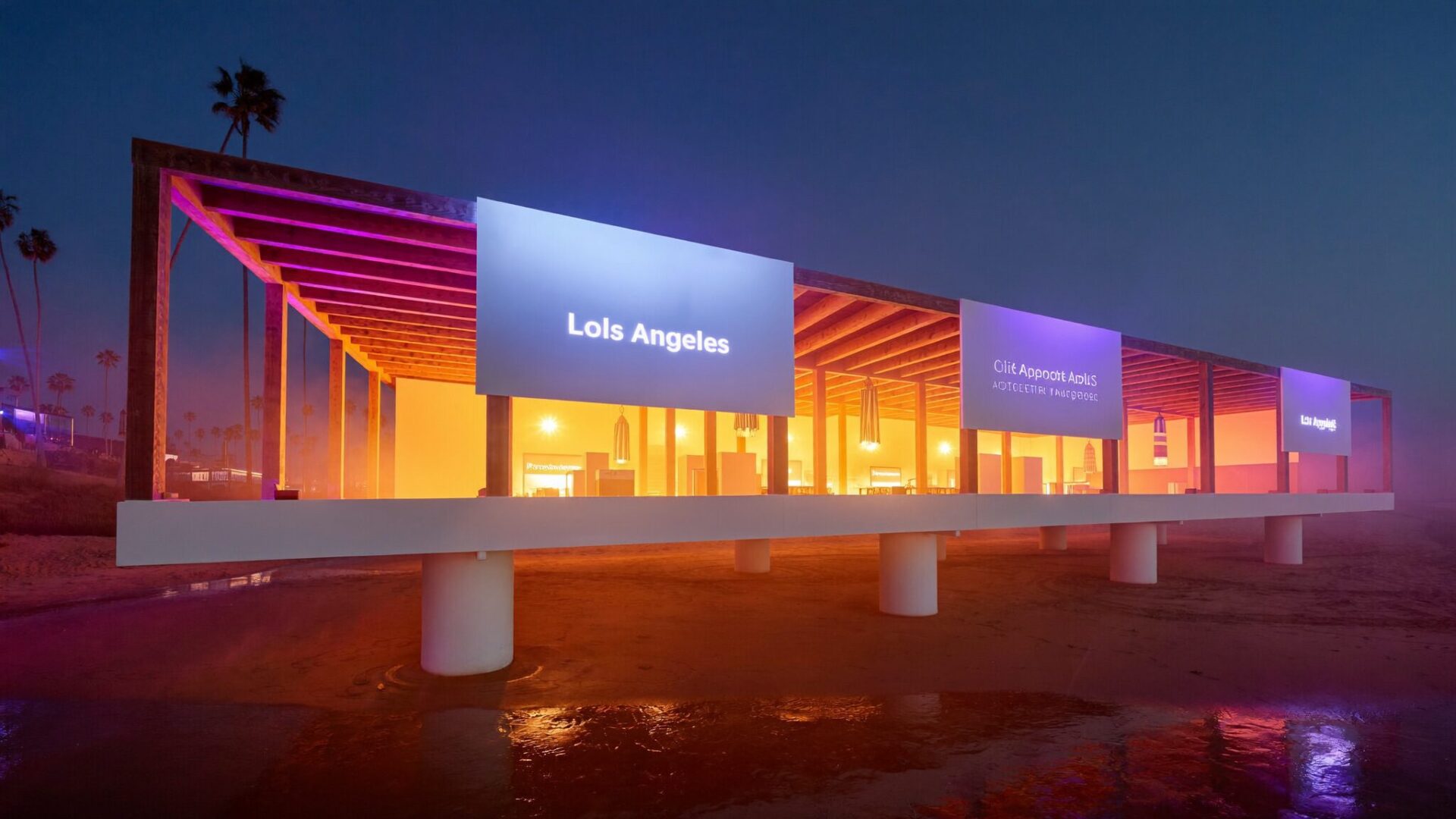
Super Bowl LXI is on Sunday, February 14, 2027, at SoFi Stadium in Inglewood, and for brands the week before the game is the real event. Super Bowl activations in Los Angeles are hospitality houses, client lounges, public builds and venue takeovers that run across that week, and as of October 29, 2026 there are about fifteen weeks to design, permit, build, ship and install one, with Thanksgiving and the December holidays inside that window.
This guide is written from the production side. It covers what has actually been announced for the week, which formats work, why the address decides the permit, the City of Los Angeles permit sequence, building outdoors in February, getting a build from New York to Los Angeles, and a countdown to game day. One note before we start: Geo Events is an independent production company based in New York, and Los Angeles is one of the markets we build for; our page for event production in Los Angeles explains how we work there. We are not affiliated with the NFL, the host committee or any official sponsor.
What has actually been announced for Super Bowl LXI week?
As of late October 2026, the NFL and the Los Angeles host committee have confirmed the game date and stadium, named the week’s main league events and dated one of them. The venues for the rest have not been announced. Plan on that basis: the fixed points are few, and most of the map is still blank.
Here is what the official sources say. The Los Angeles Super Bowl Host Committee, led by the Los Angeles Sports & Entertainment Commission, confirms the game on February 14, 2027 at SoFi Stadium. The NFL’s announcement names the events that make up Super Bowl week, NFL Honors, the Super Bowl Experience, Super Bowl Opening Night and a community program, and says they are expected to take place across Los Angeles. The host committee and the NFL have also announced an inaugural Sports Media Summit, presented by YouTube, on Friday, February 12, 2027.
One more plan is on the public record. In December 2025 the City of Santa Monica said its council had approved preliminary agreements that include an ESPN fan festival and broadcast presence on the Pier and beach in February 2027. That is a city plan, not an NFL confirmation, but it tells you the coast will be busy.
What is not yet public: the site and dates of the Super Bowl Experience, the venues for Opening Night and NFL Honors, and the kickoff time. For a brand, that means choosing a site before you know exactly where the crowds will gather. Pick a format that works wherever the league lands, or hold a short list of two sites until the announcements come. Early 2027 also has another big show week to plan around: if your team is working on CES week in Las Vegas in January, the same people will be stretched across both.
Which formats work for a game-week activation?
Most game-week builds fall into four formats: a hospitality house or client lounge, a public-facing brand activation, a media or creator space, and a takeover of an existing venue. Each one changes the site you need, the permits that apply and what gets built. Decide the format first, because it decides almost everything after it.
| Format | Goal | Typical site | What gets built | Main constraint |
|---|---|---|---|---|
| Hospitality house or client lounge | Host clients, partners and talent by invitation | A house, a hotel floor, a private club or a closed venue | Arrival sequence, lounge and bar builds, branded rooms, lighting, AV | Guest flow, security and the property’s own rules on what can be installed |
| Public-facing activation | Meet fans and passers-by, sample, capture data or content | An open lot, a plaza, a sidewalk frontage or a beach | Freestanding structures, a façade, dimensional logos, photo moments, sampling counters | Permits, wind and weather, crowd management |
| Media or creator space | Give press and creators a place to film and interview | A studio, a loft, a hotel suite or a corner of a larger build | Sets lit for camera, backdrops, seating, quiet zones, power for crews | Light, sound and the run of interviews through the day |
| Venue takeover | Borrow a place guests already want to be in | A restaurant, rooftop, bar or hotel | Reversible scenic, branded surfaces, bars, signage | Operator approvals, protecting the venue, short install windows |
If the term is new to your team, our guide to what a brand activation is sets out what separates an activation from an ad or a sponsorship banner. For takeovers, our piece on hotel and venue takeovers covers operator approvals and reversible builds. For media spaces, designing for the camera explains how sightlines and contrast change when the main audience is watching on a phone. If the brand pours or samples, the beverage activations playbook covers service counters and flow.
Our brand activation production team works across all four formats, and our pop-up and launch builds cover the cases where a product reveal is part of the week.
Pro Tip: Choose the format by what you want guests to do, then pick the site. A lounge where clients sit for two hours and a sampling build where fans spend four minutes need different square footage, different power and different permits, even if the brand story is the same.
Which city are you building in?
Greater Los Angeles is dozens of separate cities, and the permit rules follow the address, not the event. SoFi Stadium is in Inglewood. The Pier is in Santa Monica. Downtown, Hollywood and Venice are in the City of Los Angeles. Culver City, West Hollywood and Beverly Hills each run their own process. Before you design anything, find out which city owns the address.
This matters more than it does in most markets. A team that has produced in Manhattan is used to one city government with one set of agencies. In Los Angeles, two sites a few miles apart can sit under different building departments, different fire departments and different special event offices, each with its own forms and lead times. The City of Los Angeles sequence in the next section applies only inside City of LA limits. If your short list crosses a city line, you are running two permit processes, so call the special events office in each city first and ask what it needs and when.
Expect restrictions near the stadium too. For Super Bowl LX, the City of Santa Clara approved a special event zone around Levi’s Stadium from February 1 to February 10, during which sidewalk vending permits were paused and outdoor food and merchandise sales were banned. The city said the NFL requires such zones as part of its hosting agreement (NBC Bay Area, December 17, 2025). As of October 29, 2026 we had not seen a published zone for Super Bowl LXI. If your site is anywhere near SoFi Stadium, watch the Inglewood and Los Angeles city council agendas and plan for something similar.
What permits does a City of Los Angeles activation need, and when?
Inside the City of Los Angeles, a public-way activation runs through StreetsLA, the fire department and the Department of Building and Safety, roughly in that order. StreetsLA asks for its application 45 days before the event, and Building and Safety files last, after every other approval is in hand. Work the sequence backwards from your opening day.
1. StreetsLA Special Event Permit. If the activation uses streets or sidewalks, the StreetsLA special events portal says the application must be submitted 45 days before the event. Applications received 21 days or less before the event carry a late penalty. You will need proof of insurance submitted by your broker and a signed indemnification and hold harmless agreement, and StreetsLA will not issue a permit until every required document is in. Fees are set after the affected city departments review the application.
2. Fire department safety plan. According to LADBS, the Los Angeles Fire Department must approve a safety plan showing the event layout before you apply to Building and Safety, and LAFD approval is required for tents of 450 square feet or more. The approved plan has to be on site for the inspector. Depending on what the activation includes, LAPD (for live music or alcohol, among others) and City Planning may also need to sign off first.
3. LADBS Temporary Special Event permit. The Temporary Special Event (TSE) permit covers events of no more than seven days that include any of these:
- tents or canopies larger than 12 feet in length or width on commercial property
- stages or platforms more than 30 inches above grade (the ground level)
- grandstands or bleachers
- structures higher than 12 feet
Stages above 30 inches that are meant for live loads, which means people standing, walking or dancing on them, need approved engineering before inspection. LADBS says the application must be filed and paid at least two business days before the event and after all other approvals are in. Its inspector then checks structural stability, exits, sanitary facilities, accessible access and zoning on site. A run longer than seven days normally needs a building permit or special approval instead, so if your activation opens early in the week and stays up past game day, raise it with LADBS early. Timing guidance outside the department’s own pages varies, so confirm the filing window directly.
4. Filming. If you plan to film commercially on public property, FilmLA handles film permits for the City of Los Angeles. Check its lead time when you file with StreetsLA, not the week of.
For the wider picture of certificates, additional insured wording and flame certification, see our guide to permits, insurance and compliance. If your team usually produces on the East Coast, our piece on how permits work in New York is a useful comparison: the logic is similar, the agencies and lead times are not.
Pro Tip: Count 45 days back from your opening, then move the filing before the holidays. For an activation that opens on Monday, February 8, day 45 lands on Christmas Day. City offices, brokers issuing insurance certificates and your own approvers are all slower that week, so plan to file in mid-December.
How do you build for an outdoor site in February?
Build it in the shop, engineer it for wind and ballast, and make the on-site work placement rather than construction. An outdoor site gives you open sky and a big audience. It also gives you wind, damp evenings and a short install window, and the build has to be designed for all three before it is drawn in detail.
Any flat branded wall outdoors behaves like a sail. The wind load grows with its area and its height, and the structure wants to tip over its downwind edge. The answer starts with geometry: segmented panels, open frames, return legs that turn a flat plane into a shape that braces itself. Ballast, the counterweight that holds a freestanding structure down, does the most work when it sits at the outer edge of a wide base rather than stacked in the middle. Our guide to wind, ballast and outdoor structures covers the engineering in detail.
Beach and coastal sites add sand and salt air. Finishes, fixings and any electrical work need to be specified for that exposure, and every piece has to be moved across soft ground to its spot. February evenings are short, so plan lighting and power for the hours after sunset, and plan for wind and a rain contingency rather than counting on a dry week.
Our clearest example of this method is on the other coast. For White Claw Sessions at The Surf Lodge in Montauk, we fabricated four builds on one property, including nine mirror-finish letters standing on the sand at the edge of Fort Pond. Each piece was built in our New York shop for sand, salt air, sun and wind, and sized to be carried across the beach by hand, so the on-site work was placement and alignment, not construction. A Santa Monica or Venice site asks the same questions.
How does a build get from New York to Los Angeles?
Our elements are fabricated and test-fit in our New York studio, crated, and shipped cross-country, a freight transit of five to seven days. Our team then installs them in Los Angeles alongside local AV, lighting and crew partners. The schedule has to carry that transit week, plus a buffer, between the end of the build and the start of install.
A test-fit means assembling the build in the shop before it ships, so every panel, joint and cable is proven before the truck leaves. It is the step that turns install day into a known sequence. The pieces are then crated for transport and, in our activation fabrication work, installed by the crew that built them. When a program travels to more than one city, we design it for crating and repeat install from the start.
We have shipped a show build to California before. For Café de Colombia at the San Diego Convention Center, we designed, built, branded and delivered a 40-foot by 20-foot activation in fourteen days, for a show floor of more than 3,000 attendees. It was crated, shipped and stood up on site in under a day. That was San Diego, not Los Angeles, but the logistics are the same: a finished build leaves New York and arrives ready to place.
Sports culture can also be built as architecture rather than decoration. For a private client’s Slam Dunk: Ball Is Life celebration in New York, we built a custom-engineered, suspended LED basketball hoop above the dance floor and load-tested it in the shop before install. It was a private event, not a football project, but it shows the approach we take to sports-themed production: one strong built object, engineered properly, rather than a room full of props.
What does a countdown to February 14 look like?
From October 29, 2026, a game-week build has about fifteen weeks, and two holidays take a real share of them. Design must lock before Thanksgiving, and the StreetsLA application should go in before the December break. Our service pages give the reference points: a focused brand activation typically needs 6 to 8 weeks from approved concept to launch, and a large-scale build with complex fabrication and multi-site logistics needs 10 to 16 weeks.
The table below is our estimate for a mid-sized outdoor or venue build opening on Monday, February 8. Adjust it to your own dates and scope.
| When (estimate) | What is decided or done |
|---|---|
| Now to mid-November | Format, site short list, the city that owns each address, guest numbers, concept |
| By Wednesday, November 25 (Thanksgiving is November 26) | Design lock, engineering review, shop drawings start |
| Early to mid-December | Fabrication. StreetsLA application filed, insurance certificates requested, fire department safety plan drafted |
| December 21 to January 1 | Holiday slowdown. No design changes |
| Early to mid-January | Finishing, shop test-fit, crating |
| Last week of January | Freight leaves New York (5 to 7 days in transit) |
| First week of February | LADBS Temporary Special Event application filed (at least two business days ahead, after the other approvals), install, fire department and LADBS inspections, lighting focus |
| February 8 to 13 | Activation runs. Sports Media Summit on Friday, February 12 |
| Sunday, February 14 | Game day |
| February 15 onward | Strike and site restoration |
Strike is the term for taking the build down and removing it, and on a public site it includes leaving the ground as you found it. Our guides to the custom build timeline and to install and strike explain each stage in more depth. If your date is closer than this table allows, talk to us anyway. What changes is how early the decisions have to land.
Pro Tip: Design the build so it works on two sites. The league’s venues for the week may be announced after you sign, and a modular footprint that fits either your first or second choice keeps you from redrawing in January.
What about the NFL’s trademarks?
The NFL holds federal trademark registrations for “Super Bowl”, and the New York State Bar Association notes that the wordmark has been registered since 1969 and is actively enforced (NYSBA, May 2026). A brand that is not an official sponsor should keep league names, logos and trophy imagery off its build, signage and invitations.
Many advertisers use phrases such as “the Big Game” instead, but that is a practice, not a rule, and it does not settle every question. Have counsel review your signage, invitations and social copy before anything goes to print. We build what the brand and its counsel approve, and we flag league marks in drawings when we see them.
Super Bowl LXI activation questions we hear often
When is Super Bowl LXI?
Sunday, February 14, 2027, at SoFi Stadium in Inglewood, according to the Los Angeles Super Bowl Host Committee. Most brand activity happens in the days before, from about Monday, February 8.
Do I need a permit for a pop-up in Los Angeles?
It depends on the city and the site. Inside the City of Los Angeles, a build on streets or sidewalks needs a StreetsLA special event permit, and tents, raised stages or structures over 12 feet need an LADBS Temporary Special Event permit after fire department approval. Other cities in the region run their own processes.
How far ahead should a game-week activation be booked?
As early as you can. A focused activation needs about 6 to 8 weeks from approved concept, a large-scale build 10 to 16 weeks, and the holidays fall inside that window for a February date.
Why work with a full-service production company for game week?
A full-service production company gives you one team that designs the activation, fabricates it in its own shop, ships it, installs it, runs it and strikes it. Game week tests every handoff between vendors: a design that changes after the permit drawings are filed, a crate that misses its truck, a crew on site that has never seen the build. One accountable team removes those seams.
That is how we work. Our designers, fabricators and production managers sit under one roof in New York, with more than 200 events built in-house, and our full-service event production team carries a build from drawings to strike. In Los Angeles, we pair that shop with established local partners for AV, lighting and crew. For game week specifically, it means one team tracking the permit sequence, the freight date and the holiday calendar together, so nothing waits on someone else’s queue. Our brand activation and Los Angeles pages show the wider scope.
Tell us your dates, site and what you want guests to do, and we will come back within one business day with a production scope and a schedule that works back from February 14.