
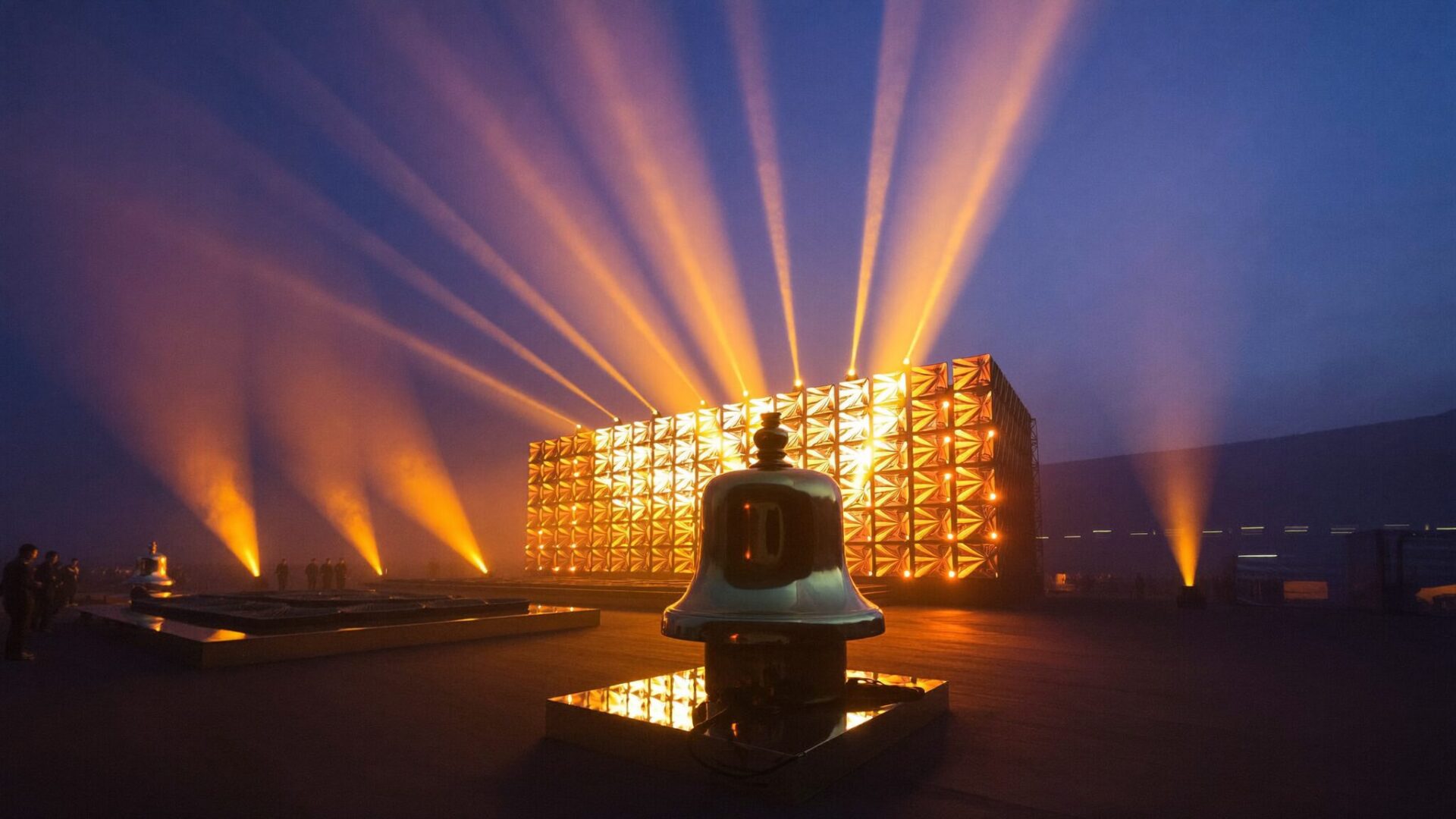
The bell rings for a few seconds, and the exchange produces it. Everything else on listing day belongs to the company: the people watching from other offices, the street outside, the evening party, the photographs and the date itself, which nobody can promise. An IPO celebration works when the company plans its own part around the exchange’s part, and when it plans for a window rather than a single day.
This guide separates the two. It uses the exchanges’ own published accounts of what they run, each linked where it is used, and it stays on the production side. Legal questions go to the company’s securities counsel, and the exchange’s listings team is the authority on its own rules, which can change.
What is an IPO celebration, and what does it include?
An IPO celebration is the program a company builds around its first day of trading: the exchange runs the bell, and the company owns everything else, from the employees watching in other cities to the evening party, the street and the photographs that outlast the day.
Most companies do some of these parts and skip others, usually because nobody owned the list. The parts are the bell ceremony itself (the exchange’s), the morning for everyone who is not on the podium, a street-level presence where the exchange agrees to one, the evening event, keepsakes, and the company’s own photography and video. Each one is covered below.
An IPO sits alongside the other moments a company marks with a built environment: a groundbreaking, a grand opening, an anniversary. Our corporate milestone events page names IPO celebrations and Wall Street bell-ringing celebrations among the work we produce, and our IPO and financial milestone events section describes them as serving two purposes at once: internal celebration and external signaling. Those two audiences, the people inside the company and the people watching it, are the reason the day needs a plan beyond the podium.
What does the exchange run on listing day, and what is left to you?
The exchange produces the bell ceremony and the time inside its own building. The company produces everything outside it. Plan your day around the exchange’s day, not the other way round.
The NYSE describes its own side in “What It’s Really Like to Ring the NYSE Bell” (published October 28, 2021). According to that account, planning can begin months ahead, and a minute-by-minute run of show is final before guests arrive. The exchange’s broadcast and multimedia teams update signage throughout the building with the bell ringer’s name and logo. Guests are escorted to the sixth-floor Board Room for a short program, and the bell ringers are then taken to the trading floor. The bell is started exactly 10 seconds before the open, or 15 seconds before the close. The same article adds that the area in front of the exchange “is often transformed into a street-level celebration.”
Nasdaq’s bell ringing ceremony page describes a similar split. The ceremony takes place at MarketSite in Times Square and is streamed live and broadcast on television. Nasdaq says its own event producers plan and choreograph each ceremony, that an on-site photographer covers it, and that each ceremony includes one hour of advertising on the seven-story Nasdaq Tower. Your exchange’s listings team will tell you what applies to your listing. We do not quote guest limits, arrival times or costs here because neither page states them.
The table sorts the day by who runs each part, based on those two pages and on what a company has to supply itself.
| On listing day | Who runs it |
|---|---|
| The bell ceremony, the podium, the trading floor or studio | The exchange |
| Signage inside the exchange, and the Nasdaq Tower hour at Nasdaq | The exchange, working from your brand files |
| Ceremony photography and the broadcast feed | The exchange |
| A street-level presence outside | Agreed with the exchange, built by your producer |
| The morning for employees who are not on site | You |
| The evening celebration | You |
| Keepsakes, gifts and wearables | You |
| Your own photography, video and edits | You |
How do you plan a celebration when the date can move?
Plan for a window, not a date. Build what can wait for the date, hold what can be released, and write every agreement so it follows the date when the date moves. An offering’s timing depends on filings, regulators and markets, none of which the party planner controls.
Our corporate milestone events page recommends 3 to 6 months of lead time for a milestone with a custom environment, and says plainly that IPO and M&A celebrations operate on unpredictable timelines. It adds that in-house design and fabrication lets us work to a compressed schedule when the moment arrives faster than planned. That second sentence only holds if the plan was built in a particular order.
- Hold the evening venue for the likely days, with written release terms, so a slip does not cost you the room or leave you paying for a date that no longer exists.
- Build the pieces that do not carry the date first. The logo, the ticker and the company’s story are known months ahead. Scenic, signage and backdrops can be finished long before anyone knows the morning.
- Add the date last. Keep it on the few printed or programmed items that can be changed the night before, and leave it off the rest.
- Book crew and freight against a window, and write down who decides to go and when.
The run of show for the day should exist in two versions from the start: one for the exchange morning, one for the evening, each with its cue owner. Our event fabrication team builds against the same schedule, so a date change moves a few finishing tasks and not the whole build.
Pro Tip: Build everything that does not carry the date first. The ticker, the logo and the story are known months ahead. The day is not. Keep the date on the small number of pieces that can be printed or programmed the night before.
What can you say in public around an IPO?
Check every public word with the company’s securities counsel. The weeks around an offering carry legal limits on publicity, so signage, speeches, press, social posts and even a street build are reviewed before anything is printed or posted. We are a producer, not a law firm, and counsel decides.
The SEC’s investor education site explains the idea on its quiet period page. The federal securities laws do not define the term, but it refers to the time around the filing of a registration statement, and it lasts at a minimum from the filing until SEC staff declare the statement effective. During that time a company has to be careful with any “offer” of the securities, and failing to follow the restrictions is called “gun-jumping.” Because the SEC and courts have read “offer” to include “communications that might generate public interest” in the company or its securities, the page says the range of communications that may be restricted is quite broad. The same page notes that SEC rules allow a company to keep communicating about other matters, including factual business information, and to share limited information about the offering itself.
For production, that turns into steps in the schedule and not a general worry:
- A review step for every public-facing word and graphic, including the street build, the backdrop and anything staff will wear.
- An approved-message list for hosts and staff at every office, so nobody improvises at a microphone.
- Speeches and signage written without forecasts, performance claims or stock references unless counsel approves them.
- Social posts and clips held until they are cleared, and a named person who clears them.
Event teams in regulated industries already work this way. Our guide to compliance-minded event design covers how creative decisions and review fit together. The point for a listing is the same: design the review into the calendar, because a graphic found to be a problem the night before is a graphic that does not exist on the day.
How do you include the people who are not on the podium?
Most of the company will not be in the room when the bell rings, so the morning needs its own production: a watch moment in each office, timed to the open, with a working feed, a host and something to hold. The exchange cannot do this for you, and it is the part most employees will actually see.
Remote viewing is part of the ceremony. Nasdaq’s page says its ceremony is streamed live. In the NYSE’s account of a bell day, Warby Parker’s co-CEO said the exchange “made it easy to involve our entire team virtually.” From there, the work is yours:
- The feed. Test the stream on the screens, speakers and network in each office, at the real time of day. Our guide to hybrid event production covers feeds and remote audiences in more detail.
- The clock. The NYSE’s November 2021 write-up has Nextdoor’s opening bell at shortly before 9:30 a.m. Eastern, which is 6:30 a.m. in San Francisco and Los Angeles. A watch party on the West Coast is a breakfast event, so plan food, seating and a host to match.
- A host in each office, briefed on the approved messages and the run of show.
- One branded moment per office: a backdrop, a wearable, a toast.
- One shared photograph that ties the offices together, taken at the same minute.
- A program later in the week for people who could not attend anything live.
If you have a Bay Area office, our San Francisco page shows how we work there. Tell us which cities your people are in, and we will say what each one needs.
Pro Tip: Test the stream in every office the day before, at the actual time. A watch party that starts on a loading wheel at 9:29 is the moment people remember.
What should the evening celebration be?
The evening is the only part of the day the company fully owns, so it should carry the story: who built the company, who backed it and what comes next. Plan it for the people who got the company there, not for the cameras.
Start with the audiences. Employees and their families want to be thanked and to see themselves in the story. Early investors, the board and the founders’ guests want something quieter. One large evening rarely serves both, and the answer is often two events: a big employee party and a smaller dinner. For the smaller format, our guide to the executive dinner explains table shape, sound and light for a room where conversation is the purpose.
Then the elements. A founding-story element, such as a timeline, artifacts or a film, gives the night its history; the anniversary guide explains how that environment is built. A toast or a reveal at a fixed time gives the evening its peak, and building the reveal covers the mechanics. The room itself should look like the company and not like a generic ballroom, which is the principle behind a room that looks like the company.
Two projects from our own work show techniques that carry over, though neither was an IPO. At the Roivant holiday gala at the New York Public Library, a corporate gala for 400+ guests in a landmark with strict preservation requirements, layered lighting lowered the perceived ceiling height and brought warmth to a grand room. For a private dinner at One World Trade Center, we built custom black acrylic dining tables, a seating plan engineered for sightlines and a hand-carved foam Earth suspended at the center of the room. Either approach suits an investor dinner or an employee evening.
For rooms in New York, our guide to corporate event venues in New York is a starting point, and our New York team works from the same shop that builds the pieces.
Can you build something on the street on listing day?
Sometimes, with the exchange’s agreement and the city’s permits. The NYSE says the area in front of its building is often turned into a street-level celebration, and anything placed on a New York street or sidewalk also needs approval from the city.
The NYSE’s own write-up of two weeks of listings in November 2021 shows the range. Kyndryl hung a banner on the exchange’s six-column facade. Bird displayed its scooters and e-bikes on Broad Street. Nextdoor erected a block of mock storefronts run by real local businesses on the cobblestone street, and rang the opening bell outdoors in the middle of it. Those are exchange examples, not our work, but they show what “a street-level celebration” can mean.
On the city side, our NYC permits guide explains that laying a red carpet, setting rope and stanchions, placing tables, hanging a banner or raising a canopy on a city street requires a street event permit through the Mayor’s Street Activity Permit Office, and that the published lead time for a special event is thirty days. A structure is a separate Department of Buildings filing. Outdoor pieces also need a wind plan; see our guide to wind, ballast and permits for outdoor structures. For Times Square, the city and the property owner decide what is possible, and Nasdaq’s page lists the Nasdaq Tower hour as part of its ceremony.
A street build is a brand activation fabrication job with an exchange and a city agency attached. The drawings, the permit path and the schedule have to line up before the first panel is cut.
What should the photographs and keepsakes be?
The bell photograph is shared by every listed company. The company’s own images and keepsakes are what make the day look like theirs. Plan a shot list, a backdrop that carries the brand and one object people keep.
The exchanges cover the ceremony. Nasdaq says its on-site photographer shoots the ceremony and photos in Times Square with your branding on the Nasdaq Tower, and that high-resolution photos are shared with guests the same day. The company adds its own crew for the offices, the street and the evening. Our guide to designing for the camera explains how to place a backdrop, light it and leave room for a phone. Clips for internal channels can be cut the same day once counsel clears them.
Keepsakes come in two kinds. The NYSE gives bell ringers an engraved medallion and a certificate of listing, and gives guests a personalized badge modeled on the badges traders wear, according to its account of a bell day. Those belong to the exchange. The company’s own keepsakes sit alongside them: a framed print of the first trade, a commemorative object, a wearable for the watch parties. Keep these simple and make them well, because they last longer than the clip.
Pro Tip: Decide the one photograph you need before the day, then build the backdrop for it. A logo wall with the ticker, lit for a phone, outlives the bell clip.
Why work with a full-service production company on an IPO celebration?
An IPO day has three owners: the exchange, the company’s counsel and the company. One team has to build the company’s side, keep it inside the exchange’s and counsel’s rules, and hold it together when the date moves.
That is the case for full-service event production. Design, fabrication, installation and show direction sit under one roof, and every surface is fabricated in our New York shop before it is installed on site, as our milestone celebrations page describes. We have 15+ years in event production and 200+ events built in-house, and we respond to inquiries within one business day. When the schedule compresses, the person who drew a piece is the person who can change it.
The company’s side of the day is a production in its own right, with a calendar, a review step and several rooms to run. Our corporate milestone events team plans it as one program, from the first conversation about the window to the last photograph.
Questions companies ask about IPO celebrations
Can employees attend the bell ceremony?
Some can, within the guest limits the exchange sets for your listing. The rest watch the live stream, which is why companies produce watch moments in their own offices.
How far ahead should an IPO celebration be planned?
Start as soon as the listing window is known. Our milestone events page recommends 3 to 6 months for a custom environment and notes that IPOs operate on unpredictable timelines, so plan for a window rather than a fixed date.
Does the exchange handle the evening party?
No. The exchange runs the bell ceremony and the time inside its building. The evening celebration, the offices and the keepsakes are the company’s to plan.
Planning a listing? Tell us the exchange, the expected window and where your people are, and we will respond within one business day with a production scope and next steps.