
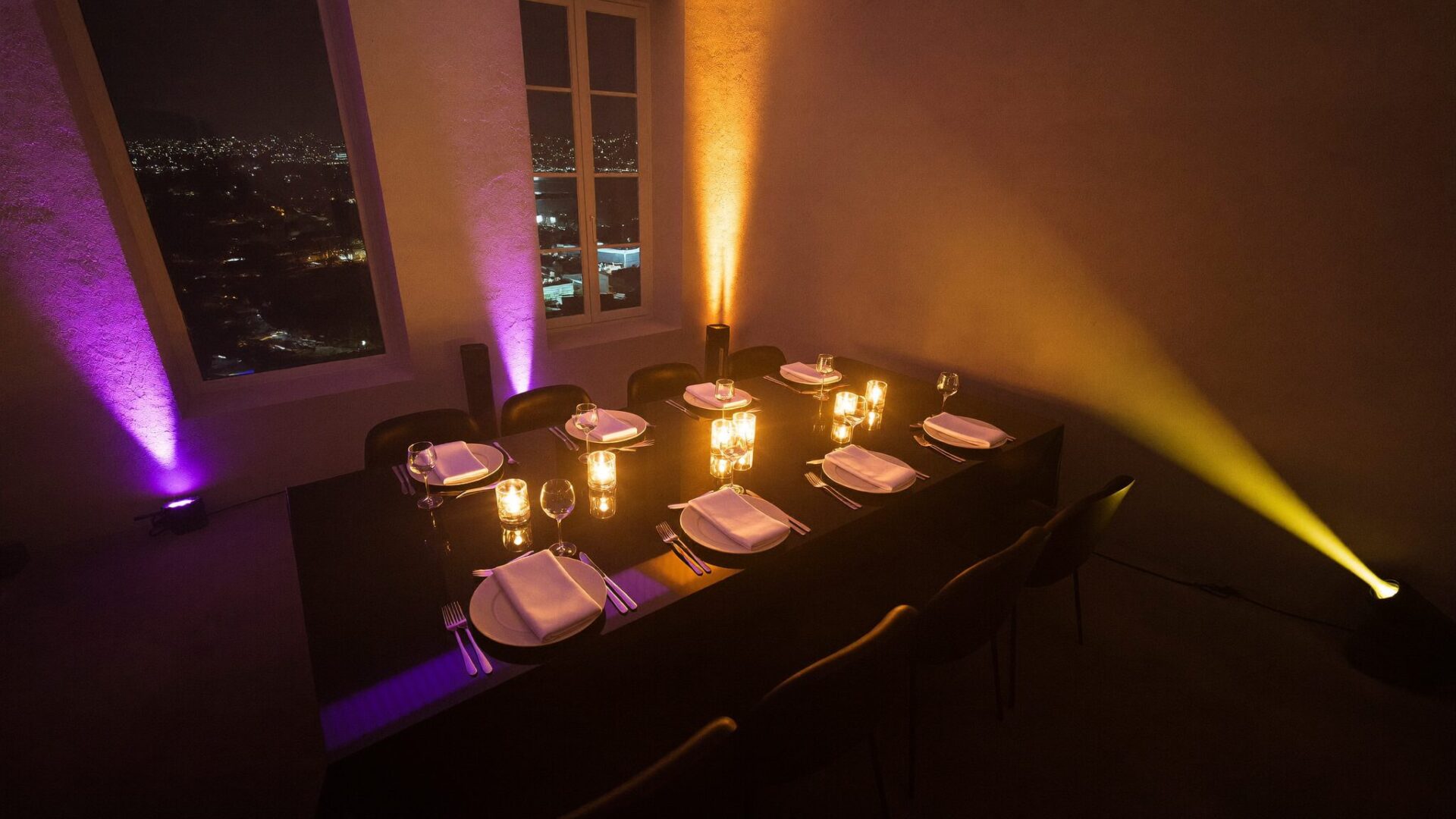
An executive dinner looks simple on paper: a small table of senior guests, a good room, a good menu. In practice it is one of the least forgiving formats we produce, because the whole evening rests on one thing that a beautiful room can quietly destroy. The people who matter have to be able to hear each other, see each other and stay in the conversation for the whole evening without a server, a speaker or a glare off the window pulling them out of it.
What follows is the production view: seat count and table shape, sound, light, when to build, service pacing and privacy. Every decision is tested against one question: does it help the conversation or get in the way?
What is an executive dinner, and what is it for?
An executive dinner is a small, invitation-only seated dinner for senior guests, such as a board, key clients or partners, where the conversation is the purpose of the evening. Producing one means designing the table, sound, light and service so that conversation can happen and nothing interrupts it.
The hosts vary. A chief executive brings the board or a group of investors together the night before a strategy session. A sales or partnerships team gathers its most important clients during a conference week. A brand invites a peer group of senior leaders to a roundtable over dinner. A company marks a milestone with the people who made it possible. In each case the host wants one outcome from the night: a relationship moved forward, a decision made easier, or a story the guests carry home and repeat.
That outcome is why the format is different from a gala or a client dinner for two hundred. A gala can survive a loud room because the program carries it. An executive dinner cannot. If guests at one end of the table cannot follow what is being said at the other, the evening has failed at its only job, however good the food was. We treat these dinners as part of our work on executive events and summits, and often the dinner is the second night of a larger program: a summit, an investor day or a launch, where the dinner is where the real conversations happen.
How many guests, and one table or several?
Decide the seat count by the conversation you want. One table keeps one shared conversation. Once the guest list grows beyond what one table can hold, the room splits into several conversations, and the host needs a plan for moving between them. The table shape follows from that choice, and the room follows from the table.
Planners often start with the venue and fit the guest list into it. We work the other way. The host’s goal decides whether this is one conversation or several, the seating chart decides the table, and the table decides which rooms are even possible. A long table that seats everyone together needs a room long enough to hold it with service space on both sides. Several rounds need a room that still feels like one event rather than a restaurant with a few reserved tables.
| Format | What conversation it creates | When it fits | What it asks of the room |
|---|---|---|---|
| One long table | One shared conversation at the centre; side conversations at the ends | A board, an investor group, a peer roundtable | Length, service access on both sides, the host seated at the centre rather than the head |
| Square or hollow-square table | Everyone sees everyone; easy to run a structured discussion | A moderated roundtable or a working session over dinner | A near-square floor plan and sound that carries across the open centre |
| Several rounds | Several separate conversations at once | A client dinner with an internal host at every table | Space between tables so neighbouring conversations do not bleed together |
| Long table, then a lounge | A shared dinner, then a looser second phase | When the host wants time to speak with each guest one to one | A second zone nearby, lit and furnished for small groups |
Treat the seating chart as a design document, not an admin task. Seat the host where they can see every guest, which on a long table usually means the middle of one side rather than the end. Place an internal host at each end, or at each round, so no part of the table is left without someone from the company to keep the conversation moving. Do not seat two colleagues side by side. Put the guests who most need to meet within easy speaking distance of each other, not across a centrepiece.
On the private dinner we produced at One World Trade Center, the seating chart was designed alongside the tables themselves, not handed over afterwards. It balanced visibility for the most important guests, the density of conversation at each table, and sightlines to the music and the photo moment, without making the hierarchy obvious. That last point matters more than it sounds. Guests notice when the seating ranks them, and a chart that reads as a pecking order changes how freely people talk.
Pro Tip: Write the seating chart before you choose the table. The chart tells you the shape, the shape tells you the room, and doing it in that order saves you from fitting the most important conversation of the year around a table that was already in the venue.
Why do so many executive dinners fail on sound?
Because the room is too loud to talk in. Research presented to the Acoustical Society of America found that people start to be disturbed by background noise above about 52 dB(A), and the study suggests keeping restaurant noise below 50 to 55 dB(A).
dB(A) is a decibel reading weighted to match how the human ear hears, which is why it is the standard unit for noise in rooms where people talk. The study, by Pasquale Bottalico of the University of Illinois, was presented in November 2018 and published as a lay-language paper by the Acoustical Society of America. Its findings are directly useful to anyone planning a dinner:
- 28 participants read passages to a listener over recorded restaurant noise ranging from 35 to 85 dB(A).
- Disturbance began above 52.2 dB(A).
- Above 57.3 dB(A), which the paper describes as approximately the level of normal conversational speech, the effort people put into their voices rose at double the rate.
- Willingness to spend time and money in the room fell at about the same point, 51.3 and 52.5 dB(A).
- The paper cites the 2016 Zagat National Dining Trends survey, in which 25 percent of diners named noise as the most irritating part of eating out.
The mechanism behind it is called the Lombard effect: in a loud room, people raise their voices without noticing so they can be understood, which makes the room louder, which makes everyone raise their voices again. At a public restaurant the noise comes from other tables. At an executive dinner it often comes from the production itself, from music that was set for arrival and never turned down, or from a hard-surfaced room that throws every voice back at the table.
What a producer does about it is practical. Take the whole room, or the whole floor, so no other party adds noise. Bring in soft surfaces where the venue allows: drape on hard walls, rugs on stone, upholstered seating, full linen on the table. Keep music below the level of conversation during dinner and off entirely during any remarks. Never point a speaker at the table; place it so it fills the room’s edges rather than the space between guests. If the room is shared or cannot be quieted, give the toast its own moment in a quieter space. Sound is one layer of the wider sensory design of an evening, and at a dinner it is the layer that decides whether the evening works.
How should an executive dinner be lit?
Light the faces and the table, not the room. Warm, low pools of light on the table let guests read each other’s expressions, which is half of any conversation, while the room around them can stay dark and quiet.
Colour temperature is measured in Kelvin, a scale for the colour of white light: lower numbers look warmer and more amber, higher numbers look cooler and bluer. Our guide to event lighting design recommends warm light in the 2700K to 3200K range for dining, because it flatters skin and encourages people to linger. The same guide describes a dinner lighting state with house lights at about 40 percent and pin spots on the centrepieces. A pin spot is a small, tightly focused fixture that throws a narrow beam onto one object, so the centrepiece seems to glow while the room stays dim.
A few rules carry most of the result:
- No hard light straight down over heads. It puts eyes in shadow and makes everyone look tired. Light the table surface and let it bounce up onto faces, or add soft light from a low angle.
- Centrepieces below eye level. Anything taller than a seated guest’s sightline hides the person opposite. If the design needs height, use something guests can see through.
- Candles where the venue allows open flame. Where it does not, good battery candles or small table lamps give the same warm, close light.
- One colour temperature at the table. Mixing a cool overhead light with warm table light makes skin look uneven and photographs badly if the host wants pictures.
Glass rooms and tower floors need one more thought. After dark, a wall of glass becomes a mirror, and a brightly lit room sees itself instead of the city. The answer is to light the table, keep the rest of the room low, and let the view do its work. We cover the details of building at One World Trade Center, including reflections, in a separate guide.
When is a built table or a designed room worth it?
Build when the room is wrong for the conversation, or when the dinner has to say something a restaurant room cannot. That usually means a venue without the right table, an address with a view that needs a quiet foreground, or a dinner that is also a statement about the company hosting it.
The One World Trade Center dinner is a clear example. The address sets a high bar before anything is brought in, so the brief was an evening that felt of the building: architectural and restrained, theatrical only where it needed to be. We built custom black acrylic dining tables designed to read as solid, monolithic surfaces under the room’s light, with a finish chosen to reflect the city without competing with the food. The seating chart was drawn with the tables. Our shop laser-cut the signage and place cards, produced large-format graphics for wayfinding and branded surfaces, and hand-carved a foam Earth that hung at the centre of the room as the photo moment, rigged on concealed hardware so it seemed to float.
The evening ran in three movements: ambient music during arrival and the photo window, a more structured musical register through dinner, and a lift in energy after it. The photo moment stayed open the whole night, so guests chose when to go rather than queueing at one point. None of that was decoration for its own sake. Every element was there to make the room feel purpose-built for the people in it.
Building gives you control over the things that decide a dinner: the exact length and width of the table, a surface that holds light the way you want, place settings and signage that match, and lighting built into the design instead of added afterwards. That is the core of how we approach private dinners designed as a whole environment, with the table, lighting and place settings planned together, and it draws on the same shop that handles our custom fabrication for launches and activations.
A restaurant private room is often enough. If the menu is the draw, the guest list is small and the room already passes the sound and light tests above, book it and spend the effort on the seating chart and the service plan. Our guide to private dining rooms in New York is a starting point for that path. There is also a middle option: a full restaurant takeover, where you take the whole restaurant for the night and redesign it around the dinner while keeping its kitchen and team.
Pro Tip: If the dinner has a view, build low. Keep the table, centrepieces and any scenic pieces below the window line so every seat keeps the city, and let the lighting stop at the table’s edge.
How should service be paced around the conversation?
Service runs to the conversation, not to the kitchen. Courses land between the host’s moments, never during them, and everyone serving the room knows the cues in advance.
Our guide to menu and service pacing describes seated service as the right choice for a board dinner where the conversation is the content, because it imposes order on the evening. It also sets the pacing rule we work to: no more than 55 minutes from first course to dessert on a working program, and no more than 75 minutes when speeches are woven in. Beyond that, attention drifts, however well the kitchen is doing.
A dinner deserves a short run of show: the written, cue-by-cue plan of the evening that the host’s team, the captain and the production crew all work from. For an executive dinner it fits on one page.
| Moment | What happens | Who gives the cue |
|---|---|---|
| Arrival | Drinks in hand within moments of arriving; music at its highest level of the night | Production lead |
| Seating | Guests move to the table; music drops below conversation level | Host’s team to captain |
| Welcome | Host speaks briefly; no service in motion, glasses already filled | Host’s team |
| First course | Plates land together after the welcome ends | Captain |
| Main course | Cleared and served before the discussion begins, not during it | Captain, on a signal from the host’s team |
| Discussion or toast | Staff step back from the table; doors closed; no clearing | Host |
| Dessert and departure | Dessert after the key moment; the room stays open for those who want to linger | Captain, then production lead |
Three details make the difference. First, one captain runs the floor with a direct line to someone on the host’s team, so service can hold when a conversation is going well and move when it stalls. Second, plates are cleared and glasses filled before the important remarks, not during them; nothing breaks a moment like a server reaching across the person who is speaking. Third, dietary needs are collected with the RSVP, so no guest is asked about allergies at the table in front of their peers, and the kitchen knows each plate by seat number.
How do you keep an executive dinner private?
Privacy is designed in, not requested on the night. It comes from a closed room, a known staff list, agreed rules on phones, photos and quotes, and a clear understanding of who may say what afterwards.
Senior guests speak freely only when they trust the room. For board and investor dinners we work under the same terms our corporate meetings service sets out for confidential sessions: production under NDA, careful handling of confidential content, and logistics planned with security in mind. Our private events service adds a closed group of vendors, planning under NDA and, when the host asks for it, a no-social-media rule for everyone working the event.
- The room. Take the whole room, or a space with its own entrance, so guests do not walk past other diners and staff do not pass through a public area mid-service.
- The people. Know every staff and vendor name in advance. Keep the team that enters the room as small as the service allows.
- The pictures. No branded or social photography unless the host asks. If there is a photo moment, keep it apart from the table so guests choose whether to take part.
- The record. Agree before the night whether remarks are on the record. Many hosts use the Chatham House Rule, a common convention under which what is said may be used but not attributed to the person who said it.
Some venues are chosen precisely because privacy is built into them. Our guide to private clubs in New York covers the rooms where discretion is part of the house rules.
Pro Tip: Agree the record before the invitations go out. “Can I quote you?” is a decision for the host to make in advance and state in the invitation, not a question for a guest to raise over the main course.
Why work with a full-service production company on an executive dinner?
Because the details that make an executive dinner work belong to different trades: a built table, light on faces, a quiet room and service that waits for the host. One team has to own all of them, or each will be done well in isolation and badly together.
Think about how the pieces depend on each other. The seating chart decides the table. The table decides the lighting positions. The lighting decides where the centrepieces can sit. The room’s surfaces decide how loud it will be, and the run of show decides when the captain can move. When four separate vendors handle those four things, nobody is responsible for how they meet. When one team designs, builds, lights and runs the evening, the person who drew the table is the person who checks the light on the host’s face before the doors open.
That is how we work. Geo Events has more than 15 years in event production and more than 200 events built in-house. As our private events page explains, design and fabrication happen in our New York City studio, and for events elsewhere the pieces are crated and shipped with our installation and production team. The same page gives our planning guidance for a bespoke, designed event: start four to eight months ahead in New York and six to twelve months for a destination, with shorter timelines possible because fabrication is in-house. A dinner attached to a summit or launch usually follows that program’s schedule, and our corporate meetings and summits team plans the two together.
Our New York production team handles dinners at the city’s landmark addresses, and we produce across the markets we serve nationally. Whether the dinner is one long table in a tower or a series in several cities, it sits within our wider full-service event production: one team from the first seating sketch to the last guest leaving.
Common questions about executive dinners
What is a formal dinner called?
A formal seated meal is usually called a plated or seated dinner, and a large one a banquet. In business, it becomes a board dinner, client dinner or executive dinner when the guest list is small and senior, attendance is by invitation only, and the conversation is the reason for the evening.
What should you serve at an executive dinner for 10 guests?
For 10 guests, plan one table, one captain and a seated menu of three courses, which our catering guide treats as the standard for a seated dinner. Collect dietary needs with the RSVP so the kitchen can plate by seat number, and keep the meal within the pacing rule above so it supports the conversation rather than stretching the evening.
How is an executive dinner different from a corporate dinner?
Scale and purpose. A corporate dinner can be a team meal or a large client event. An executive dinner is a small, senior, invitation-only table planned around one conversation.
If you are planning a dinner for a board, an investor group or your most important clients, tell us who is coming, how many seats and where. We respond within one business day with a project scope and next steps.