
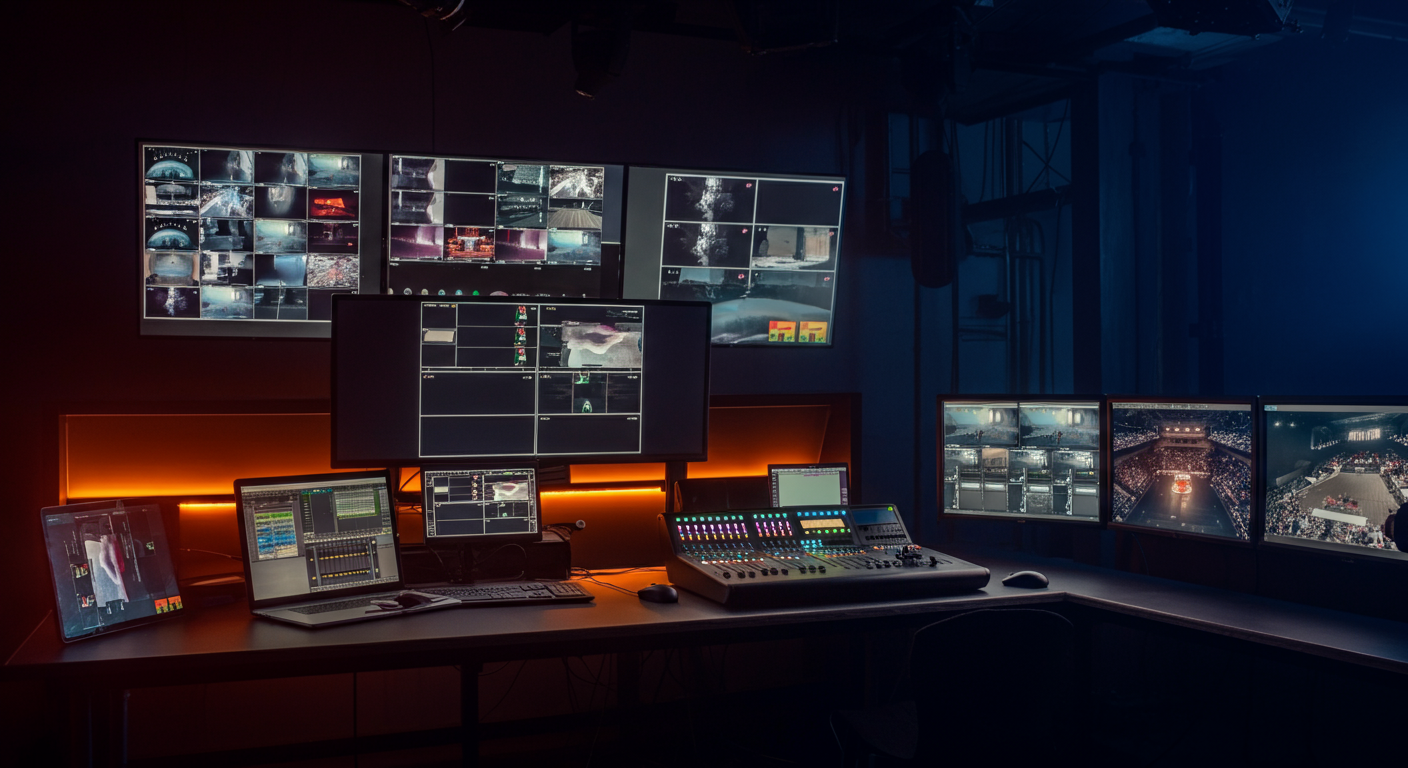
Hybrid event production in 2026 is no longer a Zoom link stapled to a ballroom — it’s a separate production discipline with its own crew, its own budget line, and its own rules about when to deploy it and when to walk away. The format survived the post-pandemic reset, but it didn’t survive unchanged. What passed for hybrid in 2021 would embarrass a competent producer today, and the companies still running their annual summit on a single fixed camera and a laptop mic are quietly losing the room — on both sides of the glass.
We’ve spent the last four years watching the category sort itself out. Some events need hybrid. Some events are actively damaged by it. The distinction matters more than the technology, because the wrong hybrid decision costs you both the in-person magic and the digital reach you were chasing in the first place. What follows is a working read on where the format lands in 2026, what it actually costs, and how to decide which of your events should carry a broadcast truck and which should stay behind closed doors.
What “Hybrid” Actually Means in 2026
The word has stretched to the point of uselessness. A fireside chat streamed on LinkedIn Live is hybrid. A 2,000-person global summit with three simultaneous broadcast feeds, a studio control room, and a dedicated virtual audience experience is also hybrid. The production reality — and the invoice — are nothing alike.
When we scope hybrid event production for a client, we start by forcing a definition. Not “do you want hybrid?” but “what does the remote audience need to be able to do?” Watch passively? Ask questions in real time? Network with each other? Access sessions on demand six weeks later? The answer determines whether you’re building a broadcast, a livestream, an archive, or something in between. Most clients arrive asking for all four and leave having chosen one.
The Four Hybrid Tiers
Internally, we run every hybrid conversation through the same four-tier framework. It’s blunt on purpose. It keeps the conversation on outcomes instead of equipment lists.
Tier 1: Broadcast-Grade
This is television production that happens to have a live audience in the room. Multi-camera switching, a dedicated control room, lower-thirds and motion graphics, a director calling shots, a technical director cutting the feed, and a show caller running transitions the way a sports broadcast runs them. The remote audience isn’t watching a meeting — they’re watching a show. Think investor days for public companies, flagship corporate summits, and keynote moments where the video asset will live on the brand’s YouTube channel for years.
Broadcast-grade hybrid is expensive and it earns it. A proper broadcast setup requires a minimum of four cameras, a vision mixer, a dedicated audio engineer running a separate broadcast mix (in-room audio and broadcast audio are different problems with different solutions), a graphics operator, and a director who has done this before. It’s typically a six-to-eight-person broadcast team on top of your standard event production crew.
Tier 2: Livestream with Interaction
One or two cameras, a cleaner feed than your CFO’s laptop can produce, real-time Q&A and polling for the remote audience, a platform that actually works on corporate VPNs, and a moderator whose only job is to carry remote voices into the room. This is the workhorse tier. Most annual meetings, most product briefings, most partner summits live here.
The trap in Tier 2 is assuming your AV vendor’s default livestream package covers it. It almost never does. Interaction design — how remote attendees raise their hand, how that hand gets acknowledged on stage, how their question appears on the presenter’s confidence monitor — is a production design problem, not an equipment problem. Skip it and you get 40 minutes of in-room audience watching a Q&A with nobody remote, because the remote audience gave up trying to be heard.
Tier 3: On-Demand Archive
No live stream. Professional capture, clean audio, and a post-production edit that ships two to ten days after the event. Sessions get chaptered, captioned, and dropped into a gated or open content library. For sales enablement, investor follow-up, and ongoing brand activations that feed content marketing pipelines, this is frequently the smartest option. You get the asset without paying the broadcast premium, and the editing layer lets you fix what happened in the room instead of televising it live.
Tier 4: In-Person Only with Content Repurposing
No live digital audience. No streaming. A small capture crew shoots b-roll, pull quotes, keynote highlights, and atmosphere. The content becomes a recap film, social cut-downs, case study assets, and sales collateral. This is the right call more often than clients expect. It costs a fraction of true hybrid and it protects the in-room experience — nobody performs for a camera, nobody hedges their language for the internet, and the FOMO that makes a private event valuable stays intact.
The Production Cost Delta
Here’s the number most procurement teams don’t want to hear: true hybrid event production typically adds 25 to 40 percent to the production line item. Not 10. Not “a little more.” A quarter to nearly half again, on top of what you were already going to spend.
The math is unsentimental. Hybrid means:
- A second crew with a second scope of work (the broadcast team runs parallel to your in-room AV team and doesn’t replace it)
- A second technical rehearsal — cameras, graphics, and stream need their own run-through, which eats venue hours
- A streaming platform with a real SLA, not a free tier
- Bandwidth. Real bandwidth. Often a bonded cellular or fiber drop the venue doesn’t include
- Content licensing — music on stage and music on stream are different legal problems
- Redundancy. Broadcast-grade means two of everything that matters, because a failed stream in front of 8,000 shareholders is a different kind of bad day
- Post-production, if the archive has commercial value
We’ve seen clients approach hybrid as a checkbox and end up paying the full premium for a Tier 2 experience they could have gotten for a third less with honest scoping. We’ve also seen clients try to do broadcast-grade on a Tier 2 budget, which is how you end up with the investor day clip your comms team spends three months apologizing for.
Where Hybrid Wins
Some events genuinely require hybrid production, and for those, the cost delta is a bargain. The pattern is clear: hybrid wins when the information itself is the product, when the audience is distributed by necessity rather than choice, and when the content has a long tail.
Investor Days and Analyst Briefings
SEC disclosure obligations, a global analyst base, and regulatory archiving requirements all point the same direction. A public company’s investor day is a Tier 1 event by default. The in-room audience is largely symbolic — the real audience is on the stream and in the replay. This is where broadcast-grade production stops being a luxury and starts being table stakes.
Annual Summits and User Conferences
For B2B software companies, partner networks, and professional services firms with global footprints, the annual summit is both a live event and a content factory. The in-person audience in New York or San Francisco is a fraction of the addressable audience. A well-produced hybrid extends the room to EMEA and APAC without asking every customer to fly.
Our work on the VTEX Corporate Event at The Glasshouses is a reference point here. The room itself was the product — a purpose-built environment at one of Manhattan’s most distinctive venues, with the Hudson as a backdrop and a production design that treated the physical space as the primary asset. The hybrid layer captured and extended that, but the in-person experience was engineered to be the non-negotiable centerpiece. Remote attendees saw something worth logging in for because the in-person guests were in something worth showing.
Conference Keynotes with Shelf Life
When a keynote is a signal — a CEO’s annual address, a product vision, a policy position — the video asset is going to do more work than the live event. In those cases, hybrid production pays for itself in content reuse: clipped for social, excerpted for press, archived for sales, and repackaged for onboarding. The live event is the generating moment. The stream and the archive are the distribution.
Where Hybrid Loses
Hybrid is also the wrong call for a surprising portion of the event calendar, and the damage runs both directions. A poorly placed hybrid layer makes the in-person experience worse and produces digital content nobody wants to watch.
Intimate Milestone Events
A 60-person anniversary dinner, a partner retreat, a closed-door executive offsite — none of this benefits from a camera. The presence of broadcast equipment changes the way people speak. Candor dies. Small rooms are small on purpose. Corporate milestone events are usually engineered to produce a specific kind of intimacy, and hybrid dismantles it.
Private Dinners and Luxury Hospitality
The unspoken rule of a well-run luxury private event is that what happens in the room stays in the room. Discretion is the product. Streaming a private dinner is a category error — you’ve taken an event whose entire value proposition is exclusivity and made it available to everyone with a link.
Brand Activations Built on FOMO
This is the one that trips up marketing teams. A brand activation designed to generate cultural urgency — the line around the block, the guest list that leaks, the Instagram moment you had to be there for — is actively undermined by a livestream. If anyone can watch from their couch, you haven’t built a destination. You’ve built content. Those are different products.
The Barbie Dream House at Cipriani and the Emily in Paris Immersive Photo Experience are instructive here. Both generated enormous digital spillover, but the digital reach was user-generated. The earned content came from guests who wanted to prove they were in the room. A corporate livestream would have killed it.
A Working Framework for the Decision
The question we put to clients before we scope anything: what is the cost of not extending this event digitally, and what is the cost of extending it badly? Both numbers matter. If the event is a quarterly all-hands for a distributed workforce, the cost of not extending is catastrophic and the cost of a Tier 2 livestream is modest — obvious hybrid. If the event is a 40-person client cultivation dinner at a private club in the Hamptons, the cost of not extending is zero and the cost of extending is the destruction of the intimacy you paid for. Obvious in-person only.
Most events fall somewhere in between, which is where the Tier 3 and Tier 4 options earn their keep. You don’t need a live audience to get a content asset. You need a plan and a capture crew.
What to Ask Before You Approve a Hybrid Budget
Before any producer quotes a hybrid line item, push back with these questions. The answers should be in writing.
- Who is the remote audience, specifically? Named segments, approximate counts, and why they’re not in the room.
- What do they need to do? Watch, interact, access later, or some combination.
- What’s the content’s shelf life? Live-only, 30 days, a year, forever.
- What happens if the stream fails at minute 14? If the answer is “we’re ruined,” you need Tier 1 redundancy. If the answer is “we’ll post the recording,” you need Tier 3 and a smaller check.
- Is the in-room experience enhanced or diminished by the cameras? Answer honestly.
The 2026 Read
Hybrid event production in 2026 is mature, which is the most useful thing that’s happened to it. The honeymoon is over. Nobody is impressed by a stream anymore — the bar is what the stream actually does. Clients who treat hybrid as a production discipline with its own craft, its own team, and its own decision criteria get events that work on both sides of the camera. Clients who treat it as a checkbox get neither a good live event nor a useful digital asset, and they pay the premium anyway.
The companies getting this right in 2026 are the ones willing to say “in-person only” out loud for the events that deserve it, and willing to invest in real broadcast-grade production for the ones that demand it. The middle — hybrid-by-default, under-scoped, under-rehearsed — is where budgets go to die.
When you’re weighing whether your next summit, launch, or keynote needs full hybrid event production or something leaner, start the conversation here. We’ll scope it honestly, tell you which tier fits the actual outcome you want, and show you the delta before anyone signs anything.