
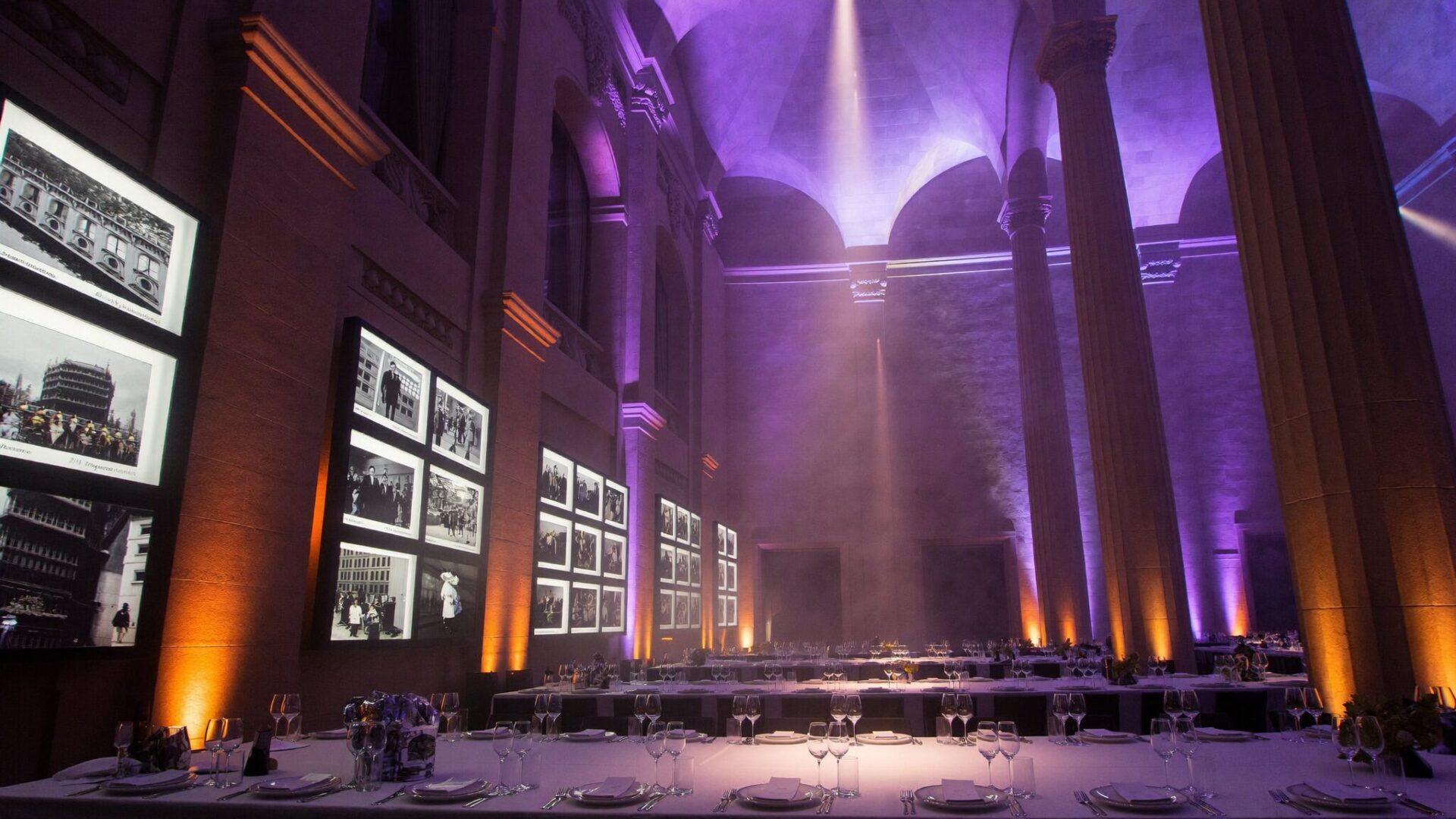
A company anniversary celebration is rarely one party. The 25th, 50th or 100th year arrives with a date fixed decades ago, a leadership team that wants it to mean something, and several audiences who each expect a part in it: employees, alumni, clients, the board, the press and often the city where the company started. Planners who treat it as one evening tend to end up with a dinner and a slideshow. Planners who treat it as a program end up with a night people remember and a story the company keeps telling for years.
This guide explains how we produce company anniversaries at Geo Events: where the story comes from, how to serve each audience, what the anchor night should be, how a company’s history becomes a room guests walk through, where to hold it, and how far back from the date to start. It is written for the communications lead, chief of staff or agency producer who has been handed the date and asked to make it count.
What is a company anniversary celebration?
A company anniversary celebration is a produced program that marks a company’s years in business for the people who built it: a story the leadership wants to tell, an environment that makes the company’s history visible, one anchor night, and separate moments for employees, clients, partners and press.
It is not a work anniversary. A work anniversary recognizes one employee’s tenure and belongs to HR: a card, a gift, a mention in a team meeting. A company anniversary marks the organization itself, and it has to say two things at once: where the company came from and where it is going. That second half is what separates it from a party with a cake. The usual markers are the 10th, 25th, 50th, 75th and centennial years, and the larger the number, the more the room expects to hear about the future as well as the past.
A gala is designed to entertain. A milestone event is designed to tell a story and fix a moment in time, so every element, from the invitation to the scenic environment to the closing toast, is shaped by the achievement being marked. That is the brief behind our corporate milestone events, and it is the lens for everything below.
What is the anniversary for? Start with the story
Decide what the anniversary has to say before choosing a venue or a format. Most anniversary stories run in three acts: the past honored, the present celebrated and the future announced. The third act is usually the one leadership cares about most, and it gives the night its reveal.
The raw material sits in the company’s own records. The Society of American Archivists’ Business Archives Section lists “corporate, customer and product anniversary celebrations” among the business activities a company archive supports, alongside investor relations, employee communications and corporate histories (Society of American Archivists). If the company has an archivist, that is the first call. If it does not, the story lives in old annual reports, product photography, press clippings, early offices and the memories of the people who have been there longest.
We usually start a milestone production with two to three weeks of narrative development before any design direction is set: gathering archives, interviewing long-tenured staff and finding the through-line that connects the founding to today. The interviews matter more than planners expect. A founder’s first customer, the product that nearly sank the company, the office everyone still talks about: these are the details guests repeat the next morning, and they rarely appear in an official history.
Four questions for leadership shape the rest of the work:
- What moments changed the company, and which of them can be shown rather than told?
- Who has to be thanked by name: founders, long-serving staff, first clients, the city?
- What will be announced on the night: a new chapter, a commitment, a building, a name?
- What single sentence should every guest be able to repeat when they leave?
Write the answers into the event brief so every designer, writer and vendor works from the same story. From there, experiential event design turns the three acts into spaces, moments and a sequence.
Who is the anniversary for? One milestone, several audiences
Most company anniversaries serve four or five audiences at once, and each needs its own moment: employees and alumni, clients and partners, the board and investors, the press, and the home city or community. One evening rarely serves all of them well, so the program is designed audience by audience.
| Audience | What they need from the anniversary | Format that fits |
|---|---|---|
| Employees and alumni | To be thanked, and to see themselves in the story | An all-company celebration, office events, a history exhibit that visits each location |
| Clients and partners | The relationship honored, not a sales pitch | A seated dinner or reception with a short program |
| Board and investors | A clear signal about strategy and the next chapter | An executive dinner or a private preview of the announcement |
| Press | A story, images and access to leadership | A media moment, press photography and a ready-made asset pack |
| City or community | A public gesture from a company that grew there | An open day, a civic moment or a community program |
A public example shows the shape. Dykema, a national law firm, announced in January 2026 a yearlong centennial program for its June 1, 2026 founding date. Its own press release lists a firmwide celebration in late June at Campus Martius Park in Detroit, the city where it started; a “100 Years, 100 Stories” content series told by its attorneys and staff; a centennial website launched on February 21, 2026, 100 days before the anniversary; a traveling exhibit of artifacts and memorabilia that visits each office; and client and community programs through the year (Dykema, January 7, 2026). That is Dykema’s own program, not our work. It is a useful model because it has one anchor, several audiences and a year of content around them.
When one night has to carry more than one audience, we design the separation into the spatial flow: a board and investor moment before doors, a press position with its own access, VIP guests routed through a quieter sequence, and employees given the loudest part of the evening. When the audiences are too far apart, we produce two events instead: an internal celebration for employees and a separate client or public evening, each built on the same story.
Pro Tip: Write the audience list before the guest list. If employees and clients must share one night, plan the room in zones with their own moments, not a single program everyone sits through.
What should the anchor night be?
Choose the anchor format from the audience and the story: a gala for a large mixed audience, a seated dinner when clients and the board matter most, a headquarters takeover when the building is part of the story. Whatever the format, program it in acts, and save the future for the reveal.
The three acts translate directly into a program. Arrival and the first part of the evening belong to the past: the history environment, archival film, the people who were there early. Dinner belongs to the present: the people in the room, short tributes, recognition. The final act is the future: the announcement, a film premiere, a commissioned piece unveiled, a new name on the wall. Placing the reveal late gives the evening somewhere to go, and gives the press the image they came for.
Remarks are the part most likely to run long. Keep them short, write them into the run of show (the cue-by-cue script that tells lighting, sound, video and stage management what happens and when), and rehearse them in the room. Lighting states are programmed on the console ahead of time over DMX, the control protocol that tells each fixture what to do, so a shift from dinner to reveal happens on one called cue rather than a scramble. Tributes to founders or long-serving leaders should be reviewed with the honoree’s inner circle before the night; an anniversary is not the moment for a surprise anyone would regret.
Two projects from our own work show techniques that carry over, though neither was an anniversary. At the Roivant holiday gala at the New York Public Library, a corporate gala for 400+ guests inside a landmark with strict preservation requirements, layered lighting lowered the perceived ceiling height to bring warmth to marble and stone, and a choreographed arrival through the library’s corridors moved guests from the street into the celebration. Anniversaries held in grand rooms need exactly that: intimacy at the table without fighting the architecture.
For a private dinner at One World Trade Center, listed among our milestone celebrations, we built custom black acrylic dining tables, a seating plan engineered for sightlines, and a photo moment around a hand-carved foam Earth suspended at the center of the room. The evening ran as three experiences at once, plated dinner, live music and the photo moment, choreographed in three movements so none of them competed. That structure is the anchor-night problem in miniature. For the wider planning sequence of a formal evening, see our guide to planning a corporate gala.
How do you turn company history into something guests walk through?
Build the history as an environment, not a slideshow: a spatial timeline guests move along, real artifacts in cases, archival photographs and film projected at architectural scale, and one commissioned piece that carries the story. A room lets guests take in the story at their own pace, stop where it means something to them, and talk about it with the people beside them.
The elements we use most:
- A spatial timeline. The company’s history laid out along the path guests take, decade by decade, so they move through the story before they reach the main room. Each decade becomes a zone with its own material, light and objects, and the path ends where the present begins.
- Artifacts in cases. First products, founding documents, early signage, uniforms, prototypes. Originals belong behind glass. Agree handling, security and light limits for each object with the archivist or records owner before the cases are drawn, and light them in a warm white, typically 2700K to 3200K on the Kelvin scale (lower numbers read warmer), as our notes on event lighting design explain.
- Projection at scale. Projection mapping fits film or images precisely to the shape of a wall, a facade or an object. Archival photographs that would be lost on a screen become the room itself, and a headquarters facade can carry the company’s story for one night.
- One big piece. A single commissioned object or installation that the evening is organized around, often unveiled in the final act. Our note on building a milestone around one big idea covers the method.
- Built to travel or to stay. A heritage installation does not have to end with the night. It can move through the company’s offices afterward, as Dykema planned for its centennial exhibit, or be rebuilt as a permanent version in the headquarters lobby.
All of this is physical work. Timeline walls, display cases, plinths and the centerpiece are designed and built through custom fabrication in our New York shop, and the stage that carries the reveal comes from our set and stage design team. The aim is a room where the company’s identity is legible without a single logo, which is the principle behind brand environment design.
Pro Tip: Get the artifact list before the floor plan. Object sizes, case counts and security requirements decide where the timeline can run, and finding out late means redrawing the room.
Where should a company anniversary happen?
Hold it where the story lives: the headquarters, the founding city, a landmark that matches the company’s stature, or every office in turn. The venue is part of the message, so choose it for what it says before what it holds.
Our approach is venue-agnostic: we construct the environment inside the venue rather than depending on the venue to provide the atmosphere. We have produced milestone events in corporate headquarters, cultural institutions, industrial spaces, historic landmarks and private estates. Each brings its own conditions. A headquarters has security, working floors and staff who need the building back the next morning. A landmark brings preservation rules: nothing fixed to historic surfaces, protected floors, and a short load-in, the window in which crews bring in and install everything. Our guides to venue protection at landmark buildings and load-in at historic venues cover both in detail.
The address can carry meaning on its own. Dykema chose Campus Martius Park in downtown Detroit, the city where it started. When Dropbox went public, we produced its IPO launch party in Times Square, a milestone without a round number where the location was part of the statement. For a company celebrating in New York, our New York production team works from the same shop that builds the pieces, and our guide to corporate event venues in New York is a starting point for the room.
For a company with offices in several cities, the most efficient model is to build once and install many times. Timeline walls, cases and the centerpiece are designed to break down into crates, labeled to a floor plan and installed in the same sequence at each office, so the tenth stop looks as finished as the first. The anchor night then happens in the founding city or headquarters, and the exhibit carries the anniversary to everyone else.
How early should you start planning a company anniversary?
Start with the story, four to eight months ahead of the date. That is the planning timeline on our milestone celebrations page. Inside it, narrative development takes two to three weeks, and production runs 12 to 20 weeks from the narrative brief to event day. The rest of the window goes to holding the venue, leadership approvals and archive research. A yearlong program, with content before and after the night, starts earlier still.
The date is the one thing that cannot move, which is both the advantage and the risk. A company knows its anniversary years in advance, yet anniversaries are often planned late because the date feels far off until it is not. Counting back from the date makes the sequence clear:
| Phase | When | What gets decided |
|---|---|---|
| Story and audiences | First, before any format is chosen | The three acts, the announcement, who the anniversary is for |
| Narrative development | Two to three weeks | Archive pull, interviews with long-tenured staff, the through-line |
| Concept and venue | Start of the 12 to 20 week production window | Format, venue, renderings, the history environment |
| Fabrication and content | Middle of the production window | Timeline walls, cases, the centerpiece, film, tributes, timeline graphics |
| Rehearsal and install | The final days | Run of show locked, remarks rehearsed, load-in and technical rehearsal |
| After the night | The weeks that follow | The film, photography, the exhibit’s next stops |
Two schedules run in parallel: the build and the content. Fabrication of heritage pieces and the stage follows the same stages as any custom build, set out in our custom build timeline. Content, the films, tributes and timeline graphics, depends on the archive and the interviews, so it is usually the longer of the two. For the planning side of the whole event, see our corporate event planning timeline.
Pro Tip: Lock the date and the announcement first. Almost everything else in an anniversary can move. What leadership will say on the night cannot, and every design decision depends on it.
Why work with a full-service production company on an anniversary?
Because an anniversary only works when the archive, the room, the program and the film all tell the same story. One team that carries it from the first interview to the built environment and the edit afterward keeps that story intact; a chain of separate vendors tends to lose it at every handoff.
At Geo Events, design, fabrication, installation and show direction sit under one roof, so the story gathered in the first interviews is the one built in our New York shop and called on the night. We have more than 15 years in event production and more than 200 events built in-house, and that continuity is what full-service event production means in practice. It matters most at the reveal: the team calling that cue knows why the moment exists.
The anniversary also has to outlive the evening. Documentary-quality capture, press-ready photography and a post-event brand film are produced alongside the live event, with camera positions designed into the room rather than added on the day; our notes on designing for the camera explain how. The film often becomes the piece the company uses for the rest of the anniversary year. The full scope is on our corporate milestone event production page.
Common questions about company anniversary celebrations
What are some ideas for a company anniversary party?
The strongest ideas come from the company’s own story: a heritage timeline guests walk through, a film premiere, a commissioned piece unveiled in the final act, an alumni reunion, a client dinner, or an exhibit that tours every office. The sections on the anchor night and the history environment above show how each is built.
How do you celebrate 75 years in business?
The same way as any milestone: decide the story and the audiences first, then choose the format. A 75th usually has a deep archive and long-serving people to draw on, so the history environment and the tributes carry more weight than at a 10th.
Is a company anniversary the same as a work anniversary?
No. A work anniversary marks one employee’s years with the company and is usually handled by HR. A company anniversary marks the organization’s years in business and speaks to employees, clients, investors, press and the community at once.
Planning a 25th, 50th or centennial? Tell us which anniversary you are marking, the date, and who needs to be in the room. We respond within one business day with next steps.