
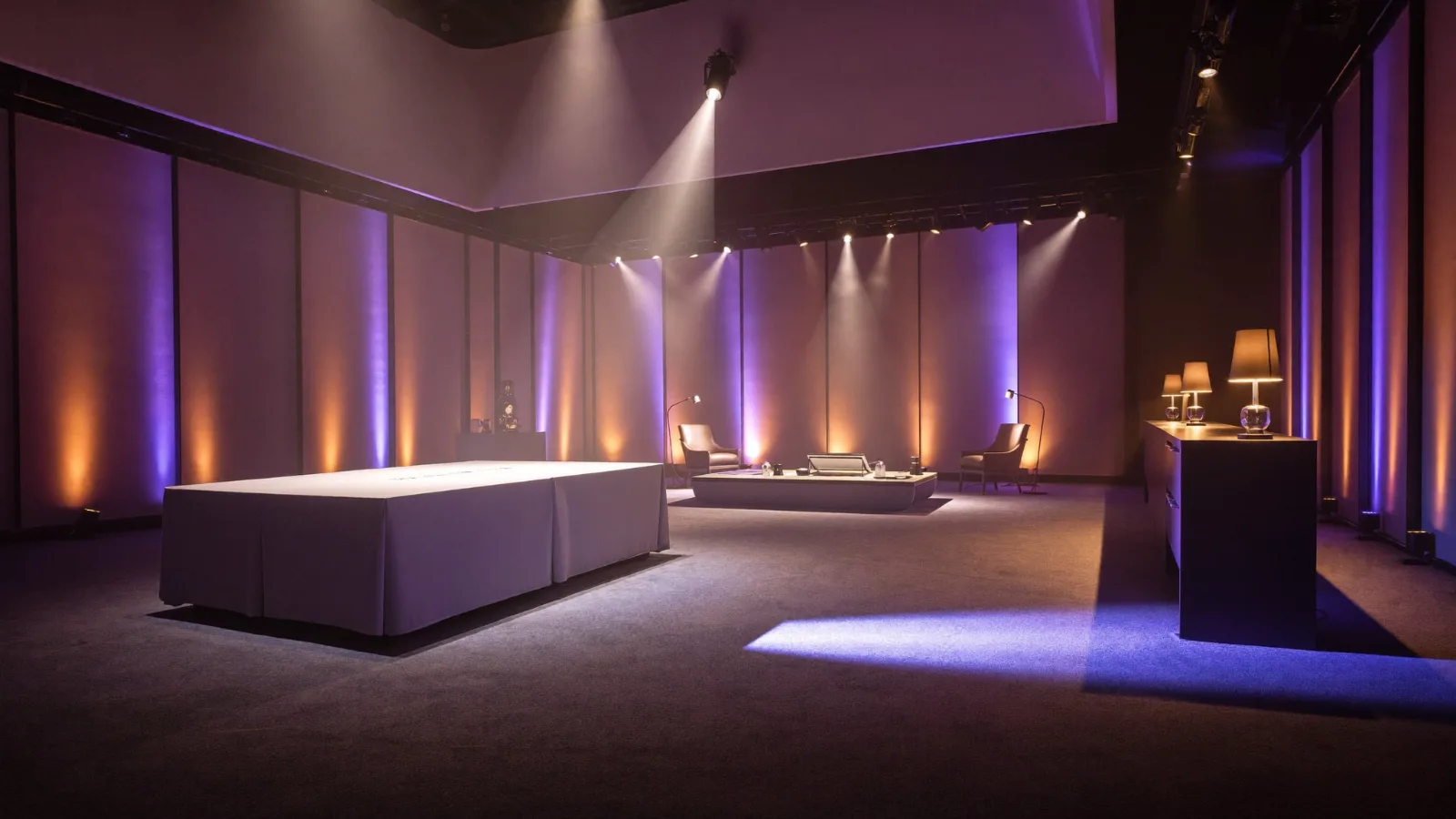
Guests at a launch party enjoy the evening. Guests at a media preview are working. They have a deadline, a camera or a laptop, an editor waiting and a rule about when they may publish. A room built for the first group frustrates the second, and the second group decides what the world reads about your product.
This guide covers the media preview from the side of the team that builds the room: who comes, how the embargo is run, what the space has to contain, how creators and journalists share it and what editors need afterward. External sources are summarized from their own pages, read in November 2026, and can change. We leave out costs on purpose. Every estimate depends on scope, and none is ever set in advance.
What is a media preview event, and how does it differ from the launch?
A media preview is a press-only event held before a launch goes public, where editors, photographers and creators see the product and the space under an embargo, meet the people behind it, and leave with the images and facts they need to file on time. It is smaller than the launch, it comes first, and it exists to produce coverage and content, not goodwill.
It is also not a press conference. A conference is one statement and a round of questions for assembled press. A preview is a room the press move through, with the product, the people and time to work. Most launches use four formats, and each asks something different of the build.
| Format | Who it is for | What it is for | What the room must do |
|---|---|---|---|
| Media preview | Accredited press, then creators | First look, interviews, the story | Give a clear shot of the product, quiet for interviews, a place to file |
| Press conference | Assembled press | One statement and questions | A stage, microphones, a position for cameras |
| Launch night | Invited guests, partners, VIPs | The celebration and the reveal | Carry a program and a crowd |
| Public day | Customers and the neighborhood | The doors open for good | Handle a line, then settle into a working space |
Trade shows run their own press calendars. The New York International Auto Show's media page describes Media and Industry Days ahead of its public days, with registration required. CES's media inquiries page says its media list becomes available to exhibitors on December 1 through the exhibitor dashboard. If your launch falls in a show week, our guide to CES week in Las Vegas shows how a brand's own press moment fits around that calendar. A preview outside any show has no calendar to borrow, so it is built as its own room.
A press preview is also one phase of an opening, and our guide to grand opening events places it between a soft opening and the public day. Our product launch and pop-up production team plans the preview and the public moment as one environment, not two builds.
Who do you invite, and what does each guest need?
Invite editors and reporters, photographers and video crews, creators and, sometimes, analysts, and design the room for what each of them has to deliver. Their needs differ more than their invitations do.
| Guest | What they are there to get | What they need from the room |
|---|---|---|
| Editor or reporter | Facts, quotes, a point of view | A spokesperson, a quiet corner, an accurate fact sheet |
| Photographer or video crew | Clean, original frames | A clear line to the product, controlled light, time without a crowd |
| Creator | Content in their own voice | Something to handle and film, good light, a plain brief on what to post and when |
| Analyst or trade press | Detail and context | Specifications, a technical lead, time for follow-up questions |
Accreditation is the process of confirming that a guest is who they say they are and works for the outlet they name. The Washington, DC Auto Show's media page says credentials go to qualified journalists working in print, broadcast or web. Media attending without charge must focus solely on reporting about the event and must accurately identify their name and publication at registration, and the press room asks for photo ID and inspects bags and equipment. CES addresses media, analysts and creators as separate groups, and says media who meet its qualifications register at no cost.
For production, the door of a media preview is a check-in desk with a named list, not an open entrance. Decide in advance who the brand's PR lead will vouch for, and whether creators share the room with journalists or take a parallel slot. Each has a deadline and a format, and the room should not rank one above the other. If creators are on the list, build one station for them; our guide to immersive photo experience design explains how to make a station that is built for shooting.
How is the embargo run in the room?
An embargo is an agreement that coverage waits until a set date and time. In the room it needs a written opt-in, one named person holding the clock, and assets that can be released at the lift and not before.
PR Newswire's article How to Use Embargoes, Exclusives and Timing Effectively in PR describes an embargo as a deal where a journalist gets news early but promises to wait to publish. It advises asking a journalist whether they want embargoed news before sending it, and sharing the full story only after they accept, which creates a written record. It says to label the embargo date, time and time zone clearly, and to include clear photos, leader bios and fact sheets, with leaders available for interviews. It also separates an embargo from an exclusive: an exclusive gives a single outlet the story, while an embargoed release shares the same news with many outlets under a time restriction.
Those are PR practices. The room has to carry them out. Our product launch page lists embargo-grade security as closed-studio fabrication, NDA-protected production processes and controlled installation protocols for embargoed launches. In practice, the product is built in a closed shop, the install crew works under a non-disclosure agreement, and the room is closed to anyone who is not on the list.
Four decisions belong to the PR lead and the producer together:
- When the embargo lifts. At the end of the preview, at a fixed time that night or the next morning. The story and the outlets decide, so settle it with the PR lead.
- Where the time is printed. The time and time zone go on the check-in card, the first page of the fact sheet and the asset folder.
- Who releases the assets. One person, with the folder locked until the lift.
- What happens if someone breaks it. Agree in advance who calls whom.
Pro Tip: Print the embargo time, with its time zone, on the check-in card and on the first page of the fact sheet. The agreement was made in an email weeks ago. The room is where people forget it.
What does the room need? Build it as six zones
A media preview room works as six connected zones: check-in, the hero view of the product, hands-on stations, interview corners, a filing space and an exit that leads back past the product. Each zone has one purpose, and each has a typical way of going wrong.
| Zone | What it is for | What to build | What goes wrong |
|---|---|---|---|
| Check-in | Accreditation, badges, the embargo card, the assets link | A named-list desk, a clean backdrop, space for a short queue | A queue in the doorway; guests handed paper they will not carry |
| Hero view | The first sight of the product and the photograph | One clear line, controlled light, a defined shooting position | A crowd in every frame; a sponsor's banner behind the product |
| Hands-on stations | Touching, testing and filming the product | Retail-grade fixtures, power, a staffed host | One product and a crowd of photographers |
| Interview corners | Quotes and one-to-one conversations | A quiet space inside the room, sound control, a soft frontal light on faces | Interviews held beside the music or the demo |
| Filing space | Writing, uploading, calling in | Seating, power at every seat, a network that is ordered, not assumed | No power; shared guest wifi |
| Exit | The last impression | A route back past the product, one contact for follow-ups | Guests leaving through the loading area |
The hero view
The hero view is where the photograph is taken, so protect it first. Give it one clear line from a marked shooting position to the product, with controlled, consistent light. Stagger photographers in short slots so each gets a clean frame instead of letting everyone shoot at once. Our guides to building the reveal and designing for the camera cover how the product is staged and lit.
Interview corners and the filing space
Sound matters as much as light. An interview corner beside a demo is a corner nobody can use, so build it behind a partition, away from music and speakers. Give it a soft, frontal wash of warm light at the same color temperature as the hero view. Color temperature is measured in Kelvin: lower numbers are warmer, higher numbers cooler. Matching it keeps skin tones and the product consistent when footage is cut together.
The filing space is the least glamorous zone and the one editors remember. Give it seating, power at every seat and its own internet connection, ordered for the job and not borrowed from the guest network. Put the connection in the technical rider, the document that lists what the production needs from the venue; our guide to the technical rider explains what to include.
What our case studies show, and what they do not
Neither of these projects was a media preview, and we do not claim they were. They are lessons about building for the lens.
The Barbie Dream House at Cipriani was a two-story structure for 500+ guests, engineered to be walked through and photographed from every angle, installed in a single load-in window and struck in under eight hours. A built environment can be designed so the press can shoot it from any side, and it can leave in one night. In Montauk, the mirror-clad façade we built for Delilah x Chase was an engineered paneled system that read as one continuous surface at photographic distance. Surfaces the press photographs must be finished for the lens, not the walkthrough. Both are the work of our experiential event design team.
Pro Tip: Walk the room as an editor with a laptop, a photographer with a lens and a creator with a phone, in that order, before you approve the floor plan. Each of them will find a problem the others did not.
What does the run of show look like for a press preview?
A media preview is shorter and looser than a launch night: guests arrive in a window, see the product early, hear a short statement, get hands-on time and book interviews, and the embargo lift is the last cue. The run of show is the cue-by-cue script every department works from, and our guide to writing a run of show explains how to build one.
A typical order:
- Arrival window and check-in, with the badge and the embargo card. The asset link is live but locked.
- Product view before any speech, so photographers get the clean frame while the room is empty.
- A short statement from the spokesperson, short by design.
- Hands-on time at the stations.
- Interview slots, booked at check-in against the number of spokespeople.
- The hero photograph window, staggered.
- Filing time.
- The embargo lift, one called cue from the person who holds the clock.
- The exit, past the product, with one contact for follow-up.
Large shows publish a media and industry schedule, and a preview deserves the same detail at a smaller scale. Our own launch process names press and VIP flow management as a step. We give no durations here, because the run of show decides them for your product and guest list.
How do you host creators and journalists in the same room?
Give both the same access and a different brief. Journalists report on their own terms. Creators who receive early access, products or hospitality have a connection to the brand that the audience may not expect, and the FTC's Endorsement Guides say that connection must be disclosed clearly and conspicuously.
The relevant text is 16 CFR 255.5, which the eCFR showed as up to date as of November 13, 2026. It says a connection that might materially affect the weight or credibility of an endorsement, and that the audience does not reasonably expect, must be disclosed clearly and conspicuously. Free or discounted products count whether or not the advertiser requires an endorsement in return, and so does early access to a product. One example covers a manufacturer that sends a product to an influencer: it should advise the influencer at the time that the connection should be disclosed, and have reasonable procedures to monitor the postings.
These are guides, not a statute, and this is production guidance, not legal advice; check the current rules with counsel before you finalize invitations. What the room can do is make the disclosure easy:
- Put a short disclosure note on the creator's invitation and again on the check-in card.
- Add a plain line to the creator brief on how to say it, in the creator's own words.
- Build monitoring into the asset plan, so someone watches the posts after the lift.
For journalists, ask each outlet whether it has a policy on gifts and hospitality before you offer anything; we make no claim about what any newsroom's policy says. Do not script creators beyond the disclosure and the embargo time. Audiences notice a script.
What do editors need after they leave?
They need the assets, the facts and one person to call: embargo-cleared photographs and video, captions, a fact sheet, leader bios, and a spokesperson reachable at the lift. PR Newswire's article says a full kit gives a journalist time to write and improves accuracy, so have it ready before the doors open.
The practical version is a short list agreed with the PR lead before the day:
- A shot list for the brand's own photographer: the hero shot, hands-on frames, the people and the details.
- Captions written beforehand and checked afterward.
- One folder, with the embargo time and time zone on the first line.
- One named person to call.
The room's work ends when the assets are delivered, not when the doors close. The environment can then carry into the invited night or the public day, with the press zones struck or converted.
Coverage is the PR lead's to measure, and we do not claim to deliver it. Our part is the room and the assets. We run post-event surveys and deliver a results report for events we produce, and our guide to event ROI explains how to design an event so it can be measured.
How long does it take, and what has to stay secret?
Count back from the public date. Our product launch page says focused launch experiences with custom-built environments typically take 6 to 10 weeks from approved concept to launch day, and large multi-room launches take 10 to 16 weeks. It adds that embargoed launches may need additional security and logistics planning.
The countdown for a preview runs in this order:
- Concept and the guest list, then drawings and approvals.
- Closed-studio fabrication in our custom event fabrication shop.
- A test assembly in the shop, so a panel that does not fit costs an afternoon, not the install window.
- Installation under a non-disclosure agreement.
- A rehearsal that runs from check-in to filing.
- The preview, then the embargo lift.
- Strike or conversion for the public day.
A short schedule can still work when decisions are made early. Café de Colombia at the San Diego Convention Center was designed, built and delivered in fourteen days for more than 3,000 attendees, and installed on the floor in under a day. That was a trade show activation, not a preview, but the sequence is the one a tight preview asks for.
Pro Tip: Schedule a dress rehearsal with the real product under cover, the real light and the real spokespeople, and walk a mock editor from check-in to filing. Everything a press preview depends on can be tested the day before. None of it can be fixed during.
Why work with a full-service production company on a media preview?
A media preview asks one team to keep a secret, build a room that works for four kinds of guest, run an embargo clock and deliver assets. Those tasks break when they sit with separate vendors, because nobody owns the moment a photograph leaks.
Geo Events brings more than 15 years in event production and more than 200 events built in-house. The same team designs, fabricates, installs and runs the room, under closed-studio protocols when a launch needs them. That is what full-service event production means for a preview: the people who built the room are at the check-in desk when the first editor arrives. The model runs through our brand activations and starts in our New York studio, where we design and build before anything ships.
Tell us what you are launching, the date and who needs to see it first, and we respond within one business day with a production scope and next steps.
Frequently asked questions
What is a media preview?
A media preview is a press-only event held before a launch goes public. Editors, photographers and creators see the product and the space under an embargo, meet the people behind it and leave with the images and facts they need to file on time. It is usually smaller than the launch and comes first.
What are some examples of media events?
Common formats include a press conference, a product or media preview, a media and industry day at a trade show, and a studio or factory tour for press. Shows such as CES and the New York International Auto Show publish their own media calendars. These are formats, not a ranking, and each asks something different of the room.
What is the difference between a press preview and a press conference?
A press conference is one statement and a round of questions for assembled press, so the room is built around a stage, microphones and camera positions. A press preview is a room the press move through, with the product, interviews and time to file, so it needs stations, quiet corners and power.