
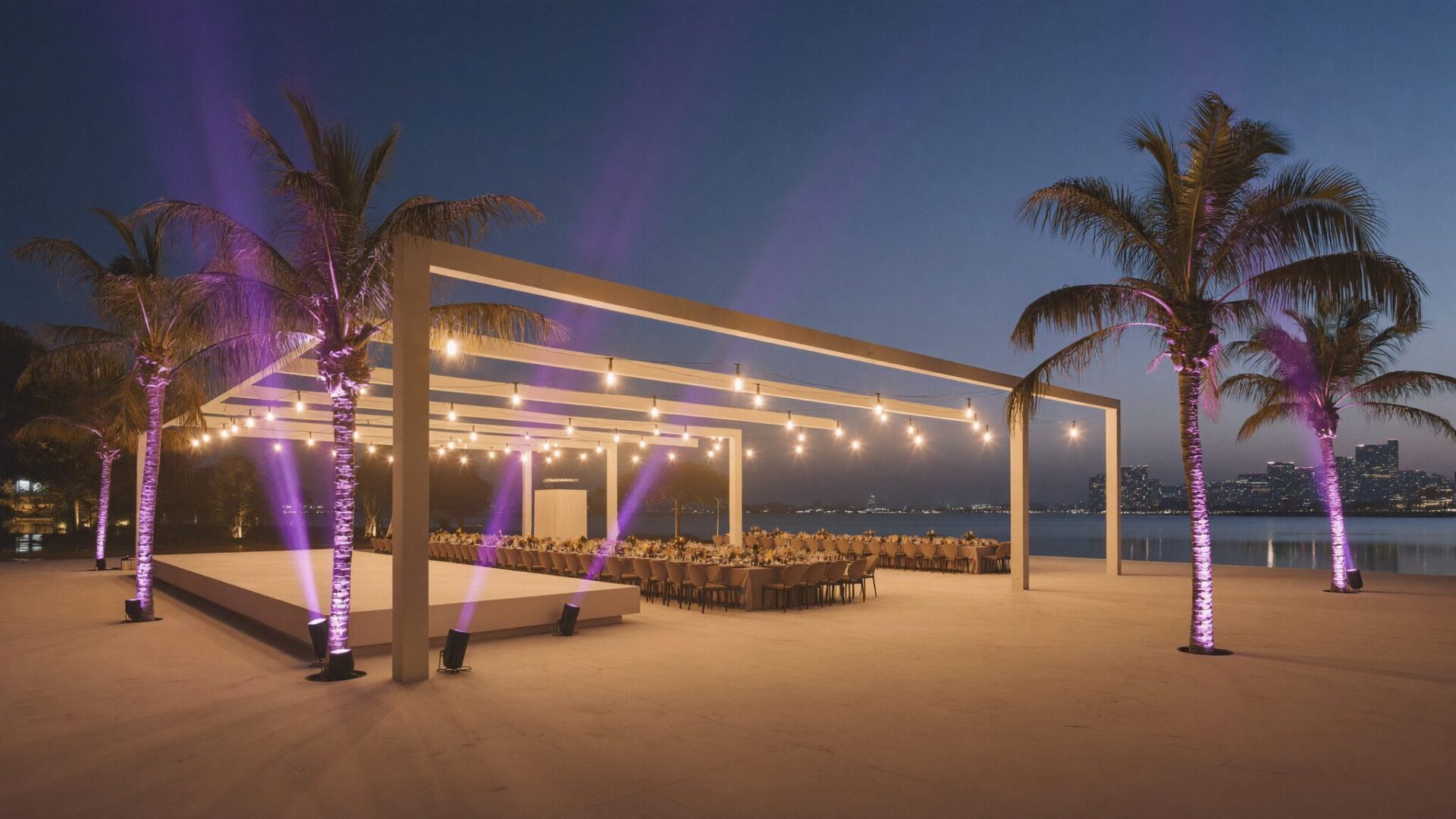
Corporate event venues in Miami sell the view, and they are right to. But in Miami the weather a room lets in decides more of the build than its square footage does, and this winter that deserves more thought than usual. A sealed ballroom, a glass pavilion and an open lawn are three different production problems, even at the same guest count.
This guide sorts Miami venues by exposure, meaning how much sky each room has. It is written from the side of the team that designs, builds and installs the event. Venue facts come from each venue’s own pages, or from the cited tourism and city pages, read on November 16, 2026. They change, so confirm them with the venue’s event team. We leave out prices, fees and food and beverage minimums on purpose: the venue’s sales team is the only reliable source for them.
How do you choose a corporate event venue in Miami?
The right Miami venue for a corporate event depends on how much sky the room has: a sealed hall or ballroom keeps rain and wind out of the program, a covered or glass room keeps most of it out, and an open lawn, rooftop or waterfront gives you the setting and takes on the weather, so the build and the rain plan are designed for the exposure you choose.
That sets the order of decisions. Choose the exposure first, then the room, then what you build in it, then the rain plan. Guest count narrows the list less than planners expect, because a room that seats 300 is easy to find in Miami and a room that lets you run a stage, screens and a dinner through an afternoon thunderstorm is not. It is also where we start when a client brings us event production in Miami.
| Exposure | Rooms from published pages | What the weather can reach | What it asks of the build |
|---|---|---|---|
| Sealed | Miami Beach Convention Center ballrooms and halls; Faena Forum’s two exhibit halls | Almost nothing inside; the load-in path and the guests’ arrival | Build to indoor standards, plan the dock and a covered arrival, ask about exclusive vendors |
| Covered or glass | Miami Ironside’s Glassbox glass pavilion; the Sunset Vista Ballroom veranda and Grand Ballroom terrace at the convention center | Sun, glare and heat through glass; wind and rain at the open edge | Control light on screens, keep screens off the open side, plan an inside fallback |
| Open air, roof optional | Miami Ironside’s Lemon Grove garden and outdoor stage; Pride Park at the convention center | Rain, wind, sun, lightning | A roofed or tented centre for the program, ballast, a named call time |
| Open water or roof | The terrace at Rum Room over Collins Canal; any waterfront or rooftop room | All of it, plus stronger wind at height | Engineered ballast, marine-grade finishes, the strictest rain plan |
What does Miami’s weather actually do to an event?
In Miami the calendar problem is rain, not heat. Monthly average highs sit between 76 and 91 degrees all year, while average monthly rainfall runs from under two inches in January to more than ten inches in June and September, according to NOAA’s 1991-2020 climate normals for Miami International Airport.
| Month | Average high (°F) | Average low (°F) | Average rain (in) | What it means for an event |
|---|---|---|---|---|
| January | 76 | 61 | 1.8 | Dry on paper; carry a rain plan this winter |
| February | 78 | 63 | 2.2 | Same |
| March | 81 | 66 | 2.5 | Peak demand; Miami Beach treats March as a High Impact Period |
| April | 84 | 70 | 3.4 | Drier and warming; the first two weeks are also a High Impact Period |
| May | 87 | 73 | 6.3 | Rain roughly doubles from April |
| June | 89 | 76 | 10.5 | Wettest month; hurricane season opens June 1 |
| July | 91 | 78 | 7.4 | Heat and storms together |
| August | 91 | 78 | 9.6 | Same |
| September | 89 | 77 | 10.2 | The Atlantic hurricane season peaks on September 10 |
| October | 86 | 74 | 7.7 | Still wet |
| November | 81 | 68 | 3.5 | Rain falls back; the season ends November 30 |
| December | 78 | 64 | 2.4 | High season opens |
Computed from those same monthly normals, December through April holds about 12 inches of rain across five months. May through October holds about 52 inches across six, roughly three-quarters of the year’s rain once all twelve months are counted (November adds another 3.5 inches). That is the gap a planner is really choosing between when picking a date.
Lightning does not follow the calendar as neatly. The National Weather Service lightning safety page says lightning strikes the United States about 25 million times a year, that most of it comes in summer, and that people can be struck at any time of year. A winter program in Miami still needs someone with the authority to move it indoors.
Pro Tip: Read the rain column before the room column. A terrace that is perfect in February is a different bet in June, and moving the date is often the easier change.
What does a stormier dry season change for a winter event?
This winter’s dry season is forecast to be wetter and stormier than normal, so a December to April program should carry a rain plan for the moment that matters most. An outlook is a probability, not a forecast for your date, but it is a reason to stop treating Miami’s winter as a guaranteed dry window.
The National Weather Service office in Miami carries the headline “Dry Season 2026-2027 Outlook for South Florida: Wetter and Stormier” on its site as of November 16, 2026. Read the full outlook there before you lock a rain plan.
The reason is a strong El Niño in the Pacific. In its seasonal outlook discussion of October 15, 2026, NOAA’s Climate Prediction Center says the event continues to strengthen and gives an 80 percent chance that at least a strong El Niño lasts through January to March 2027. For November through January it says the greatest likelihood of wetter-than-normal conditions is in the Southeast and Florida, and it favors above-normal temperatures for south Florida. The same discussion calls the Atlantic hurricane season “well below” normal so far this year, which is one more reason winter, not storm season, is the risk to plan for now. The Center issues its next monthly outlook on November 19, 2026.
What to do about it is production guidance, not forecasting. Give the moment that matters, whether the reveal, the toast or the stage, a roof or a sealed room. Keep a covered arrival so guests do not stand in a downpour at the door. Set a call time for the weather decision, covered in the storm clock section below. Our notes on seasonal venue transformations show how a space can be rebuilt for the season it is actually in, and our guide to wind and ballast on outdoor structures covers what an open site demands of the build.
What can you build in a sealed room?
In a sealed hall or ballroom the weather leaves the program alone, so the questions become the dock, the exclusive vendors, the ceiling and the arrival. Miami has two clear examples on Miami Beach, and hotel ballrooms fill in the rest.
Miami Beach Convention Center. The figures below come from a Greater Miami and Miami Beach tourism article dated March 11, 2024, so confirm them with the center. It describes 500,000 square feet across five stories, with Exhibit Hall ABCD at 491,651 gross square feet of contiguous space and a Grand Ballroom of more than 60,000 square feet including pre-function areas and an outdoor terrace. Four junior ballrooms range from 12,194 to 19,714 square feet, there are 84 breakout rooms, and two loading docks offer dozens of dock spaces. Food and beverage is managed exclusively by Sodexo Live!, and the article says critical building systems are raised above flood-level requirements.
Faena Forum. According to Faena’s Faena Forum page, the Rem Koolhaas and OMA building offers 43,000 square feet of flexible space: two exhibit halls that combine into one, a 2,900 square foot rose marble amphitheater and five meeting rooms, for up to 1,000 guests. The page lists conferences, banquets, product launches and “grand unveiling” among its uses.
Hotel ballrooms. We have not listed hotel capacities, because room configurations change and the hotels publish their own. Ask each one four things before you sign: the in-house AV terms and what outside production requires, the ceiling height and rigging points, the freight elevator size and dock hours, and the turnover time between functions. Ask for the hotel’s storm closure policy as well. A technical rider sent to each shortlisted hotel answers most of this before a site visit, and our guide to the technical rider explains what to include.
A sealed room still has to be made to look like your event. The closest proof of zoning one big room is VTEX at The Glasshouses, a New York project, not a Miami one: fabricated dividers, lighting shifts and furniture turned one open-plan volume into a keynote stage, networking areas and breakouts for more than 350 attendees. Our executive meetings and summits team and our set and stage design team do that work, and our guide to convention center activations covers the show-floor rules that come with a hall this size.
How does a covered or glass room change the plan?
A glass pavilion or a veranda gives the room its view and daylight, and the producer’s job becomes controlling glare, heat and the open edge. The room is protected from rain overhead and exposed in every other way.
Miami Ironside is the clearest example. According to its event venues page, the Glassbox glass pavilion holds 250 people, 200 seated, in 4,000 square feet, and The Event Space is a two-story loft for 400 standing and 300 seated in 10,000 square feet. The campus has in-house catering and what the page calls direct loading access for staging, scenic and custom builds, and extra load-in, build and strike days can be added to most bookings. Ironside’s page places it in Little River, Miami, on the mainland and not on Miami Beach, so the Miami Beach permit rules later in this guide do not apply to it. The local jurisdiction has its own. At the convention center, the 2024 article describes the Sunset Vista Ballroom as drenched in natural sunlight with a veranda, and the Grand Ballroom with an outdoor terrace.
Four production points follow from glass and daylight:
- Screens lose contrast. An LED wall, the panel screen built from tiles of lit modules, fades in daylight and through glass. Push content and reveals to after sunset, or put screens on the side with no glass.
- Dark scenic surfaces take sun. They heat and show every fingerprint. Finish and colour are chosen with the afternoon in mind.
- The open edge is for guests, not the stage. Wind and spray reach it first.
- Rain on glass is loud. It carries to a microphone and into a recording, so speeches belong at the far side or under a solid roof.
A New York rooftop shows how a covered space still needs care at its edges. At Magic Hour Mountain Lodge at the Moxy, shop-built faux log cabin walls wrapped the dining tables, installed without modifying the rooftop. That was Manhattan, not Miami, but the lesson travels: stand the build on its own feet. Our guides to designing for the camera, event lighting design and building on a rooftop go deeper on each point.
What changes when the room is open air, water or roof?
Open air gives Miami its best photographs and takes on all of its weather, so the structure is engineered for wind, the finishes for sun and salt, and the program for an inside fallback. The open venues are the ones where the rain plan is the design.
According to the 2024 tourism article, Miami’s open rooms include Pride Park, the six-acre lawn and plaza on the convention center campus, and the Rum Room terrace over Collins Canal. The restaurant’s dining room hosts events for 48 guests, the adjoining Venu space up to 100, and the terrace seats 50 more. Ironside’s page lists the Lemon Grove open-air garden at 200 guests and an outdoor stage for 150 standing or 80 seated, and says outdoor spaces follow local noise ordinances, with amplified-sound timing confirmed for each date.
Our Miami production notes say heat and humidity call for climate-controlled tenting, weatherproof fabrication materials and backup plans, and that we specify marine-grade finishes and UV-resistant graphics for outdoor installations. Marine-grade means finishes and fasteners chosen to survive salt air. On a roof, add height: the National Weather Service’s Miami hurricane safety page notes that hurricane winds are stronger at higher elevations, which is the same logic that makes a rooftop stage a different wind problem from a ground-level one.
The wind logic is the one every open site follows: open frames, segmented panels, mesh, wide bases and ballast hidden inside the base. Ballast is dead weight added so a freestanding piece stays upright without fixing it to the ground. We proved it on sand at White Claw Sessions at The Surf Lodge in Montauk, where mirror-finish letters stood beside Fort Pond and every piece was resolved in our shop for sun, salt and wind before it travelled. That was Montauk, not Miami. For a living environment that has to survive heat and humidity, see our tropical celebration at Glen Oaks on Long Island, where living and preserved foliage was built into the scenic structures, and our guide to living tropical environments. For water-edge planning, our piece on waterfront venues covers the questions that carry across coasts, and our private dinners and celebrations team applies them to smaller rooms.
For any beach program, the City of Miami Beach’s guidelines add one more layer. They say additional restrictions apply from April through October 31 under the State of Florida’s marine turtle guidelines, and that state Department of Environmental Protection permits may be required throughout the year. Ask about lighting and equipment early, because those rules shape what you can place on sand.
Pro Tip: Put the moment that matters under a roof or a sealed edge and let the open air carry the arrival and the after-dinner hour. Guests remember the sunset, not the keynote they sat through in the wind.
What is the storm clock?
Tropical storm and hurricane watches and warnings are time windows, and an outdoor build should be planned so its strike time fits inside them. Strike is the dismantling and removal of everything you brought in.
The National Weather Service’s Miami page defines a watch as tropical storm or hurricane conditions being possible within 48 hours, and a warning as those conditions being expected within 36 hours. The National Hurricane Center’s climatology page says the Atlantic season runs from June 1 to November 30, that an average season from 1991 to 2020 has 14 named storms, seven hurricanes and three major hurricanes, that the first named storm typically forms in mid to late June, and that the season peaks on September 10.
| Signal | What it means (source) | What the program does (our production guidance) |
|---|---|---|
| Tropical storm or hurricane watch | Conditions possible within 48 hours (National Weather Service) | Call the weather meeting, stop adding outdoor install, confirm the inside fallback |
| Tropical storm or hurricane warning | Conditions expected within 36 hours (National Weather Service) | Outdoor elements come down and are secured; guests and vendors are told |
| Lightning | Can strike at any time of year (National Weather Service) | A named person has the authority to move the program inside without a committee |
Write the call time and the name of the person who makes it into the run of show, the cue-by-cue script every department works from. The decision that is easy at noon is hard at 6:30 with guests arriving. A site survey before design locks tells you where the inside fallback is and how long it takes to reach. Outside November to May, the plan is different, not closed. Many programs move indoors or to covered rooms in the wet months.
When does the City of Miami Beach need to know?
A corporate event inside a hotel or other commercial venue often needs no special event permit, but temporary structures, open flame, parking or City services trigger one, and the City asks for 30 to 60 days’ notice on private property. This section covers Miami Beach only. Other cities and Miami-Dade County have their own rules, so ask the venue which jurisdiction you are in.
The City’s special events guidelines set out the rules, and the special events page repeats the key clocks. In plain terms:
- A special event permit applies to events on public property or on private commercial property that exceed temporary occupant load, erect temporary structures over a threshold or need City services such as police, fire or parking.
- The guidelines list what they call customary uses for hotel properties that do not need a special event permit. They include awards functions, networking events, fundraisers, charity events, incentive group functions, corporate group functions and convention group functions, press conferences and product announcements. The test is recurring activity that is typically not open to the general public and is customary and incidental to the property’s use.
- On private property, the City asks for 60 days’ notice if the event needs temporary structures or building permits, fire department involvement such as open flame, City parking spaces or City services, and 30 days’ notice if it needs none of those.
- On public property, an event of 150 people or more that needs City services applies 90 days before the first day of load-in.
- Permits are only issued on private property in facilities with a current Certificate of Occupancy or a Temporary Certificate of Occupancy, the document that says a building may legally be used for its purpose. They cannot be issued to any property in a single-family residential zoning district, which matters for estates.
- March and the first two weeks of April are High Impact Periods, when applications need City Commission approval.
The clock runs early. The City’s page notes that the deadline to submit applications for Art Week Miami Beach was August 28, 2026, which shows how far ahead a December permit has to be filed. We do not quote fees here; the City publishes them and adjusts them each year. This is a summary of published rules, not legal advice. Confirm your event type with the City and the venue before you commit. Our overview of event permits and insurance explains how the layers fit together.
How does a New York build get to Miami?
We design and fabricate in our New York studio, ship by climate-controlled freight, and travel to Miami for the survey, installation and on-site production management. Our Miami page gives standard transit as three to four days and says crating and shipping are built into every timeline.
Those days sit inside a longer schedule that runs back from the venue’s load-in window: design approval, shop drawings, fabrication, a test assembly in the shop, crating, freight. A test assembly is the step where the whole build is stood up once before it ships, so a panel that does not fit costs an afternoon in the shop, not the install window. Our custom event build timeline and installation and strike guide cover each stage. Ask each venue about delivery: Ironside lists direct loading access and the convention center’s article lists two loading docks, so ask each venue and the City about delivery hours and alley or dock rules.
We have built for an out-of-town convention center on a short clock. For Café de Colombia at the San Diego Convention Center, a 40 by 20 foot activation with a coffee bar and two tasting zones was designed and built in fourteen days and installed on the floor in under a day. That was San Diego, not Miami, but the sequence is the one a Miami hall asks for, and it is the work of our custom event fabrication shop.
Pro Tip: Count freight and a test assembly back from the venue’s load-in window, then count the permit clock back from the first load-in day, not from the event. On Miami Beach that clock is 30 to 60 days on private property, and longer on public land.
Why work with a full-service production company in Miami?
One team that designs, builds, ships, installs and runs the program keeps the exposure, the storm clock, the City’s clock and the dock in a single plan. When separate companies handle the scenic, the freight, the permits and the show, nobody owns the day the forecast changes.
Geo Events brings more than 15 years in event production and more than 200 events built in-house. Our Miami production team assesses venues for production feasibility, load-in and fit with the design before you sign, and the same people who walked the room are the ones at the dock when the truck arrives. That is what full-service event production means in practice, and it runs through our brand activations and our executive programs alike. If your program is a gala in Florida’s winter season, our guide to Palm Beach gala production covers the neighbouring market.
Tell us your dates, guest count and the Miami venues on your shortlist, and we respond within one business day with a production scope and next steps.
Miami venue questions we hear often
What is the best time of year for a corporate event in Miami?
December to April has the least rain, about 12 inches across five months in NOAA’s normals. But National Weather Service Miami’s 2026-27 outlook says this dry season is expected to be wetter and stormier than normal, so plan for rain. June to October is the wet season.
When is hurricane season in Miami?
The Atlantic season runs from June 1 to November 30, and the National Hurricane Center puts the peak on September 10. An average season has 14 named storms, seven hurricanes and three major hurricanes.
Do you need a permit for a corporate event at a Miami Beach hotel?
The City lists corporate group functions, awards functions, networking events, press conferences and product announcements among the customary hotel uses that do not need a special event permit. Temporary structures, open flame, parking or City services can change that. Confirm with the hotel and the City.