
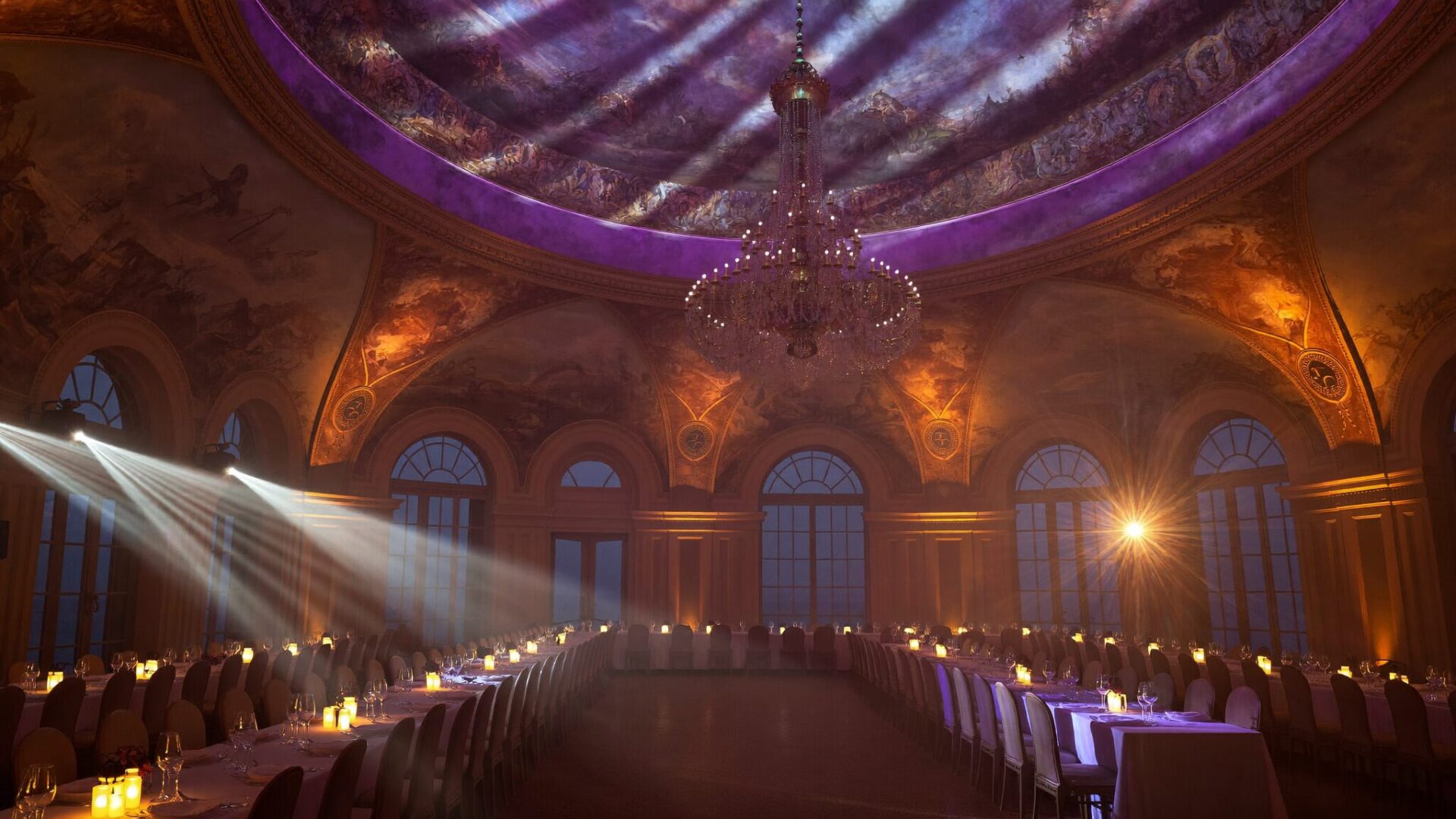
A Palm Beach gala stands apart when its production is designed for the room it is in: lighting and scenic that work with ballrooms guests have seen many times, one built moment they have not seen, and a schedule that respects the island’s season, its three bridges and its venues’ back-to-back winter calendars. That is the short answer. The rest of this guide is the producer’s version of it, written for gala chairs, development directors and the planners who work with them.
Gala planning in general is covered in our guides to planning a corporate gala and nonprofit gala planning. This one is narrower. It covers what changes when the benefit happens on the island during the season, and what it takes to bring a New York design and fabrication team in for event production in Palm Beach.
What is the Palm Beach gala season?
In our planning, the Palm Beach season runs from November through April, and the charity gala circuit peaks from January through March. Those are the months when the island’s population, its social calendar and its ballrooms are all at their fullest, and when a benefit committee competes hardest for dates, rooms, vendors and guests’ attention.
The major benefits publish their dates a season ahead, and many committees book their venue a year out. By the time a chair calls a production company, the date and the room are usually settled. The open questions are different ones: how the evening will look, how the program will run and whether the build can get onto the island in time.
The season creates a specific design problem. The same few rooms host benefit after benefit through the peak months, and the same guests often attend several of them. A guest at a February gala may have sat under the same chandeliers twice already that winter. Whatever your evening does, it is being compared with the last three they attended, in the same space.
Why do so many Palm Beach benefits look alike?
Palm Beach benefits look alike because they share rooms and they share defaults. The venue’s standard setup, a centerpiece on every round, a wash of colored uplight on the walls and last year’s plan carried forward by a committee with little time: each choice is reasonable alone, and together they produce an evening guests have already seen.
The architecture is not the problem. The frescoes, the chandeliers and the ocean windows are why the room was booked. The problem is a default production placed inside it. Our approach is to design with the room rather than against it. The fixed elements stay. What changes is everything that can: the light, the arrival, the stage and auction wall, and the landscape of the tables.
We have done this in New York inside one of the city’s most formal interiors. For the Roivant holiday gala at the New York Public Library, a corporate celebration for more than 400 guests, the design did not compete with the Beaux-Arts building. We used warm downlight on the tables, amber washes on the lower walls and subtle uplight on the ceilings to lower the perceived ceiling height and bring the room down to guest level, all under strict preservation requirements. Palm Beach’s grand rooms raise the same question in a different style: how to make a monumental space feel like your evening and nobody else’s.
Pro Tip: Ask the venue for photographs of the last three benefits held in your room, then give them to your designer as a list of what not to repeat. It is the quickest way to see the defaults your guests already know by heart.
How do you produce inside a landmark resort ballroom like The Breakers?
You plan around what the room will not let you change. In a historic resort ballroom, the chandeliers and painted ceilings fix the sightlines and limit where anything can hang, the hotel’s own event team holds part of the scope, and the room’s calendar sets how long you have to build. The Breakers is the clearest example on the island.
The resort describes itself as 130 years old on its venues and floor plans page, which also lists the ballrooms below. The descriptions come from that page. The Breakers does not publish capacities there; dimensions sit in a downloadable venue list, so confirm capacities with the resort directly.
| Room | Size and ceiling (as published) | Character | What it means for production |
|---|---|---|---|
| The Circle Ballroom | 30-foot domed ceiling, 15-foot windows | Eight oval fresco murals; a Venetian crystal chandelier under a gold-leaf sunburst | The dome is the centerpiece. Light it softly and keep tall décor away from the sightline to it. |
| Venetian Ballroom | 9,600 sq ft, 24-foot ceiling | Six chandeliers, floor-to-ceiling windows over the ocean | Plan lighting states for the change from daylight to dark, and decide what the windows show after sunset. |
| Mediterranean Ballroom | Over 6,100 sq ft | Venetian-style chandeliers, 15-foot arched windows onto the Mediterranean Courtyard | The courtyard can carry the arrival or cocktails, so the ballroom reveal happens at the door. |
| Ponce de Leon Ballroom | 15,000 sq ft, divisible into six sections | Nine crystal chandeliers, an 8,000 sq ft foyer, next to the Ocean Lawn | Large enough for a full stage, screens and an auction program; the foyer suits an arrival build, the lawn an indoor-outdoor evening. |
Three production questions come up in every room like these. The first is rigging. Chandeliers and painted ceilings limit what can be suspended, so scenic usually stands on the floor as freestanding, self-supporting pieces, and lighting comes from floor positions, truss towers or approved points. Our guide to builds that leave no mark covers the protection methods a landmark room expects.
The second is scope. A resort’s event team typically handles logistics, seating and the room’s own lighting and AV. Agree in writing where its work ends and the production company’s begins, before the design is drawn, so nobody discovers an overlap on load-in day. The third is time. In peak months a ballroom may host an event the night before yours and another the night after. Ask for your exact access window, then design to it. Our article on load-in at historic venues explains how we sequence a build into a short window.
What changes in a museum, a performing arts center or a private estate?
Each venue type moves the constraint somewhere new. A museum protects its collection, a performing arts center works through its own events and hospitality team, and a private estate has no event infrastructure at all, so power, flooring, structures and neighbors become the production team’s responsibility.
Two cultural venues across the bridge in West Palm Beach show the range in scale. The Norton Museum of Art’s Jane and Leonard Korman Room is 1,874 square feet, for 175 guests at a reception or 120 seated, according to the Norton’s private events page. At the Kravis Center, the Cohen Pavilion’s Weiner Banquet Center and Gimelstob Ballroom cover 10,500 square feet with seating for more than 700, and events there are planned with Kravis Events by Lessing’s Hospitality Group, according to the Kravis Center’s Cohen Pavilion page. On the island itself, Whitehall, Henry Flagler’s estate completed in 1902, is a National Historic Landmark open to the public as the Flagler Museum. Each sets its own terms for private events, so ask what they are before a concept is drawn.
Private estates and club properties are a large part of the Palm Beach calendar, and they ask the most of a production team. Before an estate benefit is designed, we work through five things:
- Power. A house is not wired for stage lighting, kitchens and sound at once. Plan generators, their placement and their noise.
- Ground and floors. Lawns, terraces and stone need protection under structures, dance floors and service paths.
- Structures and weather. An outdoor dinner needs a covered plan, with wind and rain decisions made in advance. Our guide to wind, ballast and permits covers the engineering.
- Neighbors and sound. Music levels, end times and the delivery schedule should be agreed with the host before the first truck arrives.
- Arrivals. Guest parking, valet routes and shuttles from a staging point, planned around the island’s few access roads.
Club rooms raise a different issue: a conventional interior that has to disappear. For a tropical celebration at Glen Oaks Club on Long Island, a private event for more than 250 guests, we built custom scenic walls to conceal the club’s standard banquet interior, set living and preserved foliage into fabricated structures at architectural scale, and moved the lighting through programmed states from golden-hour warmth at cocktails to a deeper glow at dinner. It was a New York project, but the method travels. Our article on transforming club venues explains how it works.
Pro Tip: In a museum or cultural venue, ask for the collection-protection rules before the first render, not after. Open flame, haze, fastening methods and floor loads are the usual limits, and each one changes the design.
Which production choices change how a gala reads?
Three choices do most of the work, in this order: lighting, one built scenic idea and a program that is produced rather than simply staged. A room lit with intent and given one strong built moment will read as a different evening even when every guest knows the ballroom.
Lighting first. Color temperature is measured in Kelvin. Lower numbers look warmer and more amber; higher numbers look cooler and bluer. Candlelight sits near 1,800 K and daylight at roughly 5,000 to 6,500 K. We usually keep a gala room in the warm range, around 2,700 to 3,200 K, because warm light flatters faces and gilded surfaces, and we keep the stage a little cooler only if cameras need it. Pin-spotting, a narrow beam aimed at each table, makes the centerpieces glow in a darkened room so the décor carries without extra props. All of it runs through DMX, the control standard that lets one lighting console run every fixture from a programmed cue list. That is how the room moves from a cocktail state to a dinner state to a program state on cue, without anyone touching a fixture. Our guide to cinematic lighting design goes further.
One built idea second. A single strong piece of scenic does more than many small ones. It might be an arrival passage that changes the mood before guests reach the ballroom, a stage and auction wall built for the evening, or a reveal when the dinner layout opens onto the dance floor. Our set and stage design team builds these as finished panels in our New York studio, so they arrive ready to stand up rather than to be assembled from raw materials. For botanical builds suited to the setting, see our piece on tropical and botanical builds.
The program third. The live auction and the paddle raise are the financial peak of a benefit, and production either supports them or gets in their way. The stage needs to be lit and readable from the back tables. IMAG, short for image magnification, puts a live camera feed of the auctioneer on the screens so the far side of a large room sees a face rather than a figure. Screens can show the lot and the bid levels as they move. A show caller, the producer who calls every cue from the run of show, keeps the music, lighting and screens in step with the auctioneer. The run of show is the minute-by-minute script that lists each cue, who triggers it and when. Our article on pacing a stage program covers the cue sequences in detail.
How does a New York build get onto the island?
It travels by climate-controlled freight, typically three to four days from our New York studio to Palm Beach, and the team follows by air for the site survey, installation and the show. The island is connected to the mainland by only three bridges, so delivery windows and guest arrivals both need planning.
Everything starts with a site visit. The direct flight from New York is about 2 hours and 45 minutes, so the survey is a day trip when it needs to be. We measure doors, service corridors, freight elevators and the route from the dock to the room, then size every scenic panel to fit them. Our site survey checklist lists what we record. Pre-built panels sized to the service path are what make a short ballroom window possible during peak months.
The Town of Palm Beach also publishes rules worth knowing early. Its Planning, Zoning and Building page sets a winter period for construction and landscaping working hours from November 1 to April 30, pauses construction work from December 24 through January 1, and lists further no-work days, including dates around Thanksgiving. These are construction and landscaping rules. Whether any part of an event install falls under them depends on the property and the work, so confirm it with the venue and the Town before the schedule is fixed. Events with guests or setup on public property need a special event permit from the Town Clerk’s Office, and the Town’s event permit FAQ asks for general liability cover of at least $1,000,000 per occurrence and $2,000,000 aggregate, with the Town named as additional insured. Our guide to permits and insurance explains how those documents fit together.
On the ground, we coordinate closely with venue teams and local vendors who know the island’s expectations and protocols. Palm Beach is not our only Florida market: our Miami team plans its builds the same way, fabricated in New York and shipped south.
Pro Tip: Book freight to land a day earlier than you think you need it. A three-to-four-day transit leaves no room for a missed pickup in the week before a Saturday gala, and a spare day costs far less than a scramble.
What does a countdown for a 2027 season gala look like?
For season events we recommend booking production four to six months ahead. As of late October 2026, a late-January gala is about 13 weeks away and a mid-February gala about 16 weeks away, both shorter than that window. January and February benefits therefore need their design decisions locked in November. March and April dates still sit inside the recommended range.
The holiday stretch is the hidden constraint for January dates. Fabrication shops, freight carriers and committee approvers all slow down in late December, and the Town’s construction pause runs from December 24 to January 1. Plan for any January build to be finished and crated before the holidays begin. The table below counts in weeks before the gala, so it works for any date in the season. It is our typical sequence when the four-to-six-month window is available; a January date booked now compresses the first two rows into November.
| Weeks before the gala | What gets decided or done | Who owns it |
|---|---|---|
| 26 to 17 (four to six months) | Site survey, concept, the venue’s vendor and AV terms in writing, auction and program format | Chair or planner, production team, venue |
| 16 to 12 | Design lock: scenic drawings, finishes, lighting plan, screen and camera plan | Production team, with sign-off from the chair |
| 11 to 4 | Fabrication and finishing in the studio, graphics, auction content brief, first run of show | Production team, committee, auctioneer |
| 3 | Build complete and crated; freight confirmed for its pickup date; final run of show issued | Production team |
| 1 | Freight lands with a spare day; local vendor schedule confirmed; access window reconfirmed with the venue | Production team, venue, local vendors |
| Load-in | Install, lighting focus, sound check | Production crew |
| Show day | Rehearsal of the program and auction cues, then the gala | Show caller and full crew |
| After the last guest | Strike: scenic taken down, crated and removed, room returned as found | Production crew |
Load-in is the period when scenic and equipment arrive and are installed in the venue. Lighting focus is when each fixture is aimed and set. Strike is the reverse of load-in, and in a peak-month ballroom it often happens overnight because another event follows. Our custom build timeline explains each stage in more depth.
If your date is closer than the table allows, talk to us anyway. In-house fabrication lets us work to compressed timelines when the occasion demands it. What changes is how early the decisions have to land.
Palm Beach gala questions we hear often
How far ahead should we book production for a Palm Beach gala?
We recommend four to six months ahead for season events, because venue and vendor availability from January through March is highly competitive. Shorter timelines are possible when design decisions are made early and held.
Can an outside production company work in a Palm Beach hotel ballroom?
Generally yes, working alongside the venue’s own event team. Terms for outside production and equipment vary by property, so get them in writing before you sign the contract, and agree who owns lighting, AV and staging.
Does Geo Events work in Palm Beach?
Yes. Palm Beach is one of our markets. Scenic is designed and fabricated in our New York studio and shipped by climate-controlled freight, and our team travels for the site survey, vendor coordination, installation and on-site production.
Why work with a full-service production company for a Palm Beach benefit?
A full-service production company gives a committee one team that designs the evening, fabricates it, ships it, installs it, runs the program and strikes it. On an island in peak season, with a short ballroom window and a three-to-four-day freight leg, every handoff between separate vendors is a place where time is lost.
Our luxury private events and galas work is built around that model. The people who draw the scenic are the people who build it in our New York studio and the people who install it on site. Our full-service event production team then runs the room on the night, from lighting cues to the auction program. For sponsor-produced evenings, our corporate galas and milestone celebrations service covers the same scope.
Discretion matters as much as craft here. Palm Beach hosts expect privacy in planning and on the night, and our closed-vendor model and NDA protocols are standard for this market, with zero-social-media protocols when a host requires them. Our approach to the island comes down to one line: taste over trends, craft over spectacle, discretion over display.
Tell us your date, venue and guest count, and we will respond within one business day with a production scope and next steps for your Palm Beach gala.