
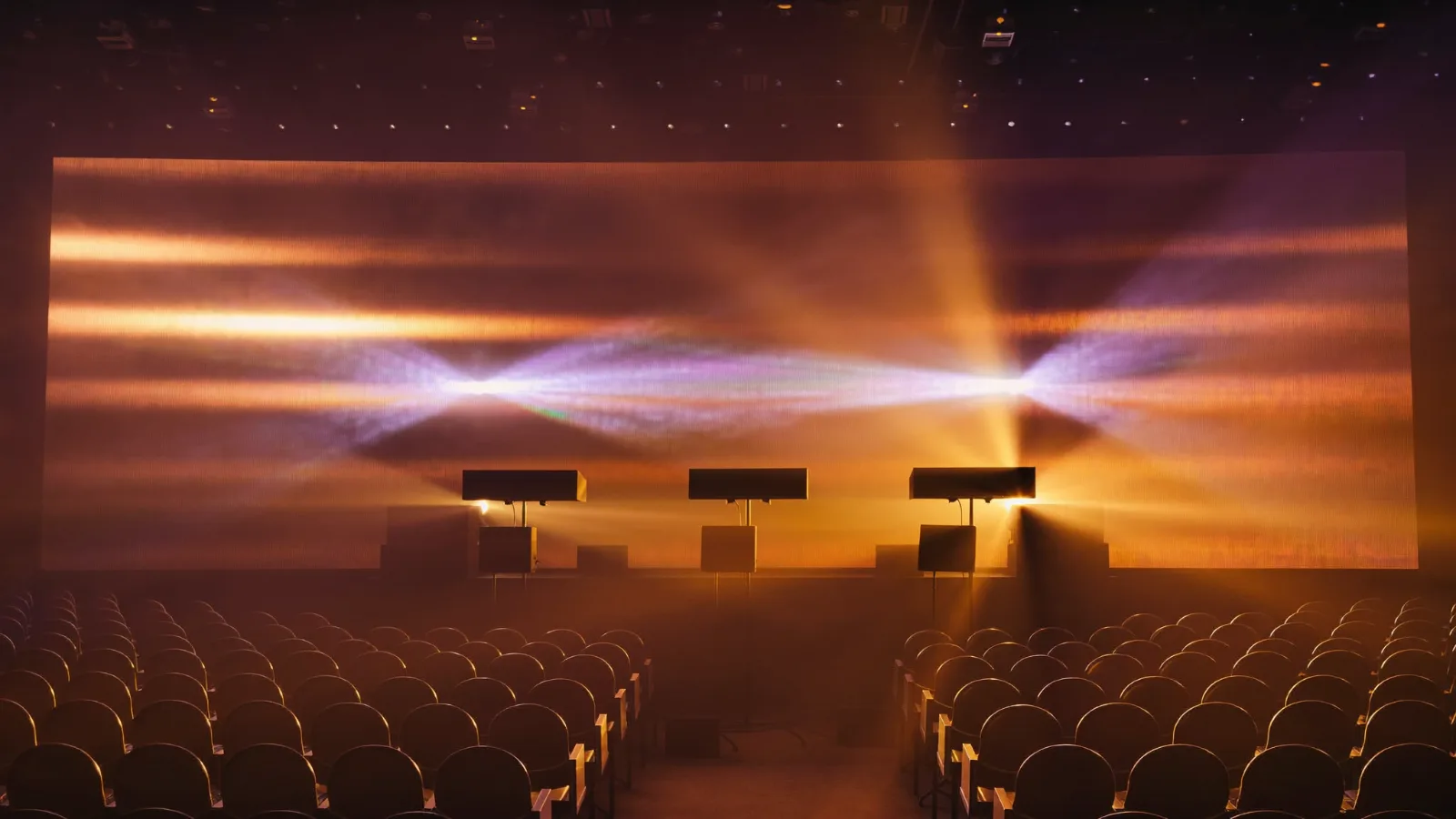
An investor day is a planned program in which a company's senior management presents strategy, targets and business detail to analysts and investors. The room often holds a few dozen to a few hundred people. The webcast and the replay reach everyone else, and the rule a listed company works under is written for the public that is not in the room. That changes what a producer builds.
This guide covers the production side only: the stage, the cameras, the feed, the Q&A, demos, tours and the schedule. Investor relations strategy and securities law belong to the company's IR team and its counsel. Geo Events is a producer, not a law firm, and nothing here is legal advice. We read the rule text on November 19, 2026. Rules and exchange practices change, so counsel confirms where things stand for your date.
What is an investor day, and who is it really for?
An investor day is a planned program in which a company's senior management presents strategy, targets and business detail to analysts and investors; for a public company the main audience is usually the webcast, so the production is built as a broadcast with a room attached: camera-first staging, a controlled Q&A and a schedule that follows the disclosure plan set by the company's counsel.
Some companies call the same event an analyst day, and some a capital markets day. The format is a long management program, questions, and often a product demonstration or a site tour. There are two audiences: the invited room of analysts, large holders, press and sometimes employees, and the public that watches the webcast and the replay. The split differs by company, so plan for both from the first sketch.
Three groups own three different parts of the day, and the production runs smoothly when everyone knows which part is theirs.
| Who | What they own | What that means for the producer |
|---|---|---|
| Investor relations and finance | The message, the guest list, the date and the agenda | Sets the program the stage is built around |
| Counsel | What is said and shown, and how it is made public | Supplies the disclosure plan the run of show follows |
| The producer | The room, the stage, the cameras, the feed, the cues and the clock | Builds and runs everything that carries the program |
The last row is also the limit. A producer implements the company's rules; it does not write them. Our corporate meeting and summit production page names investor days among the executive events we produce. If your event is a smaller conversation among senior decision-makers rather than a public company's program, our guide to executive summit production covers that room, and our conference and summit production page shows the wider range.
What does Regulation FD change for the production?
Regulation FD, the SEC's fair disclosure rule, requires a listed company that discloses material nonpublic information to securities professionals or likely traders to make it public at the same time, and one accepted way is an open, announced webcast, so the production plan is built around who can watch, when they were told and what is said in rooms the webcast does not reach.
Start with the text. Under 17 CFR 243.100(a), as published by the eCFR, whenever a company or a person acting on its behalf discloses material nonpublic information to a covered person, the company must make public disclosure "simultaneously" if the disclosure was intentional and "promptly" if it was not. Covered persons include brokers and dealers, investment advisers, institutions that file a Form 13F, investment companies, and holders of the company's securities where it is reasonably foreseeable they will trade on the information. The rule applies to an issuer, which section 243.101(b) defines as a company with securities registered under section 12 of the Exchange Act or one required to file reports under section 15(d), with foreign private issuers excluded.
In the SEC's adopting release, information is material if there is a substantial likelihood that a reasonable shareholder would consider it important in making an investment decision, and nonpublic if it has not been disseminated in a manner making it available to investors generally (Selective Disclosure and Insider Trading, 65 Federal Register 51716, August 24, 2000, effective October 23, 2000). Whether anything in your program is material is counsel's call. Who is "acting on behalf of the company" matters to a producer too: section 243.101(c) covers any senior official, and section 243.101(f) says that includes directors, executive officers and investor relations officers. Every presenter and the IR team are in the frame.
The rule also says how a company makes disclosure public. Section 243.101(e) allows furnishing or filing a Form 8-K, which is a report a company files or furnishes with the SEC, or another method or combination of methods "reasonably designed to provide broad, non-exclusionary distribution of the information to the public." The adopting release lists conference calls and press conferences that interested members of the public may attend or listen to in person, by telephone or by other electronic transmission, including the Internet, and adds that "the public must be given adequate notice of the conference or call and the means for accessing it." It also describes a model for a planned disclosure with three steps: a press release, a notice of the date, time and access instructions for the call, and then a call held in an open manner by phone or webcast.
Here is how those words turn into production steps.
| What the rule text says | What the production does |
|---|---|
| The public needs adequate notice and a way to access | The webcast page is built and tested before the notice goes out, and one named person owns the link |
| Disclosure to covered persons must be "simultaneous" when intentional | The cameras cover every session in which management speaks to the room, and the stream is not delayed behind the room |
| A company may use a method or a combination of methods | The producer runs the stream; the press release and any filing belong to the company and counsel |
| Unscripted statements are where judgment gets tested | Q&A is staged as a managed channel (see below) |
| Some parts of the day do not reach the webcast | Breakouts, demos, tours and dinner are decided with counsel before the design is final |
On the fourth row, the release notes that a materiality judgment that might be reckless in a prepared written statement would not necessarily be reckless in "an impromptu answer to an unanticipated question." That is a point about how the SEC weighs conduct, not a license, but it explains why the unscripted parts of the day get the most planning.
We do not say whether a webcast is required, what must be filed, what wording to display or what any exchange expects. The rule names a Form 8-K or another suitable method, and the release names an open, announced webcast as one such method; counsel decides what your company needs. Give counsel a slot in the run of show for any statement they want displayed at the start.
Pro Tip: Ask counsel for the disclosure plan on one page before the first rehearsal: which sessions are public, which are not, who may speak at demos and tours, and what is shown at the start. Then draw that plan into the run of show, so the producer and the show caller work from the same page counsel signed off on.
The weeks around a company's own offering carry different limits, which our guide to IPO celebration planning touches on. This guide is about a listed company's day, and our notes on financial services events cover the wider balance between compliance and creative choices.
How do you design the stage for the webcast first?
Design from the camera position back. The webcast audience sees a wide 16 by 9 frame, so the backdrop, the lighting and the slide design are built for that frame, and the room is lit and staged to match.
We fix the camera positions first, usually a center camera, two side angles and a wide shot, and then draw the stage and screens to what the lens sees. The points below are production practice, not rules.
- A low, wide stage with a seamless backdrop. An LED wall or a scenic surface that reads as one clean plane behind a presenter keeps the frame uncluttered. Our set and stage design team builds these in the studio, so the backdrop arrives as finished panels.
- Slides designed at broadcast size. Tables and charts must read on a laptop, not only on a 30-foot screen. If a number matters to the story, it needs to be legible in the stream.
- Presenter light matched to the cameras. Our sales kickoff production guide gives a range of about 3,200 to 5,600 Kelvin for presenters, matched to the cameras, so faces look natural on screen and in the recording. A key light is the main light on the presenter, usually from the front. Mixed color temperatures in one shot are what make a face look green or blue on the replay.
- Support for the presenter. A confidence monitor is a screen at the stage lip that shows the presenter the current slide, the next slide and a clock. A teleprompter carries scripted sections. A clock the presenters can see keeps a long program honest.
- A graphics plan. A lower third is a graphic with a name and title across the lower part of the frame. Decide who approves each one before the day.
We have no investor day to cite, and we do not claim one. Two other builds show the methods. At the Roivant holiday gala at the New York Public Library, a 400-plus guest event under strict preservation requirements, layered lighting lowered the perceived ceiling and the production included full AV. At VTEX at The Glasshouses, for 350-plus attendees, fabricated dividers, lighting shifts and furniture zoned one open-plan volume into a keynote stage and breakout conversations. Neither was an investor day. Both show light and scale decided before anything is built. Our guide to designing events for the camera goes deeper on sightlines and contrast.
Who runs the broadcast, and what happens if the feed fails?
A broadcast-grade investor day needs its own crew beside the in-room AV team: a director, a technical director on the switcher, camera operators, a broadcast audio engineer, a graphics operator and a producer who owns the replay.
The switcher, also called the vision mixer, is the console that cuts between cameras and graphics. In our guide to hybrid events, we describe broadcast-grade production as at least four cameras, a vision mixer, a dedicated audio engineer running a separate broadcast mix, a graphics operator and a director, typically a six-to-eight-person broadcast team on top of the standard production crew. The guide names investor days for public companies as an example of that tier.
The roles split like this. The producer owns the plan, the clock and the decision to pause. The show caller calls every cue to the stage and the broadcast together. The director and technical director decide which camera and which graphic is on air. Two audio engineers work separately, one for what the room hears and one for what the stream hears. A graphics operator runs lower thirds, slides on air and any statement counsel asks to display. A replay owner handles capture, edit, approval and the posting plan.
The run of show is the cue-by-cue script every department works from; our guide on how to write a run of show shows the columns. The show caller is the producer who calls those cues live.
Plan for the failure before it happens. A failed stream is a different kind of bad day from a failed room, because the public can no longer follow. Our practice is two of everything that matters: a second encoder, a second internet path, a backup camera on the main speaker, and a standby person with the authority to pause the session, plus a short script for the host. This is production practice, not a legal rule.
Decide the replay before the day: who hosts it, who edits it, who approves it and when it goes up. The company publishes; the producer supplies the capture and the edit. Any retention or accessibility requirement is a question for counsel.
How do you stage Q&A so the right people answer?
Stage Q&A as a managed channel: a moderator who reads the queue, microphones that only the audio engineer can open, and a plan for who answers what, so the unscripted part of the day is also the best-run part.
The points that make it work:
- Questions from the room. Runners with handheld microphones, or table microphones the engineer can cut. A guest should never hold an open microphone.
- Questions from the webcast. A question box or a dial-in line that a producer screens and passes to the moderator. The moderator reads each question aloud, so the room and the stream hear the same words.
- A moderator seat. At the side of the stage, with a confidence monitor showing the queue, the next question and the clock.
- A seat for management. A low panel, stools or a table rather than a lectern, which puts a barrier between speaker and audience and sits badly on camera.
- Talkback. A producer on the intercom who can tell the host to repeat a question for the stream.
The answers are the company's. Production does not coach answers or screen questions on content; IR and counsel set the rules for the queue, and the producer carries them out.
Pro Tip: Rehearse the Q&A with the real microphone path, including a question from the webcast and a late hand from the back of the room. That is where a feed delay or a silent microphone shows up, and it costs an afternoon in rehearsal instead of a pause in front of the public.
What do demos and site tours become on an investor day?
A demo station or a tour stop is a place where management talks to the room, so counsel should decide before the design is final whether the webcast covers it and who may speak there.
The adopting release lists types of information to review carefully for materiality, among them earnings information, mergers and acquisitions, new products and developments regarding customers or suppliers, and changes in management, and it adds that none is automatically material. A product demonstration is the obvious place those topics come up. The rule also has exclusions, for example for a person who owes the company a duty of trust or confidence or who expressly agrees to keep information confidential (17 CFR 243.100(b)(2)). Whether any of that applies to a given guest is for counsel. The producer's job is to ask the question early and build for the answer.
Our production points for demos and tours:
- Build demo stations like the stage. The same material palette, the same lighting and the same sightlines, as designed fabrications from our custom event fabrication shop, so a demo feels like part of the day rather than a trade show booth in the corner.
- Small, timed groups for tours. Wireless headsets so the guide is heard over machinery and corridors, a route walked and timed in advance, and safety and access briefings written into the run of show.
- Coverage decided stop by stop. One camera or one clearly briefed host at each stop, if counsel wants it covered.
- A holding room and a private arrival for executives. Our corporate meetings page lists NDA-protected production processes, confidential content handling and security-conscious logistics among the services.
Where should an investor day be held?
Choose the room for broadcast first: a quiet room, a path for the feed out, a ceiling that takes lighting, a dock for the build and a lobby for check-in. Then choose for guests' travel.
We do not name venues here, because we have not verified any venue's rules for this guide. What matters is the control each option gives. The company's own headquarters offers the most control, the most security and the product on site, but working floors and staff have to be kept out of the shot. A hotel ballroom is convenient for guests, with in-house AV terms to read closely. A theater or studio-style room is built for sightlines and sound, usually with a house rig that shapes the design. An exchange or an institution is a statement of its own, with its own house rules.
Whatever the option, ask the venue the same questions in writing: the house internet and whether a second path can be brought in, in-house AV terms for outside production, ceiling height and rigging, quiet hours and load-in windows, a holding room and a private arrival. Our event site survey checklist lists what to measure on the walk-through. For a New York date, our guide to corporate event venues in New York and our New York production team are the starting points.
How far ahead should you start planning an investor day?
Our guidance for executive summits and investor days with custom environment design is 8 to 16 weeks, and 4 to 6 months for large meetings with complex staging, broadcast production and several venues, as stated on our corporate meeting and summit production page.
Inside that window the work follows the four stages of our process: strategic alignment, environment and stage design, fabrication and technical production, and installation and show direction. The table below places the investor day decisions in those stages. It is Geo's process, not a rule.
| Stage | What gets decided or done | Who owns it |
|---|---|---|
| Strategic alignment (first) | The date window, the room hold, the audiences and the format of the day | IR, with the producer holding the room |
| Environment and stage design | Camera positions, stage concept, slide format, demo and tour plan | Producer and IR |
| Counsel's disclosure plan | Which sessions are public, who speaks where, what is displayed first | Counsel |
| Fabrication and technical production | Stage and demo builds made and tested in the studio, content deadlines set, broadcast crew booked | Producer |
| Deck lock | The presentation is final, so what counsel reviewed is what is on screen | IR and counsel |
| Installation and show direction | Load-in, technical rehearsal with presenters and the Q&A path, then show day | Producer, show caller |
| After the day | Replay approval and publication | The company, with the replay owner |
Pro Tip: Lock the deck before the technical rehearsal. A late slide change means the version counsel reviewed is not the version on screen, and every change has to be reloaded, checked against the screen layout and rehearsed again with the show caller.
Our custom event build timeline explains each fabrication stage.
Why work with a full-service production company on an investor day?
The stage, the cameras, the feed, the Q&A and the clock depend on each other, and one team keeps them in one plan. Discretion matters too, because the content stays confidential until the company makes it public.
Geo Events brings more than 15 years in event production and more than 200 events built in-house. As our corporate meetings page sets out, everything is built and tested in our studio before it reaches the venue, our team runs the technical rehearsal and calls the show, and NDA-protected processes cover confidential content. We respond within one business day. When the same people design the stage, build it and call the show, the person who surveyed the room is the one on the intercom when a question comes in from the webcast. That is what full-service event production means on a day like this.
A listed company has other milestones to mark, and our corporate milestone events page covers those, including the evening that follows a listing in our IPO celebration guide. If you want the day built so the numbers exist afterward, such as webcast attendance and replay views, our guide to designing an event so it can be measured shows what to build in. Analyst feedback and investor surveys belong to IR.
Tell us the company, the date window, the room and where your investors will watch from, and we respond within one business day with a production scope and next steps.
Frequently asked questions
What is the definition of an investor day?
An investor day is a planned program in which a company's senior management presents strategy, targets and business detail to analysts and investors. For a public company the main audience is usually the webcast, so the production is built as a broadcast with a room attached: camera-first staging, a controlled Q&A and a schedule that follows counsel's disclosure plan.
Does an investor day have to be webcast?
Not by the rule as we read it. Regulation FD requires public disclosure of material nonpublic information that is disclosed selectively, and 17 CFR 243.101(e) names a Form 8-K or another method reasonably designed for broad, non-exclusionary distribution. The SEC's 2000 adopting release names an open, announced webcast as one such method. Counsel decides what the company needs.
How far ahead should we plan an investor day?
For an investor day with custom environment design, Geo Events recommends 8 to 16 weeks. Large meetings with complex staging, broadcast production and several venues benefit from 4 to 6 months. Counsel's disclosure plan and a locked deck should be in hand before the technical rehearsal, whatever the schedule.