
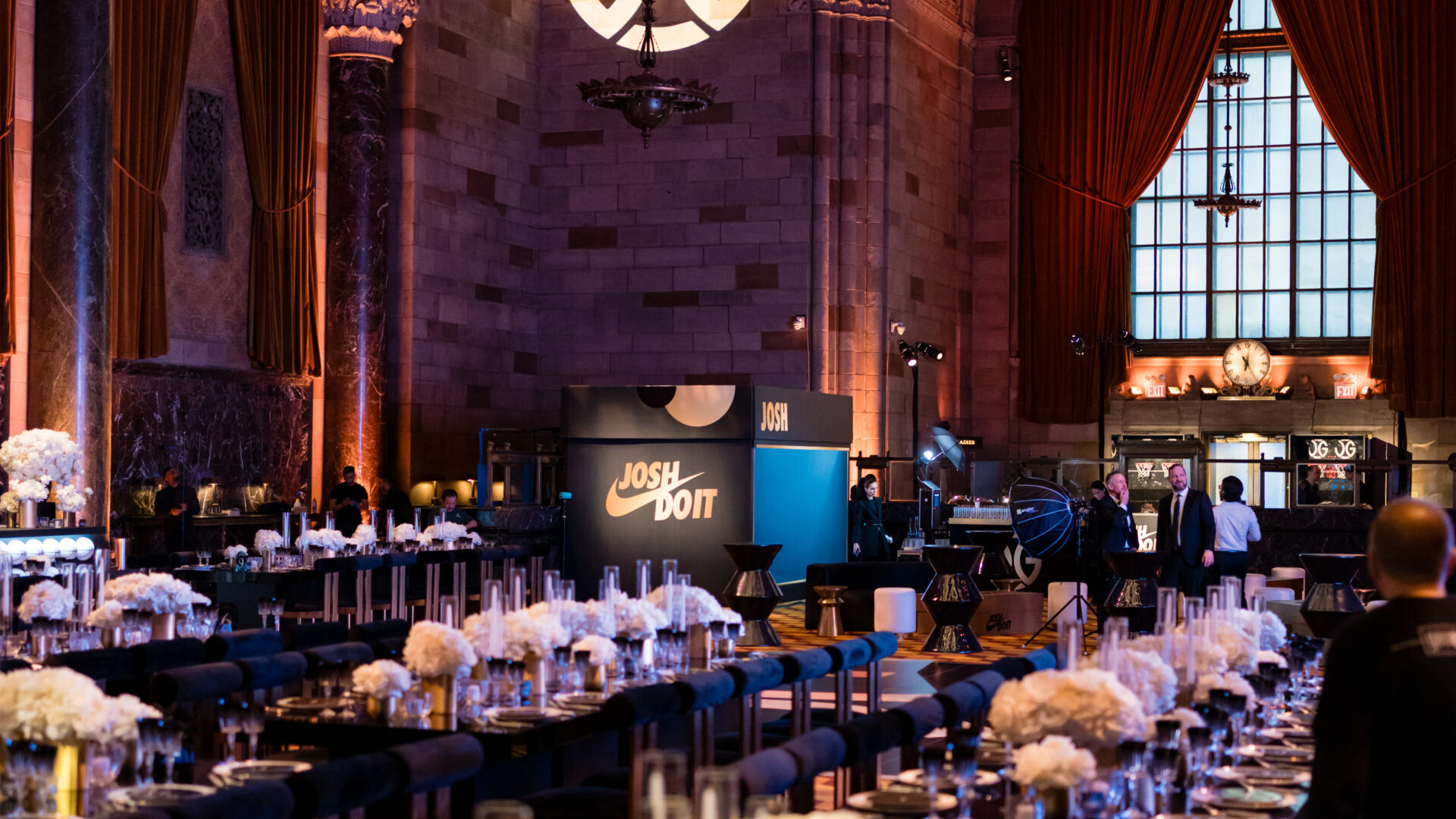
The strongest milestone celebrations are built around one idea, fabricated at architectural scale, and then defended from everything that wants to dilute it. Not a theme spread thin across forty surfaces — one object, one structure, one gesture that the room organizes itself around. Good milestone celebration design works the way a good building works: there is a primary move, and everything else is in service of it.
This is the single most reliable decision available to anyone producing a significant birthday, anniversary, or private honor. It is also the one most often skipped, because a theme is easy to approve in a deck and a built centerpiece is not. A theme can be described in an adjective. A centerpiece has to be drawn, engineered, cut, finished, transported, and hung — and someone has to commit to it early enough that the shop can do its work.
What follows is how our production team selects that one idea, builds it so it holds a room full of people, and then designs everything else to point at it.
A Big Idea Is a Structural Decision, Not a Mood
A theme is a set of adjectives applied evenly: warm, tropical, art deco, black-tie-with-an-edge. Applied evenly, adjectives cancel out. The eye has nothing to land on, the photographs have no subject, and the room reads as expensive rather than memorable.
Milestone celebration design begins where that habit ends. A big idea is an object with mass, position, and a sightline. It occupies real coordinates on the ground plan. It has a weight the venue has to accept, a power drop it needs, and an install sequence that determines what can happen in the room before and after it goes in. That is what makes it structural: it constrains the rest of the production, and those constraints are what give the room its order.
At a basketball-themed milestone at Cipriani in New York, the idea was a regulation court drawn in light overhead. Our shop built a twenty-eight-by-twenty-foot truss-and-LED structure rigged from the ceiling, a four-inch luminous line tracing the outline of a court above two hundred guests. Nobody had to be told the theme. They walked in under it.
Choosing the Idea: Three Tests It Has to Pass
Most rooms offer half a dozen plausible centerpieces. The one worth building passes three tests, and a candidate that fails any of them should be cut in concept, not discovered in fabrication.
Can it actually be built in the time available?
An idea that cannot survive engineering review is not an idea, it is an illustration. Before anything is promised, the concept goes into shop drawings and gets checked for load paths, connection details, material behavior, and how it breaks down for transport. A structure that cannot fit through a freight elevator door has to be conceived as sections from the first sketch, not cut in half the week of the install.
Does it hold the center?
Position matters as much as the object. The centerpiece has to be visible from the entry, legible from the far corner, and impossible to ignore from the dining tables. That is a sight line problem solved on the ground plan, long before anyone talks about finishes. If the only place the structure fits is behind a column, the idea is wrong for the venue or the venue is wrong for the idea.
Is it specific to this person or this occasion?
Generic grandeur is forgettable. A suspended installation that could belong to any client belongs to none of them. The idea should be unrepeatable: a detail from a life, an obsession, a private joke rendered in steel and light at a scale nobody expected. Specificity is what separates a genuinely private celebration from a well-dressed banquet.
Building It So It Holds the Room
Once the idea survives those tests, it becomes a fabrication problem, and fabrication is where most centerpieces either earn the room or quietly lose it.
Scale is the first decision. A structure that reads as heroic in a rendering can look apologetic in a double-height space, and the correction is rarely a matter of adding a few feet. It is a matter of establishing a relationship with the volume: the object should either command the air above the guests or ground itself so firmly that the room appears to have been built around it. The middle distance is where centerpieces go to die.
Material is the second. Every surface in a celebration is read at two distances, and it has to hold up at both. From across the room, the eye is judging silhouette, reflectance, and contrast. From arm’s length, it is judging joinery, edge quality, and finish. A cast-aluminum logo finished in gold survives the second look; a vinyl graphic on a flat panel does not. At that same Cipriani milestone, the bar carried the idea down to the guest’s own eye level: a twenty-four-foot front bar faced with more than ninety mounted regulation basketballs, and a CNC-fabricated back bar in basketball-line-textured metal grate. The centerpiece overhead and the bar below were the same argument made twice.
The third decision is how the structure meets the building. Landmark interiors, hotel ballrooms, and club dining rooms all impose some version of the same rule: leave no mark. That pushes work toward free-standing, self-supporting construction and toward pre-assembly in the shop rather than problem-solving on site. For a two-story walk-through house built inside Cipriani, our team engineered a modular, self-supporting steel and wood structure, pre-fabricated it in our New York shop, and test-assembled the whole thing before it ever went on a truck. The scenic panels, branded surfaces, and interior vignettes arrived as drop-in components and attached without touching the venue’s original surfaces. A test fit is not a luxury on a build like that. It is the difference between an install and an improvisation.
The Rest of the Room Is Supporting Cast
Here is where milestone celebration design most often collapses: the centerpiece is strong, and then every other element is given equal weight. Four competing focal points are the same as none.
Lighting is the clearest instrument for enforcing hierarchy. The centerpiece should hold the highest contrast in the room, and everything else should be lit to a level that flatters guests and food without competing. Warm downlight on the tables, restrained washes on the walls, and a deliberate gap in intensity between the object and its surroundings will do more for a photograph than any additional scenic element.
Circulation is the second instrument. Guest flow should deliver people toward the idea, not past it. The entry sequence, the bar positions, and the path to dining are all decisions about where the crowd stands and therefore about what the room looks like when it is full. A centerpiece surrounded by a service corridor reads very differently than one that people gather beneath.
Material echo is the third. The supporting elements should speak the centerpiece’s language quietly: the same metals, the same finish family, the same geometry at a smaller scale. At a milestone celebration in New York built around a custom-engineered LED basketball hoop suspended above the dance floor, the bespoke lounge environments and custom-fabricated dining surfaces carried the arena logic outward into a raw venue without ever restating it literally. Three hundred guests read one continuous world, not a centerpiece plus furniture.
There is a variant worth naming, because it inverts the arrangement. Sometimes the big idea is the envelope itself. At a private celebration at Glen Oaks Country Club on Long Island, custom scenic walls concealed the existing interior entirely to create a new spatial envelope, with living and preserved foliage integrated into the fabricated structures and ambient lighting tuned to a warm coastal evening. There was no single object at the center. The room itself was the object, and the same discipline applied: one idea, executed completely, with nothing allowed to contradict it.
Designing the Idea for the Camera
A milestone celebration is photographed more thoroughly than almost any other private event, mostly by guests, mostly at chest height, mostly in low light. A centerpiece that only works from the production photographer’s ladder has been designed for the wrong audience.
Good milestone celebration design accounts for that lens. Three things make a built object photograph well from a phone. It needs contrast against whatever sits behind it, because a dark structure against a dark wall disappears at high ISO. It needs a light source that is part of the object or aimed at it, rather than relying on ambient room light. And it needs a comfortable standing distance where a person can frame themselves against it without backing into a table.
Suspension solves several of these at once. A private dinner at One World Trade Center was anchored by a hand-carved foam Earth hung at the heart of the room, with custom-fabricated black acrylic dining tables built to read as monolithic surfaces beneath it. An object in the air has clean background separation from every angle, it stays available while the floor fills with people, and it never needs a queue.
Where the Single-Idea Approach Goes Wrong
Four failures account for nearly all of them, and all four are scheduling failures disguised as design failures.
- The idea arrives too late. Rigging points, floor loads, and power all get locked early. A ceiling-hung centerpiece conceived after the venue contract is signed may have nowhere to hang from.
- The idea is too small for the volume. Under-scaling is almost always a consequence of approving a concept from a rendering that was cropped tight.
- The committee adds a second big idea. And then a third. Each addition is individually reasonable and collectively fatal.
- The build is treated as decor. Structures that carry weight, hang overhead, or hold guests need engineering review and a real install crew, not a delivery.
The remedy for all four is the same: commit to the one idea early, put it through custom fabrication as a designed and engineered object, and then protect it. Every subsequent decision gets easier, because there is finally a standard to judge it against — does this serve the idea, or compete with it?
If you are planning a milestone celebration and you already know what the one idea should be, the useful next conversation is about whether it can be built and hung in the room you have chosen. If you do not know yet, that is the conversation too. Tell us who this night is for and what it is marking, and our team will come back with something worth building.