
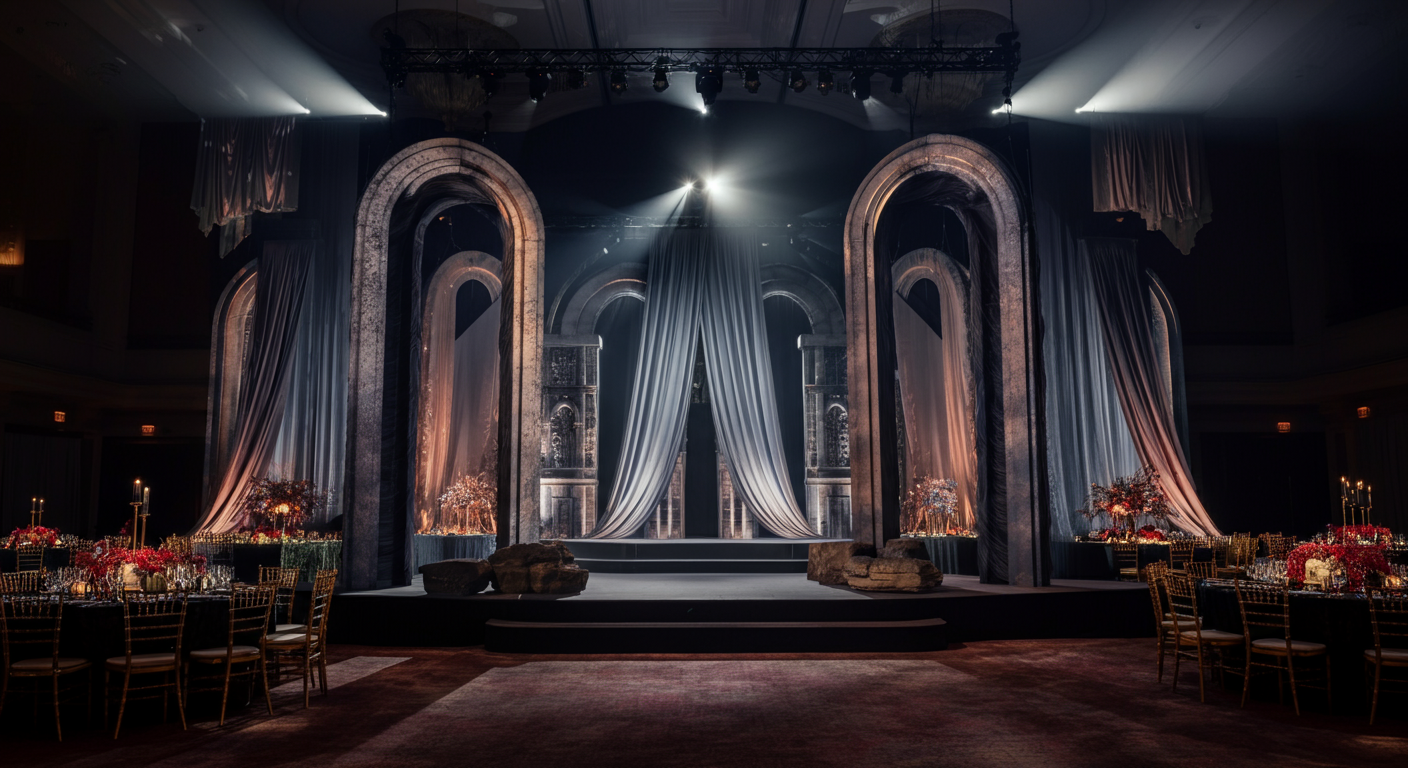
Event scenic design is an architectural discipline, not a decorating decision — and treating it as the latter is the fastest way to spend six figures on a room that photographs like a trade show booth. The difference between a venue that disappears and an environment that becomes the event isn’t florals or furniture. It’s structure, surface, scale, and the quiet engineering that makes a 30-foot archway read as permanent on the guest’s first walk-in. Done well, scenic is invisible as a line item and inevitable as an experience. Done badly, it’s the thing your CMO keeps circling in the recap deck.
Most clients arrive with the wrong vocabulary. They use “scenic,” “set dressing,” and “decor” interchangeably, and their vendors let them, because the confusion is profitable. In practice, the three are different crafts with different budgets, different timelines, and different failure modes. Getting the terminology right is the first step to getting the invoice right.
Scenic vs. Set Dressing vs. Decor
Scenic is architecture you can load into a truck. It’s the built environment — walls, arches, columns, facades, platforms, raked seating, scenic ceilings, portals, custom bars. It has structural requirements. It requires CAD drawings, engineering review, and often fire marshal sign-off. It’s fabricated in a shop weeks or months before the event and installed by a crew who understands rigging and load paths. When people talk about “building a world” inside a venue, scenic is what they actually mean.
Set dressing is everything that sits within the scenic environment to make it read as believable and lived-in. Props, signage, books on the shelf of a built library, glassware staged on a custom bar, the faux products in a faux bodega. It’s not structural. It’s inhabiting detail — the craft of making a built space feel occupied.
Decor is the third layer: florals, linens, tabletop, candles, ambient soft goods. Decor can be beautiful, decor can be expensive, and decor can carry an event on its own for certain formats. But decor is additive. It sits on top of what’s already there. Asking decor to do the work of scenic — to transform a venue rather than dress it — is where budgets disappear without a visible return.
The shorthand we use internally: scenic changes the shape of the room. Set dressing makes the room feel real. Decor makes the room feel beautiful. A sophisticated experiential event design brief usually needs all three, sequenced correctly, with budget allocated to each according to the outcome.
The Three Cost Tiers
Scenic pricing isn’t a spectrum, it’s a set of discrete tiers with real architecture behind the numbers. Confusing them is the most common scoping error we see.
Tier 1: Off-the-Shelf Rental
Modular scenic from a rental inventory — pipe-and-drape upgrades, prefab arches, branded step-and-repeats, standard stage decks, rental truss and scenic flats. Fast to spec, fast to deploy, and forgiving on budget. The right call for internal town halls, sales kickoffs where the stage is a backdrop rather than a character, and most Tier 2 corporate summits.
The limitation is obvious on sight. Rental scenic reads as rental scenic. It photographs fine from the right angle and betrays itself from every other one. The surfaces are standardized, the finishes are what the rental house stocks, and the dimensions are what fits in their existing crates. If the brief involves “memorable” or “press-worthy,” Tier 1 is the wrong starting point.
Tier 2: Custom Fabrication on a Rental Base
The middle path — custom-built scenic elements combined with rental structure. Custom bars, branded portals, hero moments with bespoke finishes, scenic graphics printed for this event only, but set against standard stage decks and rental lighting grids. This is where most high-end corporate work lives. You get the signature moments that make the event feel specific without fabricating every inch.
Tier 2 is also where production design and brand design have to actually talk to each other. The fabric wrap, the printed scenic, the laser-cut signage — these are branding decisions made at fabrication scale, and a typo at 40 feet is a very expensive typo.
Tier 3: Full Scenic Build
Ground-up environmental construction. The venue becomes a shell, and the event is a new interior built inside it. Structural framing, custom architectural elements, purpose-fabricated surfaces, integrated scenic lighting, custom flooring, ceiling treatments — often an entirely new spatial logic laid over whatever the venue actually looks like.
This is the tier behind the activations people remember. The Barbie Dream House at Cipriani is a reference case — Cipriani’s landmark interior is one of the most architecturally assertive spaces in Manhattan, and the brief required building a different world inside of it without damaging a single original surface. That’s a full scenic build problem. Custom fabrication, bespoke finishes keyed to a specific color system, structural staging that held its own scale against the venue’s architecture rather than disappearing into it.
The Emily in Paris Immersive Photo Experience operated on the same logic from the opposite direction. The brand didn’t need to compete with the venue — it needed to replace it. Guests walked out of New York and into Paris for 90 seconds at a time, and that transition is a scenic problem. Not a decor problem, not a signage problem, not a lighting problem alone. Scenic.
Real vs. Faux: Materials That Matter
The most expensive mistake in event scenic design isn’t over-building. It’s building in the wrong material. Event scenic lives in a specific physics — it has to be structurally sound, fire-rated, load-in-friendly, photograph correctly under stage lighting, and come apart in under four hours at strike. Picking materials without thinking about all five is how you end up with a 12-foot marble bar that’s neither marble nor structurally sound nor allowed in the venue.
When Real Matters
Surfaces within arm’s reach of guests. Bars they lean on. Tables they set drinks on. Touchpoint moments where a camera might get within two feet. Real wood, real stone veneer, real metal — anything a guest or a lens can interrogate at close range — needs to be real, or a fabrication-grade substitute convincing enough to survive the inspection.
When Faux Is Not a Compromise
Anything above sightline. Anything that reads at distance. Structural elements wrapped in print. Architectural facades that suggest a material without being it. A faux-brass column at 15 feet is indistinguishable from brass and weighs a sixth as much — which matters because the venue has floor load limits you’re not going to argue with.
The real craft is knowing where the threshold lives. For a luxury private event with 120 guests and a two-hour cocktail hour in a tight footprint, the threshold is high — guests will touch everything. For a 2,000-person brand activation where the primary engagement is visual and photographic, the threshold drops significantly. Budget should follow the threshold, not the other way around.
Structural Considerations the Decor Team Won’t Raise
This is where scenic stops being a creative conversation and starts being an engineering one. Experienced producers raise these in the first scoping meeting. Inexperienced vendors discover them at load-in, at which point the answer is always expensive.
- Load-in paths. Can the scenic elements physically fit through the venue’s service doors, elevators, and corridors? An eight-foot arch that has to come through a six-foot doorway gets built in sections, and sectional construction changes the fabrication budget materially.
- Floor load limits. Every venue has them. Ballrooms in historic buildings have stricter ones. A solid scenic wall with real stone veneer can exceed what the floor is rated to hold.
- Venue protection. Landmark venues — the New York Public Library, Cipriani, historic estates — require protective flooring, wall protection at every scenic contact point, and sometimes bespoke rigging solutions that don’t touch the architecture. This is its own line item and it’s not optional.
- Fire marshal approval. Any scenic element above a certain size, any fabric not treated with flame retardant, any build that alters egress paths triggers inspection. NYFD and LAFD both have published thresholds and published patience levels. Plan for approval or plan to tear it out an hour before doors.
- Rigging and structural safety. Anything overhead requires an engineer’s stamp. Not sometimes. Always.
Our work on the Roivant Holiday Gala at the NYPL is a case study in the venue protection side of this. The Stephen A. Schwarzman Building is one of the most restricted event venues in New York, and every scenic element had to be engineered to coexist with a landmarked interior. That’s not a decor problem. That’s a scenic, rigging, and venue protection problem solved in CAD eight weeks before load-in.
Lighting and Scenic: The Same Conversation
Scenic that hasn’t been designed with lighting in mind is scenic that will look flat on the day. The two disciplines resolve the same problem from opposite sides — scenic builds form, lighting reveals it — and the design conversation has to happen in the same room, with the same drawings, at the same time.
A custom scenic wall is a very different object under flat house light, theatrical wash, color-temperature-tuned downlights, and dramatic gobo patterns. Textured surfaces become scenic assets when lit from a grazing angle and become invisible when lit from the front. Scenic graphics that pop at 3200K vanish at 5600K. The scenic designer and lighting designer need to have fought about this before the scenic gets to fabrication, not after.
The practical test: ask to see a lighting rendering over the scenic drawings. If the vendor can’t produce one, the two conversations aren’t actually happening.
The Silent Engine Behind the Instagram Moment
Every activation that trends owes its shareability to scenic. The photo moment that fills a feed for a week is a scenic moment, engineered to work from multiple angles, in multiple lighting conditions, with and without the guest in frame. The “set” isn’t decoration — it’s the camera’s subject, designed with the same discipline a film art director brings to a principal location.
A few numbers worth keeping in mind: for a well-designed brand activation, 60 to 80 percent of the measurable content reach is user-generated from two or three engineered scenic moments. Not from the speeches. Not from the branded swag. From the photograph guests took in front of an environment someone built on purpose.
That’s the math that justifies scenic budgets on product launch and pop-up work. A $180,000 scenic build that produces 40 million organic impressions across guests, press, and influencer channels is cheaper per impression than almost any paid channel. But it only works if the scenic was designed to be photographed — height, background, lighting, spatial depth, color behavior on camera. A pretty room without photographic logic doesn’t produce the same lift.
What to Brief Your Scenic Designer
If you’re writing a scoping brief, lead with these answers, not with a Pinterest board:
- What is the guest experience at the threshold? The first 10 seconds after they walk in define the event.
- Which moments need to be hero photographs? Name two or three. Not twelve.
- What’s the venue’s restriction list? Landmarked surfaces, load limits, rigging rules.
- What happens at strike? A build that takes six hours to install and 12 hours to remove has a load-out bill attached to it.
- Where is the scenic budget vs. the decor budget? If they’re commingled, you’ll shortchange the structural work.
Scenic as the Design Lead
The mental shift the best clients make is treating event scenic design as the lead discipline that the rest of the production — lighting, florals, audio, catering flow, even guest circulation — organizes around. Scenic goes first because scenic is the slowest, the most expensive to change, and the most consequential. Everything else adapts to it.
Done right, guests walk into a room and can’t tell where the venue stops and the build begins. That’s the bar. Not “nice decor.” Not “beautiful flowers.” A built environment that reads as architecture, behaves as architecture, and disappears into the memory of the night as “the place where this happened,” even though the place didn’t exist 72 hours earlier.
When you’re ready to build a world inside a venue — not dress one — start the conversation here. We’ll bring the CAD drawings, the material samples, and the structural logic. Decor, we can talk about later.