
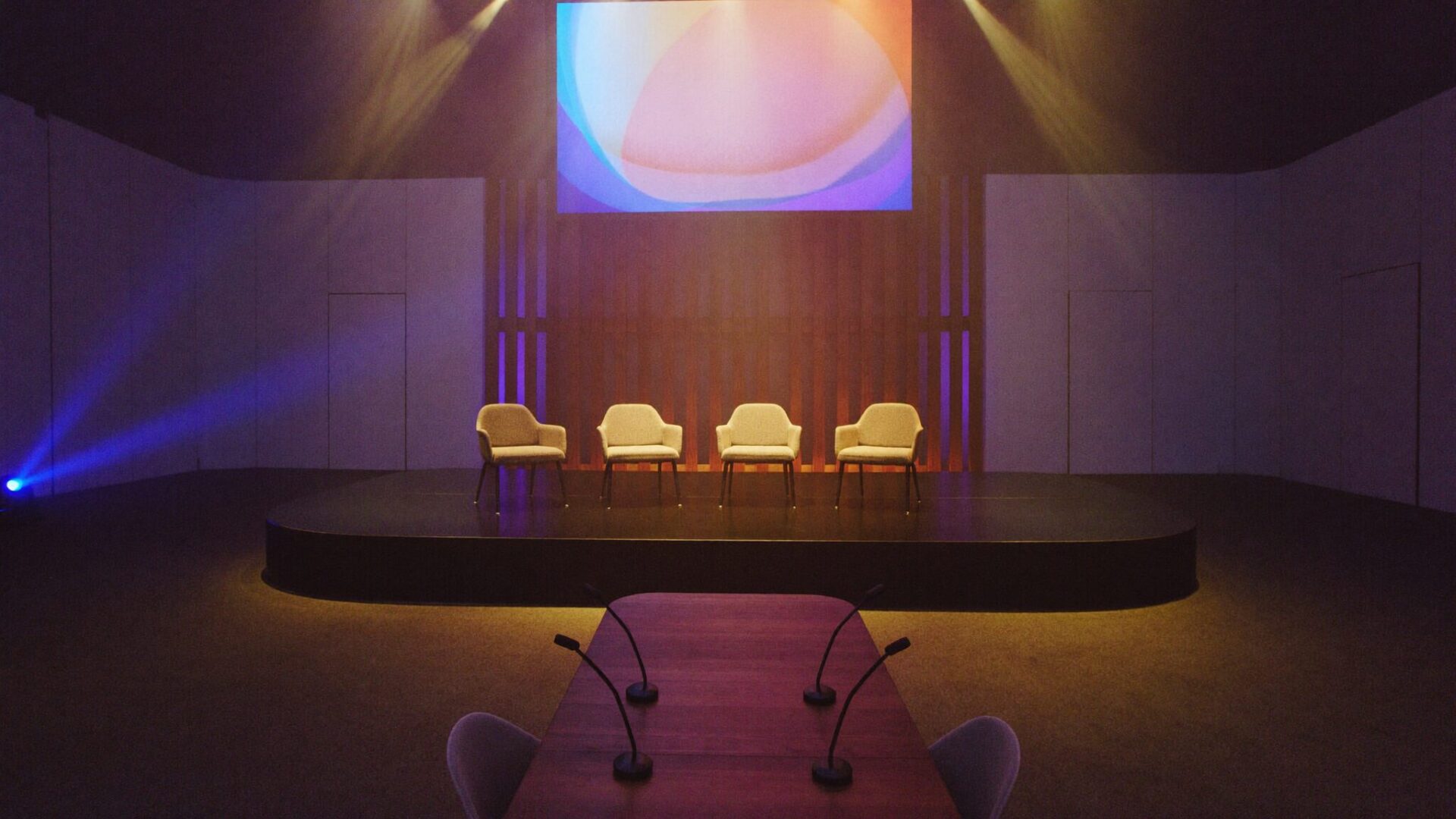
An executive summit is built the other way round from a conference. A conference delivers content from a stage to an audience. At an executive summit, the audience is the content: the people in the seats are the ones whose views, objections and agreements the day exists to capture. That single shift changes the room, the stage, the microphones and the rules about what leaves the building.
This guide is the producer’s view of an executive summit. It walks through six decisions in the order we make them: the room format, the stage, how every voice is heard, confidentiality, remote leaders, and what happens between sessions. Each one is tested against the same question. Can the people who matter talk to each other, and will what they decide survive the day?
What is an executive summit, and how is it different from a conference?
An executive summit is an invitation-only gathering of senior leaders, small enough to work as one conversation or as tables that report back, convened to discuss and decide rather than to be presented to. Producing one means designing the room, stage, sound and rules so that conversation among the people who matter can happen and be captured.
The purpose of a summit is to put the people who make decisions in one room long enough to align on something. It might be a strategy, a reorganization, a partnership, or the priorities for the coming year. The agenda may look like a conference agenda, with an opening, sessions and a close, but the measure of success is different. Nobody leaves a good summit saying the keynote was impressive. They leave saying the group finally agreed.
| Conference | Executive summit | |
|---|---|---|
| Audience | Open or broad registration | Invited, senior |
| Size | Usually much larger | Small enough for one conversation, or tables that report back |
| Flow of content | From the stage to the seats | Among the seats |
| Stage | Keynote scale, large screens, camera magnification | Low, close, built for conversation |
| Success measure | Attendance and satisfaction | Decisions made, relationships moved |
The format takes several forms: a senior leadership meeting, an investor day, a partner or customer advisory summit, a board and leadership offsite held in a city venue, or an invitation-only industry forum. What they share is a guest list where almost everyone has something to say. Our executive summit and corporate meeting production work covers executive summits, investor days and all-hands meetings. If your event is really a multi-day program with tracks and an exhibition hall, our page on conference and summit production covers that larger format.
Which room format fits the conversation?
Choose the format by how many people need to speak, not by how many need to sit. One shared discussion needs everyone to see everyone. Once the group is too big for that, the room splits into tables that work separately and report back.
Planners often start with the venue’s capacity chart and pick the layout that fits the most chairs. For a summit that is backwards. The agenda tells you how the conversation moves, the conversation tells you the format, and only then does the format tell you which rooms can hold it. A few terms first. A hollow square is four tables set as a square with an open center, so every participant faces every other. Crescent rounds are round tables with the seats on the stage side left empty, so everyone can turn to the front without turning their back on their table. In the round means the stage sits in the middle with the audience on all sides.
| Format | Best for | What it asks of the room |
|---|---|---|
| Boardroom or hollow square | A single discussion where every face must be visible | Width for service and camera paths behind the chairs; sound that carries across the open center |
| U-shape facing a low stage | Discussion led by a moderator, with occasional presenters | A clear open end for the stage and screens; sightlines from both arms of the U |
| Crescent rounds | Larger groups that alternate between stage segments and table work | Space between tables so neighboring conversations do not bleed together |
| In the round | A leadership dialogue where the stage should feel like part of the group | Screens on several sides or none; lighting that works from every angle |
| Theater | Only the segments where content truly flows one way | A fast reset if the room has to change format mid-day |
The room itself narrows the choice quickly. A flat ballroom with a low ceiling punishes theater seating, because the back rows see the backs of heads. A hollow square needs more floor than its seat count suggests, since staff, cameras and late arrivals all move behind the chairs. A summit in the round needs either screens facing every side or no screens at all; one screen behind the stage leaves much of the room facing the wrong wall.
One room can carry several modes if they are designed together. At our VTEX event at The Glasshouses in New York, a corporate event for 350+ attendees according to our published case study, a single open-plan volume had to support a keynote stage, networking environments and intimate brand conversations. We zoned it with fabricated dividers, lighting shifts and furniture, so each area had its own atmosphere while the whole floor still read as one environment. That event was not an executive summit, but the method carries straight over: a summit that moves between plenary and table work does not always need a second room. It needs a room drawn for both from the start.
For a boardroom-scale summit around a single table, the right room is often not an event venue at all. Our guide to private clubs in New York covers rooms where a boardroom table and house rules on discretion come with the address.
Pro Tip: Count the speakers before you count the seats. If more than a handful of people must be able to respond to each other directly, design for that conversation first and let the guest list fit around it.
What should the stage look like when the content is a conversation?
Low, wide and close. Chairs and a small table instead of a lectern, a stage just high enough for the back of the room to see faces, and a front row near enough that a leader on stage can take a question without a microphone runner crossing the room.
A keynote stage is built to make one person look large from far away. A summit stage is built to make a few people look like they are in the same conversation as everyone else. The difference shows in every choice:
- One stage, several shapes. The same platform should hold a two-person fireside, a four-person panel and a solo opening without a reset between them. That means furniture that can be added or struck in a minute and a lighting plan with a state for each.
- Chairs chosen for posture. Deep lounge chairs fold people in half and look worse on camera than they feel. Upright chairs with arms keep speakers forward and engaged.
- A scenic wall that frames rather than shouts. At a summit the brand belongs in material, color and light, not in banners repeated across the back wall. The people on stage are the message.
- Screens for information, not spectacle. Data, the question under discussion and remote participants earn screen space. Opening videos and walk-on graphics usually do not.
Presenter support still matters when a leader does present: a confidence monitor at the stage edge lets them see their slides without turning away from the room. For the large-room version of that setup, our sales kickoff production guide covers the general session in detail, and our notes on event stage design cover scale and sightlines. Our set and stage design team draws the summit stage to the room’s actual dimensions, and the pieces are made in our own studio before they travel.
How does everyone in the room get heard?
Put a microphone within reach of every person who may speak, and give the audio engineer a plan for cross-talk. A discussion summit fails quietly when a senior leader’s best point is lost because the only handheld microphone was at the other end of the table.
Sound is where conferences and summits differ most. A conference needs a few microphones on stage and a system that carries them to the back of the hall. A summit needs to hear the room itself, and the people in it do not take turns politely. The setup follows the format:
- Boardroom and hollow-square tables take a discussion microphone system: a microphone at each seat that the participant switches on to speak, so nobody waits for a handheld to arrive.
- Crescent rounds work with a small number of wireless handheld microphones and runners who know the room, or a microphone on each table.
- Stage segments use lavalier microphones (small clip-on microphones worn on a lapel) or headsets, fitted before the session so there is no fumbling on stage.
- A dedicated audio engineer mixes the room, the recording and any remote feed, and follows the conversation instead of a script.
The room has to help. Hard walls, glass and stone throw voices back at the table and make every comment harder to follow. Drape, carpet and upholstered seating calm a room down, and music belongs in the breaks, never under a discussion. The same quiet-room logic runs through our guide to executive dinner production, which goes further into background noise and how it affects conversation at the table.
Recording is a decision, not a default. Before the invitations go out, decide which sessions are recorded, who receives the recording, where it is stored and when it is deleted. Some summits record everything for the leadership team’s own notes; others record only the opening and closing and leave the working sessions unrecorded so people speak freely. Either is a sound choice, as long as it is made in advance and the guests know it. Our overview of event AV production explains how the audio, video and recording systems fit together.
How do you keep an executive summit confidential?
Confidentiality is designed in advance and written down: who is in the room, what is recorded, what can be repeated afterwards and with whose name, and what happens to devices, screens and printed material.
Senior people are candid only when they trust the room, and trust comes from rules they know before they arrive. Many summits use the Chatham House Rule, a convention set out by the London policy institute Chatham House. Under it, participants may use the information they receive, but may not reveal who said it or who else was present. It is a single rule, and it works because it is simple enough to state in one line of the invitation.
On the production side, confidentiality is a working practice. Our corporate meetings service sets out how we handle board meetings, investor presentations and strategic communications: production processes protected by non-disclosure agreements, careful handling of confidential content, and logistics planned with security in mind. In practice, these are the measures we plan with the host, chosen to fit the session:
- A known crew. Every crew and vendor name is on a list before the day, and the team inside the room is as small as the show allows.
- Signed NDAs for everyone working the session, including the people who never see a slide.
- Screens placed with care. Confidence monitors and displays face away from doors, corridors and windows, so the content cannot be read from outside the room.
- Printed material numbered and collected at the end of each session.
- No event photography or social posts unless the host asks for them, and then only in agreed moments.
- A holding room where leaders can take a call or prepare between sessions without walking through a public lobby.
- Private arrival paths in hotels and clubs, so guests do not file past other events.
- A closed network for anything streamed or sent off site.
Pro Tip: Put the recording and attribution rules in the invitation. Senior guests decide how candid to be before they arrive, so the rule has to reach them before the room does.
How do you bring remote leaders into the room?
Treat them as participants with a seat, not as an audience for a stream. A remote board member or regional leader needs to see the room, be seen at a human scale, and be able to cut into the discussion when they have something to say.
Most hybrid setups are built for watching. A camera at the back of the room sends a wide shot to people at home, and they type questions into a chat box. That works for a town hall. It fails at a summit, where a remote leader may hold a deciding view. The setup changes in a few specific ways:
- Cameras at eye level on the speaking positions, so remote participants see faces and expressions, not the tops of heads from a balcony.
- A screen for remote participants in the room’s sightline, sized so each person reads as someone at the table rather than a thumbnail in a corner.
- A return feed, the picture of the room sent back to the remote participants, so they can see who is speaking and how the room is reacting.
- A named person who brings remote voices in. The moderator or a producer watches the remote participants and gives them the floor, because nobody in the room will notice a raised hand on a screen.
- A separate broadcast mix, the audio sent to remote listeners, balanced on its own. What sounds right in the room rarely sounds right through a laptop speaker.
Our guide to hybrid event production sets out the levels of hybrid production and when each one is worth it. The camera side of the job, from sightlines to what reads on a small screen, is covered in our notes on designing for the camera.
What happens between sessions and after dark?
At a summit, the breaks, the breakouts and the dinner are where alliances form and objections surface, so they are designed with the same care as the main room.
Breakouts sit close to the main room, so moving between them takes minutes, not a walk down two corridors and a wait for the elevator. Each breakout gets its own display and audio, scaled to its size. Every breakout also needs a way to capture what it decided: a facilitator or note-taker, a short template agreed in advance, and a report-back slot on the main stage where each group’s output is read into the record.
The break area matters more than its floor plan suggests. A summit’s most useful conversations often happen between two or three people next to the coffee, so the space needs quiet corners away from the main traffic, seating that invites a five-minute talk, and enough room that a private word does not happen in a queue.
The evening is the summit’s second room. A seated dinner is where the conversation of the day either settles or reopens, and the seating chart is as much a design document there as the room format was in the morning. Our guide to the summit dinner covers table shape, light and service pacing. When the whole program moves out of the city, our guide to corporate retreat production covers the destination version.
The whole day runs from a written run of show, the cue-by-cue plan that the host’s team and the production crew both work from. For a one-day summit, the outline looks like this:
| Block | What happens | What production handles |
|---|---|---|
| Arrival | Guests check in; leaders go to the holding room | Private arrival path, microphones fitted for stage speakers, remote participants connected and tested |
| Opening | The host frames the day and the decisions it needs to reach | Stage in its solo state, recording rules confirmed aloud if agreed |
| First discussion | The main question, worked through by the whole group | Seat microphones live, remote participants on screen, engineer following the conversation |
| Breakouts | Smaller groups take one question each | Rooms ready before the turn, note-takers in place, templates on the tables |
| Report-back | Each group’s output is read into the record | Outputs on screen as they are read, capture for the final summary |
| Closing decisions | The host states what was agreed and what happens next | The agreed list on screen, printed copies collected afterwards |
| Dinner | The conversation continues at the table | A quieter room, a seating chart, service timed around the host’s remarks |
Pro Tip: End every block with a written output. A summit with no captured decisions becomes a pleasant memory. A summit that ends with a page of agreed actions becomes the reason for the next one.
Why work with a full-service production company on an executive summit?
Because the format, stage, microphones, screens, remote link and confidentiality rules all depend on each other, and when separate vendors own them, nobody owns how they meet. One team that designs, builds, rehearses and calls the show lets the leaders concentrate on the conversation.
Follow the dependencies through. The room format decides where the microphones go. The microphones decide what the recording captures. The stage height decides where the cameras sit, and the cameras decide what remote participants see. The confidentiality rules decide where the screens can face. When a venue’s in-house team supplies the sound, a separate company supplies the screens and a third builds the set, each part can be fine on its own and still fail where it meets the others.
Who produces executive summits? A full-service event production company that designs the environment, builds the stage and scenic in its own shop, and runs the audio, video and show calling on the day. Show calling is the job of the person who calls every cue from the run of show, so the room, the recording and the remote feed all change at the same moment. If you are comparing options, our guide on how to choose an event production company sets out what to ask.
That is how we work. Geo Events has more than 15 years in event production and more than 200 events built in-house. As our corporate meetings page sets out, the process runs in four stages: strategic alignment on what the leadership team needs the room to do; environment and stage design, presented as 3D renderings for approval; fabrication and technical production, with scenic, displays, audio and lighting built and tested in our New York studio before installation; and on-site installation, technical rehearsal, show calling and live production management.
On timing, our corporate meetings and summits page recommends 8 to 16 weeks of lead time for executive summits and investor days with custom environment design, and 4 to 6 months for large all-hands meetings and conferences with complex staging, broadcast production and logistics across several venues. Because fabrication is in-house, shorter timelines are possible when the business calls for them. Every summit sits within our wider full-service event production: one team from the first room sketch to the last decision on the screen.
Common questions about executive summits
Should an executive summit be recorded?
Only by decision. Agree before the invitations go out which sessions are recorded, who receives the recording and where it is kept, and tell guests in the invitation. Many hosts record the opening and closing and leave the working sessions unrecorded.
How many people attend an executive summit?
There is no standard number. The right number is the one the room format can keep in a single conversation, or in tables that work separately and report back to the whole group.
How far ahead should you plan an executive summit?
Our guidance is 8 to 16 weeks for a summit with custom environment design, and longer for large all-hands meetings. Shorter timelines are possible because our fabrication is in-house.
If you are planning a leadership summit, an investor day or an advisory board meeting, tell us who is in the room, how many seats and where. We respond within one business day with a project scope and next steps.