
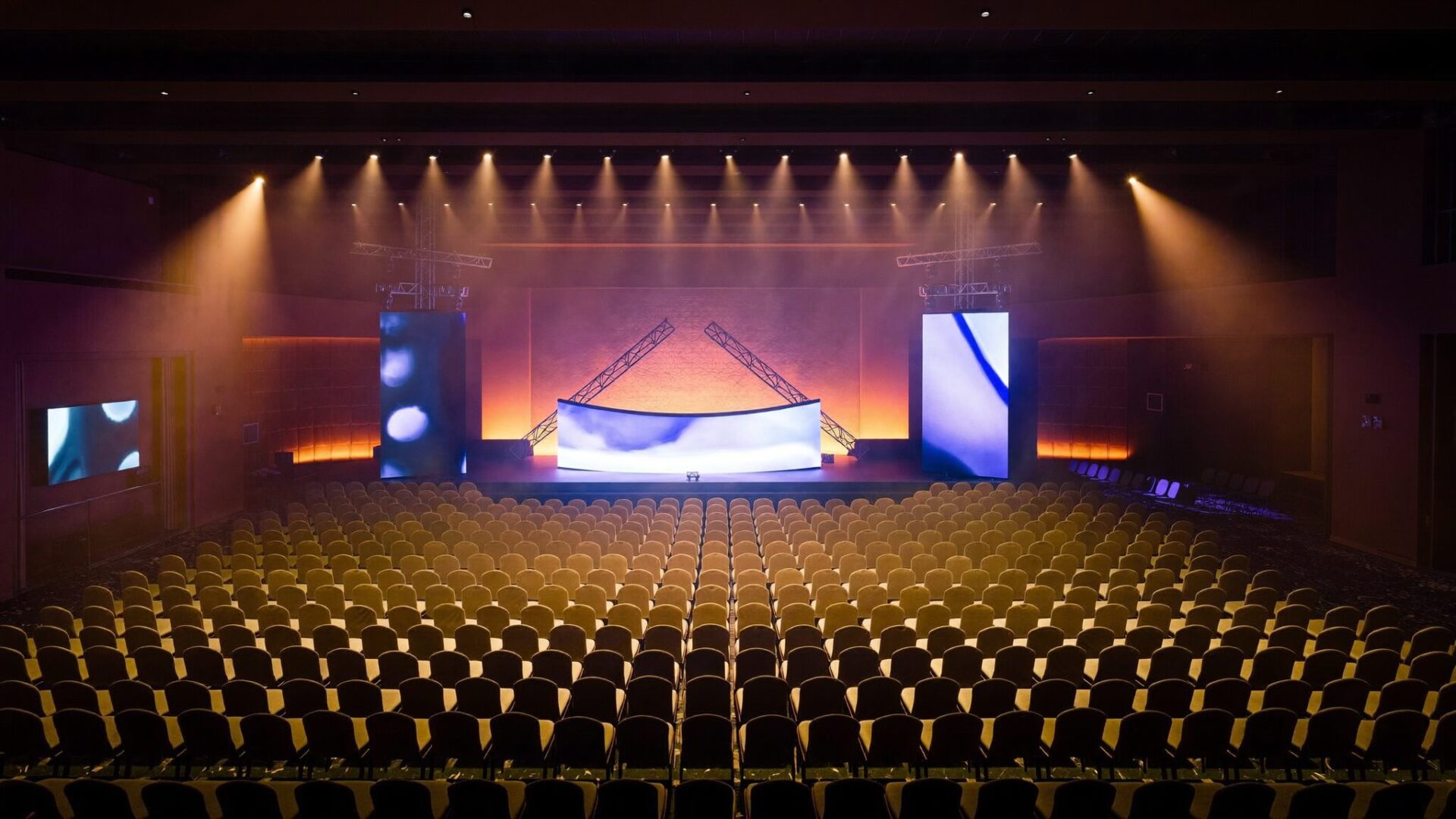
A sales kickoff is produced well when the room works as hard as the agenda. The sales leaders write the message; the production team decides whether a few hundred reps can still follow it from the back row on day two. This guide covers sales kickoff production from the side of the team that designs, builds and runs the room: the three spaces a kickoff needs, where a hotel’s in-house AV stops, how the general session turns into an awards night, and a dated countdown for a January 2027 show.
Agenda design and sales enablement are covered well elsewhere, so we keep them short here. What follows is the part that usually gets decided too late: staging, screens, cameras, show calling and the schedule that holds a January date.
What is a sales kickoff, and why does it need production?
A sales kickoff (SKO) is the internal event at the start of the sales year where a company aligns its sales team on targets, strategy and products. Converve’s sales kickoff planning guide describes it as usually one to three days, often in January or February, and frequently the biggest internal event of the year. From a production point of view it is three events in one: a general session, a set of breakouts and an awards night.
That is why the room matters more than it does at most internal meetings. Attendance is expected, so applause tells you little. The general session sets the tone for the year, and leadership is on stage in front of the people who carry the number. A screen that half the room can’t read, a microphone that drops during the CRO’s opening or a forty-minute gap while a ballroom is reset all send a message nobody wrote.
In-person is the default again for many teams. SalesHood’s 2025 Sales Kickoff Industry Report, a vendor survey of more than 100 B2B software companies, found that 62% planned a fully in-person kickoff, as reported by Converve. It is one survey of one sector, so treat it as a signal rather than a rule. When the team does travel, the event has to justify the flights. Our corporate meeting and summit production work starts from that premise.
What are the three rooms of a sales kickoff?
Every kickoff, whatever its size, breaks into a general session where the whole team hears the plan, breakouts where smaller groups practice it, and an evening of recognition. Each one asks something different of production, and a plan that treats them as one room with three agendas usually under-serves the second and third. Two supporting spaces, registration and an optional demo zone, sit alongside them and are included in the table below.
| Part | What it is for | Production needs | What to check with the venue |
|---|---|---|---|
| General session | Targets, strategy, product news, leadership on stage | Designed stage and scenic, LED or projection, IMAG cameras, line-array audio, confidence monitors and teleprompter, a show caller | Ceiling height, rigging points, power, load-in hours, sightlines from the back row |
| Breakouts | Practice in small groups, regional and product sessions | A display, wireless microphone and audio reinforcement in every room; recording if content will be reused; wayfinding | Room sizes, distance from the ballroom, corridor width, turnover time between sessions |
| Awards night | Recognition, energy, the social close | A different look from the general session, walk-up and reveal staging, lighting cues, music playback | Whether the same room can be turned in time, music licensing, the venue’s end time |
| Registration and arrival | First impression, badges, the first look at the theme | Branded arrival build, signage, sometimes a screen loop | Lobby rules, what can be placed in shared hotel space |
| Product demo zone (optional) | Hands-on time with new products before reps sell them | Demo counters, power and network to each station, task lighting | Floor load, network access, security overnight |
Two terms in that table are worth explaining. IMAG, short for image magnification, is a live camera feed of the presenter shown on the big screens, so the person in row thirty sees a face rather than a figure. A show caller is the producer who calls every cue during the session, from walk-in music to slide changes to lighting shifts, working from the run of show: the minute-by-minute script that lists every cue, who triggers it and when.
Breakouts are the part most often under-produced. Our conference and summit production standard is that each breakout room carries its own AV: at minimum a display, a wireless microphone and audio reinforcement. If the breakouts are where reps practice the new pitch, a dead microphone in the regional room does more damage than a weak opening video.
Should you use the hotel’s AV package or a production company?
A hotel’s in-house AV package is built to make any ballroom usable: a screen, a podium, house sound and basic lighting. A production company is brought in to make one specific event look and run the way you intend. For a kickoff with a designed stage, an awards night and several breakout tracks, the gap between those two goals is wide.
We say it plainly on our service page: “We reject the convention of pipe-and-drape staging, hotel AV packages, and templated ballroom layouts.” That is not a criticism of hotel AV teams, who often know their building better than anyone. It is a statement about scope. An in-house package rarely includes stage design, scenic fabrication, lighting design for camera, a show caller or one team accountable for every room across three days.
The practical issue, in our experience, is that many hotels have an exclusive or preferred in-house AV provider. Some require outside production to work alongside that provider or apply terms to outside equipment. These terms vary by property and change between contracts, so we won’t generalize them. Ask the venue in writing what outside production requires before you sign, and put the answer into your technical rider, the document that lists every power, rigging and equipment need for the show.
Pro Tip: Get the hotel’s in-house AV terms in writing before you sign the room block. They will shape your production options more than the ballroom’s square footage does, and they are far easier to negotiate while the hotel is still trying to win the business.
How do you design a general session stage that holds a sales team for a day?
A kickoff general session stage has to work for six or eight hours, not forty minutes. It needs clear sightlines from every seat, screens placed where eyes naturally go, a layout that suits a solo CEO and a five-person panel without a reset, and lighting that reads well in the room and on camera.
Start with sightlines. In a flat hotel ballroom the stage height, the screen height and the distance to the last row decide whether people see the presenter or the back of a head. We draw the room in section, not just in plan, before choosing screen sizes. Wide rooms usually need side screens carrying IMAG so the center screen can stay on content.
Then the stage itself. A kickoff stage hosts keynotes, fireside chats, panels and award walk-ups, often on the same day. A wide, shallow deck with a scenic wall framing a central LED surface handles all of them. Our set and stage design team builds that scenic in the studio, so it arrives as finished panels rather than raw materials, and the brand reads in the architecture rather than on a printed banner. For the wider principles, see our piece on event stage design.
Lighting is where long sessions are won or lost. Color temperature is measured in Kelvin: lower numbers look warmer and more amber, higher numbers cooler and bluer. Presenters are usually lit somewhere between about 3,200 K and 5,600 K, matched to the cameras, so faces look natural on the IMAG screens and in any recording. The awards night can then move warmer and more theatrical. All of it runs through DMX, the control standard that lets one lighting console run every fixture in the room from a programmed cue list. Our guide to event AV production explains the rest of that system.
Finally, presenter support. Confidence monitors are screens at the stage lip that show the presenter their current slide, next slide and a clock. A teleprompter carries scripted sections. Even experienced speakers do better with this support, and the show caller can give time cues without walking on stage.
One example of a room that had to serve several modes: for VTEX at The Glasshouses in New York, a corporate event for more than 350 attendees, we delivered full scenic fabrication and a staging configuration that supported both keynote presentations and intimate breakout conversations inside a single open-plan volume. It was not a kickoff, but the problem was the same one: one space, several kinds of attention.
How do you turn the general session into the awards night?
When the awards night happens in the same ballroom, the turn is a planned production phase, not a break. The crew strikes the general session layout, resets tables and stage, refocuses lighting and changes screen content, often in a few hours. It works when the awards night is designed as its own event from the start, with its own look and its own run of show.
Strike means taking down and removing set elements; here it is partial. The stage deck and LED usually stay. The scenic dressing changes, the lighting moves from presenter-friendly white to a warmer, more dramatic look, and the floor goes from rows of chairs to rounds. If a second room is free, the awards night can be built there in parallel, which removes the pressure but needs a second set of equipment and crew.
The awards themselves need staging thought. Walk-up paths should be short and lit. Winners need a clear mark for photos. Each award needs a cue sequence: name read, music sting, lighting hit, photo moment, walk-off. Our article on awards ceremony production covers pacing in detail, and our corporate galas and award ceremonies service page shows the wider scope.
Changing the feel of a large room is mostly a lighting job. For the Roivant holiday gala at the New York Public Library, a corporate celebration for more than 400 guests, we designed the lighting to lower the perceived ceiling height and create intimacy at guest level, with full AV and strict preservation requirements. The same approach turns a daytime ballroom that felt like a classroom into an evening room that feels like a celebration.
Pro Tip: Write the room turn into the run of show with named owners and times. The awards night starts when the last breakout ends, not when guests walk in, and every minute of the turn should have a person responsible for it.
How do you choose a city and venue for a destination kickoff?
A destination kickoff is chosen for the team, but it is produced in a ballroom, so the production checks matter as much as the weather. Before the contract, confirm ceiling height and rigging points, the loading dock and freight elevator, the hours the room is truly yours, and what other groups are in the building that week.
Five of our markets suit a winter kickoff, each for its own reasons. Scottsdale offers resort campuses and mild winter weather. Miami brings warmth and strong air connections. Nashville has music built into the evening program. Dallas is central, with two major airports. Las Vegas has a deep supply of hotel ballroom and convention space, which suits large sales teams.
Las Vegas has a calendar catch. CES 2027 runs January 6 to 9, according to the Consumer Technology Association, and during CES week in Las Vegas hotel rooms, ballrooms, freight docks and production crews are all in short supply. A kickoff that lands the same week, or the days either side of it, competes with the whole technology industry for the same resources. Moving it a week later often makes production simpler.
Whatever the city, walk the space before the design locks. Our site survey checklist lists what we measure: door and elevator dimensions, floor loads, power locations, rigging capacity and the route from dock to ballroom. In a resort, add the distance between the general session and the breakout rooms, which decides how long turnover takes. If the kickoff is closer to an off-site, our guide to corporate retreat production covers the smaller-format version.
What does a January 2027 sales kickoff countdown look like?
As of late October 2026, a mid-January kickoff is about eleven weeks away. On our service page we recommend 8 to 16 weeks of lead time for executive summits with custom environment design, and 4 to 6 months for large all-hands meetings and conferences with complex staging, broadcast production and multi-venue logistics. A summit-scale kickoff still fits this January if the big decisions lock in November. A large, multi-venue all-hands with broadcast production is different: eleven weeks is shorter than the 4 to 6 months we recommend at that scale, so either narrow the scope or lock every design decision now.
The December holidays are the hidden constraint. Fabrication shops, freight carriers, venue teams and your own approvers all slow down in the last two weeks of the year. Plan for the build to be finished, crated and ready before mid-December, and treat the holiday stretch as time you do not have.
| When | What gets decided or done | Who owns it |
|---|---|---|
| Now to mid-November | Venue walkthrough, stage concept, screen and camera plan, award format, breakout count and room list | Planner, production team, sales leadership |
| Mid-November | Design lock: stage drawings, scenic finishes, LED layout; shop drawings begin | Production team, with sign-off from the planner |
| Late November to mid-December | Fabrication and finishing, graphics, video content briefs, presenter content deadlines set | Production team, internal comms, presenters |
| Mid-December to New Year | Build complete and crated; holiday slowdown; no new design changes | Production team |
| First week of January | Freight delivery confirmed (booked in December, when the build was crated), rehearsal plan confirmed, final run of show issued, presenter decks in | Production team, planner, presenters |
| Load-in day | Install, lighting focus, sound check, technical rehearsal with presenters | Production crew, show caller |
| Show days | General session, breakouts, room turn, awards night, strike | Show caller and full crew |
Load-in is the period when equipment and scenic arrive and are installed in the venue; the technical rehearsal is the run-through with presenters, cues and screens before doors open. Both need protected time in the hotel contract, which is another reason to settle the room hours early. Our custom event build timeline explains each stage in more depth, and the corporate event planning timeline covers the planner’s side of the calendar.
If your date is closer than the table allows, talk to us anyway. Our in-house fabrication and production let us work to compressed timelines when the business needs it; what changes is how early the decisions have to land.
Pro Tip: Set the presenter slide deadline one week before load-in and hold it. Late decks are the most common cause of a rough first session, because every late change has to be loaded, checked against the screen layout and rehearsed with the show caller.
How should hybrid and recorded sessions be handled?
When remote teams join, give the stream its own production path rather than sending a feed of the room. That means dedicated cameras and switching for the broadcast, graphics built for a laptop screen, and a way for remote reps to take part in the practice sessions rather than just watch.
Recording is a separate decision. If breakout content will be reused for new reps who join later in the year, or for teams who could not travel, plan the recording into those rooms from the start: a camera, clean audio from the presenter’s microphone and slides captured directly. Adding it on the day rarely produces anything usable. Our article on hybrid event production explains when the extra scope is worth it.
Sales kickoff questions we hear often
How long is a typical sales kickoff?
Most run one to three days, according to Converve’s planning guide, which notes that two days usually leaves room for a general session, practice in breakouts and one evening of recognition.
What should a sales kickoff agenda include?
Targets and strategy, product and skills sessions, practice in small groups, recognition and a clear close. From a production view, the agenda should also show where each session happens and when the rooms turn over.
How far ahead should we plan a sales kickoff?
We recommend 8 to 16 weeks for a summit-scale kickoff with custom stage design, and 4 to 6 months for large all-hands meetings with complex staging, broadcast production or several venues. Shorter timelines are possible when design decisions are made early and held.
Why work with a full-service production company for your kickoff?
A full-service production company gives you one team that designs, fabricates, installs, runs and strikes the whole kickoff: the general session, the breakouts and the awards night. Every seam between vendors is a place where something can fall through, and a three-day kickoff has a lot of seams.
For our executive meetings and summits, that means architectural stage and set design, and broadcast-quality production with multi-camera capture, LED displays, confidence monitors, teleprompter and hybrid capability designed in from day one. It also means attendee experience design for registration, breakouts and networking areas. Confidential content is handled under NDA-protected processes, which matters when the general session includes next year’s numbers.
Everything we build is fabricated and tested in our studio before it reaches the venue. On site, our team runs the technical rehearsal, calls the show and manages live production, so your sales leaders can focus on what they came to say. It is the same model behind our full-service event production work across our markets.
Tell us your dates, headcount and venue, and we’ll come back within one business day with a production scope and a schedule that fits your kickoff.