
A Hamptons brand activation is a logistics problem wearing a design brief. The East End gives you salt air, low horizons, and an audience that photographs everything, and it takes back most of the conveniences a production crew relies on in the city: loading docks, freight elevators, hardware stores open past six, and a permit office that has seen your kind of build a hundred times before. Everything you install between Southampton and Montauk arrives on a truck from somewhere else, on a schedule set by a season that does not negotiate.
We have built on that sand. The work we have installed at The Surf Lodge and along the Montauk waterfront taught us that the East End rewards preparation and punishes improvisation more sharply than any venue in Manhattan. This guide covers what actually governs a build out here: the season, the permitting authorities, the freight, the weather loads, and the venues themselves, which are almost always operating businesses at their busiest moment of the year.
The Season Sets the Schedule Before You Do
The East End operates on a compressed calendar, and every serious activation in the Hamptons is scheduled backward from it. The commercial season runs roughly from Memorial Day through Labor Day, with shoulder weeks on either end that behave differently in every hamlet. Inside that window, the venues worth activating are booked, staffed to capacity, and unwilling to lose a service period to your load-in.
That has two consequences for the build. The first is that your install window is almost never the day before the event; it is a few hours between a lunch service and a dinner service, or a single morning before a venue opens its gates. The second is that the fabrication has to be finished before it leaves the shop. There is no second truck, no overnight run to a supplier, no shop hour bought back on site.
Design development and engineering therefore have to land in the spring for a summer install. By the time the season opens, the drawings should be approved, the materials ordered, and the finish samples signed off. A Hamptons brand activation that is still resolving its structural approach in June is an activation that will be resolving it in a parking lot in July.
Shoulder Seasons Are Not a Discount Window
Brands sometimes look at May or September as an easier path. The calendar is looser, but the weather is less predictable and the venue’s staffing is thinner, which means fewer hands available to help and less tolerance for a build that needs the venue’s cooperation. Plan a shoulder-season install with the same rigor and more contingency, not less.
Permits Are Town Business, and the Towns Are Specific
The Hamptons is not a single jurisdiction. It spans the Town of Southampton and the Town of East Hampton, plus several incorporated villages that write their own rules, and Montauk sits inside the Town of East Hampton rather than standing on its own. Whoever tells you a single permit covers the East End has not filed one.
East Hampton reviews special event applications on a sliding lead time keyed to expected attendance: three weeks for the smallest gatherings, a month at the next tier, and up to sixty days once you cross a few hundred people. Applications go in on paper, with notarized signatures, and a committee that includes the police chief, the fire marshal, and the town clerk’s office reviews them together. Southampton runs its own special event process through the town clerk, with liability insurance naming the town, crowd managers carrying fire-marshal-approved training certificates, and coverage that has to extend across setup and breakdown rather than the event hours alone.
Three details catch production teams from out of town:
- Tents are a separate filing. On commercial or public property, a tent of any size needs its own permit from the fire marshal’s office, and so do generators, inflatables, and anything with an open flame. That filing runs parallel to the special event application, not after it.
- Beach jurisdiction is layered. In East Hampton, the Town Trustees control many of the ocean and bayfront beaches, and an event on Trustee land needs a Trustee permit in addition to the town’s. Montauk’s beaches sit outside Trustee jurisdiction, which does not mean they are unpermitted, only that the paperwork goes to a different desk.
- Food service is a county matter. Temporary food service and sanitary permits come from Suffolk County, and the towns will ask to see them attached to your application.
The practical lesson is that permitting drives the design, not the other way around. Attendance tiers set your filing deadline, so the headcount has to be honest early. Whether a structure is a tent or a fabricated architectural element changes which office reviews it. We resolve those questions during design development, while a drawing is still cheap to change.
Everything Comes From the Shop, Complete
The single biggest difference between producing in the city and producing on the East End is the distance between the build and the site. Our shop is in New York City, roughly a hundred miles and one heavily trafficked summer highway from Montauk. That distance turns every unfinished detail into a day lost.
So we finish in the shop. Panels get cut, assembled, painted, and test-fit before anything is crated. Hardware gets bagged and labeled to the element it belongs to. Touch-up finish travels with the crew in known quantities. The install crew’s job on site is assembly and placement, not fabrication, which is the only way an install fits inside the hours a working venue will give you.
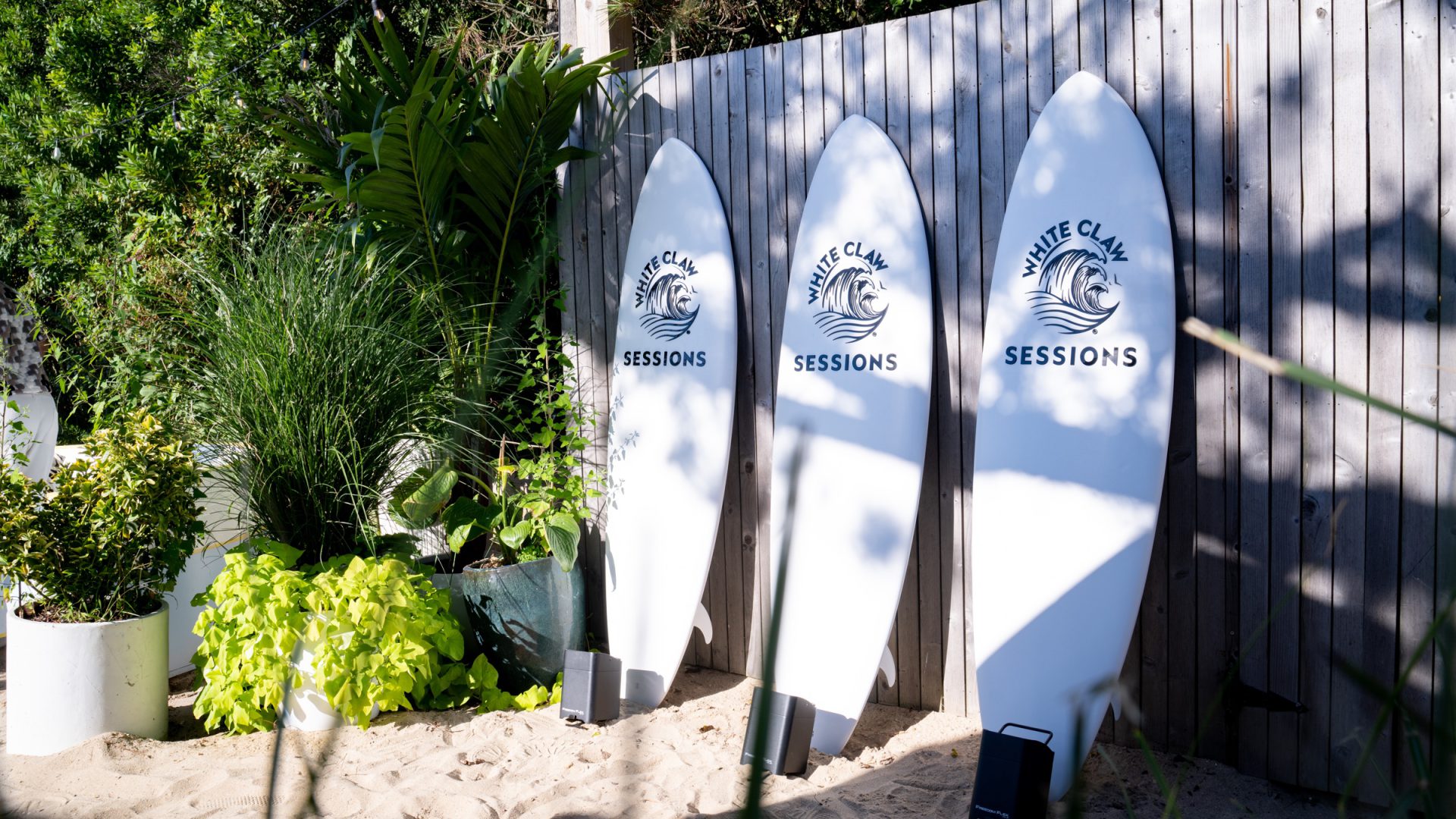
The White Claw Sessions takeover at The Surf Lodge in Montauk ran exactly that way. We fabricated, produced, and installed the branded environment, and every piece moved from drawings through shop build, transport, on-site production, and installation as a planned sequence: mirror-finish WHITE CLAW letters standing on the sand at the edge of Fort Pond, an oversized white photo frame scattered with the brand’s colored can tabs on the waterfront deck, custom surfboards at the entrance and around the property, and a reclaimed-wood entrance sign. Nothing about that inventory is improvisable at the end of a long drive.
Crate for the Site You Are Going To
Crating for the East End is not the same as crating for a convention center. There is no marshaling yard and often no dock. Elements have to come off a truck by hand, cross gravel, grass, or sand, and clear a gate built for guests rather than freight. That constrains the maximum size of any single piece long before it constrains the design, which is why we set the module size with the path to the site drawn on the plan, not after the fact.
Sand, Salt, and Wind Are Structural Inputs
Waterfront sites apply loads that indoor work never sees. Wind off open water is steady rather than gusty, and a flat branded surface is a sail. Sand offers no anchoring resistance worth counting on, so freestanding elements need ballast designed into their bases, weighted low and concealed, rather than stakes trusting ground that shifts.
Salt air is the quieter problem. It finds untreated steel, raw fasteners, and any edge where a finish was not sealed, and it works on them for the length of a summer install. Elements that live outdoors for a season are specified differently than the same object built for one indoor night: sealed edges, corrosion-resistant hardware, finishes chosen to survive UV as well as spray.
Reflective surfaces deserve their own note, because the East End invites them and the conditions punish them. Mirror finishes capture sky and water and make an object read larger than it is, which is why they work so well on a waterfront. They also hold salt spray, fingerprints, and dune dust visibly, so any mirror element needs a cleaning plan assigned to a named person for the run of the activation, not just a crew at install.
Scale demands restraint too. A tall element that reads beautifully in a rendering becomes a liability on an exposed deck in an afternoon onshore breeze. We would rather build wide and low with real ballast than tall and light with a hopeful anchor, and that trade-off is easier to make in event fabrication drawings than in a conversation on site at four in the afternoon.
The Venue Is Open, and It Is Not Yours
Almost every East End site worth activating is an operating business in its peak weeks. The restaurant is serving, the bar is turning, the hotel is full. A build that treats the venue as an empty shell will be removed or resented, usually both.
The approach that works is integration at the venue’s own touchpoints. For NYLON Magazine’s NYLON Nights celebration at The Surf Lodge, we fabricated and installed a series of premium branded activations placed at key points through the property, built to sit inside the venue rather than be imposed on it. Working alongside the project’s architects, the brand presence read as part of the place, which is exactly the outcome a venue operator will agree to again next season.
The opposite extreme is also available when the brief and the operator support it. For the Delilah collaboration with Chase in Montauk, we transformed an existing restaurant into a one-of-a-kind pop-up by treating the building as a single re-skin rather than a set of installed pieces. The entire street-facing façade was clad in mirror as a paneled cladding system fabricated in our shop and installed over the existing exterior, and a ground-up new entrance was built. That is a fundamentally different negotiation with a venue than hanging signage, and it only works when the operator is a partner in the concept from the start.
Read the difference before you design. Ask who owns the outdoor space, what hours the venue will surrender, what can touch the building, and what has to be gone by opening. Those answers define the activation footprint more precisely than any creative brief will.
Build for the Camera, Because the Camera Is the Distribution
Reach on the East End is earned, not bought. There is no paid channel that performs like a guest photograph taken at golden hour with open water behind it, which is why a Hamptons brand activation should be designed around a small number of engineered photo moments rather than a scatter of branded objects.
Three principles hold up out here. Frame the horizon rather than blocking it, because the view is the reason people came and any structure that competes with it loses. Put the brand in the object instead of on it, so a surfboard, a letter set, or a frame carries the identity through form and material rather than an applied logo. And design for the angles guests will actually stand at, which on a beach or a deck means low, wide, and legible from a phone held at chest height.
Durability is part of the design, not a separate concern. An element that thousands of guests lean on, sit near, and hand drinks over across a season has to survive contact without looking tired in week six. Finishes get specified for wear, edges get radiused, and touch-up gets scheduled. Strong content capture comes from objects that still photograph well in August, not just on opening night.
A Working Checklist Before You Commit
Before a concept goes to a client for approval, we want honest answers to a short list. What is the real attendance number, and which permitting tier does it trigger? Which town or village governs the site, and is any part of it Trustee or county land? What is the install window in hours, and what is the venue doing on either side of it? How does the freight get from the truck to the final position, and what is the largest piece that path allows? What is exposed to wind and salt, and for how long? Who cleans it, and how often?
Those six questions resolve most of what goes wrong on the East End. They also tend to improve the design, because constraints stated early get solved with craft instead of compromise. A brand activation conceived with the freight path and the wind load already in the drawing is usually a better object than one that had to be cut down to fit reality later.
If you are planning a summer activation in Montauk, Southampton, or anywhere along the East End, the most useful conversation happens early, while the season is still far enough away to build properly. We design, fabricate, and produce brand activations out of our own shop, which means one team carries the concept from drawings through the install and back out again at strike. Tell us about the site and the season you are aiming for, and we will tell you what it takes to build there.