
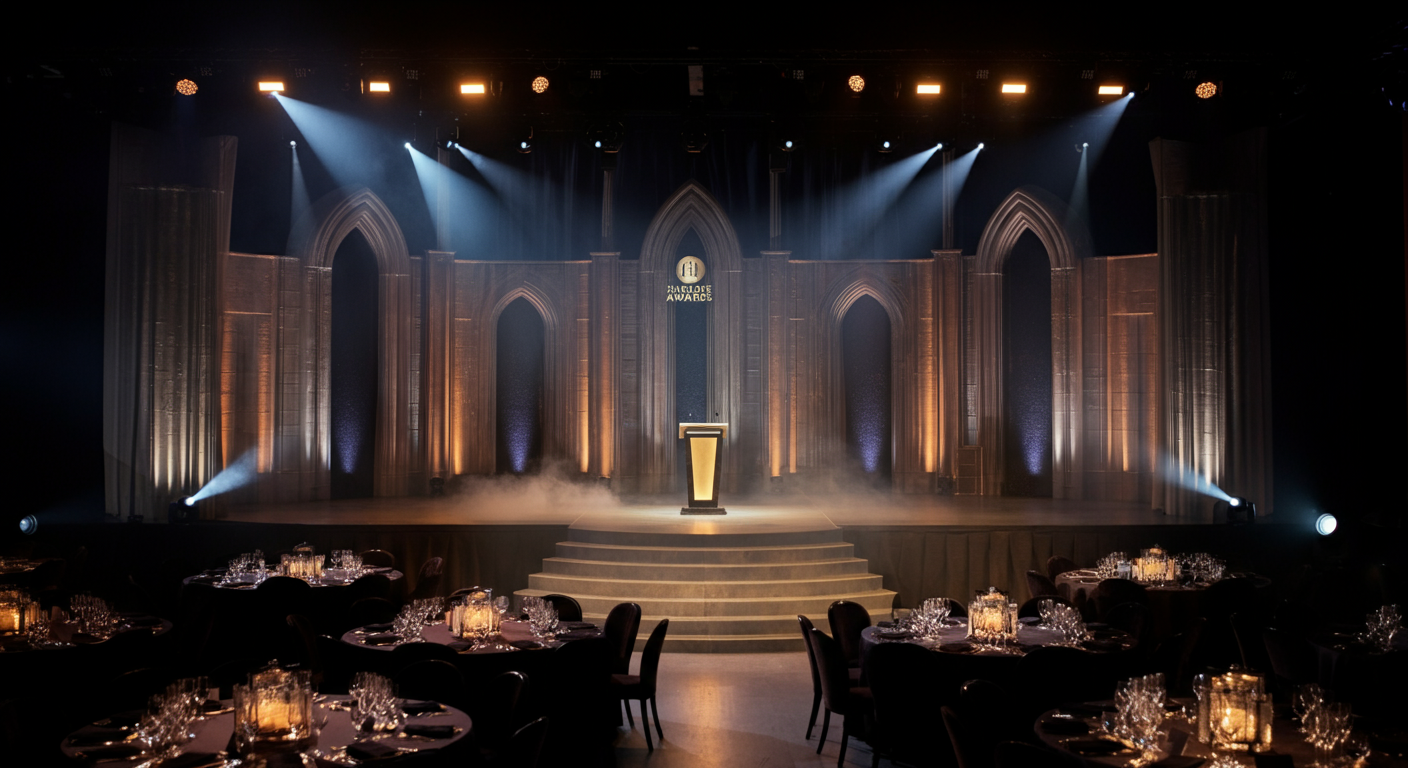
An awards ceremony either lands or it drags, and by the end of the first commercial break the room has already decided which one it is. There is no middle state. A tight 90-minute show with a strong cold open, a host who steers, and clean transitions creates a night the winners remember and the audience posts about. A loose 140-minute show with over-scripted speeches and dead air between segments creates a night everyone leaves early from. Awards ceremony production is the most structurally unforgiving format in the event industry — every element either compresses energy into the room or bleeds it out.
The difference between the two is almost never budget. It is rundown discipline, staging rigor, and a handful of structural decisions made three months before the first rehearsal.
The architecture of a show that lands
Every awards ceremony that works shares the same skeleton. Strip away the creative — the category themes, the production design, the host’s voice — and the underlying structure is almost identical from the Oscars to a regional industry association dinner. Get the skeleton right and the creative has room to breathe. Get it wrong and no amount of production design can rescue the night.
The cold open
The first 90 seconds set the ceiling for the rest of the show. A cold open is the pre-titles sequence that pulls the room into the night before the host even walks out — a video package, a live performance, a single wide-angle reveal of the room. It answers the question “why are we here tonight” in under two minutes. Skip the cold open or weaken it, and the show starts from a deficit that the host has to spend the first ten minutes clawing back.
The host
The host is not just a presenter; the host is the pacing mechanism. A strong host moves the show from category to category, reads the room in real time, and absorbs the inevitable technical bump without breaking the energy. The cardinal sin in awards show casting is hiring a celebrity who reads the teleprompter but cannot steer the room. A B-list comedian with stage reps will outperform an A-list movie star with none, every time. For corporate ceremonies, the best hosts are often the executives’ own colleagues with genuine stage experience — not the CEO, not the CMO, not the agency creative director trying to be funny.
Category pacing
The classical awards show pacing pattern is category-cluster-break-category-cluster-break, with the clusters built around emotional variety. You do not want three “lifetime achievement” categories in a row. You do not want the technical categories bunched at the front and the glamour categories bunched at the back. You want texture: a serious category, a lighter category, a surprise, a musical transition, a heavier moment. The eight-category corporate awards show and the 24-category industry gala follow the same underlying principle, just at different scales.
Acceptance time limits
The most consequential single line in the rundown is the acceptance speech time limit. 45 seconds is tight but workable. 60 seconds is the sweet spot. 90 seconds is the ceiling before the show starts to bleed. The limit has to be communicated to nominees in writing weeks out, reinforced at the pre-show briefing, and enforced live with a visible timer and a play-off cue. Nominees who go over are not bad people — they are people who were never given a real constraint. The producer’s job is to give them one.
Musical transitions
Music is the connective tissue of the show. A live band, a DJ, or even well-cut playback carries the audience from category to category without the host having to do all of the work. The transition from category announcement to winner walk-up to podium to acceptance to walk-off should have a scored under-bed. Dead air between segments is the single most common failure mode in amateur awards shows; a musical bed eliminates it entirely.
The walk-off
The final two minutes of the show are as important as the first two. A closing musical number, a tight thank-you from the host, a final wide shot of the room — and out. Not an awkward “and now please enjoy the afterparty.” Not a raffle. Not a surprise encore from the sponsor. A walk-off is a produced moment, not an announcement.
The production requirements nobody sees
The show’s skeleton is the creative brief. The skeleton holds up because of a production apparatus that the audience never sees and the press never mentions.
Rundown discipline
The rundown is the second-by-second document that governs the show. Every element — VTR, live category, winner walk-up, speech, band, transition, commercial-equivalent break — has a start time, a duration, a cue name, and an owner. A well-built rundown for a 90-minute show runs 40 to 60 pages. It is the single most important document in the production office, and it is rewritten daily until the morning of show. The stage manager calls from the rundown. The lighting board runs from the rundown. The camera shaders cue from the rundown. A rundown that drifts by 30 seconds per category compounds into a 15-minute overrun by the end of the night.
Teleprompter
The host reads from prompter; the presenters read from prompter; the category announcement cards read from prompter. The prompter operator is one of the most skilled roles in the building — they are steering the host’s delivery in real time, slowing down when the host needs breath, speeding up when the show is behind. A good prompter operator will never be thanked publicly and should be paid like a specialist because they are one.
Stage management
The stage manager calls the show. “Standby cue 14… go cue 14.” Lighting, sound, video, pyro, band, talent — every department listens to the stage manager on headset, and the stage manager listens to the producer. In a well-run show, the producer never has to raise their voice, because the stage manager is doing all of the live talking.
Lighting cues tied to the rundown
Every transition in the rundown has a corresponding lighting cue. A winner’s walk-up has a follow spot. A heavy category has a tonal shift. A musical break has a look change. The lighting designer programs hundreds of cues against the rundown; the lighting board operator executes them on the stage manager’s call. When a show feels cinematic in the room, it is almost always the lighting doing the work.
Playback reliability
Every VTR — every nominee package, every sponsor reel, every intro video — is a potential point of failure. Production shows run redundant playback: two playback machines, two audio paths, two feeds to the screen, with an engineer watching both. The cost of redundancy is trivial. The cost of a dead screen during the keynote award is the night.
The award itself is a design object
The trophy matters more than most clients realize. A light, plasticky award telegraphs “we did not take this seriously.” A heavy, well-crafted award telegraphs gravitas. The weight of the object in the winner’s hand, the feel of it on the photograph stand, the way it photographs under stage light — all of it communicates the seriousness of the category.
The best awards are designed as part of the event’s creative system, not sourced from a trophy catalog the week before. Material matters: bronze, cast glass, machined aluminum, marble. Weight matters: 3 to 5 pounds is the threshold at which the object starts to feel like a real award. The engraving has to be legible but not center-stage. The base has to sit flat on a mantle, a shelf, a corner office desk. These are object-design questions, not procurement questions.
- Lifetime achievement awards: heavier, darker, more sculptural — 5 to 8 pounds, bronze or cast metal, often custom.
- Category winners: 3 to 5 pounds, unified design language, consistent material.
- Nominee mementos: a lighter object or a keepsake, given to all nominees regardless of outcome. Small but specific.
Winner coordination: the choreography nobody notices
The 45 seconds between a winner’s name being announced and that winner standing at the podium is one of the most choreographed sequences in live production. Done well, it looks effortless. Done badly, it is where the show loses its rhythm.
The walk-up path
Every seat in the nominee section is mapped. Every aisle is known. A runner — often multiple runners — is stationed near each nominee table to guide the winner to the stage-right steps. The path is rehearsed in the walkthrough, even if the winner is not. Lighting follows. Cameras cut. The walk-up takes 20 to 30 seconds, and the band is playing under it.
The green room
A proper green room is not an afterthought. Winners come off stage with adrenaline, an award in one hand, a need for water, a makeup touch-up, and often the press line waiting. The green room needs a private monitor feed of the show, water, light food, a mirror, a stylist on call, and a stage manager tracking who is where. For a corporate milestone event with named honorees, this is non-negotiable.
The photo moment
Every winner needs a formal photograph with the award. Some ceremonies do this live onstage after the speech; others route winners to a photo wall backstage immediately after the walk-off. The photo is the asset the winner will post, the organization will print, and the press will run. Budget a dedicated photographer, a branded backdrop, and a photo wrangler whose only job is to move winners through the photo station in under 90 seconds each.
Broadcast versus in-room
An awards ceremony built for a room is a different show than one built for a camera. If the ceremony will be streamed, broadcast, or cut into content afterward, the production specs multiply.
In-room priorities
In-room, the priorities are energy in the space, visibility from every seat, acoustic clarity, and the emotional arc of the evening. Lighting is warmer. Stage moves are slower. The host can break the fourth wall.
Broadcast priorities
For broadcast, the priorities are camera coverage (minimum three cameras, ideally five plus a jib and a handheld), color-correct lighting for camera (usually cooler than in-room), mic coverage on every podium and nominee table, and a show that can hold the attention of a viewer at home with no ambient energy to carry them. Acceptance speeches cut tighter. The cold open is a harder sell. The host has to perform for two audiences at once.
The Roivant Holiday Gala at NYPL was a production that sat at this intersection — a seated dinner that functioned as a corporate milestone, a high-stakes honoree moment, and a content capture simultaneously. The rundown had to hold up as an in-room experience for the principals in the room and as a highlight reel for the internal audience the next week. Every lighting cue, every musical transition, every walk-up had to satisfy both frames. That kind of dual-frame production is the hardest in our category, and it is why the strongest experiential event design practices invest in broadcast-grade discipline even for in-room-only shows.
The running time target
Ninety minutes is the right target for a produced awards ceremony with a meal wrapped around it. Two hours is the ceiling before the room fatigue curve breaks. The math is simple:
- Cold open and host welcome: 8 minutes
- First category cluster (3–4 categories): 18 minutes
- Musical interlude or sponsor moment: 4 minutes
- Second category cluster: 18 minutes
- Mid-show keynote or honoree: 8 minutes
- Third category cluster: 18 minutes
- Headline award and walk-off: 16 minutes
That is 90 minutes of show. Every additional category adds roughly five minutes. Every unscripted moment adds two. A ceremony with 24 categories and three honorees cannot be under two hours unless the speech time limit is enforced aggressively. Clients who want 28 categories and no limits should be told the truth: the show will run 150 minutes, the room will empty by the final category, and the last three winners will accept to a half-room.
The common failure modes
After 200+ events, the same failure modes repeat.
- Over-scripted speeches: Someone at the client organization rewrites every category script into a paragraph when it should be two sentences. The host loses the audience in the third paragraph.
- Technical flubs on VTR: The nominee package freezes because it was not tested on the show’s playback system. Redundancy and a full tech rehearsal solve this.
- Dead air between segments: The category ends, the winner is walking up, nothing is happening on stage, and 45 seconds of silence kill the energy. Music under, always.
- Over-running speeches: No timer, no play-off music, no enforcement. The winners who go three minutes teach the next three winners that they can too.
- Host fatigue: A two-hour show is a lot to ask of any host. The host needs a teleprompter partner, scripted banter, and ideally one off-stage break around the 50-minute mark.
- Audio drops on acceptance: The podium mic feedbacks or cuts out. A redundant lavalier on the winner and a backup shotgun mic at the podium eliminate this.
- The “surprise” that derailed the rundown: A last-minute sponsor addition, an unscripted tribute, a founder who decided to go up and speak. The producer’s job is to politely prevent this — and the client’s job is to back the producer.
What actually makes a night land
The clients who come back to us for their annual corporate ceremony or honoree evening do so because we treat awards ceremony production as a discipline with its own rules. It is not a dinner with a program. It is not a conference with trophies. It is a show — with the rundown, the stage management, the talent coordination, and the rehearsal rigor of a network broadcast — produced for an audience that knows whether it landed the moment they walk out the door. Most of our awards-format work runs out of our New York studio, though we have produced the same format in hotel ballrooms from Miami to Los Angeles.
The best night we produce in any given year is usually an awards ceremony, because the structure is so demanding that when it works, everyone in the room knows. The room exhales at the walk-off. The winners are holding objects they will keep for decades. The photos will run in the trade press the next morning. The host has the room in their hand until the final bow. That is not luck. That is a rundown, built three months out, rehearsed three times, and executed on a call from a stage manager the audience never sees.
Awards ceremony production is the format where the invisible work is most visible in the result. When you are ready to design a night that lands — a ceremony with the structural discipline to honor the work, not just announce it — start the conversation here.