
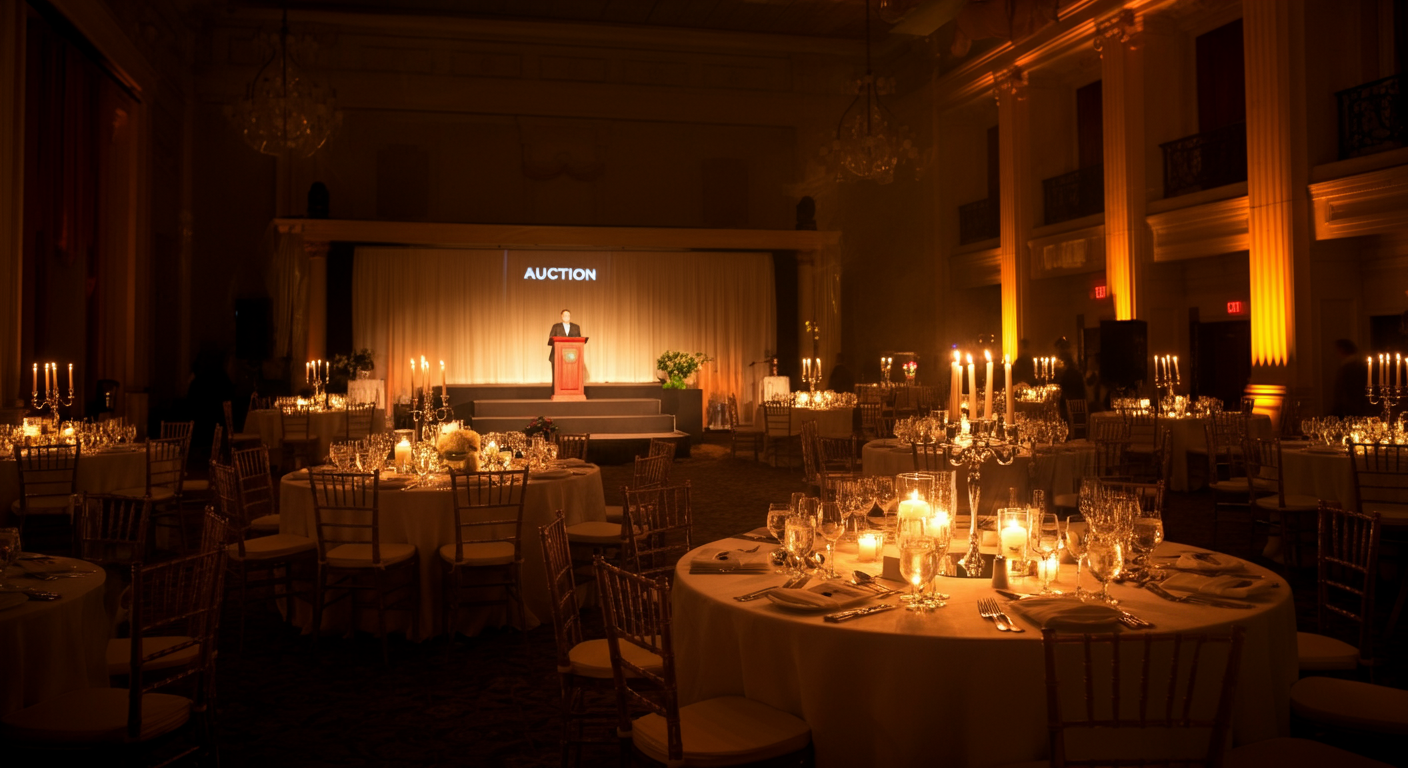
A nonprofit gala is the only event format where the production itself must generate a measurable financial return. Every design decision, every programming choice, and every dollar spent on production must be justified not just by guest experience but by its direct impact on fundraising outcomes. This dual mandate — create a world-class experience while maximizing philanthropic revenue — makes nonprofit galas among the most complex events to produce well.
The organizations that raise the most money are not the ones that spend the least on production. They are the ones that invest strategically in the elements proven to drive donor generosity. High production value does not compete with fundraising — it fuels it. Data from hundreds of galas consistently shows that events with professional-grade production raise 30 to 40 percent more during paddle raise segments than events with minimal production investment.
Here is how to plan a nonprofit gala that delivers extraordinary guest experiences and extraordinary fundraising results.
The Unique Challenge: Production Value vs. Fiduciary Responsibility
Every nonprofit event planner faces the same tension: donors want to attend a beautiful, memorable event, but they also want to know their contributions are going to the mission — not to the party. This is a legitimate concern, and it requires a thoughtful approach rather than a reflexive one.
The reflexive approach is to cut production costs to the bone, serve modest food, and project an image of frugality. This feels responsible, but it consistently underperforms. Guests at austere events give less, not more. The psychology is straightforward: a lackluster experience signals that the organization lacks the sophistication and ambition to deploy resources effectively. Donors give to organizations they believe will use their money to create impact — and an organization that cannot produce a compelling evening raises questions about its ability to execute its mission.
The strategic approach is to invest in production elements that directly correlate with fundraising success — and to be transparent about the economics. Many successful galas now include a brief statement in their program or from the stage noting that the event is underwritten by sponsors, that corporate partners have covered production costs, or that a specific percentage of every ticket goes directly to programs. This transparency disarms the concern and frees guests to enjoy the experience and give generously.
Pro Tip: Secure event underwriting from corporate sponsors before setting your production budget. When you can truthfully say “Tonight’s event has been fully underwritten by our sponsors — 100% of your contribution goes directly to our programs,” you will see an immediate lift in giving.
Setting Fundraising Goals That Drive Planning
Your fundraising goal is not a number pulled from last year’s results plus ten percent. It should be engineered from the bottom up based on your donor base, your audience capacity, and your revenue streams.
A well-structured gala generates revenue from multiple channels: ticket sales, sponsorships, live auction, silent auction, paddle raise (fund-a-need), and post-event follow-up gifts. Each channel should have its own target, and the sum of those targets should exceed your overall goal by 10 to 15 percent to account for underperformance in any single area.
Ticket revenue is the most predictable channel. If you are selling 300 tickets at $500 each, you know you will gross $150,000. But remember that ticket revenue must cover the cost of the guest’s attendance (food, beverage, and a portion of production), so the net contribution to your mission may be modest.
Sponsorships are where sophisticated organizations generate the majority of their gala revenue. A well-structured sponsorship program with tiers ranging from $5,000 to $100,000+ can generate two to five times more than ticket sales. The key is offering sponsors genuine value — brand visibility, client entertainment opportunities, executive access, and association with your mission — rather than simply listing their logo in a program booklet.
Paddle raise is the single highest-impact fundraising moment of the evening, and its success depends almost entirely on execution. We will cover this in detail below.
Honoree Selection: The Strategic Decision Most Organizations Undervalue
Your honoree is not just the person you celebrate — they are your most powerful fundraising asset. The right honoree brings their network to the event, motivates giving through personal connection, and lends credibility to your organization. The wrong honoree fills the room with people who have no relationship to your mission and no inclination to give.
The ideal honoree has three qualities: genuine connection to your cause, a large and affluent personal and professional network, and the willingness to actively fundraise on your behalf. This last quality is critical and often overlooked. An honoree who agrees to be celebrated but will not make calls, host a committee, or personally solicit table purchases is an honoree in name only.
The most successful galas treat honoree selection as a year-round strategic process, identifying and cultivating potential honorees 12 to 18 months before the event. The conversation should be direct: “We would be honored to recognize you, and we need your active partnership in making this our most successful evening ever.”
Auction Strategy: Live, Silent, and When to Skip Both
Auctions can be significant revenue generators or painful time-killers, depending entirely on execution.
Silent auctions work best when they run during cocktail hour and close before dinner. Mobile bidding platforms have transformed silent auctions from clipboard-and-pen affairs into engaging, competitive experiences. Stock your silent auction with experiences rather than objects — exclusive dinners, travel packages, VIP access — and set minimum bids at 40 to 50 percent of fair market value.
Live auctions should be limited to five to eight lots maximum. Each lot should be unique, experiential, and valued at $2,500 or above. A professional benefit auctioneer is not optional — they are essential. A skilled benefit auctioneer will generate 20 to 50 percent more revenue than a celebrity or board member filling the role. Their fee ($5,000 to $15,000) is the highest-ROI investment in your entire gala budget.
Some organizations are moving away from auctions entirely, replacing them with expanded paddle raise segments or exclusive “golden ticket” experiences. If your auction has underperformed for two consecutive years, consider eliminating it and redirecting that programming time to more effective fundraising formats.
The Paddle Raise: Engineering Your Highest-Revenue Moment
The paddle raise — also called the fund-a-need or direct appeal — is where production value pays for itself most dramatically. This is the moment when you ask every person in the room to make a direct gift to your mission, and the environment you have created all evening determines how they respond.
The paddle raise sequence has four essential components:
The mission moment. Before you ask for money, you must remind guests why they are here. A three-to-five minute video or live testimonial that puts a human face on your mission is the most effective format. This is where production investment matters enormously — a professionally produced video with cinematic quality, compelling storytelling, and emotional resonance will outperform a homemade slideshow every time. The difference in giving can be tens of thousands of dollars.
The ask. Your auctioneer or emcee should start at the highest level ($25,000 or $50,000 for major galas, $10,000 for smaller events) and work down through predetermined increments. Each level should be tied to a specific impact: “$25,000 funds a full year of programming for 50 children.” Concrete impact statements outperform abstract appeals by a wide margin.
The energy. This is where lighting, sound, and room design prove their value. The room should feel electric — music underscore building beneath the ask, lighting focused on the stage and then sweeping the room as paddles rise, and genuine celebration as each gift is made. Guests give more when they feel the collective energy of generosity in the room.
The close. Never let the paddle raise fade out. End with a powerful thank-you, a final emotional beat, and an immediate transition to celebration — music, applause, a toast. The emotional high of collective generosity should carry into the rest of the evening, not dissipate into awkward silence.
Pro Tip: Brief your production team on the exact paddle raise sequence in advance. Lighting cues, music cues, and video playback must be rehearsed as precisely as any theatrical performance. A technical glitch during your highest-revenue moment can cost tens of thousands of dollars.
How Production Value Directly Increases Donations
The correlation between production quality and fundraising results is not anecdotal — it is measurable and consistent. Here is why high-quality production translates to higher giving:
Emotional priming. Professional lighting, sound, and scenic design create an emotional environment that makes guests more receptive to giving. A beautifully produced evening puts guests in a generous state of mind before the ask ever happens.
Credibility signaling. High production value signals organizational competence. Donors give larger gifts to organizations they perceive as sophisticated, well-managed, and capable of deploying resources effectively. Your event is a proxy for your operational excellence.
Social proof amplification. In a well-produced room with excellent sightlines and lighting, guests can see each other raising their paddles. This social proof effect — seeing peers give generously — is one of the most powerful drivers of donor behavior. Poor lighting and bad room design hide this effect and suppress giving.
Dwell time and engagement. Guests who are enjoying themselves stay longer, drink more (responsibly), build stronger social connections, and are in a better emotional state when the ask comes. An event that feels flat or poorly executed drives early departures — and every guest who leaves before the paddle raise is revenue lost.
Our experience producing galas like the Roivant Holiday Gala at the New York Public Library has consistently demonstrated this principle. When the production quality matches the caliber of the venue and the significance of the occasion, donors respond with generosity that reflects the investment you have made in their experience.
Donor Stewardship: The Event After the Event
The gala is not the end of the donor journey — it is the beginning of the next phase. Within 48 hours of the event, every donor should receive a personal thank-you. Within two weeks, they should receive a formal acknowledgment with tax documentation. Within 30 days, they should receive an impact report showing how gala funds are being deployed.
The most sophisticated organizations use the gala as a cultivation tool for major gifts. The guests who gave $1,000 at the paddle raise are candidates for $5,000 annual gifts with proper cultivation. The table captains who brought eight friends are candidates for board membership. The corporate sponsors who underwrote the event are candidates for deeper programmatic partnerships.
Capture data aggressively during the event — not just gift amounts, but engagement signals. Who stayed late? Who asked questions about programs? Who introduced the executive director to their network? These behavioral indicators are more predictive of future giving than the size of the initial gift.
Build a Gala That Maximizes Impact
Planning a milestone gala that needs to deliver both an extraordinary experience and extraordinary fundraising results requires a production partner who understands both sides of the equation. Every design decision should be evaluated through two lenses: Does this create a better guest experience? And does this drive higher fundraising outcomes?
If you are planning a nonprofit gala and want to ensure your production investment translates directly into fundraising impact, let’s talk about your goals. We will help you build an event that your donors will remember — and that your mission will benefit from for years to come.