
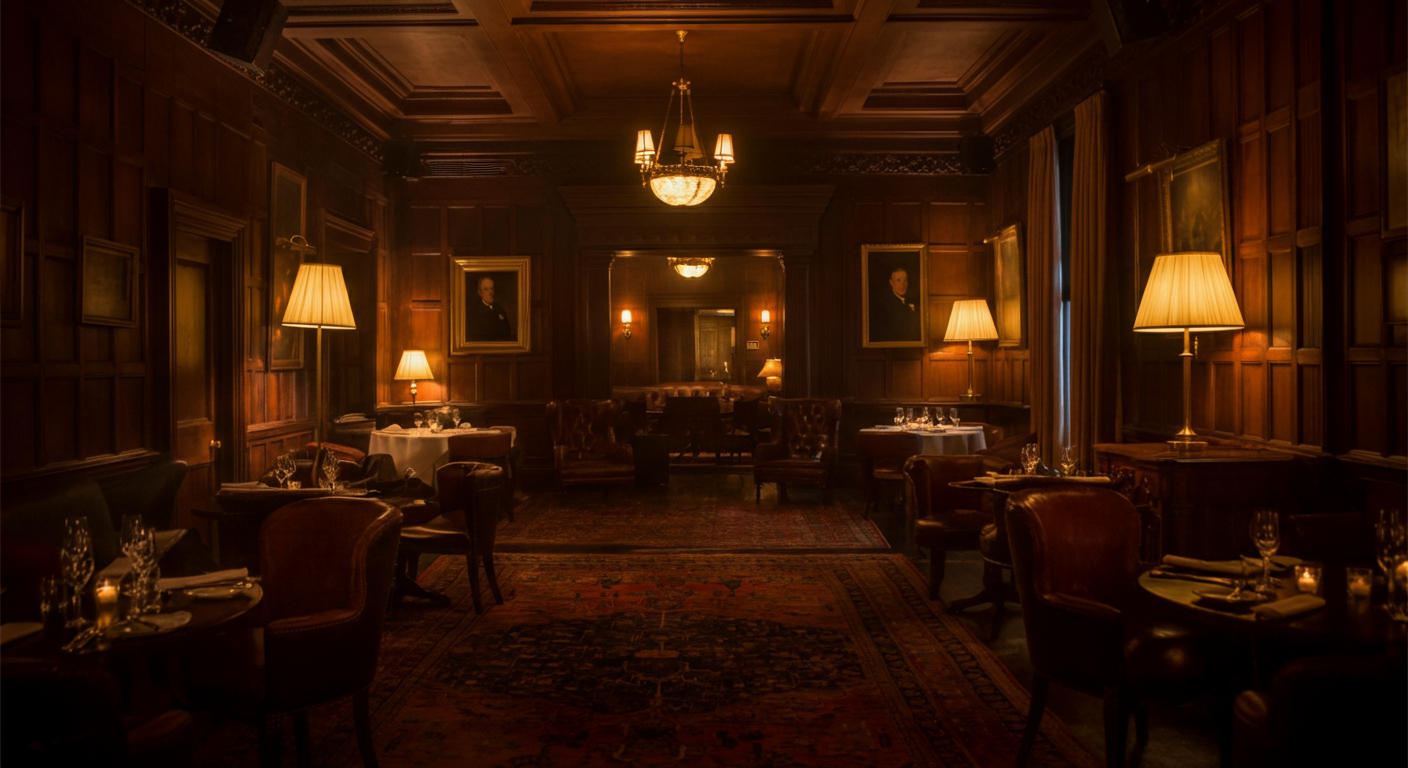
The most consequential rooms in New York are the ones the public cannot book.
That is the premise of the city’s private club landscape, and it is why private club events NYC producers handle with the most discretion are almost always hosted behind a membership door. Hotels advertise. Restaurants buyout. Clubs do neither. They exist, quietly, for members and the select corporate audiences those members are willing to sponsor — which is exactly what makes them valuable for certain kinds of dinners, board meetings, and cultivation evenings.
The question for senior marketers, chiefs of staff, and principals is not whether a private club is impressive. It is whether the operational friction — house catering, AV restrictions, member sponsorship requirements, dress codes, photography bans — is worth the signaling advantage the address delivers. For the right audience, it is. For the wrong one, a club is an expensive way to annoy your guests.
What follows is the working landscape of NYC private clubs as event venues, how the member-sponsor model actually functions, and the frameworks we use with clients to decide when a club beats a hotel private room or a restaurant buyout.
The Two Tiers of NYC Private Clubs
The city’s private club landscape splits cleanly into two categories, and conflating them is the most common mistake producers and clients make.
The first tier is the legacy clubs: old-world, deeply credentialed, typically anchored to specific professions or universities. These are places where the furniture has a provenance and the dress code is strict. The University Club, Knickerbocker Club, Metropolitan Club, Lotos Club, Yale Club, and Union Club sit here. Membership requires sponsorship, vetting, and in some cases decades of waitlist. Private event access for non-members requires a current member’s formal sponsorship on every booking.
The second tier is the new private members’ clubs: Soho House, Casa Cipriani, Core: Club, Zero Bond, The Ned NoMad, Aman New York’s residences and private rooms, and the rotating cast of similar venues opening and closing around Tribeca, NoMad, and the Financial District. These are designed for a younger, industry-driven membership — media, finance, fashion, tech, entertainment. They monetize events more openly and, for the right corporate buyer, are substantially easier to book.
Both tiers deliver the same headline benefit (a private room the public cannot access), but the guest experience, operational constraints, and social signaling are entirely different. Producers who treat them interchangeably end up matching the wrong venue to the wrong audience.
The Landscape: Twelve Clubs That Host Private Events
Soho House
Soho House operates multiple Manhattan and Brooklyn locations — Meatpacking, DUMBO, and the recently opened outposts — each with bookable private dining rooms and screening spaces. The brand is the most accessible of the new private clubs for corporate buyers: members sponsor, but the event team is responsive to non-member producers. Capacities range from 20 to 200 depending on location. Expect house catering, standard AV, and firm policies against photography in public areas of the club.
Casa Cipriani
Casa Cipriani occupies the Battery Maritime Building at the southern tip of Manhattan and combines a private club, a hotel, and a series of ballrooms that function as both. The private club areas are members-only; the ballrooms can be rented for private events without club sponsorship, which makes Casa one of the rare venues that bridges both worlds. Our Barbie Dream House activation at Cipriani used the space’s ballroom infrastructure for a large-scale brand moment that would not have been possible inside a strictly members-only club.
Core: Club
Core: on East 55th Street is one of the most serious new clubs in the city — members-only, culturally programmed, and architecturally ambitious. Private events are almost exclusively member-sponsored. The club hosts board dinners, art-world evenings, and tightly curated cultivation programs. House catering is strong; the AV is conference-grade.
Zero Bond
Zero Bond sits in NoHo and is, for many in media and finance, the current default club for private dinners of 30 to 150. The space includes multiple private dining rooms, a main dining room that can be bought out, and programming areas. Member sponsorship is required. The room runs cool, service-forward, and photographed extensively by the industry it serves.
The Ned NoMad
The Ned NoMad, the New York expansion of the London private club, occupies the former NoMad Hotel building. The ground-floor restaurant is publicly accessible; the upper floors are members-only with a series of private rooms, a library, and a rooftop. Events here skew fashion, media, and hospitality. The club sponsors its own programming, which means the calendar competes with external buyouts.
Aman New York Private Rooms
Aman New York’s private rooms inside the Crown Building are not a club in the traditional sense, but they function as one: access is gated by reservation priority, membership, and hotel-guest status. The private dining room, the Garden Terrace, and the residential floors’ event spaces are available to a small number of corporate clients. The discretion is absolute. Pricing is commensurate.
The University Club
The University Club, on Fifth Avenue at 54th Street, is a McKim, Mead & White landmark that admits men and women who hold degrees from a specified list of institutions. The dining rooms, the library, and the main hall host seated dinners of 60 to 400. Member sponsorship is required. Dress code is enforced. The house catering is old-school in the best sense.
The Knickerbocker Club
The Knickerbocker on Fifth Avenue and 62nd Street is one of the oldest and most discreet clubs in the country. Events are exceptionally rare and require member sponsorship at a level most corporate clients cannot access. When it hosts, it hosts small, seated, and quiet.
The Metropolitan Club
The Metropolitan Club at Fifth Avenue and 60th Street, the Stanford White building facing Central Park, is one of the city’s most gilded interiors. The ballroom seats 400-plus. Member sponsorship is required for every booking. The club is a fit for legacy philanthropic events and finance-driven galas where the address signals a specific kind of seriousness.
The Lotos Club
The Lotos, on East 66th Street, is a literary and arts-oriented club in a 1900 townhouse. Private dining rooms accommodate groups of 20 to 120. The culture is intimate and publishing-friendly. Member sponsorship required.
The Yale Club
The Yale Club on Vanderbilt Avenue, adjacent to Grand Central, is the largest collegiate club in the world and among the most active for private events. Members and their companies book the grand ballroom, library, and private dining rooms for board meetings, class reunions, and corporate evenings. Member sponsorship is required; the roster of members at NYC-headquartered firms makes this less of a barrier than it sounds.
583 Park
583 Park Avenue, the former Christ Church, is a buyout venue that trades on private-club aesthetics without the membership requirement. It is the default answer when a client wants a Park Avenue address, a 400-seat dinner, and full control over catering and AV — a flexibility private clubs do not offer.
The Member-Sponsor Question: How Bookings Actually Work
For most legacy clubs and about half the new ones, a current member must formally sponsor every private event. This is not a formality. The member’s name is on the booking contract, the member is accountable for guest behavior, and in many clubs, the member must be physically present at the event.
For corporate clients, this shapes the planning cycle significantly. The practical paths are:
- Use an internal member. Most large firms have executives or board members with club memberships. Identify the member early, brief them on the event, and route the contract through their name.
- Use the agency’s network. Established producers maintain relationships with members across the major clubs. This is commonly how first-time corporate bookings happen.
- Choose a club with commercial event sales. Soho House, Casa Cipriani, The Ned, and several of the newer clubs have dedicated event teams that will work with non-member producers without requiring a formal sponsor.
- Default to a buyout venue that looks like a club. 583 Park, certain hotel private rooms, and townhouse rentals offer the aesthetic without the sponsorship requirement.
The sponsorship requirement is also a feature, not only a bug. It signals to guests that the evening is serious. A corporate dinner at the Metropolitan Club sponsored by a board member reads differently from the same dinner at a hotel ballroom.
Production Constraints That Define the Category
Clubs protect their members’ experience above all else. This drives every operational policy, and it is the source of the friction producers complain about most.
- House catering lock-ins: Nearly every NYC private club requires in-house catering. Off-menu negotiations are possible at some clubs but rare.
- AV restrictions: Many clubs prohibit external AV vendors, cap sound levels, and restrict stage builds. DJ-forward events are often impossible.
- Dress codes: Legacy clubs enforce jackets for men, no denim, no athletic wear. This must be communicated in the invitation or you will have guests turned away at the door.
- No-photo policies: Most clubs prohibit photography outside contracted private rooms, and several prohibit it entirely. Social media posting rules apply to guests and crew.
- Member privacy: Events must not disrupt member spaces or reveal member identities. Production crew are routed through service entrances.
- Load-in windows: Shorter than hotels, often shorter than restaurants, because clubs operate on member schedules that cannot be compressed.
- Vendor approvals: Florists, photographers, and entertainment must be pre-approved. Same-day substitutions typically are not.
By the numbers: A seated dinner for 100 guests at a legacy NYC private club runs $85,000 to $220,000 all-in: room fee ($8K–$25K), house catering ($350–$750 per person including service and tax), floral and styling ($12K–$40K), AV ($4K–$15K capped by house vendors), and ancillaries. By comparison, a hotel private room at the same guest count runs $55,000 to $150,000 with significantly more creative and catering flexibility. The private-club premium averages 30 to 50 percent — and roughly 80 percent of first-time corporate club bookings in NYC still require a member sponsor’s signature on the contract.
Why Clubs Are Worth the Hassle for Certain Audiences
For a subset of guest lists, a private club delivers what no other venue can: an audience that reads the room before the program starts. HNW principals, senior board members, and legacy-philanthropy audiences understand the signaling of a Metropolitan Club or Knickerbocker dinner in a way that a hotel ballroom cannot produce. The venue does editorial work on the invitation.
Clubs also excel at three specific event types. Board dinners and private cultivation evenings benefit from the controlled environment, the absence of other guests, and the discretion of club staff. Legacy industry gatherings — finance roundtables, publishing anniversaries, alumni-adjacent philanthropy — use clubs because the guests are already members of the same social architecture. HNW family office events frequently select clubs because privacy is the point.
Our luxury private event practice spends meaningful time inside NYC’s clubs for these reasons. The operational friction is real. For the right evening, it is also worth it.
When to Choose a Club Over a Hotel Room or a Restaurant Buyout
A few decision frameworks we use with clients weighing the options:
Choose a club when the guest list skews senior and relationship-driven, when discretion matters more than spectacle, when the invitation itself needs to signal seriousness, and when you have access to a member sponsor or can route through a commercial-access club. Dinners of 30 to 200 seated, cultivation evenings, and board-adjacent events are the sweet spot.
Choose a hotel private room when the guest list is mixed-tier, when creative flexibility matters (staging, custom AV, branded moments), when catering customization is non-negotiable, or when the timeline is short. Hotels turn bookings in weeks; legacy clubs take months. Our corporate meetings and summits work overwhelmingly lives in hotels and purpose-built venues for this reason.
Choose a restaurant buyout when the food itself is the creative, when the room size is right (most restaurants cap at 80 to 150 for full buyouts), and when the guest experience benefits from a space already designed for hospitality. Restaurants also tend to be the fastest to confirm and the most flexible on menu.
Choose a buyout venue like 583 Park, a townhouse, or a private event space when the club aesthetic is the point but the constraints aren’t. This is often the compromise route for producers who want the Park Avenue read without the sponsorship chase.
The Practical Playbook for a Private Club Evening
For teams producing inside a club for the first time, a few patterns hold across venues. Brief the member sponsor early — they are the contract holder, and their preferences shape the booking. Confirm dress code in writing on every invitation, and again in the day-of run of show. Pre-approve every vendor a week before load-in; substitutions are rarely permitted. Walk the service entrances during the site visit, not just the guest flow. Build the AV plot around the house’s capacity, not the ideal; most clubs cannot support external rigs. And assume photography is off unless written approval says otherwise.
The evenings that work at a club are the ones designed around the club’s operating reality rather than against it. The ones that don’t are the ones where the producer tried to treat the space like a hotel ballroom and discovered, slowly and then all at once, that clubs do not bend.
We operate across New York club venues regularly, from Casa Cipriani to the legacy rooms on the Upper East Side, and the pattern repeats: clubs reward producers who respect the house. They punish the ones who don’t.
The Quiet Power Venue Question
Private clubs occupy a specific slot in the NYC event landscape. They are not the largest venues. They are not the most flexible. They are not, in most cases, the cheapest. What they are is the most deliberately gated — and for audiences that read the gate as meaningful, no hotel, restaurant, or buyout venue produces the same effect.
For senior teams weighing a club for an upcoming event, the question is not whether the venue is impressive. It is whether the audience will register the distinction. When the answer is yes, a club is frequently the right call. When the answer is no, the operational overhead is a cost without a corresponding return.
If you are sizing up a private club for a board dinner, cultivation evening, or HNW gathering and want a candid read on sponsorship access, total cost, and fit before the briefing goes further, start a conversation with our team. We will tell you which clubs will actually work for the evening you are trying to produce, and when you should be looking elsewhere instead.