
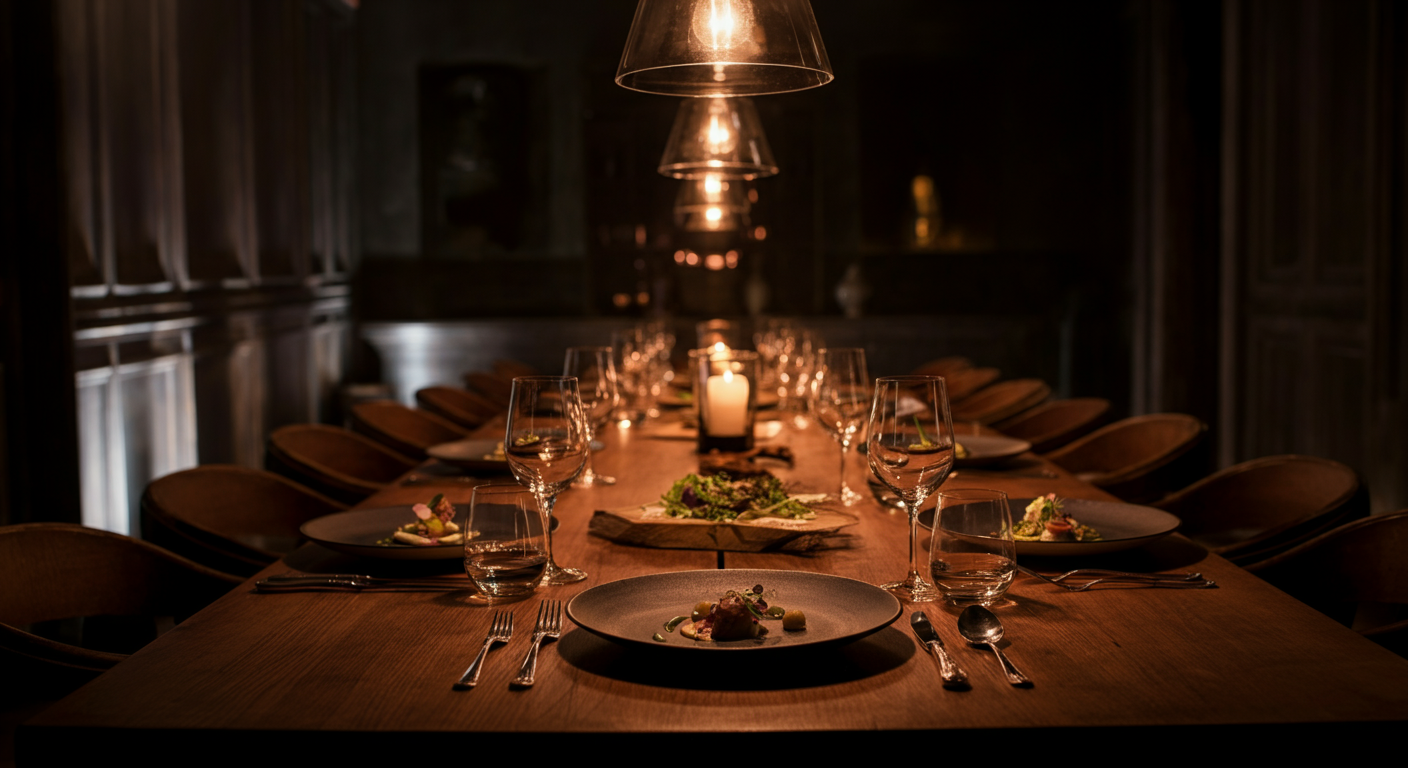
Catering is production. It is not decoration, not an accessory, not the thing you hand off to the venue and hope for the best. On a serious event, the food and beverage program runs parallel to every other discipline — lighting, sound, scenic, guest flow — and it either binds the evening together or quietly unravels it. The most common failure of luxury event catering in our industry is not a bad dish. It is a beautiful dish served at the wrong moment, in the wrong style, to a guest who had already moved on emotionally fifteen minutes earlier.
Menu architecture is how you prevent that. So is service-style selection, beverage strategy, and a working knowledge of the kitchen behind the curtain. What follows is how we think about catering when we produce a gala, an activation, or a private dinner — and why the brief we write for a chef looks nothing like a restaurant order.
The honest distinction between restaurant and event kitchens matters here. A restaurant chef is optimizing for a steady-state service where tables arrive in waves over three hours. An event chef is optimizing for a single, simultaneous plating moment where three hundred covers need to leave the pass inside a four-minute window. Those are different crafts. The best event caterers are not simply restaurant chefs who occasionally do off-premise work; they are kitchen operators who understand the production context from the first conversation.
Menu Architecture: The Four Acts of a Guest’s Night
A well-produced evening has an emotional arc, and the menu should trace it. We structure most programs around four acts: arrival, seated, reception, and late-night. Each act has a different job, and each wants a different kind of food.
Arrival food buys you time. Guests are cold, or hot, or anxious about the coat check line, or wondering if they know anyone. A perfectly crisp gougère, a single oyster, a glass of something cold in the hand — these are not about taste first. They are about physiological reassurance. Portion small. Serve fast. Keep the hands busy so the mouths start talking. We time the first tray to drop within ninety seconds of a guest clearing the coat check, not from the official program start, because the perceived wait is what drives anxiety in the first thirty minutes of a room.
Seated is the set piece. This is where menu design earns its keep — where course progression, pacing, and the pairing of food to speech program either work or derail the room. Three courses is the standard; four is luxury; five is an imposition unless the chef is the draw. The pacing rule we hold to: no more than fifty-five minutes from first course to dessert on a working program, and no more than seventy-five on a gala where speeches are woven in. Longer than that and the room disengages, regardless of how well the kitchen is executing.
Reception is the release. After the seated portion, guests stand up, move, and expect a second wave of texture and surprise. This is where pastry stations, carving moments, and interactive counters live. The reception act is also where the program regains the ability to sell itself — where the photography that will live on a client’s social channel gets made, and where the honoree works the room on their own terms rather than from a head table.
Late-night is the reward — truffle fries at 11:30, grilled cheese at midnight, a slider that photographs well on a phone. Late-night food is the one moment where nostalgia outperforms sophistication every time. The best late-night menus are unapologetically American diner, unapologetically cheap-at-heart, and unapologetically designed to be eaten with one hand while holding a drink in the other. A late-night truffle risotto is a menu item that has misunderstood the assignment.
The Four Service Styles and Where Each Wins
Most catering briefs collapse service style into one line: passed hors d’oeuvres and a seated dinner. That is not a plan. It is a shorthand. There are four legitimate service modes, and knowing which to deploy where is the difference between a room that breathes and a room that stalls.
- Passed service works best during the first forty minutes of a cocktail hour. It creates the illusion of abundance without committing the guest to a station. Cap it at six to eight bites and retire the tray before anyone notices the pattern.
- Stationed service belongs to the reception act, after the seated portion. Stations reward exploration. They also solve for dietary fragmentation — guests self-select rather than flagging a server.
- Seated service is for rooms where the program matters more than the food — a gala with an honoree, a wedding with speeches, a board dinner where the conversation is the content. Seated service imposes order.
- Chef’s-counter service is a luxury moment, usually folded into a larger format. A ten-seat omakase counter inside a two-hundred-person reception tells a specific guest tier that the night was built for them.
Our Tropical Luxury event at Glen Oaks leaned hard on stationed service after a short seated course, because the emotional arc of the evening required movement — guests needed to explore the property and discover the program, not sit through it. A fully seated format would have killed the animation we had built into the garden.
The hybrid format — passed into seated into stationed into late-night — is where the serious programs now live. It treats each act as a distinct discipline rather than trying to extend one service model across the entire evening. The transitions between acts are the seams where most events fail; servers need a clear choreography for breaking down the cocktail setup, clearing seated covers, and opening stations, and those transitions should be rehearsed the day before the event the way a show calls cues. A caterer who cannot describe their transition sequence in detail has not produced enough events to be trusted with a flagship.
Beverage Strategy: Beyond Wine and Cocktails
The beverage conversation in luxury catering has shifted materially in the last thirty-six months, and planners who are still pairing a white, a red, and a signature cocktail are missing half the room. Three threads matter right now.
First, the wine-versus-cocktail debate is not binary. A serious program runs both, but staggers them. Cocktails own arrival. Wine owns seated. A well-built reception bar returns to cocktails, often with a lower-ABV house pour designed to keep guests vertical through the late-night moment. Pouring claret alongside an aggressive mezcal negroni at the same bar station is a logistical signal that no one is in charge of the program.
Second, the zero-proof moment is not a trend — it is structural. We now build every beverage program with a genuine non-alcoholic track, not a token mocktail. That means a zero-proof cocktail with the same glassware, the same garnish, and the same menu card presence as the alcoholic version. Guests who do not drink used to accept an apologetic seltzer. They no longer do, and the shift in expectation is most pronounced at the top of the market.
On a recent 220-guest corporate gala, 34% of beverage consumption tracked to the zero-proof program — up from roughly 12% three years ago in our internal production data.
Third, the bar team is not a line item. Bartenders in a serious program are performers, and staffing one bartender per fifty guests is the floor, not the ceiling. On a well-produced milestone event, we push that ratio to one per forty for the first cocktail hour and dial back once guests are seated. Under-staffing the bar is the single most common mistake in corporate catering. A ten-minute wait for a drink at minute forty of a cocktail hour rewrites the entire tone of the evening — guests who had to queue for a Negroni will tell their seatmates about it before the amuse-bouche arrives.
The glassware question also deserves more seriousness than it usually gets. A signature cocktail served in a rocks glass at a passed format is a spill waiting to happen; a coupe is cleaner optically and safer logistically. Stemware for wine service should be pre-briefed against the actual pour — an oversized Burgundy bowl at a seated dinner with a modest red is a visual mismatch that reads as misjudged rather than generous.
Kitchen and Venue Realities
Every catering brief begins with a kitchen question that most clients never ask: is the venue cooking in place, or finishing off-site? The answer reorders the entire menu. A full working kitchen at the venue means you can plate à la minute, serve delicate proteins, and run a tasting menu. An off-site finish — which is the reality at most tented, industrial, or landmark venues — means the menu has to be engineered for holding.
Dishes that hold badly: medium-rare beef, anything cream-sauced, tempura, eggs in any serious form. Dishes that hold brilliantly: braises, roasted root vegetables, anything built around a room-temperature component. A planner who does not know the kitchen configuration six weeks out cannot write a realistic menu.
Venue caterer restrictions are the second reality. A growing share of New York and Los Angeles venues operate with an exclusive or preferred list, which means you cannot simply bring in the chef you want. Negotiating around that list — or, more honestly, designing within it — is part of the producer’s job. Our Roivant holiday gala at the New York Public Library is a useful case: the venue’s caterer list is tightly controlled, and the entire menu had to be built from the list inward rather than from a blank page outward. The result was still cinematic, but only because the program was designed to work with the kitchen’s actual capabilities rather than around them.
Union rules are the third. In New York, Chicago, and most landmark venues, union stagehands control load-in windows, which determines when the kitchen can stage equipment, which determines when the chef can start prep. Miss that window and the tasting menu becomes a buffet. Producers who have not worked in union venues routinely underestimate the cascade, and the correction — a 4am load-in to compensate for a lost afternoon window — is the kind of cost overrun that shows up in the final invoice in a way the client did not authorize.
A fourth kitchen reality that rarely makes it into the RFP: power. Venues with working kitchens still have finite amperage, and a catering team running induction hobs, convection ovens, and warming cabinets at the same time can trip the house power if the electrical load has not been modeled. This is why a serious caterer walks the kitchen with the venue’s facilities lead at least twice before the event — once at contract signing, once at menu lock — and maps every piece of equipment against the actual available circuits. We have seen a ballroom go dark at minute thirty of a cocktail hour because a crème brûlée torch-and-warmer station was sharing a breaker with the stage lighting. That failure belongs to the producer, not the venue.
Dietary Compliance at Scale
The dietary landscape has grown past the point where a vegetarian alternative solves it. On a 300-guest event, we typically now plan for six to nine distinct dietary tracks: standard, vegetarian, vegan, gluten-free, dairy-free, nut-free, shellfish-free, halal, and kosher — sometimes with specific intersections (vegan gluten-free is common enough to deserve its own line).
Three operating principles hold up at scale.
- Default toward the restrictive. When one course can be naturally gluten-free without compromise, make it gluten-free for the whole room. You reduce the number of asterisks on the kitchen ticket and eliminate an entire category of service error.
- Label the plated course, not the guest. Tagging a guest at the place card creates a caste system at the table. Tag the dish instead — a discreet marker on the plate or the menu card — and let servers deliver by seat number.
- Rehearse the dietary run. On the pre-event walkthrough, run the full dietary sequence as if it were a fire drill. The back-of-house choreography is where most errors originate, and most of them are solvable with one additional runner.
Dietary compliance at a luxury private event is not a service problem. It is a design problem that happens to surface at service. The intake form you send guests six weeks out is where the actual work begins, and how you phrase the questions determines how usable the answers will be. Asking for allergies or restrictions gets you a paragraph that no kitchen can act on. Asking for specific check-box categories gets you a spreadsheet the chef can plate against.
Pairing Menu to Brand and Emotional Arc
The question we ask first on any program is not what will the chef cook? It is what should the guest feel at minute forty, minute ninety, minute one-fifty? The menu answers that question. Food is the most literal emotional language available to a producer. A warm, dark, root-vegetable course drops the room into intimacy. A cold, bright, citrus course lifts it. A bread service with a shared oil decants the table into conversation.
Brand pairing follows the same logic. A fashion activation cannot serve a dinner that contradicts the house — if the collection is spare and architectural, the plates should be too. A financial services gala is not helped by molecular gastronomy; it is helped by confidence and restraint. A brand activation for a beverage client that does not make the client’s product the spine of the bar program has misunderstood its own brief.
The menu should also be legible to the people it is serving. A cocktail menu written in house-cocktail slang — obscure amari, esoteric garnishes, opaque names — can feel exclusionary at a room where half the guests came to close a business relationship, not to study a drink list. We generally write menus in two registers: a short, human name on the card that any guest can order without feeling tested, and a longer descriptive line that rewards the guests who want the detail. The goal is hospitality, not a pop quiz.
The menu, at its best, is the brand sentence. When a guest leaves and describes the evening to a colleague the next morning, the two things they will recall are the first drink and the last bite. Everything in between is production scaffolding. The bookends are what the program is remembered for, and they are the two moments where the chef and the producer have to be in the same conversation.
Luxury catering, done well, does not look like catering at all. It looks like hospitality — the sense that someone anticipated what you would want before you knew to ask. That feeling is engineered. It is a menu architecture, a service-style sequence, a beverage program with a zero-proof track, a kitchen plan that respects the venue’s actual constraints, and a dietary system that protects the guest without singling them out. If you are planning a program where the food has to carry meaning — a gala, a milestone, a dinner that has to land — tell us what the evening needs to say, and we will build a menu that says it.