
A mirror is the only material in the scenic kit that changes what a room contains without adding anything to it. Hang one and the space doubles. Stand a set of mirror-finish letters on a beach and the sky, the water, and the people become part of the build. That is the entire argument for reflective surfaces, and it is also why they fail so publicly: a mirror shows the guest whatever happens to be standing behind them, including the catering line, the cable ramp, and the back of the LED wall.
Mirror event design is therefore less a material decision than an aiming decision. Before a shop cuts a single panel, someone has to settle what the finished surface will be pointed at, at what height, and at what hour of the day. Get that right and reflection does work no printed graphic can do. Get it wrong and you have built a flawless surface that documents the back of house all night.
What follows is how our shop approaches mirror event design — what each finish actually does under event lighting, how it behaves outdoors, what cladding a building demands that installing an object does not, and the unglamorous maintenance that decides whether the surface still looks like a mirror at 10 p.m.
What Reflection Actually Does to a Room
Reflection buys depth. A wall of mirror at the end of a long room reads as a room beyond it, and guests walk toward it the way they walk toward a window. That is a spatial effect you cannot get from paint, print, or projection, and it is the reason mirror keeps earning its place in tight venues where the floor plan cannot grow.
Reflective surfaces also have no color of their own. They borrow the color temperature of whatever is thrown at them, which makes them a lighting instrument as much as a scenic one. An amber wash turns a mirrored wall amber; a cool front light turns the same wall silver and clinical. This is why reflective material should never be specified without the lighting plot in the same conversation — the finish is only half the look.
The third thing reflection does is register motion. A printed backdrop is identical in every frame; a mirrored surface changes with every step the guest takes, which is why phones favor it. That responsiveness is the mechanism behind good content capture: the guest is not photographing an object, they are photographing themselves inside one.
Mirror Finish Is a Family, Not a Material
Clients tend to say “mirror” and mean one specific memory of a mirror. In the shop it is a family of materials with genuinely different behavior, and choosing wrongly is the most common source of disappointment on delivery day.
Glass mirror gives the truest, flattest reflection and the crispest edge, and nothing else looks quite like it at close range. It is also heavy, brittle, and unforgiving of an out-of-plane substrate. It belongs where it can be supported continuously, protected from crowd contact, and backed for safety.
Mirrored acrylic is far lighter, cuts cleanly on the router, and can be formed around a curve with heat, which makes it the default for suspended pieces, dimensional letters, and anything that has to fly. Its weakness is flatness: over an unsupported span it will bow, and a bowed mirror turns the reflection into a funhouse. The fix is mechanical, not optical — laminate it to a full-bed substrate and frame it rigidly. Acrylic also scratches with a dry cloth, so the cleaning protocol has to be written before it ships.
Mirror-polished metal — stainless, polished aluminum — reflects slightly softer than glass and is effectively unbreakable, which makes it the honest answer for anything at hip height in a crowd or anything living outdoors for a month. Fingerprints show, but they wipe off without ceremony.
Mirrored film over a built substrate is the large-area option, and it is only ever as flat as the panel underneath it. At distance it reads perfectly. At arm’s length, seams and any ripple in the substrate announce themselves. Use it for the broad field, not for the hero object.
Tinted and gold finishes are their own category, because they change the color of everything they return rather than simply doubling it. For a basketball-themed milestone at Cipriani we fabricated a back bar in basketball-line-textured metal grate carrying a cast-aluminum “JOSH DO IT” logo finished in gold — a reflective surface chosen specifically because it warms faces and picks up the room’s light rather than mirroring the room back at itself.
Aim the Mirror Before You Build It
The design question is never “where does the mirror go.” It is “what does the mirror show.” Those are different questions and only the second one has a wrong answer.
Start at the venue, at the hour the event actually runs. Stand where the guest will stand, hold a phone at chest height, and look at what occupies the reflected cone. Nine times out of ten the ceiling grid, an exit sign, or a service door is sitting in the middle of the shot, and a two- or three-degree downward tilt built into the frame solves it before anything is fabricated. That tilt is a sight line decision, and it costs nothing if it happens during design development instead of on site.
Aim reflective surfaces at the things that took the most work: the bar, the floral moment, the skyline out the window, the crowd itself. A mirror pointed at the best thing in the room doubles it. A mirror pointed at the load-in corridor doubles that instead, and no amount of lighting will rescue it.
Height governs content. Below roughly knee level a mirror mostly returns floor and ceiling. Between chest and head height it returns faces, which is where photo moments live. Above head height it returns the ceiling and whatever is rigged from it, which is either a gift or a confession depending on how the venue is dressed.
Outdoors: Sky, Water, Sand, and Wind
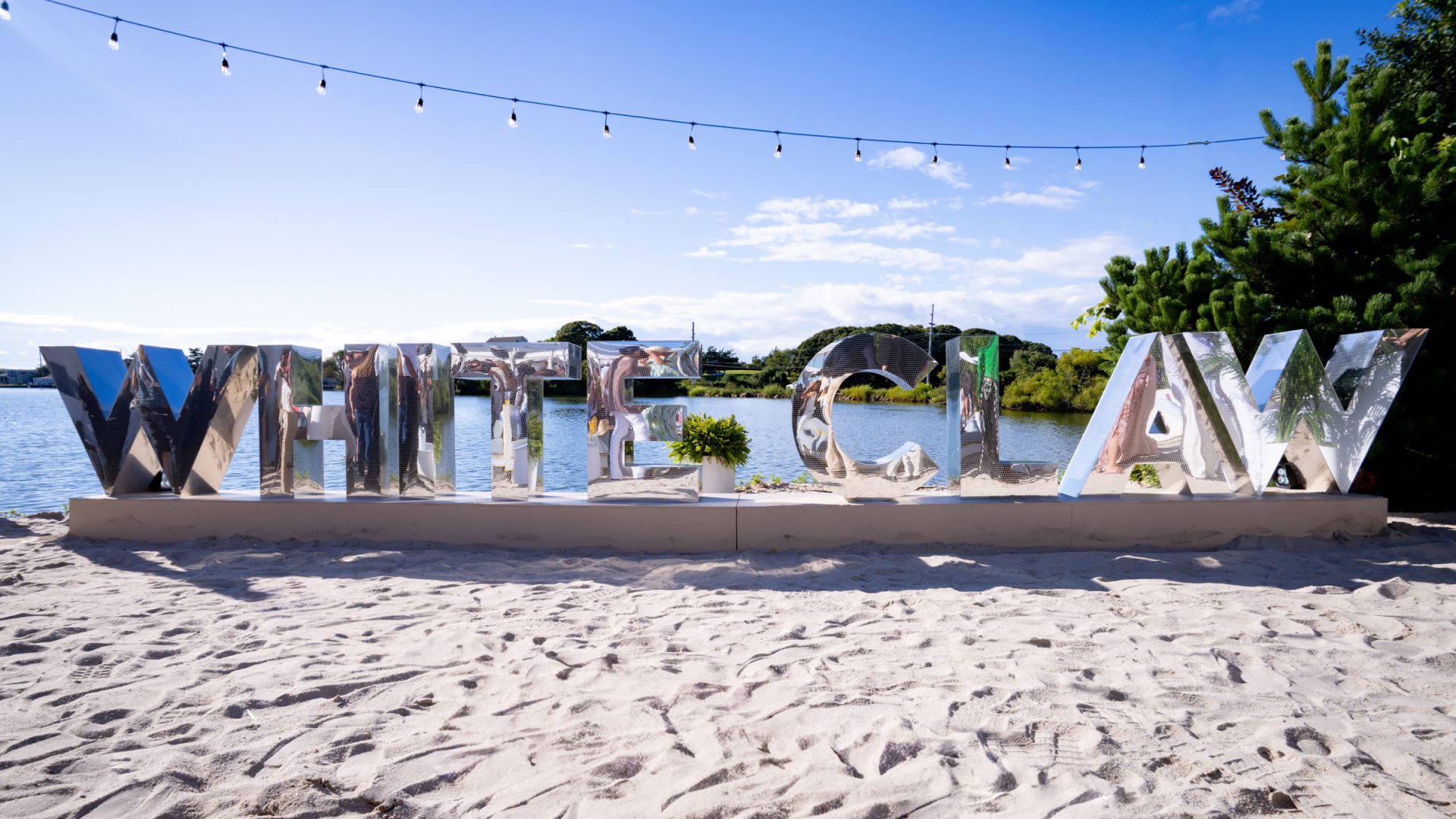
Outside, a reflective surface stops being a wall finish and becomes a piece of the landscape. For White Claw’s summer takeover of The Surf Lodge in Montauk we fabricated, produced, and installed mirror-finish WHITE CLAW letters standing on the sand at the edge of Fort Pond, along with an oversized white photo frame scattered with the brand’s colored can tabs on the waterfront deck. The letters did not need to be lit or printed, because the pond and the sky did the work: at every hour the piece looked different, and none of those hours looked like a step-and-repeat.
That payoff comes with three engineering realities. The first is wind. A mirror panel is a sail, and on open sand or an exposed deck the wind load, not the weight of the piece, sets the footing and the ballast. The second is sun. Reflective material concentrates and redirects light, so a surface that photographs beautifully at golden hour can put glare directly into a queue at four in the afternoon; the fix is orientation, worked out on the site survey.
The third is abrasion. Salt air, blown sand, and daily wipe-downs are hard on soft finishes, which pushes coastal work toward polished metal and away from thin film. Brand work across the Hamptons lives with all three conditions at once, and the material call has to be made at design stage, not when the truck arrives.
Cladding a Building Is Not Installing an Object
There is a hard line between hanging reflective pieces in a space and re-skinning the space itself. For the Delilah collaboration with Chase in Montauk, our team clad the entire street-facing façade in mirror as a paneled cladding system fabricated in the shop and installed over the existing exterior, with a ground-up new entrance built alongside it. It was treated as a single re-skin rather than a set of installed pieces, and that framing changed every decision downstream.
Cladding begins with plane, not with panels. Existing exteriors are never flat, and mirror is the least forgiving material you can ask to lie on something that is not. The first move is furring and shimming a true plane, and the time spent there is what separates a surface that reads as architecture from one that ripples.
Panelization then becomes a design decision rather than a shop convenience. Seams will be visible, so the grid should be laid out deliberately — centered on the entrance, aligned to door heads, reveal lines treated as drawn elements. A mirror grid that lands halfway across a doorway is the detail every photograph will find.
Finally, cladding at building scale is event fabrication in the structural sense: panels are numbered, dry-fit in the shop, crated in install sequence, and hung by a crew working to a drawing. A re-skin that is improvised on site is a re-skin that will not close out.
Fingerprints and the Rest of the Night
Every reflective surface within reach will be touched, and mirror is the one material that keeps a record. Planning for that is not housekeeping — it is part of the design.
Protective film stays on through transport, install, and every adjacent trade’s work, and it comes off last, after the ladders are out and the crew’s gloves are off. Peeling early is the single most common way a perfect panel picks up its first scratch.
Cleaning method follows material. Glass tolerates most things; acrylic does not, and ammonia-based cleaners will craze it over time, so acrylic gets mild soap, clean water, and a dry microfiber pass in one direction. A dusty cloth on acrylic is sandpaper. Whoever is touching up during service should be told which surface is which.
Then assign the wipe. On any build where guests interact with a mirrored surface, somebody on the crew owns a microfiber cloth and a pass at the top of each hour. It takes two minutes and it is the difference between a hero shot at 7 p.m. and a smeared one at 10.
Strike deserves the same discipline. Corners are where mirror dies, so panels get re-filmed or blanket-wrapped and crated the way they arrived. A reflective build that survives the event and dies in the truck is a build you cannot use again.
Restraint, Safety, and the Engineering Underneath
Reflective material is loud. One mirrored gesture in an otherwise matte room is an event; four competing mirrored gestures are a hall of glare with no focal point. The discipline in mirror event design is deciding which single surface carries the idea and letting the others stay quiet — a principle that runs through experiential event design generally, and that reflective finishes punish more than most.
Safety sets the outer boundary. Anywhere a crowd can reach, specify shatter-resistant material or glass with a safety backing, and treat every edge: polished, capped, or returned into the frame. An exposed mirror edge at hip height is a hazard, not a detail.
Free-standing reflective structures need engineered bases and a load path that does not rely on the venue. Landmark and hotel interiors in particular will require that nothing fastens to original surfaces, which pushes the build toward self-supporting structures and ballast. Expect the venue and the fire marshal to ask what the substrate is, so specify rated materials during design rather than defending them the week of load-in.
One more caution worth designing around: a large mirror near an egress path can read as an opening. Keep reflective surfaces off sight lines that lead to exits, and keep them out of positions where a guest moving quickly could mistake the reflection for a route. It is a small planning constraint and an easy one to honor once the brand activation footprint is drawn.
Used with restraint, reflection is the most efficient material in the scenic kit: it borrows the sky, the light, the crowd, and the architecture, and it gives them back at twice the scale for the cost of one well-built surface. Used carelessly, it is the fastest way to photograph your own back of house. If you are weighing a reflective build for an activation, a pop-up, or a milestone celebration and want a straight answer about which finish will hold up in your venue, talk to our team — bring the venue, the hour, and the shot you want, and we will tell you what to build.