
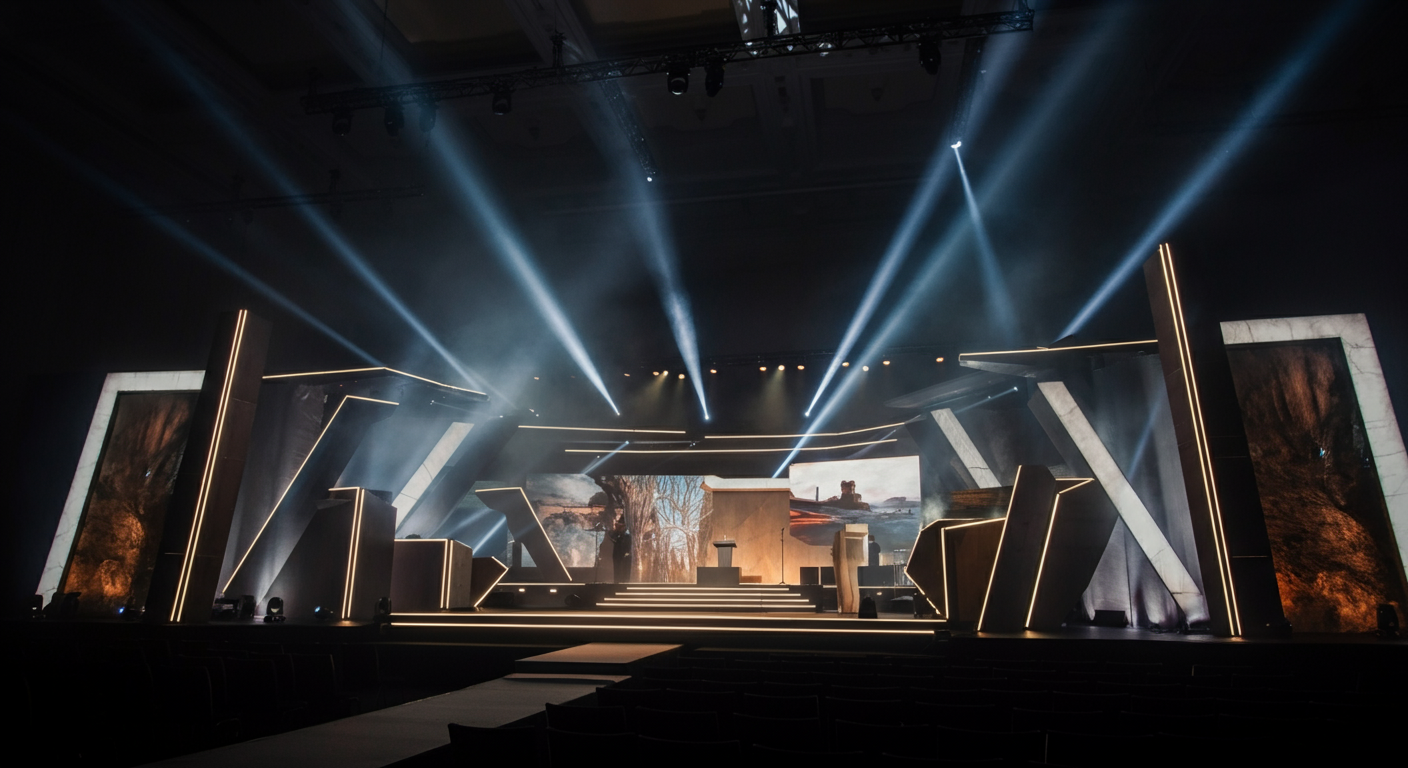
The stage is the argument. Before a single word is spoken, before the lights shift and the music swells, the stage itself communicates everything an audience needs to know about the scale, ambition, and character of what they are about to experience. Stage design is where architecture, engineering, lighting, and narrative converge into a single physical statement that shapes every moment of an event.
Yet stage design remains one of the most misunderstood disciplines in event production. Too often treated as a technical specification rather than a creative opportunity, the stage is reduced to a platform with a lectern and a screen. This approach wastes the most powerful storytelling tool in the event designer’s arsenal.
Stage Types and Their Dramatic Properties
The fundamental geometry of a stage determines the relationship between performer and audience, which in turn shapes the emotional dynamics of the entire event. Choosing the right stage type is not a logistical decision but a narrative one.
Proscenium Stage
The proscenium is the most familiar stage configuration: a rectangular platform at one end of the room, framed by a proscenium arch or scenic border, with the audience facing it from one direction. This configuration establishes a clear performer-audience hierarchy and creates a “picture frame” effect that focuses attention on the stage plane.
Proscenium stages excel at formal presentations, theatrical performances, and events where the content is delivered to the audience rather than created with them. The clear front-facing orientation simplifies lighting design, scenic construction, and sight lines. It is the default for a reason: it works reliably across a wide range of contexts.
The limitation of the proscenium is distance. Guests in the back rows can feel disconnected from the stage, and the configuration inherently creates a passive viewing experience. For events that prioritize intimacy, interaction, or energy, other configurations may serve better.
Thrust Stage
A thrust stage extends into the audience, with seating on three sides. This configuration dramatically reduces the maximum distance between performer and audience and creates a more intimate, energetic relationship. The audience partially surrounds the action, which increases the sense of immersion and participation.
Thrust stages are excellent for keynote presentations where the speaker wants to connect personally with the audience, for fashion shows and product reveals where the extended platform creates a runway effect, and for award ceremonies where presenters can engage with tables on multiple sides.
The design challenge of the thrust is that scenic elements must read from three directions. A flat backdrop that works beautifully on a proscenium stage becomes a visual dead end from the side seats of a thrust. Three-dimensional scenic elements and in-the-round lighting designs are essential.
In-the-Round
An in-the-round configuration places the stage at the center of the room with the audience surrounding it on all sides. This is the most democratic and intimate stage arrangement, eliminating the performer-audience hierarchy entirely and creating a shared space where the action happens among the audience rather than in front of them.
In-the-round is powerful for events that want to communicate inclusivity, accessibility, or shared experience. It works exceptionally well for panel discussions, musical performances, and ceremonial moments like toasts and awards. The configuration naturally generates energy because audience members can see other audience members across the stage, creating a feedback loop of engagement.
The technical demands of in-the-round are significant. Every scenic element, lighting cue, and performer movement must work from 360 degrees. Traditional scenic backdrops are impossible. Rigging and lighting must be overhead to avoid blocking sight lines. And the stage floor itself becomes the primary scenic surface, making material selection and floor treatment critical design decisions.
Runway and Extended Configurations
Runway stages create a linear path through the audience, most commonly associated with fashion shows but increasingly used for product launches, experiential reveals, and theatrical event moments. The runway configuration creates drama through procession, with content that moves through the audience rather than being presented to them.
Extended configurations might include T-shaped stages, cross-shaped platforms, or custom geometric forms that create multiple focal points and performance zones. These non-standard configurations signal ambition and creativity, telling the audience that this event has been designed specifically for this moment rather than defaulting to convention.
Materials and Scenic Elements
The material palette of a stage communicates as powerfully as its geometry. The choice between polished surfaces and raw textures, between dark and light, between hard and soft, establishes the visual language that all other design elements will follow.
Stage Deck Materials
The stage deck, the floor surface, is the foundation of the scenic design. Standard options include painted plywood (economical, versatile), vinyl-wrapped decking (clean, branded), carpet (soft, sound-absorbing), acrylic and glass (dramatic, transparent), and polished surfaces that create reflections.
For high-impact stages, custom deck treatments can include real wood planking, poured resin floors with embedded objects or graphics, LED floor panels that display dynamic content, and even water features or living plant installations integrated into the stage surface.
Scenic Backdrops and Dimensional Elements
The scenic backdrop is the visual anchor of a proscenium or thrust stage. Traditional fabric backdrops have largely been replaced by hard-wall scenic construction, LED video walls, and three-dimensional built environments that create depth and visual interest.
Dimensional scenic elements, columns, arches, platforms, and sculptural forms, transform a flat stage into an architectural environment. These elements create sight-line variation, provide natural positions for lighting instruments, and give the stage visual depth that reads even from the back of a large room.
Our Roivant Holiday Gala at the New York Public Library demonstrated how scenic elements can work in dialogue with a venue’s existing architecture, creating a stage environment that honored the grandeur of the space while establishing a distinct visual identity for the event.
LED Integration in Stage Design
LED technology has fundamentally changed stage design by making the scenic environment dynamic. A stage backed by an LED wall is not a fixed environment but a continuously evolving one that can transform from scene to scene, speaker to speaker, or moment to moment.
LED as Scenic Element
The most effective LED integration treats the display surface as a scenic element rather than a presentation screen. This means designing content specifically for the stage environment: immersive backgrounds that create a sense of place, abstract textures that add visual depth, and dynamic elements that respond to the program in real time.
The worst use of stage LED is a PowerPoint presentation blown up to 30 feet wide. The best use creates environments that would be impossible with physical scenic elements: a stage that appears to float in deep space, a backdrop of cascading waterfalls, or a cityscape that shifts from day to night as the program progresses.
LED Form Factors
LED panels are no longer limited to flat walls. Curved surfaces, circular configurations, columns wrapped in LED, ceiling-mounted panels, and floor-integrated displays create immersive LED environments where content surrounds the performer. Custom-cut LED surfaces in non-rectangular shapes allow designers to integrate video into scenic elements of any form.
Pro Tip: When combining LED with physical scenic elements, pay close attention to the brightness balance between the two. LED that is too bright will wash out physical scenic pieces and make the stage feel like a screen with furniture in front of it. Dim the LED to a level where it complements rather than dominates the physical environment, and use content with darker overall values to keep the balance.
Sight Lines: The Non-Negotiable Discipline
Sight lines are the invisible architecture of stage design. Every guest in the room must be able to see the essential action on stage, and no scenic element, lighting instrument, or structural member should obstruct critical views.
Horizontal Sight Lines
Horizontal sight lines concern the left-right viewing angles from seats at the edges of the audience. Scenic elements that extend too far downstage on a proscenium stage will block views from the sides. Thrust and runway stages create sight-line challenges for guests seated near the base of the extension, who may see performers from behind.
Vertical Sight Lines
Vertical sight lines concern the ability of guests in rear rows to see over the heads of guests in front rows. On flat floors, vertical sight lines deteriorate rapidly with distance. Risers, tiered seating, or elevated stage platforms can address this, but each solution has implications for capacity, cost, and accessibility.
For events where the stage content includes demonstrations, product displays, or performance at stage-floor level, vertical sight lines become especially critical. IMAG (image magnification) cameras and screens can supplement direct sight lines but should be considered a complement rather than a substitute for proper sight-line engineering.
Rigging Considerations
What hangs above the stage is often as important as what sits on it. Lighting instruments, LED screens, scenic elements, audio speakers, and special effects equipment all require rigging infrastructure that must be engineered for safety, load capacity, and aesthetic integration.
Venue Rigging Infrastructure
Purpose-built theaters and convention centers typically provide robust rigging infrastructure: steel beam grids, motor-rated rigging points, and known load capacities. Unique venues, including historic buildings, tented spaces, and non-traditional event locations, often have limited or no rigging capability, requiring ground-supported truss structures that consume floor space and create potential sight-line obstructions.
Understanding the venue’s rigging capacity early in the design process is essential. Many ambitious stage designs have been significantly compromised by late discovery that the venue cannot support the intended overhead elements. Always request a rigging plot and structural engineering assessment before committing to a design that depends on overhead scenic or technical elements.
Safety and Compliance
Rigging safety is non-negotiable. All overhead elements must be engineered by qualified riggers, installed by certified technicians, and inspected before guests enter the space. Redundant safety mechanisms, including secondary attachment points and safety cables on all overhead elements, are standard practice and must never be omitted regardless of budget pressure.
Pro Tip: Budget for rigging early and realistically. Rigging costs are frequently underestimated in initial budgets because they are not visible in design renderings. A scenic element that looks stunning in a rendering may require $20,000 or more in rigging infrastructure to hang safely. Always get rigging estimates before presenting designs to clients.
Budget Ranges for Stage Design
Stage design budgets vary enormously depending on scale, complexity, and venue requirements. Understanding the general ranges helps set realistic expectations early in the planning process.
Foundational Level: $5,000 to $25,000
At this level, expect a standard stage deck with basic scenic treatment, such as a fabric backdrop or simple hard-wall flat, standard lighting, and a lectern or presentation area. This is functional staging that serves the program without significant scenic ambition.
Professional Level: $25,000 to $100,000
This range allows for custom scenic construction, LED video elements (either a feature wall or distributed screens), designed lighting that includes color, texture, and movement, and integrated audio. The stage environment begins to feel designed rather than merely specified, with a cohesive visual language that supports the event’s brand and narrative.
Premium Level: $100,000 to $500,000
Premium stage design includes large-format LED, custom three-dimensional scenic construction, advanced lighting with automated fixtures, integrated special effects, and potentially kinetic or mechanized elements. This level of investment creates stage environments that serve as the visual centerpiece of the event and generate significant social media and press coverage.
Flagship Level: $500,000+
At the flagship level, the stage is an architectural statement. Full LED environments, custom-engineered structures, theatrical automation, immersive audio systems, and bespoke scenic elements create a production that rivals Broadway or major touring concerts. This level is typically reserved for major product launches, annual corporate keynotes for global brands, and tentpole industry events.
The Stage as Storytelling Device
The most powerful stage designs are not just beautiful environments but narrative instruments that actively advance the event’s story. A stage that transforms during the program, revealing new scenic elements, shifting colors, or reconfiguring its geometry, creates dramatic structure that engages audiences at a fundamental level.
Consider a product launch where the stage begins in darkness, a void that represents the problem the product solves. As the presentation progresses, elements illuminate, surfaces are revealed, and the environment gradually assembles itself around the speaker until the full stage is revealed at the moment of the product unveil. The stage itself has told the story of transformation from problem to solution.
This narrative approach to stage design requires close collaboration between the experiential design team, the content creators, and the technical production team. The scenic elements, the lighting cues, the video content, and the speaker’s script must all be choreographed together as a single integrated performance.
Moving Forward
Stage design sits at the intersection of architecture, engineering, and theater. It demands technical rigor and creative vision in equal measure. The stage that merely supports a program is adequate. The stage that amplifies, elevates, and transforms a program is extraordinary.
As event audiences become more visually sophisticated, shaped by high-production streaming content, immersive entertainment, and global exposure to world-class design, the bar for stage design continues to rise. Meeting that bar requires investment, expertise, and a commitment to treating the stage not as infrastructure but as the single most important design element in the room.
Ready to design a stage that tells your story? Contact our production team to begin the conversation about how stage design can transform your next event from presentation into performance.