
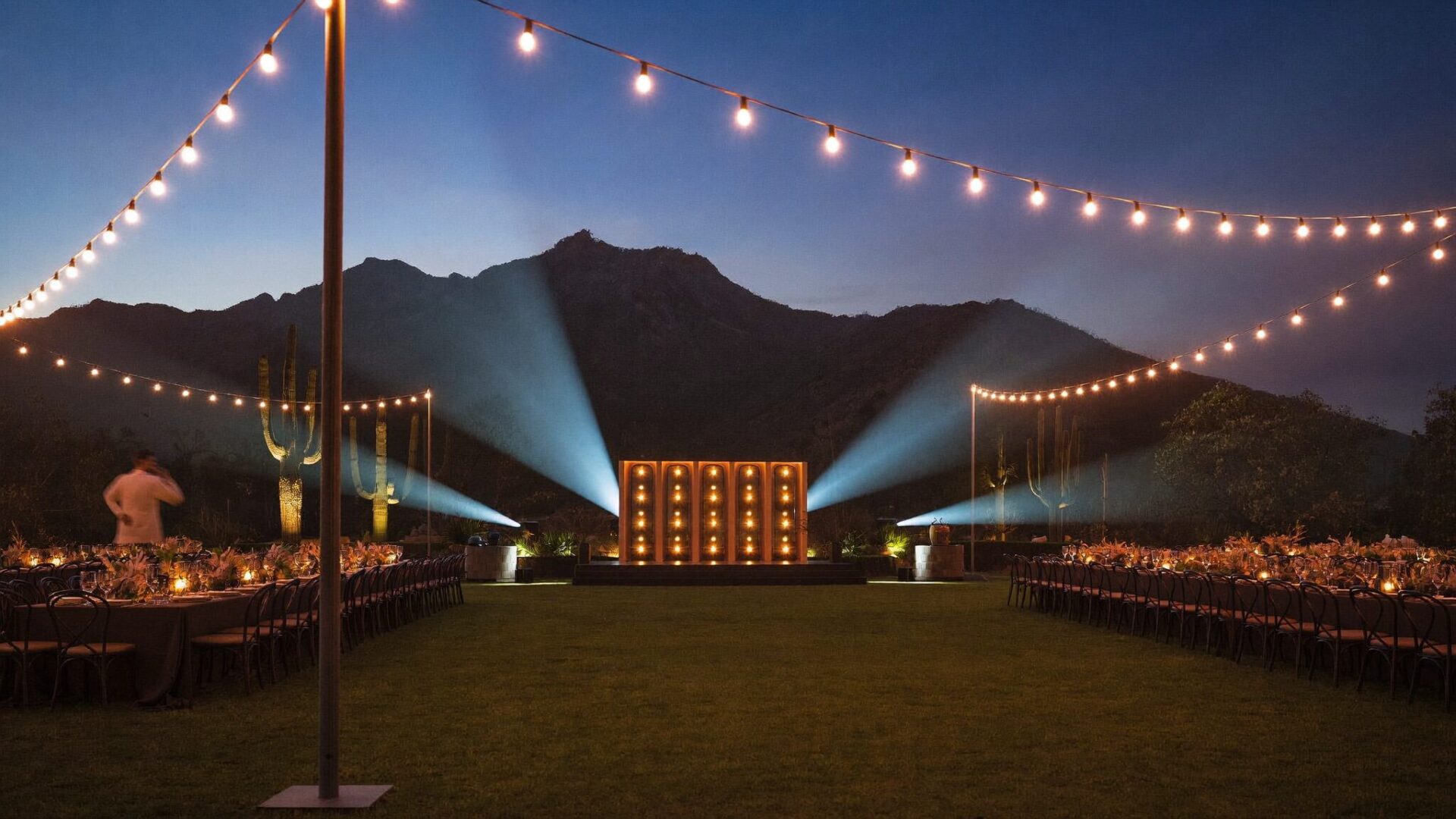
Scottsdale event venues sell the setting, and they are right to. But the same lawn is a different venue in January than in July, and at 2 p.m. than at 7 p.m. This guide reads Scottsdale’s corporate rooms through the calendar and the clock, from the side of the team that designs, builds and installs the environment inside them.
Venue facts come from each venue’s or agency’s own published pages, read in November 2026, and they can change, so confirm them with the venue’s event team before you commit. We have left out prices, fees and minimums on purpose: they move with the date and the scope, and the venue or the city is the only reliable source.
How do you choose a corporate event venue in Scottsdale?
The right Scottsdale venue for a corporate event depends as much on the month and the hour as on the room: from October to April the resort lawns and desert sites carry evening programs, while from June to September the program moves indoors to resort ballrooms and outdoor moments shift to after dark.
So decide in this order. First the month, because it sets what an outdoor plan can survive. Then the hour, because the sun and the temperature change faster in the desert than most planners expect. Then the room, with the resort’s own event team in the conversation from the first call. Last, what you build, because that depends on what the first three allow. That is the order we use when we scope event production in Scottsdale.
The table below uses NOAA’s 1991-2020 climate normals for Scottsdale Municipal Airport, as published through the National Weather Service Phoenix office. A normal is a 30-year average, so any single week can run hotter, cooler or wetter. The last column is our production guidance, not weather data.
| Month | Average high (°F) | Average low (°F) | Average rain (in) | What it means for an event |
|---|---|---|---|---|
| January | 67 | 43 | 1.11 | Days are mild and evenings are cold: heaters and layers for any outdoor dinner |
| February | 69 | 46 | 1.24 | The same, plus the WM Phoenix Open week |
| March | 76 | 52 | 1.10 | The most comfortable outdoor evenings begin |
| April | 83 | 58 | 0.34 | Warm and dry, still good outdoors |
| May | 92 | 67 | 0.16 | Shade and timing matter at midday |
| June | 102 | 76 | 0.05 | Outdoor moments move after dark; monsoon season opens June 15 |
| July | 104 | 83 | 0.90 | Indoors by day; storms are possible |
| August | 103 | 82 | 0.83 | The same as July |
| September | 98 | 75 | 0.60 | Heat eases late; monsoon season ends September 30 |
| October | 87 | 63 | 0.62 | The season reopens |
| November | 75 | 51 | 0.79 | Comfortable days and evenings |
| December | 65 | 43 | 0.99 | Like January |
What is the best time of year for a corporate event in Scottsdale?
October through April is the best window, with February to April the peak for retreats and incentive programs, according to our Scottsdale page. October is still warm, with an average high of 87°F, so it suits evening programs best, and summer programs are built indoors because average highs pass 100°F from June through August.
The numbers behind that are in the table: November’s average high is 75°F and April’s is 83°F, while June reaches 102°F and July 104°F. The same pattern shows up in how resorts and vendors book. As our Scottsdale page notes, peak season from January through April tightens resort and vendor availability considerably, so early scoping matters more in those months.
Summer has a second constraint besides heat. The National Weather Service’s Phoenix office says its monsoon season officially runs from June 15 through September 30, the stretch when the associated hazards are most likely: damaging winds, torrential rain, frequent lightning and dust storms. A tent, a stage roof or a tall scenic wall has to be designed for that wind from the first drawing, which is the subject of our guide to wind and ballast on outdoor structures.
Then there is the calendar of the city itself. The WM Phoenix Open is scheduled for February 8 to 14, 2027, at TPC Scottsdale, according to the tournament’s own announcement of its 92nd edition. That week fills the city. If your program lands in that week, book the rooms, the crew and the freight early, or plan around it. For a winter kickoff specifically, our sales kickoff production guide covers the calendar pressure from the show side.
Pro Tip: Book against the calendar, not only the room. A ballroom may be open during Phoenix Open week while the crew, the trucks and the hotel rooms around it are not. Ask the resort what else is in the building and in the city on your dates before you sign.
What happens indoors by day: the resort ballroom?
A corporate program in Scottsdale often runs its general session in a resort ballroom, and the resort’s event team is the first partner to brief: ask what an outside production team may bring in before you design anything.
The scale of a large property shows what you are working with. The Phoenician’s specs and floorplans page (read in November 2026) lists more than 160,000 square feet of indoor and outdoor meeting and event space, including 80,000 square feet of interior venue space. Its Grand Ballroom is more than 20,000 square feet, there are 24 breakout rooms from 365 to 1,037 square feet, and the Estrella Theatre is 5,525 square feet for up to 600 attendees. The page also names the Jokake Inn and the East Lawn among its outdoor settings. A property like that can hold a general session, breakouts and a dinner without anyone leaving the grounds.
Other resorts work on the same model. Our Scottsdale page names The Phoenician, The Scott Resort, Mountain Shadows, Sanctuary on Camelback Mountain, CIVANA Wellness Resort and Four Seasons Resort Scottsdale at Troon North, and notes that Sanctuary, Mountain Shadows and The Phoenician offer integrated event infrastructure. We have not listed capacities for the others here: ask each resort for its current floor plans, since those change.
Our approach in these buildings is to enhance the resort team’s capabilities, not replace them. Send the resort these questions in writing before the design is drawn:
- In-house AV. Does the resort have an exclusive provider, and on what terms may outside production work in the room?
- Rigging. Where are the rigging points, what does each hold and who signs off? A rigging point is a rated attachment in the structure from which lights, screens or scenery can hang.
- Ceiling height. What is it at the lowest point, not at the center? That number sets the size of your screens and your scenic.
- Load-in. Which route runs through back of house, and which hours is it open? Load-in is the window when equipment and scenery arrive and are installed.
- Turnover. How long between a breakfast function and your general session?
- Power. What is available on the lawn, and who supplies it?
Put the answers into a technical rider, the document that lists every power, rigging and equipment requirement for the show. It saves a round of redesign later.
A resort ballroom is a large rectangle, and a program usually needs several rooms. Our VTEX at The Glasshouses case study records how we handled it in New York: a corporate event for more than 350 attendees, where fabricated dividers, lighting shifts and furniture zoned one open-plan volume into a keynote stage, networking areas and breakout spaces. It was a New York project, but the method carries into any big hotel room. The stage itself is the work of our set and stage design team, and the format question is covered in our executive summit guide. For the whole service, see our executive meetings and summits page.
When can you use the lawn: afternoon sun and golden hour?
In season, plan outdoor receptions for late afternoon into evening, place the stage and screens so the setting sun is behind the audience and not in their eyes, and shade anything guests sit under before sunset.
Golden hour is the hour before sunset, when the light is low and warm and everything photographs well. In the desert it also arrives with long shadows and glare from one fixed direction, so the sun’s position at your start time decides which way the stage faces. Check the exact sunset time for your date with the venue; it moves through the season, and an arrangement that works in March can put the sun in the audience’s eyes in October.
Screens are the other daylight problem. An LED wall, a panel of LED modules that works as one large screen, loses contrast in direct sun, and projection washes out almost completely. Hold content-driven moments and reveals until after sunset, and use the daylight hours for conversation, food and the landscape. Dark finishes also gather heat in direct sun, and a surface that guests touch should be chosen with that in mind. Our guide to designing events for the camera explains how the same light plays on faces and finishes.
| Hour | What works | What to watch |
|---|---|---|
| Midday | Indoor sessions, shaded lunches | Glare, heat on dark surfaces, screens washed out |
| Late afternoon | Outdoor reception with shade, lawn games, welcome toast | Low sun behind the stage, in the guests’ eyes |
| Golden hour | Arrival photography, the first look at the setting | A short window; keep the program simple |
| After sunset | Dinner, the reveal, screens and light-based moments | Cooling air in winter; lighting that has to carry the room |
An open lawn also means wind and soft ground. The closest example from our own work is the White Claw Sessions case study at The Surf Lodge in Montauk, where mirror-finish letters stood on sand at the edge of Fort Pond and a photo frame sat on a waterfront deck. The pieces were resolved in our New York shop for sun, wind and salt, so the work on site was placement and alignment. Montauk is not Scottsdale, but the lesson holds: the less you build in the open, the better the evening goes.
What changes after dark in the desert?
After sunset the desert cools quickly in winter and stays hot in summer, so evening programs need heat in January and cooling in July, and the dark sky makes lighting design do more of the work.
NOAA’s normals put January’s average daily high at about 67°F and its average daily low at about 43°F, a swing of more than 20 degrees in a day, so the evening is the cold end of that range. In July the average daily low is about 83°F, so the night offers little relief. A 6 p.m. reception and a 9 p.m. dessert in January are two different climates, and the floor plan has to account for both: heaters, blankets, a warm indoor place to move to, and tables placed so that guests are not sitting in the coldest air.
Heaters, fire features and open flame are a question for the resort and the fire rules. The City of Scottsdale lists tent permits and miscellaneous fire permits among its special event resources, so for anything beyond a resort’s own permitted setup, ask the city first.
Lighting does the rest. Warm sources between about 2,700 and 3,200 Kelvin (the color temperature scale, where lower numbers look warmer and more amber) flatter faces and tables, as our guide to event lighting design explains. Keep fixtures low and uplight the landscape and architecture so the mountain silhouette stays visible, rather than flooding the sky. If the evening runs on cues, the lighting console drives each fixture over DMX, the control standard that lets one operator change every light in the room at once.
Desert estates and resort terraces suit smaller formats best, such as the executive dinner, where the table, the light and the sound decide the night. Our private dinners and celebrations team designs those as a whole environment.
Pro Tip: Plan two temperature plans for one winter evening. Put heaters and blankets in the floor plan, not on the shopping list, and decide who turns them on and when. A guest who is cold at the toast stops listening to the toast.
When does the City of Scottsdale need to know?
Inside a resort’s own permitted event spaces, the resort’s team usually handles approvals; for a temporary outdoor event elsewhere in the city, or one that changes how a property is normally used, the City of Scottsdale’s special event permit process applies.
The City’s special events page says a permit application is required for a temporary outdoor activity on public or private property that is “inconsistent with the legal use of the property” and open to the public by advertisement or invitation, with or without charge. The same page says that since January 6, 2026, applications run through the City’s online portal, Scottsdale SPUR (Smart Planning, Use and Regulations), and that its Special Event Guidebook is now in its 8th edition, effective July 2026. It also lists a document of application review timeframes.
We do not state a lead time here, because the timeframes document is the one to read for your event type, and the answer depends on the footprint. The practical advice is to apply early and to ask the City’s Tourism and Events team which of your elements need approval. The page also lists resources for tent and fire permits, liquor permits for special events, towing and the temporary use of public parking spaces.
The City also runs venues of its own: the Scottsdale Civic Center, Scottsdale Stadium, WestWorld (its equestrian center and special events facility) and Western Spirit: Scottsdale’s Museum of the West. Old Town spaces include the Marshall Way Bridge, Stetson Plaza, the Canal Banks area, Soleri Plaza and West Paseo. Each has its own booking contact on the City page. For how permits and insurance fit into a production plan, see our guide to event permits and insurance, and walk any outdoor site with our site survey checklist in hand.
How does a New York build get to Scottsdale?
We design and fabricate in our New York studio, ship the build cross-country by freight, and travel to Scottsdale for the site survey, resort coordination, installation and on-site production management, working with local vendors who know the resorts.
We do not quote a freight day count here. Transit time is built into the schedule counted back from the resort’s load-in window, along with crating and a test assembly in the shop. A test assembly means the whole build stands up once in our studio, where a wrong measurement costs an afternoon, before it is taken apart and crated in reverse install order. Our custom build timeline lays out each stage, and the installation and strike guide covers what happens when the truck reaches the dock.
Distance is not the obstacle it appears to be. The Café de Colombia case study at the San Diego Convention Center describes a 40-by-20-foot activation with a full coffee bar, designed and built in fourteen days and installed on the convention floor in under a day. San Diego is not Scottsdale, but the sequence is the same for a ballroom or a desert lawn. Everything is made in our custom event fabrication shop and tested there first.
Why work with a full-service production company in Scottsdale?
One team that designs, builds, ships, installs and runs the program keeps the resort’s rules, the city’s rules, the season and the clock in a single plan, so a decision made in the design meeting still holds on the lawn at sunset.
That is how we work. Geo Events has more than 15 years in event production and more than 200 events built in-house, and we respond to every inquiry within one business day. Our Scottsdale production team surveys the property, briefs the resort’s event team and works within its rules, then supervises the install and runs the show. It is the same model behind our full-service event production in every market, and the same producer’s view runs through our Dallas venue guide and our Chicago venue guide.
Tell us your dates, guest count and the Scottsdale venues on your shortlist, and we will respond within one business day with a production scope and next steps.
Questions planners ask about Scottsdale venues
What is the best month for a corporate event in Scottsdale?
October through April is the best window, and February to April is the peak for retreats and incentive programs. NOAA’s normals put average highs above 100°F from June through August, so summer programs are planned indoors.
When is monsoon season in Scottsdale?
The National Weather Service’s Phoenix office defines the monsoon season as June 15 through September 30, the period when damaging winds, heavy rain, lightning and dust storms are most likely.
Do you need a permit for an event at a Scottsdale resort?
Usually a resort’s own event spaces are covered by its existing approvals. A temporary outdoor event that is inconsistent with a property’s legal use needs a City special event permit. Confirm with the resort and the City’s Tourism and Events team before you design the build.