
A CNC router is the reason a custom bar front can be cut, dry-fitted, and finished inside the same two weeks a venue gives you for the entire build. CNC fabrication is not a luxury upgrade to hand-built scenic — it is the step that makes precision repeatable, and repeatability is the difference between a piece that drops into place on site and one the crew is still shimming when doors open.
Most clients never see the machine. They see a logo with crisp interior corners, a pattern that repeats exactly across six panels, a bar whose face meets its deck without a visible gap. All of that is decided days earlier, on a shop floor, by how well the file was built and how the material behaved under the bit. CNC fabrication is the quiet infrastructure underneath the finished object.
What the machine actually does
A CNC router is a computer-controlled cutting machine: a spindle carrying a rotating bit, moved across a sheet of material by a gantry that takes its coordinates from a file. The sheet is held flat on a vacuum bed so it cannot creep mid-cut. The bit follows a toolpath — the route the machine calculates from the geometry it is given — removing material in successive passes until the part releases from the sheet.
The operative word is controlled. A skilled carpenter with a track saw produces a beautiful one-off. What hand-cutting cannot do is produce the fortieth identical part at the same tolerance as the first, at three in the morning, on the last night of a build. CNC routing does that, and it does it from the drawing rather than from a dimension someone transferred by hand with a tape measure.
That matters more in events than in most trades, because event work is almost entirely one-of-a-kind parts made once, installed once, and judged immediately. There is no prototype round. The first part off the machine is usually the part that goes in the truck.
The file is the build
Everything downstream of the file inherits its mistakes. A vector that looks closed on screen but has a hairline gap will not cut as a shape; it will cut as a line. A logo supplied as a flattened image has to be redrawn as geometry before it can be cut at all. Text converted to outlines survives the trip between programs; live text does not.
So the first job in our shop is rarely cutting. It is interrogating what arrived: checking that paths are closed, that nothing is duplicated on top of itself, that curves are curves rather than hundreds of short segments, that the drawing is at full scale and in the units it claims. Only then does the geometry get nested onto sheets and assigned toolpaths, tool diameters, and tabs to keep parts from shifting as they free themselves.
Working from a client’s own CAD is a normal starting point, not a shortcut. The Netflix trade show booth we built at the Meadowlands came from the brand’s existing CAD drawings, and the first forty-eight hours of that job went to engineering review of every drawing before anything was cut. That sequence is not bureaucracy. Catching an impossible joint on screen costs an afternoon; catching it on the show floor costs the install.
If you are briefing a shop, send the vector source files, not a PDF export of them, and say which dimension is the one that must be exact. Every part has one measurement the design actually depends on. Name it.
What precision buys you that a saw cannot
Three things, mainly: pattern, joinery, and repetition.
Pattern is the obvious one. Perforations, fretwork, layered silhouettes, a texture cut through a surface so light passes behind it — these are trivial for a router and punishing by hand. For the basketball-themed milestone we designed and fabricated at Cipriani, the back bar was CNC-fabricated in a basketball-line-textured metal grate, carrying a cast-aluminum logo finished in gold. The texture reads as a deliberate graphic because every repeat is identical. Hand-cut, it would read as handmade, which was not the brief.
Joinery is the quieter benefit. A router can cut the slot, the tab, and the pocket that let parts locate themselves. Panels that key into each other go together in one order, the right way, without a tape measure on site. That is how a crew assembles a complex piece in a loading dock at six in the morning without the drawings in hand.
Repetition is where the schedule is won. Twelve identical panels cut in one run will be identical. Twelve cut by hand will be close, and close accumulates: by the twelfth, the error is visible in the seam line.
Materials, and how each behaves under the bit
Sheet goods — plywood, MDF, and the various fire-rated panels event work demands — are the backbone. They cut cleanly, hold a fastener, and take finish predictably. MDF has no grain, so a routed edge comes off smooth enough to paint directly, which is why it carries most dimensional letterwork.
Foam cuts fast and weighs nothing, which makes it the right answer for anything large, non-structural, and flown or carried. It is also the material most dependent on what happens after the cut, because raw foam reads as foam under any light worth having.
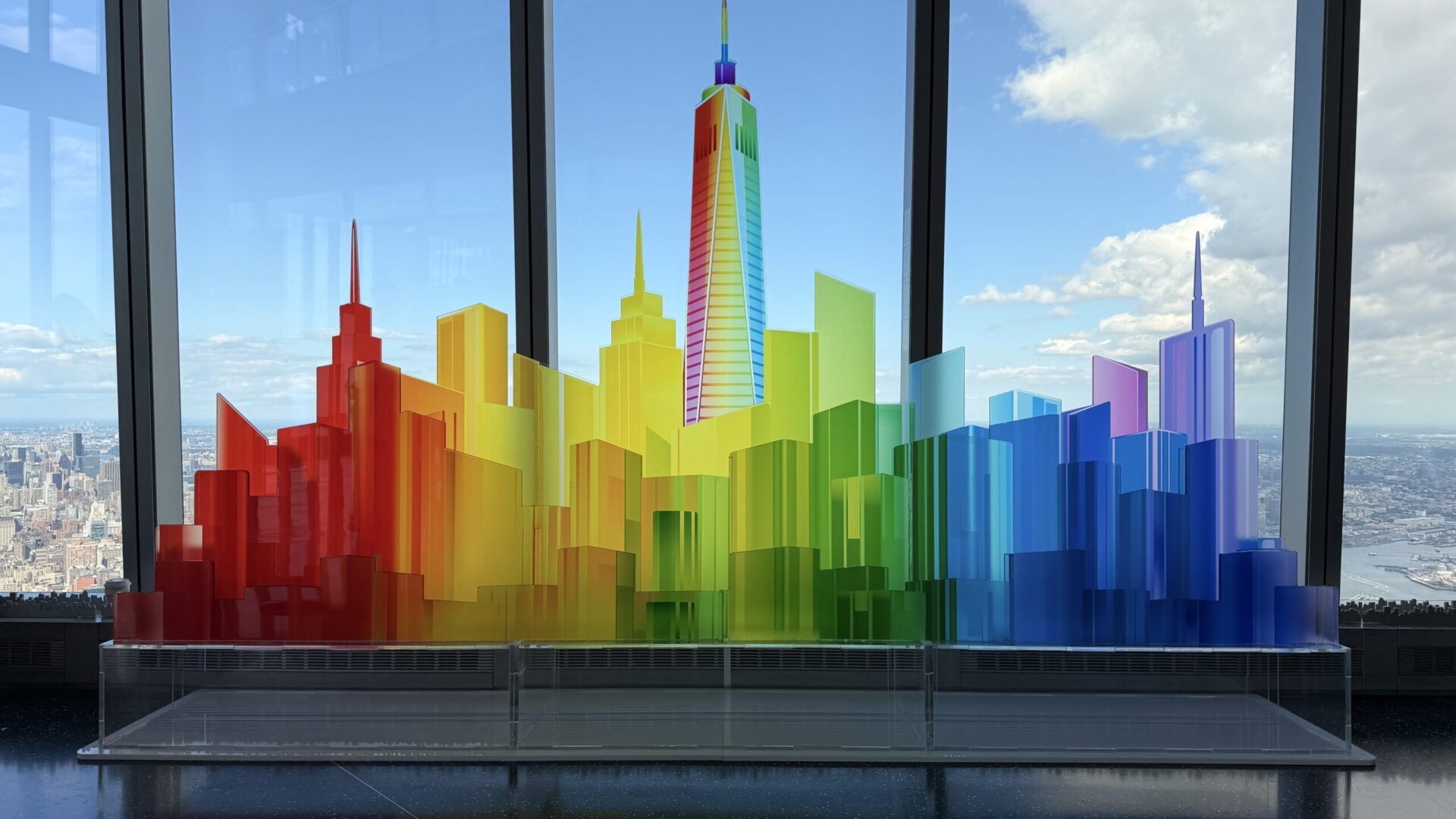
Acrylic is the material where machine precision becomes the visible design. Cut edges can be polished to catch and carry light along the sheet, so the cut line itself glows. The One Love photo activation at One World Observatory was built from laser-cut acrylic — a sibling process on the same principle of cutting from a file — layering translucent buildings and a rainbow progression into a stylized New York skyline, twelve feet wide and eight feet high. Layered translucent work only resolves if every layer is cut to the same registration. Our article on laser-cut acrylic installations covers how those layers are planned and lit. There is no eyeballing it.
Metal is slower, louder, and worth it where the finish has to look manufactured rather than built. Grate, plate, and cast elements change the register of a piece entirely: they stop reading as scenic and start reading as product.
The cut is half the job; the finish is the other half
A perfectly cut part with a raw edge is an unfinished part. This is the step clients consistently underestimate, and it is where event fabrication stops being machining and becomes craft.
Routed edges carry fine tooling marks. Sanding, filling, and sealing them is what lets a painted surface read as a continuous solid rather than a laminated stack of sheet. On acrylic, the equivalent is flame or machine polishing to turn a frosted cut into a clear one. On foam, it is a hard coat before any color goes on, because paint alone will not survive a crowd.
Then there is the finish itself, which is where the material stops being what it is. A faux finish is a distance calculation: a surface only has to hold up at the range guests actually stand and photograph from. Deciding that distance early tells the shop how much finish work the piece needs, and it is a real schedule lever on a compressed job.
For dimensional signage and logo builds, the finish is doing almost all the work. The router guarantees the shape is right. Whether it looks like gold, brushed steel, or painted MDF is decided entirely by hand afterward.
Precision is a scheduling tool
The strongest argument for CNC fabrication is not that parts look better, though they do. It is that machine-cut parts let the shop guarantee a test fit.
When tolerances are reliable, a structure can be fully assembled in the shop before it ever sees the venue, taken apart, crated, and rebuilt on site with confidence that it will go back together the same way. The two-story Barbie Dream House we built inside Cipriani was engineered as a modular, self-supporting steel and wood structure, pre-fabricated in our NYC shop and test-assembled before delivery, with scenic panels and branded surfaces designed as drop-in components. Every surprise that build was going to produce had already happened in the shop.
Speed follows from the same discipline. The Café de Colombia activation at the San Diego Convention Center — a forty-by-twenty-foot build with retail-grade finishes, an integrated coffee bar, two tasting environments, and concealed back-of-house storage — was designed, built, branded, and delivered in fourteen days. Timelines like that are not the result of working faster. They are the result of cutting accurately the first time, so no part gets made twice.
This is also the honest limit of the technology. CNC fabrication compresses the cut, not the cure. Paint still needs to dry, adhesives still need to set, and engineering review still takes the time it takes. A shop that promises otherwise is gambling with your install.
Briefing a build that uses it well
A brief that gets the most out of CNC fabrication does not specify the machine. It gives the fabrication shop what it needs to use the machine well.
- Send vector artwork at full scale, with text converted to outlines, and name the one dimension that must be exact.
- Say what the piece has to survive: a crowd leaning on it, a sponsor logo swap mid-run, a strike into a freight elevator.
- Give the viewing distance. It determines the finish, and the finish determines the hours.
- Agree who owns engineering review before fabrication starts, and build the time for it into the schedule rather than onto the end of it.
- Decide early whether the piece gets used again. Modular joinery is cheap to design in at the drawing stage and expensive to retrofit.
When design, fabrication, and full-service event production sit under one roof, the file never has to survive a handoff between companies that draw differently. That is a quiet advantage, and in New York, where load-in windows are short and freight elevators decide your maximum part size, it is usually the one that matters most.
If you have drawings, a venue, and a date that feels too close, we are happy to look at what you have and tell you honestly what can be cut, finished, and installed in the time available. Start a conversation with our team through our contact page, and bring the files — they tell us more in five minutes than a brief does in an hour.