
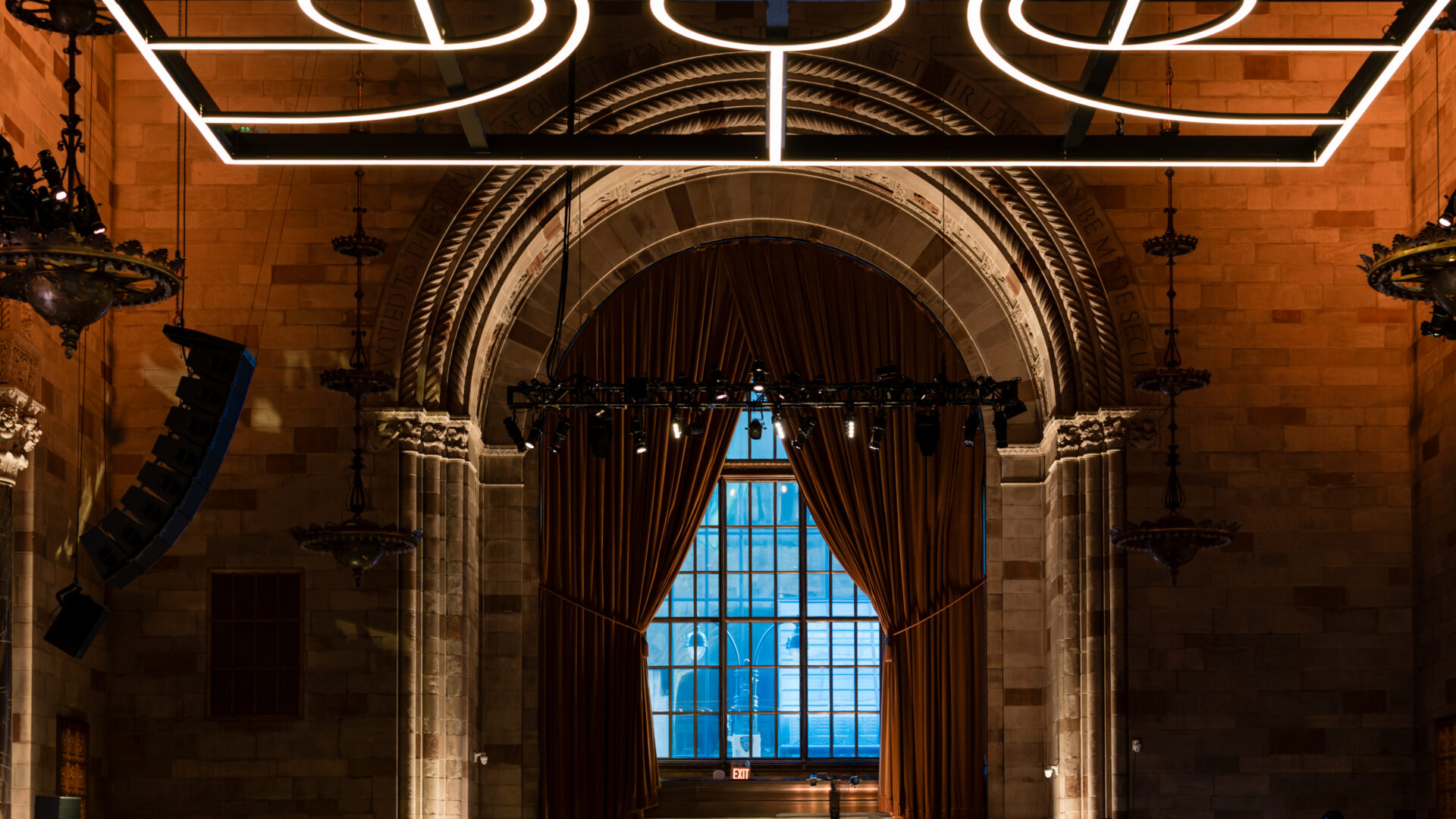
LED belongs inside the scenic structure, not bolted onto it after the walls are standing. That is the whole premise of LED scenic integration: treating light as a fabricated material with a thickness, a weight, a power draw, and a heat signature, and designing the build around it from the first sheet of drawings rather than the last. Done that way, the light reads as architecture. Done the other way, you get a well-built wall with a visible extension cord running down the back of it.
The distinction matters more every season, because briefs keep asking light to carry the idea. A logo that glows. A line that traces a shape across a ceiling. An object that hangs above a dance floor and tells the room what kind of night this is. Those are fabrication problems before they are lighting problems, and the order of operations is the part that gets lost.
What follows is how our shop approaches LED scenic integration: the three shapes it usually takes, the infrastructure each one demands, and the decisions that get expensive when they land late.
Integrated LED Is Not a Video Wall
Start by separating two things the industry routinely conflates. An LED wall is a display — a modular panel array that plays content, runs on a processor, and is specified in pixel pitch. It is a screen, and it is rented, flown, and operated as a screen.
Integrated LED is lighting built into a fabricated object. There is no content, no processor, no pixel pitch. There is a channel routed into a panel, a diffuser sitting flush with a finished surface, and a driver hidden somewhere a technician can still reach on show day. The output is a shape, not an image.
Both belong in the same build more often than not. The 22-by-22-foot Netflix booth we fabricated for the Meadowlands Complex carried flush-mount televisions set into wall pockets and a branded LED Netflix logo as its centerpiece. The televisions were displays, specified and sourced as displays. The logo was scenic — a built object that happened to emit light — and it was the element the whole booth was composed around. The booth came off the brand’s existing CAD drawings on a two-week build cycle, which is only possible when the lit elements are drawn as parts rather than specified as equipment.
The Three Shapes Integrated LED Takes
Nearly every request that reaches our event fabrication team resolves into one of three geometries. Each has a different failure mode, and knowing which one you are solving tells you where to spend the shop hours.
The Line
A line of light drawing a shape in space is the most demanding of the three, because a line shows every error. Diffusion gaps, inconsistent spacing, a hot spot where two runs meet, a corner a few degrees out of true — none of it hides. The eye follows a line and finds the flaw.
The 28-by-20-foot LED court outline we rigged above a basketball-themed milestone at Cipriani was a line problem solved as a structure problem. A 4-inch luminous line traced a regulation court, carried on a truss-and-LED assembly hung from the ceiling. Geometry at that scale has to be right in the shop, because an outline that is out of square announces itself from every seat in the room. The truss was not an afterthought for hanging the light; it was the drawing the line was built onto.
Lines also punish improvisation on site. A run that gets shortened at load-in to clear an unexpected sprinkler head changes the proportion of the whole figure. We would rather resolve that conflict on a drawing weeks out than with a crew on a ladder at midnight.
The Logo
An illuminated logo or letterform is the most common ask and the most frequently botched, because the temptation is to light a shape instead of building a lit shape. The difference shows at the edges. Face-lit letters with LED crammed behind an undersized return produce bright centers and dim corners. Halo-lit letters need a standoff distance calculated against the wall finish behind them, or the glow collapses into a smear.
Thickness is the variable people underestimate. A letter deep enough to hold a driver, a diffuser, and the air that light needs in order to even out is deeper than the render suggests. Adding an inch of return in the drawing is cheap. Explaining a hot spot on site is not.
Restraint belongs in this conversation too. Not every mark should glow. On that same basketball build, the cast-aluminum logo on the CNC-fabricated back bar was finished in gold and left to catch the room’s light rather than make its own. A metallic finish under a well-aimed fixture often out-photographs an illuminated one, and it never fails at hour six.
The Suspended Object
Light that hangs is a rigging conversation first and a lighting conversation second. The custom-engineered LED basketball hoop suspended over the dance floor at a New York milestone celebration carried the entire room — a raw venue turned arena-meets-nightclub — but a centerpiece like that only works when the load path is honest from the fixture to the building steel.
Three things have to be settled before fabrication starts. Where the point loads land and whether the venue will accept them. How power and data reach the object without a cable becoming part of the composition. And how a technician gets to a failed driver once the object is thirty feet up and the room is full. The third question is the one that gets skipped, and it is the one that ends up on a recap call.
If you cannot describe how the light gets serviced during the event, the design is not finished.
Power and Data Set the Install Sequence
LED scenic integration reorders the install. On a conventional scenic build, surfaces go up and finishes go on. On a lit build, nothing closes until the light inside it has been proven, because a sealed panel with a dead driver behind it is a demolition job.
That means driver locations, cable routes, and service openings are decided in shop drawings, not on site. Low-voltage runs have length limits before voltage drop shows up as a dim far end. Data addressing has to be mapped and labeled while the parts are still on the bench, because identical panels become indistinguishable the moment they are crated. Every lit element gets its own documented circuit, kept off the shared power that audio and kitchen equipment fight over.
We power up every integrated element in the shop and run it at full output long enough to find the driver that was going to fail anyway. A test fit with the light on also settles arguments that drawings cannot: whether the diffuser is sitting proud of the finish, whether the seam between two panels reads, whether the color matches end to end. Those are ten-minute fixes in the shop and lost hours at load-in.
Dimming, Flicker, and Every Phone in the Room
The reason to build light into an object is almost always that the object is going to be photographed. That makes the camera a stakeholder, and the camera is less forgiving than the eye.
Inexpensive drivers dim by switching the LED on and off faster than people can see. A phone shooting video does see it, and it records the switching as rolling bands across the frame. The whole point of the build evaporates in the clip the guest posts. Flicker-free drivers, specified at the start, cost a little more and remove the problem entirely. Retrofitting them after a failed content capture walkthrough costs a great deal more.
Color consistency is the companion problem. LEDs vary between production batches, so a single element assembled from two deliveries can read warm at one end and cool at the other — invisible until a photographer frames the full length of it. We order a job’s worth at once and keep the remainder as labeled spares rather than buying replacements later and hoping they match.
Dimming range deserves the same scrutiny. Many drivers lose smoothness in the bottom tenth of their output and either jump or go dark. If the design calls for light that falls away over the course of an evening, that behavior has to be tested at the levels the design actually uses, not at full.
Heat, Access, and Hour Six
Heat is the quiet constraint of integrated lighting. LEDs run cool compared with what they replaced, but their drivers do not, and a driver sealed inside a foam or acrylic enclosure with no airflow has a short life. Scenic materials make that worse: foam insulates, and acrylic softens long before anyone expects it to.
Our answer is boring and effective. Drivers live outside the enclosure wherever the design allows. Where they cannot, the cavity gets ventilation that the finish hides, and the assembly runs for hours in the shop with a thermometer on it. Service panels are real panels with real fasteners, documented on the drawings and labeled on the back of the piece.
Strike deserves the same thought as install. Lit elements have fragile faces and tails of cable, and they are being handled by a crew working fast at the end of a long night. Crates get built for the actual geometry, cables get coiled and captured to the piece, and the labeling survives. A lit object that comes back intact can go out again. One that comes back with a cracked diffuser and a missing driver is scrap.
How to Brief a Build With Light Inside It
Clients do not need to specify hardware. They need to give a shop the five facts that drive every downstream decision:
- What the lit element has to accomplish — wayfinding, a photo moment, a centerpiece, brand presence at distance.
- Where it sits and how far away the furthest guest reads it from, which sets size, thickness, and output.
- What the venue permits overhead, including rigging points, load limits, and whether anything may touch the structure.
- Whether the room changes during the event, which decides whether the light needs to be controllable or can simply be on.
- Who owns the power, and what circuits are actually available at the position rather than on the floor plan.
Answer those five and LED scenic integration stops being a risk and becomes a scheduling problem, which is the condition we want everything in. It is also the argument for keeping design, fabrication, and full-service event production under one roof: when the people drawing the object, building it, and hanging it are the same team, the light does not become the seam where accountability disappears. At The Glasshouses we treated scenic fabrication, dimensional signage, and architectural lighting as one system, which is the only way the material and the light end up agreeing with each other.
Light is the most persuasive material we work with and the least forgiving of a late decision. If you have a build in front of you with something glowing in the render, the useful conversation is the one that happens while the drawings are still open. Tell us what the room has to do, and we will tell you what it takes to make the light part of the structure instead of an accessory to it.