
Three kinds of companies will answer the same event brief, and they are not interchangeable: an experiential agency owns the idea, a fabricator owns the object, and a production company owns the outcome on site. Most builds that go wrong do not fail because one of the three is bad at its job. They fail in the space between them, where a drawing changes hands and nobody is accountable for what the handoff costs the schedule.
Clients usually arrive treating this as a vendor-selection problem — event production company vs agency, agency vs fabricator, one bid against another. It is really a question about where accountability sits at six in the morning on load-in day, when a scenic wall arrives an inch out of plumb and the venue has given you a four-hour freight window. The answer determines who solves it and who explains it.
Here is what each of the three actually does, what each one cannot do, and where custom builds fall through the gaps between them.
What an Experiential Agency Owns
An agency owns persuasion. Its product is a concept that survives internal review: the strategic rationale, the brand narrative, the creative territory, the renders that get a marketing lead to yes. The good ones are rigorous about why a guest should care, and that rigor is worth paying for, because a beautifully built environment answering the wrong brief is the most expensive mistake in this business.
What an agency typically does not own is buildability. A render is a picture of an intention; it carries no structure, no material callouts, no weight, no load path, no fire rating. A render can show a cantilevered bar top floating with no visible support because rendering software does not care about gravity. The shop that receives it does.
The useful test of an agency’s work is not the render, it is the package that travels with it. A creative brief that states the guest journey, the non-negotiable brand elements, the photograph the client actually wants, and the venue facts already confirmed is worth more to a shop than another rendered view. When the brief names which elements are fixed and which are open, fabrication can propose a cheaper structure for the open ones instead of guessing which details are sacred.
Agencies also tend to hand off and step back. Once the concept is approved, the build is subcontracted, and the agency’s accountability narrows to brand compliance — is the logo right, is the color right — rather than whether the thing stands up and goes in on time. That is a reasonable division of labor as long as everyone knows it is the arrangement. It becomes a problem when the client believes the agency is managing the build and the agency believes it is reviewing it.
What a Fabricator Owns
A fabricator owns the object. That means shop drawings, engineering, material selection, joinery, finish, hardware, and crating — the translation of an idea into something that can be cut, assembled, transported, and installed repeatably. A shop’s contribution is largely invisible in the final photograph and entirely responsible for it.
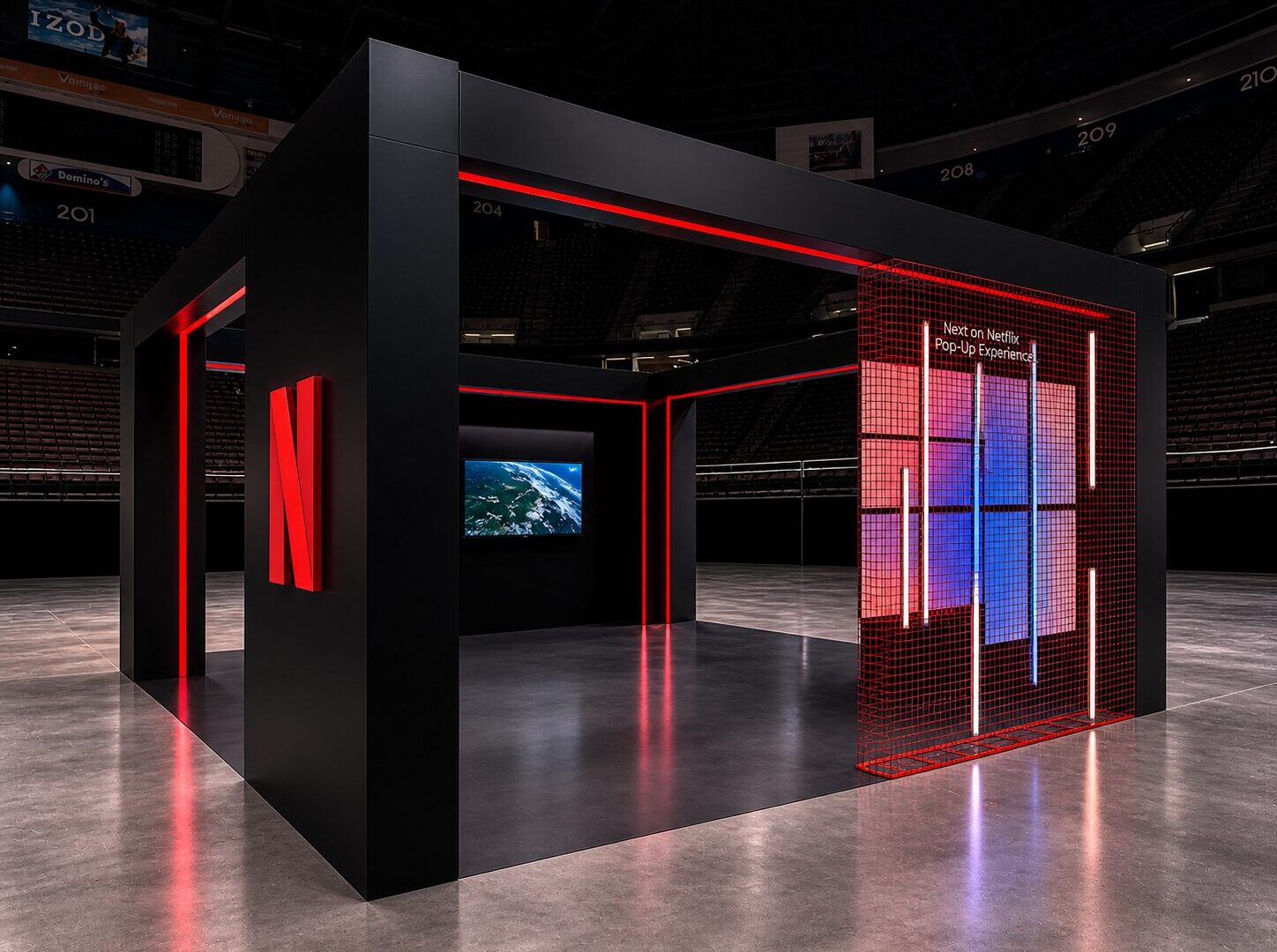
The translation step is where most of the value sits. When we built a 22-by-22-foot trade show booth for Netflix at the Meadowlands Complex, we worked from the brand’s existing CAD drawings, and engineering review of every drawing happened in the first 48 hours. That sequence is deliberate. The questions that kill a two-week build cycle — how does this panel carry a flush-mount television, what holds the branded LED logo, what does this joint do when it is craned — are cheap to answer on paper and ruinous to answer on the show floor. Our event fabrication work starts there for that reason.
What a fabricator does not own is intent. A shop bidding against someone else’s render will quote what is drawn, which is not always what was meant. If the drawing shows a mirror panel and the concept depended on the mirror catching the sky at a particular angle, nobody in the shop knows that unless somebody tells them. A fabricator is also not accountable for guest flow, vendor coordination, show calling, or the strike. Those live downstream.
What a Production Company Owns
A production company owns sequence and site. The producer is the party who knows the ceiling height, the floor load, the rigging points, the elevator dimensions, the union rules, the fire marshal’s requirements, and the hour at which the venue’s own operation resumes. They schedule the trucks, stage the crews, run the room, and put the venue back exactly as they found it.
This is the role most often underestimated, because its output is an absence of incident. For a corporate event at The Glasshouses for the commerce platform VTEX, the build had to read as a brand immersion rather than a conference reception: custom scenic in steel framing and industrial-finish surfaces answering the venue’s glass-and-steel architecture, with branded environmental graphics, dimensional signage, and architectural lighting resolved as one system. None of that is a fabrication decision alone. The order in which it enters the building, and what it stands on once it is there, is production.
A producer carries the project calendar and the single phone number the client calls. What a production company cannot do on its own is make the thing. If it has no shop, it is buying fabrication like any other line item, and it inherits whatever the shop’s queue allows. Our full-service event production practice exists on the other side of that trade.
Where the Handoffs Fail
The event production company vs agency comparison usually misses the real risk, which is not a company at all. It is the seam. Four failures account for most of the damage we see on projects that come to us partway through.
The unbuildable render. A concept is approved with no engineering sanity check, the shop prices it honestly, and the number lands outside what the approval assumed. The design then gets value-engineered under time pressure, which is the worst possible moment to make taste decisions.
Uncomparable bids. Three shops quote the same drawing set with different assumptions about finish level, install labor, and who supplies power. Without bid leveling — normalizing every proposal to the same scope before comparing — the lowest number usually just has the most exclusions.
The orphaned site fact. Nobody measured the freight elevator, so a wall that was fabricated in one piece has to be cut and re-seamed on the loading dock. The agency assumed the fabricator would ask. The fabricator assumed the producer had surveyed. A site walkthrough with the people who will build the thing, early, costs a morning and prevents this entirely.
Each of these is a communication failure with a material consequence, which is why they are expensive. Steel does not care whose assumption was wrong. The fix is almost always the same: get the people who will cut and install the work into the conversation before the concept is locked, even for an hour.
Ownerless change orders. A venue restriction surfaces in week three, the fix is obvious, and it touches design, shop, and install at once. With three vendors, the change requires three approvals and a renegotiation; the schedule absorbs the delay quietly and the cost appears at the end as rushed labor.
What Changes When It Is Under One Roof
Single accountability is not a slogan about convenience. It changes which decisions are available to you and when.
The two-story Barbie Dream House we built inside Cipriani is the clearest example. It was engineered as a modular, self-supporting steel and wood structure, pre-fabricated in our New York shop and test-assembled before delivery, with custom scenic panels, branded surfaces, and interior vignettes designed as drop-in components that attached without touching the venue’s original surfaces. Read that as three decisions made simultaneously: a design decision about what the guest walks through, a shop decision about modularity, and an install decision about venue protection. Split across three companies, those decisions get made sequentially, and the last one in the chain inherits whatever the first two made impossible.
Compression works the same way. A 40-by-20-foot activation for Café de Colombia at the San Diego Convention Center was designed, built, branded, and delivered in fourteen days, with retail-grade finishes, an integrated full-service coffee bar built to retail operational standards, two tasting environments, and concealed back-of-house storage. Fourteen days is not a function of working faster. It is a function of design, engineering, purchasing, and install sequencing happening in the same conversation instead of in four sequential email threads. Full-service production buys back the handoff time.
The honest caveat: one roof is not automatically better. A company that designs, fabricates, and produces is reviewing its own work, so you should ask how its experiential event design and its shop actually argue with each other. If design never gets told no by fabrication, you are not getting engineering, you are getting agreement.
How to Scope the Work
Start by naming which part you already have. If your internal team or a retained agency owns the creative and you need the idea made real, you are shopping for fabrication plus production, and the brief you send should include site facts, not just visuals. If the concept does not exist yet, hiring a shop first inverts the process — you will get an object instead of an environment.
Then ask three questions of whoever you are considering, because the answers reveal the structure better than any credentials deck. Who signs the shop drawings, and when does engineering review happen relative to approval? Who is standing in the venue at crew call, and are they employed by the same company as the people who built the pieces? When something changes in week three, who carries the fix — and does carrying it require a new agreement?
Framing the choice as event production company vs agency suggests you must pick a type. You are really picking a seam count. Every additional company in the chain adds a point where intent, drawing, and site reality have to be re-synchronized by someone, and the person who ends up doing that work by default is usually you.
If you are weighing event production company vs agency for a build that has to be engineered, installed in a working venue, and struck without leaving a mark, we are happy to look at what you have — a concept deck, a drawing set, or a date and a problem. Tell us about the project and we will tell you plainly which parts we would own and which parts you still need.