
A prop earns its place at an event by doing a job that a graphic cannot: it occupies space, so guests orient themselves around it, lean on it, and put themselves in frame beside it. That is why custom branded props are production elements rather than decoration, and why our shop treats a surfboard, a carved globe, or a wall of mounted basketballs with the same drawing discipline as a bar or a scenic wall. An object that guests can reach is an object that has to be engineered for reach.
The word prop does the category a disservice. On a film set a prop is handled once, by a professional, under a lighting plan. At an event it is handled by hundreds of people who did not read the brief, in a room where the lighting changes at dinner, and it has to still read correctly in a photograph taken at the end of the night. Custom branded props live closer to furniture than to set dressing.
What follows is how we think about them: what a prop is actually for, how to size it, which objects should be fabricated and which should be sourced and finished, how props carry wayfinding, and what it takes to keep one intact from the shop floor through strike.
A Prop Has Three Jobs, and Most Briefs Name Only One
The job a brief usually names is brand presence: the object says whose event this is. That matters, but it is the easiest of the three to satisfy and the least dependent on fabrication quality. A logo applied to almost anything will accomplish it.
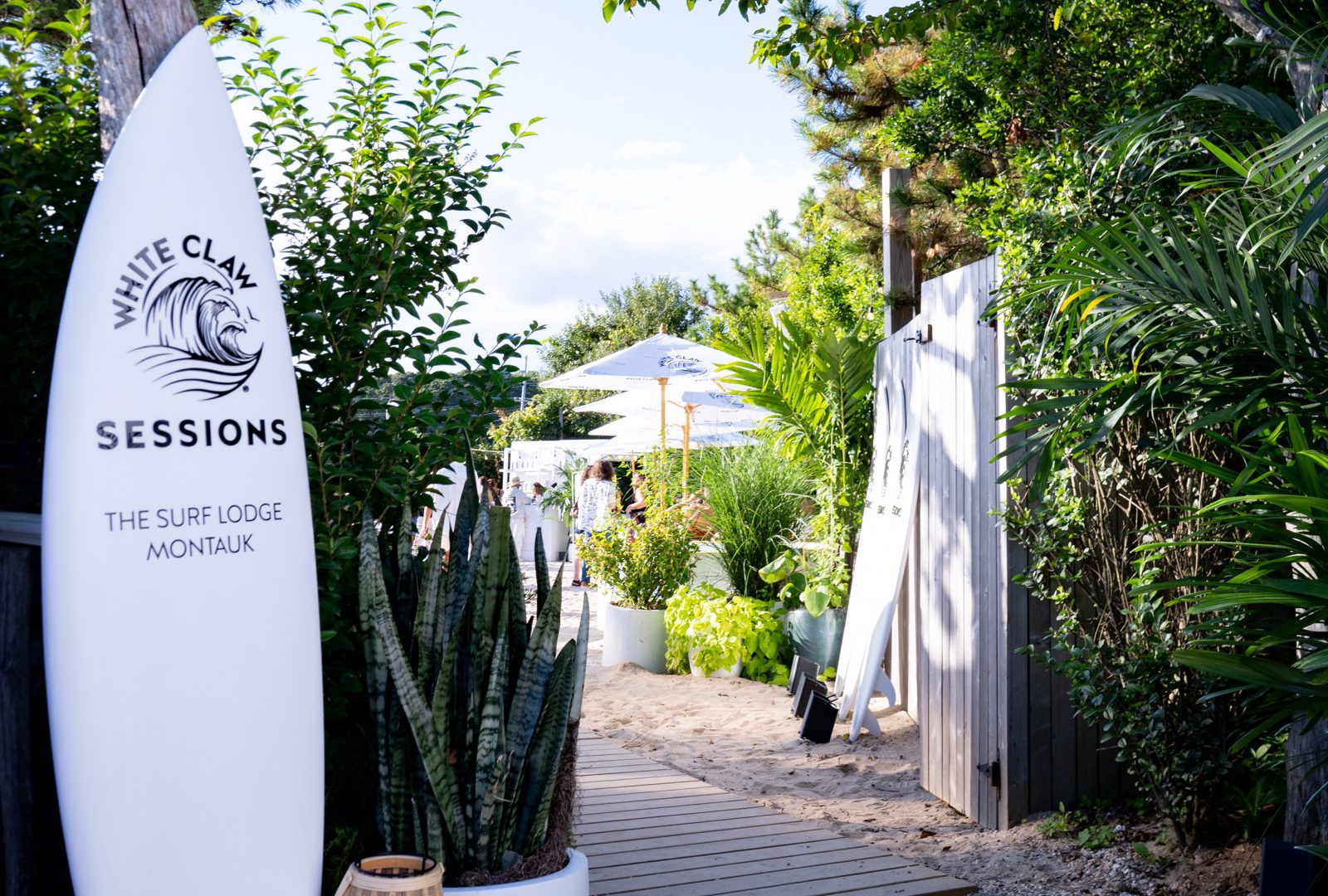
The second job is anchoring. People need somewhere to stand. A room of beautiful surfaces with nothing to occupy leaves guests drifting toward the walls, while a single well-placed object gathers a crowd around itself and generates the kind of content capture that no backdrop produces on its own. For White Claw Sessions at The Surf Lodge in Montauk, we fabricated, produced, and installed custom White Claw Sessions surfboards at the entrance and around the property, alongside an oversized white photo frame scattered with the brand’s colored can tabs on the waterfront deck. The surfboards were not scenery that happened to be branded; they gave a dispersed outdoor site a set of fixed points that guests could find and stand beside.
The third job is explanation. A prop tells guests, before any signage does, what kind of event they have walked into. That is the job that justifies custom fabrication, because an object can only explain a specific idea if it was built for that idea.
Size the Object for the Sightline, Not for the Drawing
Props are the elements most often under-scaled, because they are drawn in plan where everything looks generous and installed in a crowded room where a four-foot object disappears behind the first row of shoulders. We size props against two measurements that the floor plan does not show: eye height in a standing crowd, and the distance from which the object first becomes visible.
The second measurement decides more than people expect. An object that reads at forty feet needs mass and silhouette; an object a guest reaches in three steps needs resolution in its edges and finishes. The same prop rarely does both well, which is why we would rather specify two objects with clear roles than one compromise that is slightly wrong at every distance. Where sight lines are long and the crowd is dense, silhouette beats detail every time.
There is also a camera test. A phone held at chest height sees a narrower field than the eye does, and it cuts off anything above the subject’s head. A prop intended as a photo anchor has to fit inside that frame together with a person, which usually means it is wider and lower than the designer’s instinct, or it is tall enough that the guest stands in front of its base rather than beside its top.
Fabricate, Source and Finish, or Mount: Choosing the Right Method
Custom branded props arrive by three different routes that sit under the same line item on a brief, and they behave nothing alike in the shop or on site.
Fabricated From Scratch
When the object does not exist in the world, it gets built. The private dinner at One World Trade Center was anchored by a hand-carved foam Earth suspended at the heart of the room, with custom-fabricated black acrylic dining tables built to read as monolithic surfaces beneath it. Nothing about that globe could have been rented. Carving, hard-coating, and finishing it was the only route to an object that held its shape under event lighting and photographed as a single mass rather than a decorated sphere.
Fabricated props take the longest and carry the most drawing time, because the shop is resolving questions the brief never asked: where the seams fall, how the piece breaks down for transport, what holds it up, and which face the crowd will touch. That last question governs the finish specification more than aesthetics do.
Sourced, Then Finished
Plenty of props begin as real objects and become brand objects through finish work. A real article has a grain, a wear pattern, and a weight that a built copy has to work hard to imitate, so when authenticity is the point, we start with the thing itself. The Western-flavored décor wall at Magic Hour Mountain Lodge at the Moxy in midtown worked on exactly that logic: bighorn antlers, cowboy boots, ropes, and faux snow assembled into one surface, eighteen floors above the street on the hotel’s West Terrace rooftop bar. Around the dining tables, shop-built faux log cabin walls carried the same idea in the opposite direction, finished to read as timber from phone-camera distance.
That project is a useful illustration of the threshold. A faux finish is judged at the distance the guest actually stands, not at arm’s length under shop lights. Deciding that distance up front is what lets a crew spend finish hours where they change the photograph and stop where they would not.
Mounted in Quantity
The third method treats ordinary objects as a material. At the basketball-themed milestone at Cipriani that we designed and fabricated as Josh Do It, the custom twenty-four-foot front bar was fronted with more than ninety mounted regulation basketballs. One basketball is a reference. Ninety of them, set in a disciplined grid on a bar face, become cladding: a texture that reads as a single architectural surface from across the room and resolves into individual recognizable objects as a guest walks up.
Quantity mounting carries a particular engineering problem. Every object has to be fixed so that it cannot be removed by a guest who wants a souvenir, and the fixing has to be invisible from the front. That is a shop drawing question, settled before the first hole is drilled, not a problem to solve on site with the crowd arriving.
Props Do Wayfinding Better Than Arrows
Guests navigate an unfamiliar space by landmark, not by instruction. A prop placed at a decision point does more for guest flow than a sign at the same spot, because it is visible over heads and legible without being read.
In practice we place prop objects where the plan asks a guest to make a choice: at the entrance threshold, at the turn toward a bar, at the point where a long room needs a reason to continue into its far half. Custom branded props positioned this way reduce the signage load and relieve staff of repeating directions all night. The surfboards distributed around the property in Montauk functioned that way as much as they functioned as photo objects.
The companion rule is that an object which gathers a crowd must not sit in a path that has to stay clear. A prop will create a standing cluster around itself, so we treat its footprint as the object plus the ring of people it attracts, and we keep that combined footprint out of egress routes and service lanes. Getting this wrong converts a well-built object into a bottleneck.
Durability Is a Finish Specification, Not a Hope
Custom branded props are the most touched things we build. They get leaned on, sat on, picked up, and used as a place to park a drink, and they have to look the same at the end of the event as they did at doors. That has concrete consequences in the shop.
Edges and corners take the damage first, so they get the hardest treatment: heavier coating, a radius instead of a knife edge where a bag will strike, and a finish chosen because it can be touched up on site in minutes. Anything carved from foam gets hard-coated where hands will land, regardless of whether the design intends contact, because the design does not control the crowd. High-gloss and mirror-faced props need a cleaning pass written into the run of show, since the surfaces that photograph best also hold every fingerprint.
Weight and stability belong in the same conversation. A freestanding prop needs a base or ballast that keeps it upright when leaned on, and the base has to be part of the object visually rather than an apology attached at the end. Outdoors, as on the sand at Fort Pond, anchoring and wind profile decide the engineering before the finish does.
Transport, Install, and Getting the Venue Back
Props are awkward freight. They are rarely flat, frequently fragile, and almost never modular unless someone designed them that way, so the shop plans for the truck and the freight elevator while the object is still on the drawing. Breaking a large prop into keyed sections that reassemble on site with a hidden joint is usually the difference between an object that survives Manhattan logistics and one that arrives scratched.
Install sequence matters too. Props go in after the scenic and the lighting are set, because they occupy the floor that the crew needs, and because final placement should be judged against the actual light rather than against the plan. We expect to move a prop once after the first look, which means nothing about its mounting should be permanent until that look has happened.
Strike is where props cost projects their deposits. Objects mounted to venue surfaces are a liability in landmark and hotel interiors, so our default is free-standing or self-supporting, attached to our own structures and not to the building. The log cabin walls at Magic Hour were installed without modifying the rooftop for exactly that reason. Clean reversibility is a design constraint from the first sketch, not a cleanup problem.
How to Brief a Prop Package
The brief we can price and build quickly answers four things for each object: what the guest is supposed to do with it, how far away it first needs to read, whether it will be touched, and whether it has to travel or get reused after the event. Those four answers determine the method, the material, the finish, and the mounting, in that order.
What a brief does not need is a materials list. Specifying plywood or acrylic at the brief stage locks a decision that should follow from the duty of the object, and we would rather receive the intent and bring back a recommendation with the trade-offs named. That exchange usually happens as a drawing revision, which is the cheapest place for a change to occur. Our event fabrication work on a brand activation and our approach to dimensional letters and logo builds both start from the same questions.
Props are the part of a build that guests remember touching, which makes them the part worth resolving earliest. If you are planning brand activations or a celebration where one object has to carry the idea, we are happy to look at the plan and tell you what should be fabricated, what should be sourced and finished, and what the install and strike will actually ask of the venue. Start a conversation with our team and bring whatever you have, including a sketch on a napkin.