
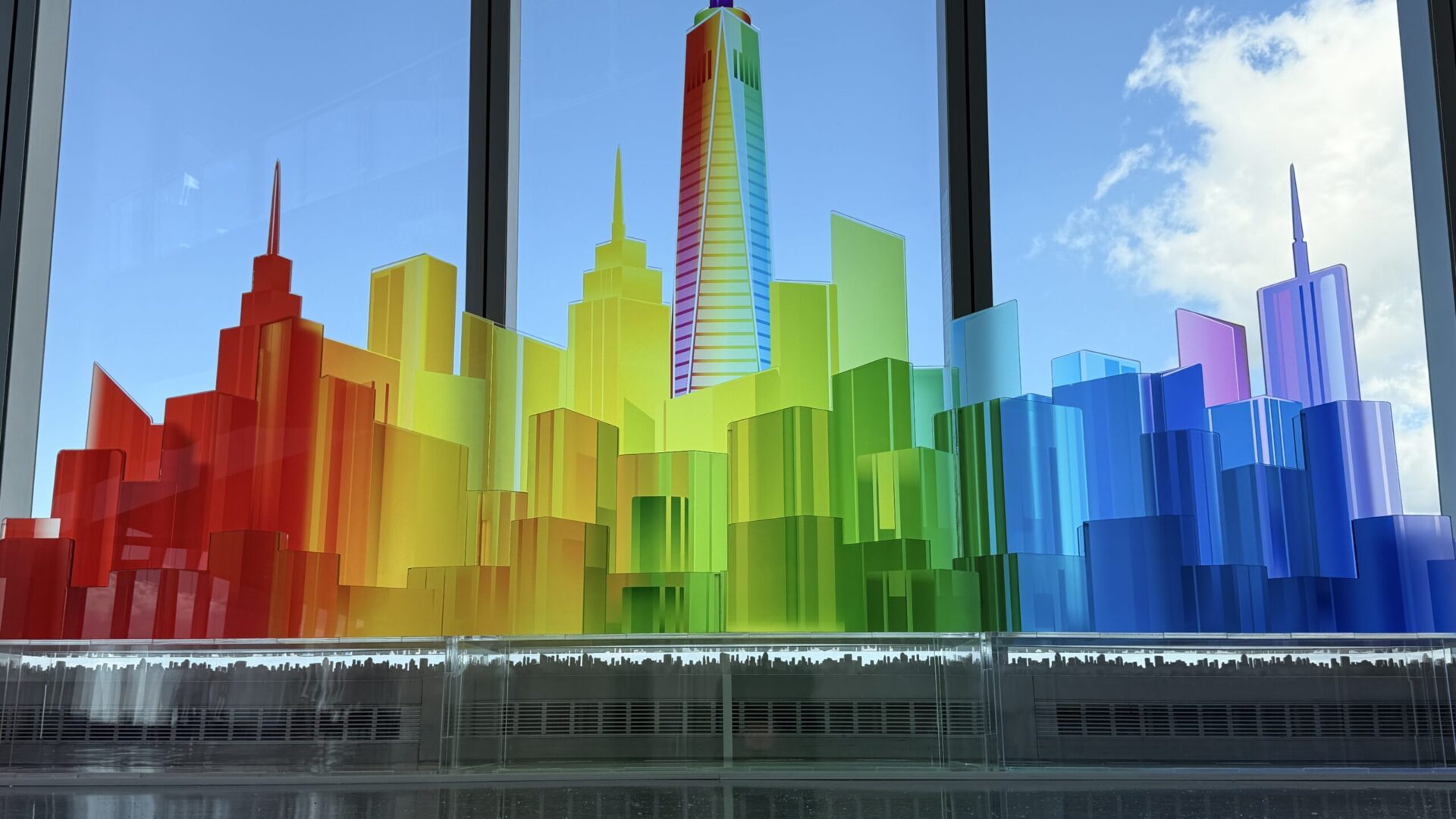
Acrylic is the only scenic material where the cut line is the design. Every contour the laser leaves behind becomes a polished edge that collects light and releases it as glow, which is why a laser-cut acrylic installation can read as luminous architecture rather than as a sheet of plastic with a logo on it. The material does that work on its own, under venue lighting, with no screen and no power.
It is also the material that punishes a careless file and an impatient install. Acrylic crazes when the wrong cleaner touches it, cracks from a hole drilled a half-millimeter too tight, and shows every fingerprint laid on it during load-in. The pieces that survive a month on the floor are the ones where the drawing, the lighting, and the mounting were decided together.
What follows is how our shop thinks about acrylic: what the laser actually does to the sheet, why the edges glow, how layers build depth, where the material is the wrong answer, and what a shop needs from you before it cuts anything.
What the Laser Does to the Sheet
A laser does not scrape acrylic away the way a router bit does. It vaporizes a narrow channel through the sheet, and the walls of that channel cool as glossy, optically clear surfaces. The edge comes off the bed already finished, effectively flame-polished, with no sanding and no buffing wheel in between.
That single property is why acrylic and the laser belong together. A CNC router cutting the same shape leaves tooling marks that a finisher has to sand through four grits and polish by hand before the edge is presentable, and a polished edge is the whole point. We still reach for CNC routing when a part is thick, structural, or made of something else entirely, but for clean contours in sheet acrylic, the laser produces a better edge in one operation.
Two material details decide whether that edge arrives clean. The first is cast versus extruded sheet. Cast acrylic cuts crisply and engraves to a bright frosted white, which is what you want for any face that will be lit from an edge. Extruded sheet holds a tighter thickness tolerance, useful when parts have to stack, but it carries more internal stress, gums slightly at the cut, and is readier to craze later.
The second is kerf. The channel is narrow, but it is not nothing, and any design built on interlocking parts, captive nuts, or layers that register to one another has to account for it in the file rather than on the bench. Parts cut without a kerf allowance either rattle or refuse to seat, and discovering which one happens during test fit is a bad afternoon.
Why the Edges Glow
Clear acrylic pipes light. Light entering a face travels inside the sheet, reflecting off the inner surfaces, until it reaches something that scatters it: an edge, an engraved line, a frosted area. Everywhere else, the sheet stays visually quiet. Hide an LED strip along one edge of a panel and every cut contour in that panel lights up, because the cut contours are edges too.
This is the mechanism behind most acrylic work worth building, and the reason a laser-cut acrylic installation reads differently from a printed panel. You are not lighting the object; you are feeding light into it and deciding where it is allowed to escape. Engrave the back face and the engraving glows while the surrounding sheet reads nearly invisible. Frost a shape and it floats. Leave the sheet untouched and it disappears into the room.
Color behaves the same way. Translucent colored sheet filters the light passing through it and carries that color out to every cut edge, so the palette of a piece is set by material selection long before anyone aims a fixture at it. When we designed and fabricated the One Love photo activation at One World Observatory, the rainbow progression across the piece came out of the acrylic itself, layered as translucent buildings behind a stylized New York skyline with One World Trade Center at its center. The sculpture stood twelve feet wide and eight feet high and held visitors throughout Pride Month, lit so that the color sat in the material rather than on it.
One decision governs all of this and gets made too late: the color temperature of the light you feed in. Warm white through a cool blue sheet dulls it toward grey. A neutral source keeps translucent color reading as the sample did in the shop. Agree on the source with whoever is doing the lighting design while the material is still being specified, not after the piece is hung.
Thickness, Layers, and the Illusion of Depth
Thickness is a visual decision before it is a structural one. At close range, the edge of the sheet becomes a visible band of color, and the thicker the sheet, the heavier and more deliberate that band reads. Thin sheet in a large panel does something worse than look cheap: it oil-cans, picking up a slight waviness that catches every reflection in the room and announces that the surface is flexible.
Layering is where acrylic does what no printed graphic can. Stack two or three translucent sheets with air gaps between them, hold them apart on standoffs, and each layer casts a soft shadow onto the one behind it. Guests moving past the piece get parallax, the front layer sliding against the back, and the whole assembly reads as having real depth rather than depicting it. Add an edge-lit layer in the stack and the depth becomes luminous.
Layered builds live and die on registration. Every mounting hole in every layer has to come from one file, from one origin, cut in the same run. Holes placed from separate drawings will miss each other by exactly enough to force someone to ream them on site, and a reamed hole in acrylic is a crack waiting for a temperature swing.
Not every acrylic piece wants light through it. For the private dinner we produced at One World Trade Center, the dining tables were custom-fabricated in black acrylic and built to read as monolithic surfaces: the material absorbing light instead of carrying it, so the tables sat in the room like cut stone under the laser-cut signage and the hand-carved foam Earth suspended above the room. Black acrylic is unforgiving in a way clear acrylic is not. It shows dust, settles every scratch into a visible scuff, and needs a crew member assigned to it before doors.
Where Acrylic Is the Wrong Answer
A laser-cut acrylic installation is a cladding and a lens, not a structure. It is strong in compression, brittle at point loads, and prone to creep: hold a span under sustained load and it will slowly bow and stay bowed. Any piece beyond a modest panel wants a frame behind it, in steel or plywood, carrying the load while the acrylic does the optical work.
Fasteners are the usual failure. A bolt through a snug hole in acrylic is a stress riser that will find a crack the first time the room heats up, because acrylic expands and contracts far more than the frame it is bolted to. Oversize every through-hole, use shoulder washers so the sheet can move, and never torque a fastener down onto bare acrylic. Radius the corners in the file as well. A square corner on a piece guests brush past all night is a chip in waiting.
There are also briefs where the material simply does not serve the idea. A build that needs weight, texture, and something that feels substantial under a guest’s hand belongs in metal or timber. The basketball-themed milestone we designed and fabricated for a private celebration at Cipriani made that trade openly: a CNC-fabricated back bar in basketball-line-textured metal grate with a cast-aluminum logo finished in gold, because the room needed hardness and grain, not glow. Choosing the material against the brief rather than for the technique is most of experiential event design.
Finishing, Mounting, and the Install You Have to Plan For
The protective paper masking stays on acrylic until the last responsible moment. It comes off after the parts are mounted, after the frame is plumb, after the cable runs are dressed, and ideally after every other trade has left the area. Masking pulled early turns a finished surface into something a crew spends an hour recovering.
Sequence a laser-cut acrylic installation late in the install. Scenic walls, rigging, and anything that produces dust happen first, because acrylic is statically charged and pulls airborne dust straight onto itself. Mount the acrylic, light it, clean it, then keep people away from it.
Cleaning is where good pieces get ruined. Household glass cleaner contains ammonia, and ammonia attacks acrylic, leaving a fine web of surface cracks that no amount of polishing removes. Warm water, a drop of mild soap, and a clean microfiber cloth handle almost everything. Blot and lift rather than scrubbing in circles. We keep an anti-static plastic cleaner and a stack of fresh microfiber on the cart, and we tell the venue team the same thing in writing, because someone will arrive with a bottle of blue spray at some point during the run.
Plan for breakage honestly. Edges chip, corners take hits, and a month-long public install means thousands of hands. Cut spares of the vulnerable parts in the original run while the file is set and the material lot matches. A replacement panel cut six weeks later in a different lot will read slightly different under the same light.
How to Brief a Shop Before Anything Gets Cut
A laser cuts vectors, so vector artwork is what a shop needs. Outlines rather than strokes, fonts converted to outlines, closed paths, and a clear note on which lines are cuts and which are engraving. A logo supplied as a raster image has to be redrawn before it can be cut at all, and redrawing someone’s brand mark is a decision we would rather hand back than make quietly.
Tell the shop three things the drawing cannot say on its own. How far away the guest will stand, because viewing distance decides thickness, engraving depth, and how fine the finest detail can be. Whether the piece is lit, and from where, because an edge-lit panel is a different build from a panel washed by a fixture. And how long it has to live, because a one-night dinner and a month-long public installation are different objects wearing the same drawing.
Then let the shop prototype. A test cut in the actual material, under the actual light source, settles arguments that renders cannot. Our event fabrication work on acrylic almost always includes a sample stack on the bench before the full run, and more than once that sample has sent us back to change a sheet color that looked correct on screen and muddy in the room. Any piece built as a photo moment deserves that test twice over, since content capture is unforgiving: a phone camera reads glare, hotspots, and reflections of the ceiling that the eye forgives.
Specified this way, a laser-cut acrylic installation becomes one of the most reliable objects in a brand activation. It needs no screen, no playback, and no operator, and it photographs the same at the first hour and the last. Most of what makes that true is custom fabrication discipline applied early, while the file is still open.
If you are weighing an acrylic piece for an upcoming build, the useful conversation starts with the room, the light, and how long the piece has to stand, not with the artwork. Send us the drawings you have and the constraints you are working against, and we will tell you plainly whether acrylic is the right material and what it will take to make it hold. Start a conversation with our team and we will work it through with you.