
A holiday activation in a cold-weather city is a building problem before it is a design problem. The concept that looks irresistible in a rendering — an open-air village, a sidewalk arch, a reflective photo moment on a plaza — has to survive wind coming off a river, a guest wearing gloves, and a sunset that lands before the doors open. Cold does not soften a weak idea. It exposes it.
The holiday activation ideas that hold up in New York, Chicago, Boston, or Aspen share a quality that has nothing to do with theme. They were designed around how long a person will actually stand still outdoors in December, and built so that the part of the footprint doing the real work is warm, lit, and under cover. Everything else is set dressing for a photograph taken in the dark.
What follows is how our shop and production team think about winter work: what the season does to dwell time, to materials, to light, and to the calendar, and which kinds of ideas survive all four.
Cold Decides How Long Your Idea Gets
Outdoor dwell time in winter is measured in a minute or two, not ten. That single fact should drive the whole design. A summer activation can afford a wandering sequence with three zones and a lounge; a December one gets a legible arc — see it, step into it, get the photo, leave with something in hand — and any step that asks a guest to linger in the wind will be skipped.
Coats and gloves also change the physical interaction. Nothing should require a fingertip: no small latches, no tablet sign-ups, no pens on clipboards. Outerwear adds real inches to every guest, which means queue lanes, door swings, and the activation footprint itself all need more room than the summer version of the same plan. Coat storage stops being a courtesy and becomes part of the floor plan.
Then there is breath. Warm bodies in cold air fog glass and mirror, and condensation on a mirror-finish surface erases the reflection that justified the material in the first place. When we fabricated, produced, and installed the mirror-finish WHITE CLAW letters standing on the sand at Montauk, reflection was doing the heavy lifting — open sky, water, summer light. The same letters on a cold plaza would need to be sited where they catch streetlight rather than breath, and wiped between photo groups.
The Strongest Winter Ideas Transform an Interior
Most holiday activation ideas worth building start indoors, because indoors is where the season stops being an obstacle and becomes the premise. Guests arrive cold and walk into warmth that looks like the reason they came. The move is not decor, it is envelope: you change what the room is made of.
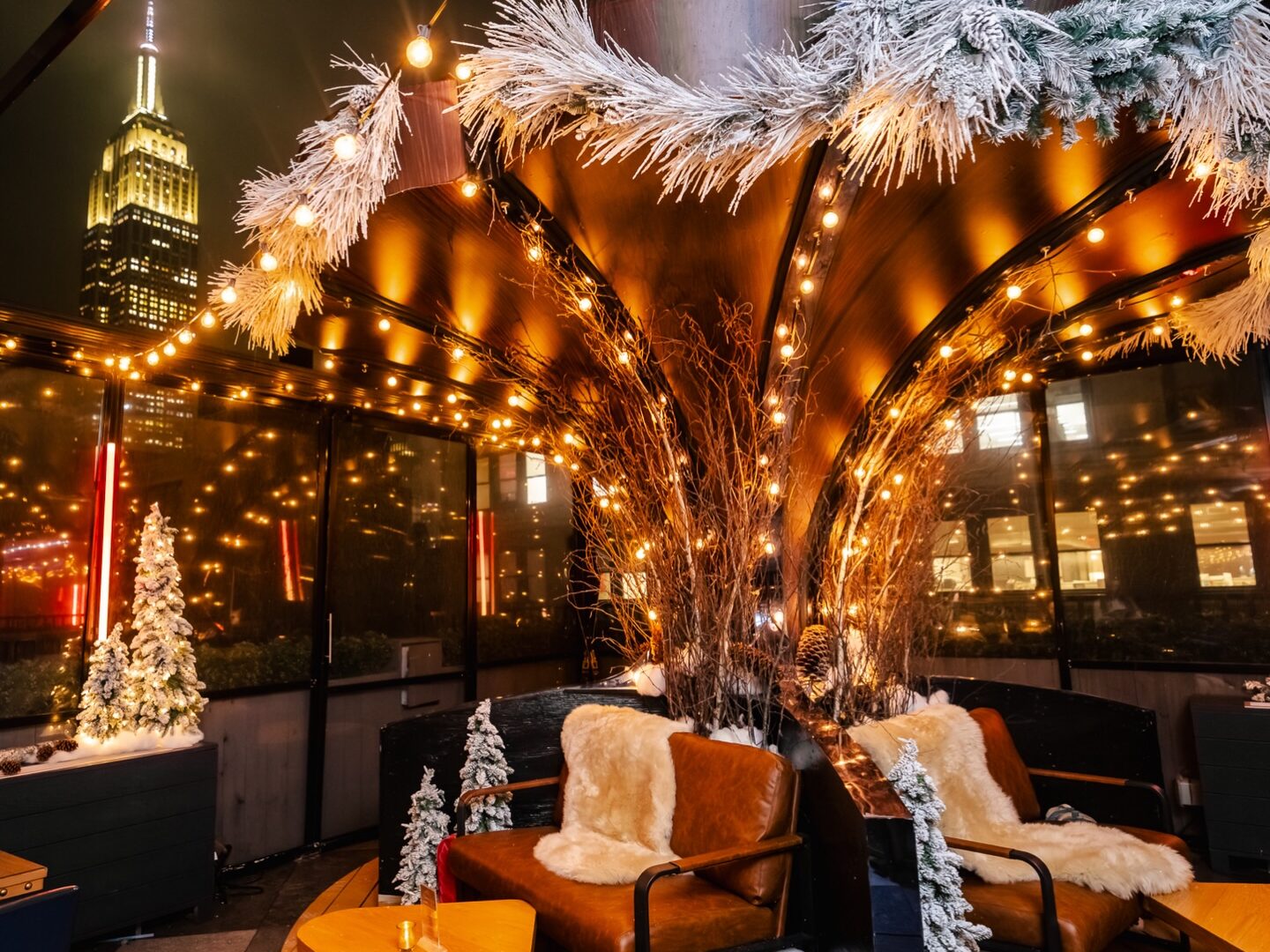
Our seasonal transformation of Magic Hour, the rooftop bar at the Moxy Hotel in midtown Manhattan, is the clearest version of that argument. Eighteen floors up, we turned the West Terrace into Magic Hour Mountain Lodge, an Aspen-inspired après-ski environment. Faux log cabin walls were built in the shop and installed around the dining tables without modifying the rooftop, finished to read as timber from phone-camera distance. A Western-flavored décor wall carried bighorn antlers, cowboy boots, ropes, and faux snow.
Two things in that build are worth stealing. The first is the distance threshold: a faux finish only has to convince at the range the guest will actually see it, and on a rooftop bar that range is a phone held at arm’s length. The second is reversibility. Shop-built panels that stand on their own let a working venue keep operating and let the whole environment come out cleanly at strike, which is the only reason a seasonal takeover of a revenue-generating room is possible at all.
In winter, the best idea is usually the one that puts the build inside the warm box and saves the outdoors for the sign.
Outdoor and Half-Outdoor Ideas That Earn Their Place
Some ideas have to be outside: a street-facing entrance, a market stall, a queue canopy, a façade. Those need to be engineered for conditions no summer build faces. Wind-driven snow finds every unsealed seam and then melts inside the structure. Standing water freezes, expands, and lifts anything resting on grade. Ballast has to hold a panel that is acting as a sail on the worst night of the run, not the calm afternoon of the install.
The half-outdoor threshold is where winter activations are won. Heat belongs at the dwell point, not spread across the whole footprint, and wind blocking usually matters more than heat output — a scenic wall placed to break the prevailing wind does more for comfort than another heater pointed at open air. A vestibule, even a shallow one, keeps the warm box warm every time the door opens.
The smartest outdoor move is often to put the build on the building instead of on the ground. For the Delilah pop-up in Montauk with Chase, we clad the entire street-facing façade in mirror as a paneled cladding system fabricated in our shop and installed over the existing exterior, and built a ground-up new entrance. Treating the whole thing as one re-skin rather than a collection of installed pieces is a cold-weather strategy as much as a design one: a structure attached to an existing wall has no footing to freeze and no ballast to calculate.
What Winter Does to Materials
Material behavior is the part clients rarely see coming, and it reshapes the build schedule more than any other factor. Water-based paints and most adhesives need warmth and time to cure, and a cold loading dock supplies neither. The answer is sequencing: finish in the shop, assemble on site, and treat anything that needs to cure in place as a schedule risk rather than a detail.
Pressure-sensitive graphics stop wanting to stick when the substrate is cold, so vinyl goes on warm panels in the shop whenever the design allows. Acrylic turns less forgiving in the cold and prefers generous radii and relieved fastener holes to sharp corners and tight tolerances. Bare metal reads beautifully and becomes unpleasant to touch, which is a good reason to keep steel and grate finishes away from handrails, door pulls, and bar edges where hands land.
Condensation deserves its own line in the plan. A panel that rides in a cold truck and goes straight into a warm ballroom will sweat, and a sweating panel will not take a graphic, a touch-up, or a clean seam. Bringing crates inside to acclimate overnight before install is unglamorous and saves a day of rework. Real timber moves with the humidity swings of a heated interior, which is one more argument for custom event fabrication on stable substrates with a painted finish rather than material that has opinions about the weather.
Faux snow is worth a warning. It photographs well and it travels: into hallways, onto stairs, under shoe soles. Contain it at the vignette, keep it off circulation paths, and tell the venue where it is going before load-in rather than after.
Light Is the Season’s Main Material
In a northern city in December, the activation will be seen in the dark for most of the hours it is open. Design the night view first and the daylight view second. That single reordering changes which ideas are worth building, because a form that depends on daylight and sky is a summer form, and a form that reads as a lit object in blackness is a winter one.
Warm light reads as shelter. Cool white outdoors reads as a parking structure. Holding the color temperature warm and keeping the brightest thing in view at human height is most of the work, and it is why the layered approach on the Roivant holiday gala at the Stephen A. Schwarzman Building of The New York Public Library transfers so well to winter builds: warm downlighting on the tables, amber washes on the lower walls, and only subtle uplighting acknowledging the ceilings without competing with them. Light low and warm, leave the architecture dim, and the room feels like refuge instead of inspection.
Phone cameras need a lit face, not a lit backdrop. A photo moment with a brilliant sign behind the guest and nothing in front of them produces silhouettes, which is the most common failure in winter brand activations and the easiest to fix: put a soft, warm front source at the standing position and let the scenic sit a stop darker.
The Calendar Is the Hardest Constraint
Most holiday activation ideas die on the calendar, not the drawing board. The season compresses every resource at once. Venues are booked, crews are spread across simultaneous installs, shop capacity fills with work that all has to land in the same three weeks, and the freight elevator in a midtown building is shared with every other holiday build in the stack. None of that is negotiable in December; all of it is manageable in September.
Two scheduling habits make the difference. Lock the structural move early — the thing with engineering, long-lead material, or a rigging question attached — and let finishes, graphics, and props stay open longer, because those can absorb late changes and structure cannot. Then test fit in the shop while the venue is still unavailable, so the first time panels meet is in a building where a saw is within reach.
Plan the strike before you plan the opening. Labor between the holidays is thin, venues want their rooms back fast, and a seasonal environment that cannot come out cleanly becomes someone’s problem on New Year’s Eve. Builds designed as free-standing, labeled, crated components come out in a fraction of the time, which is as true of holiday events in Manhattan as it is in a mountain market like Aspen.
Choosing Among Winter Ideas
When several concepts are on the table, the questions that sort them are mechanical. Where is the guest standing and for how long? Is the warm box doing the work, or are we asking the outdoors to carry the experience? Does the hero form read as a lit object at night? Can it be finished in the shop and installed cold? Does it come out in one night?
Ideas that answer those five cleanly tend to be the ones that photograph well, hold up for a month-long run, and leave the venue the way we found it. Ideas that fail two or more usually need a different form, not a bigger heater.
If you are working on a winter takeover, a holiday gala, or a cold-weather activation tour and want a build that survives the season rather than fighting it, our team is glad to talk through the form before the drawings start. The earliest conversation is always the cheapest place to solve a cold-weather problem. Tell us what you are planning and we will tell you honestly what the calendar and the material will allow.