
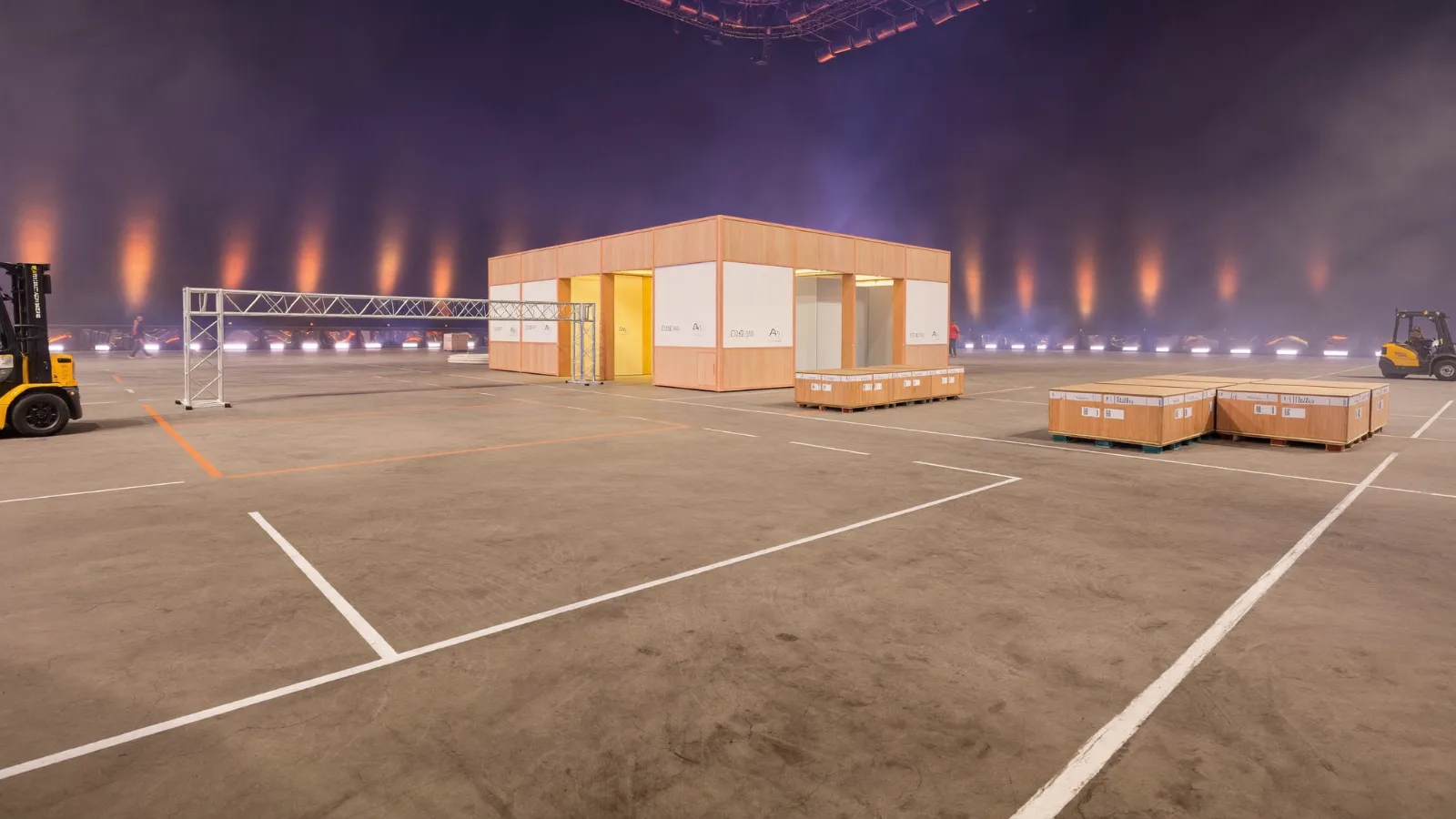
A Las Vegas trade show booth is built to a hall and a week, not to the city: the building decides how high a sign may hang, who rigs and powers it and how freight arrives, and the show calendar decides which crews and docks are busy that week. Draw to the hall's published rules, plan four to six days of freight from New York, and read the dates before you hold a build slot.
Many booth guides start with the booth. A producer starts with the hall, because the hall is where a good drawing goes wrong. This guide reads published rules the way a drawing set is read: what each one changes on the sheet, what the shop builds, and what the building orders instead.
Rules are given as each publisher's page stated them when read on November 27, 2026, and each one is named in the sentence that uses it. Each show's exhibitor manual governs, this is a summary of published rules and not legal advice, and fees, rates and insurance limits are left out on purpose. It is written for the exhibitor's events manager or the agency producer who signs off on a build. The contractor paperwork and the ten questions to put to a builder are in our guide to what a trade show booth builder must read before it draws, and are not repeated here.
Which Las Vegas show floors will a custom booth stand in?
Las Vegas shows run in a handful of buildings, and a single show can use more than one, so the first drawing question is which building and which hall.
The table is a sample of large shows that publish their dates, not a full calendar, so ask each show's exhibitor services contact for the manual of the year you exhibit.
| Show | 2027 dates | Building | Source |
|---|---|---|---|
| CES | January 6 to 9 | Las Vegas Convention Center, Venetian Expo and the C Space campus | Our CES 2027 guide, citing the organizer's dates (checked October 23, 2026) |
| World of Concrete | Exhibits January 19 to 21, education January 18 to 21 | Las Vegas Convention Center | worldofconcrete.com |
| SHOT Show | January 19 to 22 | Venetian Expo and Caesars Forum | shotshow.org |
| NAB Show | Show floor April 4 to 7 | Las Vegas Convention Center | nabshow.com |
| ISC West | Exhibit hall April 7 to 9 | The Venetian Expo | iscwest.com |
| SEMA Show | November 2 to 5 | Las Vegas Convention Center | semashow.com, which still shows 2026 dates beside the 2027 ones, so confirm |
Booth type drives the hall rules read in this guide, and each show's manual uses the same four terms. Our custom vs modular trade show booth guide, which follows IAEE's display guidelines, defines them: a linear booth sits in a row with neighbors on one or both sides, a perimeter booth is an inline booth along the outside wall of the hall, a peninsula is open on three sides, and an island is open on all four and is typically 20 by 20 feet or larger. Which type you hold decides what the hall lets you hang.
What does one Las Vegas hall allow? The Venetian Expo as a worked example
At the Venetian Expo, island and peninsula booths of 400 square feet or more in Halls A to D may hang signs up to 25 feet to the top of the sign, linear and perimeter booths may not hang signs, Hall G allows none, and rigging, overhead lighting and electrical work are ordered from the Expo rather than built by an outside crew.
That is the Venetian Convention and Expo Center's own wording on its exhibiting page and meetings FAQ, which carry identical text. A hanging sign is any sign or banner suspended from the hall's ceiling structure above a booth, and it is rigged by the building, not by the booth builder. A rigging order is the request that tells the building's riggers what to hang and where. The Venetian says a CAD or VW drawing and a service location plan, the marked-up floor plan that shows where each service lands, must go with the rigging order, that the exhibitor or a representative must be in the booth at delivery, and that its riggers will not open any crate, case or box not clearly marked "signage."
The same pages name the Expo as the exclusive provider of electrical wiring under carpet or flooring, overhead lighting and its distribution, equipment hookups that need electricity, installation of electrical fixtures, motorized hoists, truss and lighting installation, and the installation and removal of overhead electrical signs and trusses. Asked whether an outside supplier may be brought in, the Venetian answers no and lists catering, cleaning, rigging, lighting, internet and telecom, electrical and plumbing. Here is what each rule changes on a drawing.
| Rule at the Venetian Expo | What the Venetian says | What it changes on the drawing |
|---|---|---|
| Hanging sign | Islands and peninsulas of 400 square feet or more in Halls A to D, up to 25 feet; none over linear or perimeter booths; none in Hall G | Height is a design decision tied to booth type and hall. An island can carry it, an inline booth cannot, and floor-supported height is the alternative |
| Rigging and electrical | Ordered from the Expo, with a CAD or VW drawing and service location plan | Every hung or lit element is a dependency: draw it, number it and put it on one sheet the Expo can price |
| Floor load | Per the Venetian's exhibiting page: Halls A to D, 250 pounds per square foot, a static weight; no limit stated for Hall G | Ballast and a heavy counter get a weight on the sheet |
| Power | On 30 minutes before the show opens, off 30 minutes after it closes; round-the-clock power is a separate order | Anything that must stay powered overnight, such as refrigeration for a bar or a charging case, needs its own order |
| Samples, food and drink | Samples only with the Expo's written authorization; all food and drink consumed in the building comes from the center | A booth that serves anything starts with an authorization request |
| Start times | Guaranteed only for move-in work where electrical labor starts at 8:00 a.m., with at least 48 hours' notice; not available on show days | Do not build a schedule on a guaranteed start; treat one as a favor you asked for early |
Two smaller rules matter to a booth with screens. The Venetian says electrical service is not included in an audio-visual equipment order, so a screen's power is its own line, and it says wireless devices need the exhibitor's own router or access point. A live demo is a bandwidth order before it is a design.
The line between what the shop builds and what the building orders is the booth's real scope. The freestanding structure, the finish, the lighting wired inside the booth and the numbered crates are the shop's. The hung sign, the truss and the overhead power are an order and a drawing, not a build.
A booth that serves is the clearest case. Our Café de Colombia activation at the San Diego Convention Center was a 40 by 20 foot build with a working coffee bar and a concealed back-of-house storage zone, designed and built in fourteen days. That was San Diego, not Las Vegas, and we claim no Las Vegas project here. The Las Vegas reading of the same booth is the Venetian's sampling rule: the bar is drawn, and the written authorization is requested, before the bar is cut.
Pro Tip: Draw every hung or powered item on one sheet, numbered, with its weight and its height from the floor. The building's riggers and electricians price and place from that sheet, and the Venetian says a CAD or VW drawing and a service location plan must go with the rigging order. Our trade show booth design guide opens with the same hanging-sign question.
Why does one show follow two sets of rules in two buildings?
Because the building adds its own rules to the show's: the SHOT Show's own newsletter tells exhibitors that hanging-sign height limits, eligible booth locations and installation procedures vary between the Venetian Expo and Caesars Forum, so one drawing cannot serve both.
The SHOT Show Insider of October 13, 2026, on shotshow.org, says hanging signs are permitted in qualifying island and peninsula booths of 400 square feet or larger, but that height restrictions, eligible locations and installation procedures vary by facility. It also says all hanging signs must be shipped separately from booth materials to the Freeman advance warehouse, using a designated Hanging Sign Shipping Label from the Exhibitor Resource Center. An advance warehouse is a facility that receives freight ahead of move-in, so the show's contractor can deliver it to the booth when the floor opens. The same issue notes that renovations at the Venetian Expo had just wrapped up.
Three things follow for the drawing. The sign gets its own crate, its own label and its own sheet. A booth drawn for one building is checked against the other before it goes out, if the show spans both. And after a renovation, the floor plan and hall layout are confirmed with the building, not taken from last year's drawing. The Venetian lists floor plans, an Exhibitor Success Guide and a General Contractor and Production Guide on its resources page; ask for the ones that apply to your hall.
This guide states no Las Vegas Convention Center booth, sign-height or dock rule, because those reach you through each show's exhibitor manual for the year you exhibit. What we can say comes from our own pages: our CES guide says the Convention Center, Mandalay Bay and the Venetian Expo each run their own labor jurisdictions, drayage contractors and installation protocols.
How does a booth built in New York get to a Las Vegas hall?
Our CES guide puts cross-country freight to Las Vegas at four to six days in transit, and that time sits inside a longer schedule that runs back from the hall's move-in window, with crates drawn to the route and the sign in its own crate.
Move-in is the window when exhibitors may bring freight and labor onto the floor. Material handling, often called drayage, is the service of moving crates from the dock to the booth and back out, and the show's contractor controls it. Freight either goes to the advance warehouse, which receives it before move-in, or direct to the site on a scheduled date. Our convention center activations guide covers marshaling yards and dock queues in general terms, and the SHOT Show rule above adds the Las Vegas detail: hanging signs go to the advance warehouse on their own label.
| Step | Done in the New York shop | Ordered from, or done by, the hall |
|---|---|---|
| Structure and finish | Built, test-assembled and numbered | Nothing |
| Hung sign and truss | Built, crated separately and labeled | Rigging order with a CAD drawing and service location plan |
| Overhead lighting and power | Fixtures pre-wired inside the booth | Electrical orders from the building |
| Freight | Crates sized to the route, weights listed | Material handling by the show's contractor |
| Install | Supervised by the crew that built the booth, subject to the show's labor rules | The manual says which tasks stay with show labor |
| Strike | Planned in the drawings | Same |
A test assembly is the full build of the booth in the shop before it ships, so every panel, fixture and connection is proven to fit. The Netflix booth at the Meadowlands was a 22 by 22 foot build made from the brand's existing CAD drawings, with an engineering review in the first 48 hours, then pre-built and dry-fit in our shop so the on-site build was an assembly operation. That was New Jersey, not Las Vegas, and the same sequence, drawn to a hall's rules, is what a Las Vegas booth needs. Our installation and strike guide covers what happens after the crates arrive.
Pro Tip: Label the sign crate on every face with the booth number, the hall and the words the show's label asks for, and ship it on its own bill of lading. A hanging sign that arrives with the booth freight is a sign someone has to find.
Which Las Vegas weeks collide in 2027?
Two pairs of large shows overlap in 2027: World of Concrete at the Convention Center and SHOT Show at the Venetian Expo and Caesars Forum both open January 19, and NAB Show at the Convention Center and ISC West at the Venetian Expo share April 7. The weeks around them are the ones where docks, show labor and carriers are likely to be busiest.
Put the January dates together and the squeeze is plain. CES ends January 9, and World of Concrete and SHOT Show open ten days later, on January 19. A crew or carrier moving from one to the next has the same short January. That is a reading of the published dates, not a labor-supply statistic, but it is the reading a build schedule should assume.
Our CES guide recommends booking four to six months ahead for peak convention weeks. The same calendar from the room side is in our Las Vegas corporate events guide.
Where does a custom booth stand against the calendar now?
As of November 27, 2026, CES and the January shows sit inside the compression zone for a new custom booth, and the April shows sit in a workable window for a standard custom exhibit, though not for a large island or a first build: Geo publishes 10 to 16 weeks from brief to install for a custom exhibit, 3 to 4 months as a comfortable schedule, 5 to 6 months for a large island or a first build, and 6 to 8 weeks to modify a booth you already own.
Those ranges come from our custom vs modular trade show booth guide, which adds 2 to 4 weeks when a modular system is built to tour. The table counts from today to the day each show's exhibit floor opens.
| Show | Exhibit floor opens | Days and weeks from November 27 | Reading against Geo's published lead times |
|---|---|---|---|
| CES | January 6 | 40 days, 5.7 weeks | Shorter than the 10-week low end, and move-in starts before opening. Our CES guide lists early move-in desks opening December 26 at the Convention Center and December 29 at the Venetian Expo. Only a modified booth or a compressed, locked-design build |
| World of Concrete and SHOT Show | January 19 | 53 days, 7.6 weeks | Inside the 6 to 8 weeks for modifying a booth you own; short for a new custom build |
| NAB Show | April 4 | 128 days, 18.3 weeks | Past the 3 to 4 month comfortable mark for a standard custom exhibit; short of the 5 to 6 months for a large island or a first build |
| ISC West | April 7 | 131 days, 18.7 weeks | Same reading as NAB Show |
| SEMA Show | November 2, 2027 (dates to confirm with the organizer) | 340 days, 48.6 weeks | Time for a design round and a test assembly, if the dates hold |
Count back from the first move-in date, not from opening day, and the January rows tighten again. Compressed builds do happen. Netflix ran on two weeks, against four to six weeks for that scope on its case page, and Café de Colombia ran on fourteen days. Both held because the design was locked at kickoff and every trade ran in parallel. They show what a shop can do when decisions land, not a plan to assume, and we make no promise about a Las Vegas show beyond the ranges above. Our custom event build timeline lays out the stages that fill those weeks.
Pro Tip: Hold the build slot before the show's floor plan is final. The shop's calendar fills in the same weeks the show calendar fills, and the drawing can still move inside a held slot.
What should a Las Vegas booth brief include?
The show and the building, the booth number, size and type, the exhibitor manual and the hall's own guide, what hangs or needs power, anything that serves food or drink, and the freight route.
| Brief item | Where you find it |
|---|---|
| Show, building and hall | The show's exhibitor page |
| Booth number, size and type | The space contract and floor plan |
| The hall's own guide | For the Venetian Expo, its General Contractor and Production Guide and Exhibitor Success Guide |
| Hung items and their weights | Your drawing, on one numbered sheet |
| Powered items, and any need for round-the-clock power | Your drawing and the building's electrical order |
| Food, drink or samples | The building's written authorization form |
| Bandwidth for demos | The building's internet order |
| Reuse at later shows | Your show calendar after this one |
Put the manual in the brief, and compare proposals on what each one includes from it. Our trade show and exhibit production page lists the scope we cover.
Why work with a full-service production company on a Las Vegas booth?
Because one team answers for how the booth is drawn to the hall, built, shipped, installed and struck, so the sign crate, the rigging drawing and the freight date sit on one schedule.
Geo Events brings more than 15 years in event production and more than 200 events built in-house, from our shop in New York. According to our custom vs modular guide, the crew that builds a booth installs it, subject to each show's labor rules, and we deliver, install and strike nationally. Where a hall reserves a task to its own providers, that task goes to them, whoever builds the booth. Our custom event fabrication and brand activation fabrication shop builds the structure, our full-service event production team runs the program around it, and our event production in Las Vegas page shows how we cover the city from our New York shop.
Send us the show name, the dates, your booth number and size, and the exhibitor manual, and we respond within one business day with a production scope and an honest schedule from your first move-in date.
Frequently asked questions
How high can a booth sign be at the Venetian Expo?
Per the Venetian's FAQ, island and peninsula booths of 400 square feet or more in Halls A to D may hang signs up to 25 feet, measured to the top of the sign. Linear and perimeter booths may not hang signs, and Hall G allows none. Confirm the rule for your hall in the show's exhibitor manual, which governs.
Can I bring my own riggers or electricians into a Las Vegas hall?
Not for everything. The Venetian Expo says it is the exclusive provider of rigging, overhead lighting and electrical work, and it answers no when asked about outside suppliers for those services. The freestanding booth is separate. Read your show's manual and the hall's contractor guide first. This is a summary of published rules, not legal advice.
How long does freight from New York to Las Vegas take?
Our CES 2027 guide puts cross-country freight from our New York shop to Las Vegas at four to six days in transit. That time sits inside a longer schedule that runs back from the hall's move-in window, with crates sized to the route and any hanging sign shipped in its own crate.
How far ahead should I plan a Las Vegas booth?
Geo plans 10 to 16 weeks from brief to install for a custom exhibit, 3 to 4 months as a comfortable schedule, and 5 to 6 months for a large island or a first build. Our CES guide recommends booking four to six months ahead for peak convention weeks. Count back from the first move-in date.