
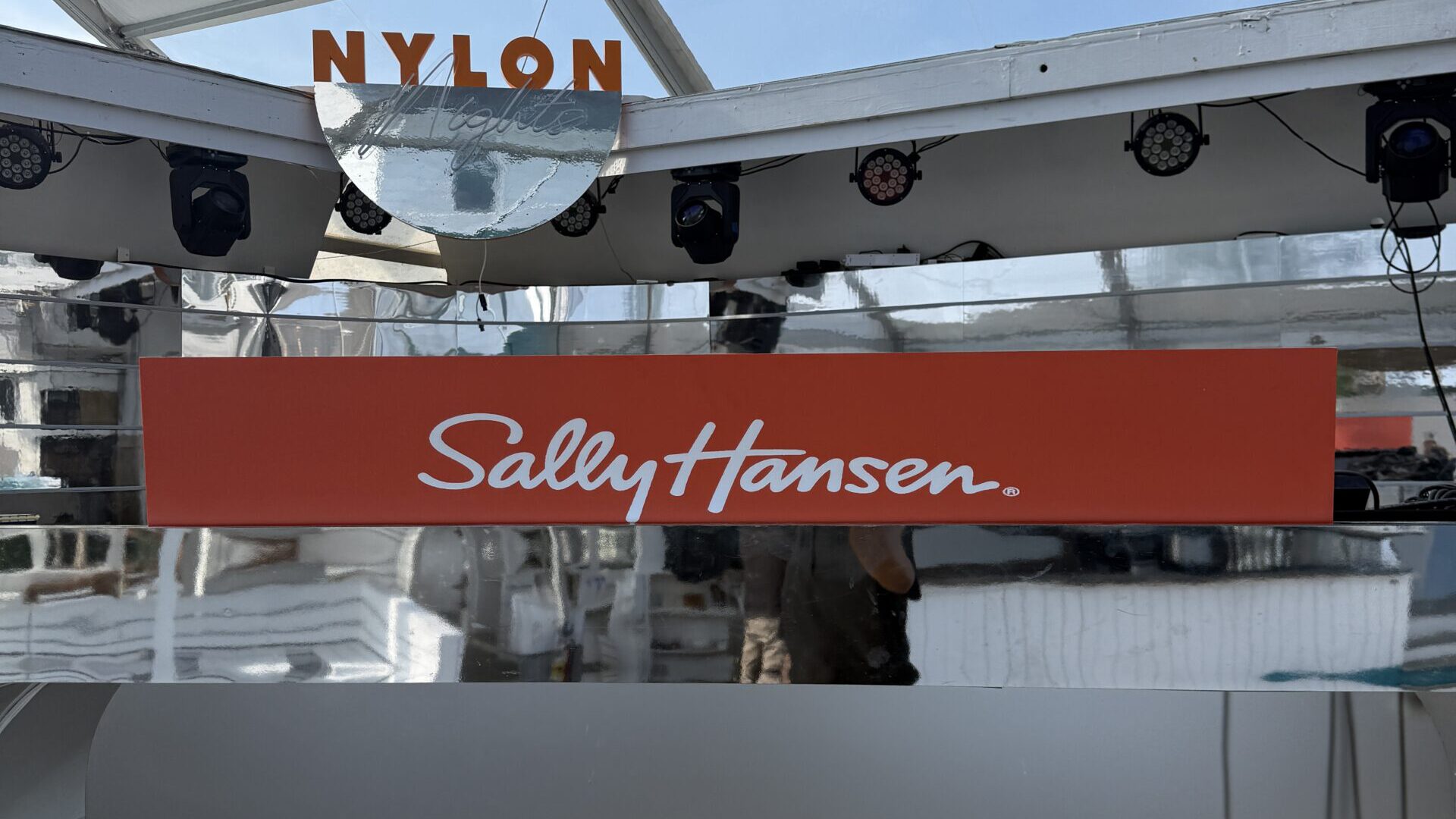
A beauty brand activation is inspected from eighteen inches away. That single fact separates it from nearly every other kind of brand environment, and it governs every material decision that follows. A guest leans into a mirror to test a shade, picks up a bottle, turns it under the light, and sets it down on a surface their hand is already resting on. At that range there is no forgiving angle and no safe sightline. Every seam, every edge, every joint is in frame.
Most event scenic is built for a twelve-foot read. It is engineered to look right from across a room, under moving light, in a photograph taken over somebody’s shoulder. Beauty does not grant that distance. The category asks for retail finish tolerances on an event schedule, and the builds that disappoint are almost always the ones treated as ordinary scenic with product placed on top.
What follows is how our shop thinks about the category: where its demands come from, which parts of a build absorb them, and what a brand team should put in front of a fabricator before anyone starts drawing.
Beauty Sits Closer to Retail Than to Events
The useful mental shift is to stop benchmarking a beauty activation against other events and start benchmarking it against a flagship store. A counter in a department store is specified to survive thousands of hands, hold a planogram, conceal its own storage, and look unbothered at the end of a trading day. A guest walking into a branded environment carries that expectation with them, whether or not anyone briefed it.
That is a fabrication problem before it is a design problem. Retail-grade work means flat substrates, deliberate seam placement, edges treated rather than merely painted, hardware that does not loosen, and surfaces that can be wiped down without burnishing. None of it is exotic. All of it is slower than the event-scenic default, which is why it has to be scoped at the drawing stage rather than discovered during finishing.
The closest analogue in our own work is the Café de Colombia activation at the San Diego Convention Center: a 40-by-20-foot build with retail-grade finishes, an integrated full-service coffee bar built to retail operational standards, two dedicated tasting environments, and concealed back-of-house storage, designed, built, branded, and delivered in fourteen days for more than 3,000 attendees. Different category, same underlying demand. Guests consumed something, handled surfaces continuously, and were served by staff who needed the build to work as equipment rather than as decor.
The Arm’s-Length Finish Problem
Finish quality is not one decision. It is a chain of them, and a beauty brand activation exposes the weakest link in that chain more cruelly than any other format.
Start with the substrate. A high-gloss or near-gloss surface is a mirror for the panel underneath it, so any waviness in the sheet, any proud fastener, any filler shrinkage reads as a ripple once light rakes across it. Flatness is bought at the material stage, not recovered at the paint stage. Sheen is the second decision: the higher the gloss, the more the surface reports every flaw, and the more a build depends on controlled spray rather than hand application.
Seams are the third, and they are the one clients rarely see coming. Any built element larger than a sheet of material has joints. The question is never whether there are seams but whether a human being decided where they land. Good event fabrication puts them on a reveal, a corner, a change of plane, or a graphic break where the eye expects an interruption. Weak work leaves them in the middle of a field of color at hand height.
Edges finish the chain. A cut edge on a composite panel is a different material from its face, and it takes a different sequence to read as one object. Banded, lipped, routed, or wrapped, that detail is what separates a surface a guest trusts from one they quietly recognize as temporary.
Distance Thresholds Are a Design Input
Every fabricated finish has a distance at which it stops performing. Part of the craft is deciding that distance on purpose and then holding the build to it.
When we transformed the rooftop bar at the Moxy Hotel into Magic Hour Mountain Lodge, the faux log cabin walls were shop-built and finished to read as timber from phone-camera distance. That was the stated threshold, and it was the right one: guests moved past those walls, photographed in front of them, and sat at tables set against them. A faux finish specified for that range is a different piece of work from one a guest will touch while deciding whether to buy a serum.
Beauty collapses the threshold to arm’s length, and it does so selectively. A back wall eight feet behind a counter can be treated for a mid-room read. The counter itself, the testers, the mirror surround, and anything within reach have to hold at contact distance. Writing that map into the drawings, surface by surface, is what keeps a build from being uniformly over-specified or dangerously under-specified.
Lighting Has Two Jobs and They Disagree
In most brand environments, lighting serves the space and the camera. In a beauty environment it also has to serve a face, and those requirements pull in different directions.
Overhead downlight alone, the default in most venues, drops shadow into the eye sockets and under the nose. It flatters architecture and nobody’s complexion. Light at or slightly above face height, diffused and delivered from the front, is what lets a guest judge a shade on their own skin and what makes the photograph they take worth posting. Mirrors with integrated illumination solve this directly, which is why they are worth building rather than renting.
Consistency matters as much as direction. Mixed color temperature across a footprint will shift the apparent shade of both the product and the skin it sits on, so a guest comparing two testers under two different sources is being given bad information. Hold one temperature across every fixture that touches a testing zone, and keep the venue’s house light off those surfaces or balanced into them.
Branded color is the third constraint. A surface matched to a brand standard in the shop will read differently under a warm wash than under a neutral one, so finish approvals belong under the lighting the activation will actually use, not under shop fluorescents.
Mirror, Reflection, and the Moment Guests Photograph
Mirror is native to this category, and it is a demanding material. It doubles apparent scale, pulls sky and surroundings into a composition, and gives a guest a reason to stop and raise a phone. It also shows fingerprints within minutes, reveals any deviation from flat as a visible bend in the reflected image, and reflects whatever is behind the camera, including crew, cases, and cable runs.
Those problems are solved in the shop and in the install sequence. For the Delilah pop-up in Montauk, built in collaboration with Chase, the entire street-facing façade was clad in mirror as a paneled cladding system fabricated in our shop and installed over the existing exterior, with a ground-up new entrance. Treating it as a single re-skin rather than a set of applied pieces is what let the panel grid, the substrate behind it, and the reflection all be controlled as one system.
Reflection is not the only route to a photographed centerpiece. For One Love at One World Observatory, we designed and fabricated a 12-foot-wide by 8-foot-high photo activation as a laser-cut acrylic sculpture with layered translucent buildings, a rainbow color progression, and a stylized New York skyline. Layered acrylic carries color and light through depth rather than bouncing it off a face, which makes it durable in a way mirror is not and forgiving of the fingerprints a month-long public install guarantees.
Throughput, Restock, and the Back of House
A beauty brand activation is an operating business for the length of its run. Guests queue, sit, test, wash, ask questions, and leave with something. That makes guest flow a fabrication requirement rather than a floor-plan afterthought.
Throughput is set by the slowest station, which is usually the one involving a mirror and a decision. Build more of those than the hero rendering suggests and the queue stops being the guest’s memory of the brand. Give staff a working side with real elbow room, a surface at the right height, and somewhere to put a cloth.
Restock is the detail most often missed in a brief. Testers run down, cotton and wipes vanish, and waste accumulates faster than anyone plans for. A build that forces staff to walk product across a guest-facing floor every twenty minutes has designed its own worst photograph. Concealed, accessible back-of-house storage, built into the footprint rather than borrowed from the venue, is what keeps the environment looking the way it looked at opening.
Durability closes the loop. Surfaces in constant contact need finishes chosen for cleaning cycles, and the cleaning protocol should be handed over with the build, because a crew wiping a satin lacquer with the wrong cloth will polish a shine into it within days.
Launches, Pop-Ups, and Builds That Travel
Much of this work arrives as a launch or a short-run retail environment, which adds a scheduling constraint to the finish constraint. A product launch or pop-up has a fixed public date, a venue handed over late, and a brand team still refining product packaging while drawings are being cut.
Two decisions protect the outcome. Lock the surfaces a guest will touch early, because they carry the longest finishing sequence and the least tolerance for revision. Then let the elements built for a mid-room read absorb whatever changes late, since graphics, backdrops, and secondary scenic can be re-skinned without re-engineering anything.
If the environment is going to more than one city, modularity has to be a condition of the design rather than a retrofit. Panels sized to crate, connections that a local crew can make without the shop present, and a finish system that can be touched up on site are what keep the tenth install looking like the first. Our brand activations practice treats that as part of the engineering review, alongside the pop-up experience questions of dwell time and frontage.
What to Put in Front of a Fabricator
A beauty brand activation gets scoped accurately when the brief answers the questions a shop is going to ask anyway. Bring these and the first set of drawings will be close.
- Finish references, physically if possible. A sheen name and a color code mean more than an adjective, and a sample a brand team has approved in hand settles arguments that renders cannot.
- Product dimensions and the merchandising intent. How many units face out, how they are held, and who restocks them changes the fixture, not the decoration.
- A throughput assumption. Guests per hour at the slowest station determines how many stations exist.
- The lighting intent for faces, not just for the room, including whether guests are expected to judge color.
- The venue envelope: door and elevator dimensions, floor loading, available power, what may be attached to and what may not.
- The strike condition. Reversibility requirements shape the structure, so free-standing and self-supporting decisions belong at the start.
None of that requires a brand team to know fabrication. It requires them to know their product, their guest, and their venue, and to say so before a shop starts guessing.
If you are planning a beauty launch, a counter takeover, or a short-run retail environment and want the finish to hold at arm’s length, we are glad to talk through the build before the drawings are fixed. Our team designs, fabricates, and installs this work in-house, which is usually what makes the finish schedule survive contact with the calendar. Start a conversation with our production team and bring whatever you have, however rough.