
Fast track event production is not a compressed version of an ordinary build. It is a different sequence, with the decision points moved to the front and the deliberation taken out of the middle, and it only works when the schedule is re-ordered from day one rather than squeezed at the end. A two-week build that fails almost never fails in the shop. It fails because a question that needed an answer on Monday got answered on Thursday.
We have built on both clocks. A ten-week project and a fourteen-day project can arrive at the same finish quality, but they are not the same job, and pretending otherwise is how rushed builds go wrong. What follows is what actually compresses, what refuses to, and what a client has to do differently when the calendar is the hardest constraint in the room.
What Compresses, and What Refuses To
Some parts of a build are elastic and some are physics. Knowing which is which is the whole discipline of fast track event production, because the elastic parts are where the time comes from and the rigid parts are where rushed projects break.
Material lead times are rigid. Sheet goods, steel tube, specialty acrylic, and custom-printed graphics arrive when the supply chain says they arrive, and no amount of urgency moves a mill order. Finish schedules are rigid in the same way: primer, fill, sand, topcoat, and cure happen in order, and a coating that needs overnight to harden will not be talked into four hours. Freight transit is rigid. Venue access windows are the most rigid of all — the dock time you are given is the dock time you have.
What compresses is deliberation. Revision cycles compress. Approval latency compresses, often dramatically. Most of all, sequence compresses: work that a comfortable schedule runs in series — design, then drawings, then engineering, then procurement — a fast track schedule runs in parallel, with drawings in progress while long-lead materials are already on order against a locked footprint.
The useful way to think about it: on a ten-week build, fabrication is the long pole. On a two-week build, decision latency is the long pole. The shop is rarely the bottleneck. The inbox is.
The Decisions That Must Land on Day One
A compressed schedule buys its speed by converting open questions into fixed facts early. Four things have to lock immediately: the footprint and overall envelope, the structural approach, the material and finish palette, and the integration list — every screen, fixture, light, and power drop the build has to accommodate.
Those four decisions are upstream of everything else. The envelope determines the cut list. The structural approach determines hardware, weight, and how the piece breaks down for transport. The palette determines which materials get ordered in the first hours. The integration list determines where blocking and wire paths have to exist inside a wall that is about to be built.
This is why a thorough creative brief is worth more on a fast track than on any other kind of project. The brief is not paperwork; it is the mechanism that lets a shop start cutting on day two instead of day six. Everything a brief leaves vague becomes a question someone has to chase while the clock runs.
The hard part to accept is what happens to late changes. On a normal production schedule, a change in week three is a change. On a two-week build, a change to a day-one decision on day eight is not a revision — it is a restart of that piece, and the piece may not have a second build cycle available to it. Fast track event production trades optionality for certainty. That is the actual deal, and it should be stated plainly before anyone signs.
Engineering Review Moves to the Front
On a comfortable schedule, engineering review tends to sit between drawings and fabrication, a checkpoint the project passes through. On a compressed one, it has to happen almost immediately, because engineering findings propagate outward into everything downstream.
When we built a 22-by-22-foot custom trade show booth for Netflix at the Meadowlands Complex on a two-week build cycle, engineering review of every drawing happened in the first 48 hours. That ordering was the project. An engineering change caught on day two is a drawing revision. The same change caught on day nine is a rebuild, because by then the cut list has been cut, the hardware has been ordered, and the freight has been booked against dimensions that are no longer true.
Engineering review on a short clock is also where honest refusals happen. If a structure cannot be made self-supporting at the height the design wants, or a rigging approach will not survive the venue’s point loads, the review says so while there is still time to re-draw. A fast track project that skips this step is not faster. It has simply moved its risk to the install, which is the most expensive place to discover anything.
Build From Drawings That Already Exist
The single biggest accelerator on a short schedule is starting from drawings rather than from a blank page. Brands with mature design systems often already have CAD for their environments, and a shop that can read and build from that package skips the entire concept phase.
The Netflix booth was built from the brand’s existing CAD drawings, and the work was translation rather than invention: custom lighting fixtures, custom display fixtures, flush-mount televisions integrated into wall pockets, and a branded LED logo as the centerpiece, all resolved into shop-ready documents. The show drew more than 2,000 attendees, and none of them could tell the build had a two-week cycle behind it.
That translation step is real work, and it is worth naming. Design CAD describes intent — how the thing looks and where it sits. Shop drawings describe construction: panel breaks, substrate, joinery, hardware, tolerances, and how a wall that reads as a single plane actually comes apart to fit through a door. Converting one into the other, including the elevation drawings the crew works from, is the first thing our event fabrication team does when a client arrives with a package in hand. It is also why an in-house shop matters more on a short schedule than on a long one: the drawings and the saws are in the same conversation.
Finish Quality Is the First Thing a Rushed Build Loses
Ask what separates a fast build that looks fast from one that does not, and the answer is almost always finish. Structure is forgiving at a distance. Finish is not. A seam that telegraphs, a paint surface with roller texture, a raw edge on a counter at hand height — these read instantly, and they read as cheap even when the underlying build is sound.
Protecting finish time on a compressed schedule is a planning problem, not a craftsmanship problem. It means locking the palette on day one, ordering long-lead materials immediately, and building the schedule backward from the cure times rather than forward from the kickoff. The finish window is the last thing to be scheduled and the first thing to be eaten if anything upstream slips, which is exactly why it has to be defended in writing.
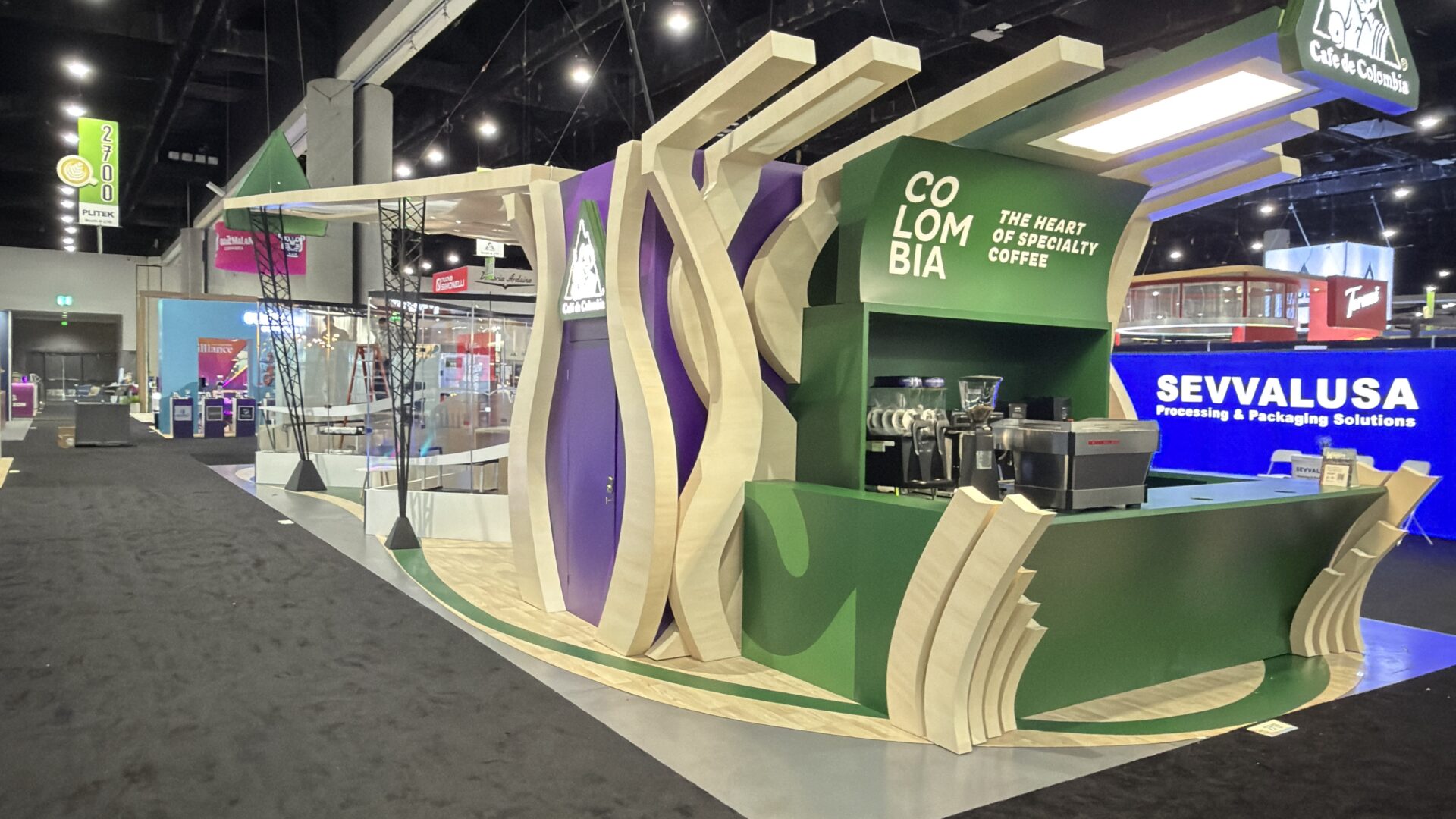
Our 40-by-20-foot activation for Café de Colombia at the San Diego Convention Center was designed, built, branded, and delivered in fourteen days, and it carried retail-grade finishes throughout. It also carried an integrated full-service coffee bar built to retail operational standards, two dedicated tasting environments, and concealed back-of-house storage, in front of more than 3,000 attendees. Operational builds raise the stakes on a short clock: a bar that has to actually serve has plumbing, power, workflow, and ergonomics to resolve, and those cannot be improvised on the show floor.
Throughput-driven builds like that one are the common shape of fast track work in the trade show and convention world, where the show date is immovable and the build window is whatever remains after the booking.
Test Fit Before the Truck
On a compressed schedule, the test fit is the only rehearsal the project gets. Everything that has not been assembled in the shop will be assembled for the first time in a venue, on the clock, with a dock behind you and a show in front of you.
When we pre-fabricated the two-story Barbie Dream House inside Cipriani, the structure was engineered as a modular, self-supporting steel and wood system and test-assembled in our New York shop before delivery. Scenic panels, branded surfaces, and interior vignettes were treated as drop-in components that attached without touching the venue’s original surfaces. The test fit is what makes that possible: it is where you discover that two panels fight each other, that a fastener pattern does not align, that a module clears the door by less than the drawing promised.
Discovering any of that in the shop costs an afternoon. Discovering it at load-in costs show time you do not have, and show time is the one resource a fast track project cannot buy back.
What the Client Has to Do Differently
Fast track event production is a two-sided arrangement, and the client side has obligations that a comfortable schedule lets you skip.
- One decision-maker with real authority. Committee approval cycles are the single most common cause of failed compressed builds. Someone has to be able to say yes the same day.
- Same-day turnaround on approvals. A drawing sitting unapproved for 72 hours has consumed a fifth of a two-week schedule.
- Venue facts up front. Dock hours, freight elevator dimensions, floor loads, rigging points, house power, and the protection the venue requires. These are not details to confirm later; they are inputs to the first drawing.
- Acceptance that the menu narrows. Certain finishes, certain materials, and certain structural ambitions need more days than exist. A good partner will tell you which, early, rather than agreeing and hoping.
What a client should expect in return is a single accountable team. On a short clock, the handoffs between separate design, fabrication, and production vendors are where the days vanish, which is why we keep full-service event production and the shop under the same management. A question about a panel detail gets answered by walking across the floor during pre-production, not by scheduling a call.
Two weeks is a real schedule, not a heroic one, when the sequence is right and the decisions land early. If you have a date that will not move and a build that has to be custom, tell us the constraints and the venue, and we will tell you honestly what can be made in the time available — and what cannot. Start a conversation with our production team and we will work backward from your show date together.