
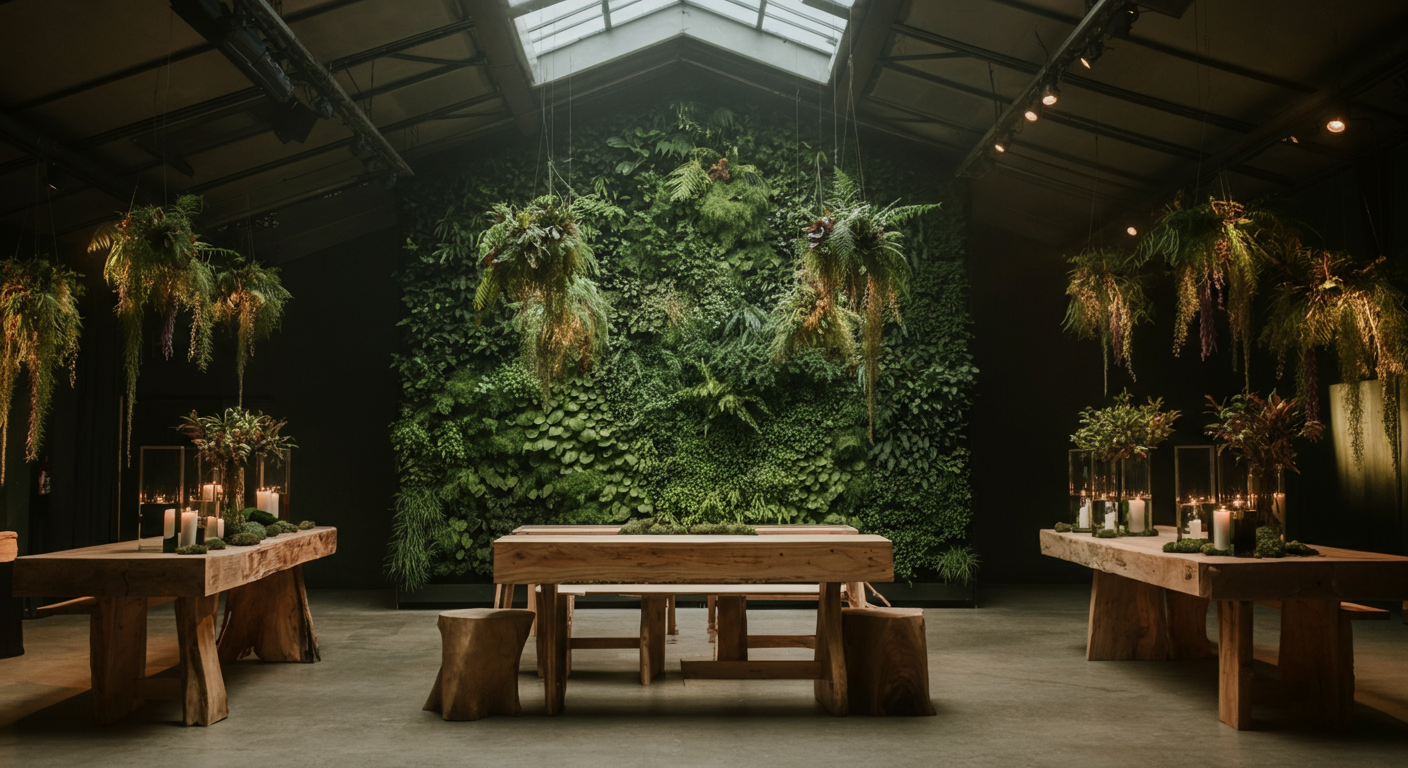
Sustainability and luxury are not opposing forces — they are converging ones. The most discerning clients and the most forward-thinking brands now recognize that environmental responsibility is not a constraint on great event design but an expression of it. An event that creates beauty while minimizing waste, that delivers sensory richness through locally sourced materials, and that leaves a venue better than it was found — that is not compromise. That is sophistication at its highest level.
The myth that sustainable events look and feel “budget” persists only among those who have not seen sustainability executed at scale with genuine creative ambition. The truth is that many of the most luxurious design choices — natural materials over synthetic, bespoke craftsmanship over mass production, seasonal ingredients over imported exotics — are inherently more sustainable than their conventional alternatives. Doing the right thing and doing the beautiful thing are often the same thing.
Here is a comprehensive guide to producing eco-conscious events without sacrificing a single degree of luxury.
The New Definition of Luxury
For decades, event luxury was defined by excess: towering floral installations flown in from Ecuador, single-use scenic builds destined for the dumpster, printed collateral by the ream, and diesel generators powering it all. That model is not just environmentally irresponsible — it is aesthetically dated. Today’s most sophisticated audiences recognize excess as a failure of imagination, not an expression of generosity.
The new luxury is intentional, considered, and conscious. It values provenance over abundance, craftsmanship over spectacle, and lasting impact over disposable opulence. A table set with handmade ceramics from a local potter, seasonal blooms from a regional farm, and linens woven from organic fibers is more luxurious than a table drowning in imported roses and petroleum-based polyester — and it tells a better story.
This shift is not theoretical. Luxury brands including Gucci, Stella McCartney, and LVMH have made sustainability central to their event strategies. Corporate clients increasingly require sustainability reporting as part of event RFPs. And high-net-worth private clients — particularly those under 45 — actively seek out event partners with demonstrated environmental commitments.
Local Sourcing: The Foundation of Sustainable Events
The single most impactful sustainability strategy is also the simplest: source locally. Every vendor, material, and ingredient that travels fewer miles to your event reduces carbon emissions, supports the local economy, and almost always delivers a fresher, higher-quality result.
Floral design is where local sourcing creates the most dramatic quality improvement. Flowers sourced from local and regional farms — picked within 48 hours of your event — have a vibrancy, fragrance, and texture that imported flowers simply cannot match. Yes, this means designing with seasonal availability rather than demanding peonies in December. But working within seasonal constraints is what separates a thoughtful designer from a catalog orderer. The resulting arrangements feel alive, organic, and connected to the moment in a way that mass-imported flowers never will.
Catering benefits enormously from local sourcing. Farm-to-table is not just a restaurant trend — it is an event strategy that delivers superior flavor, compelling storytelling, and meaningful sustainability impact. Partner with caterers who maintain relationships with regional farms, fisheries, and producers. Feature the provenance on your menu cards. Guests appreciate knowing that the lamb was raised 90 miles away and the vegetables were harvested yesterday.
Materials and rentals should prioritize local fabricators, artisans, and rental companies. A custom bar built by a local woodworker from reclaimed materials has more character, more story, and less environmental impact than a generic rental shipped from a national warehouse.
Digital Over Print
The events industry has been remarkably slow to abandon print, even as every other industry has gone digital. Invitations, programs, menus, signage, name cards, auction catalogs — the volume of single-use printed material at a typical gala is staggering.
Going digital is not about austerity. It is about leveraging technology to deliver better experiences with less waste. Digital invitations can be more beautiful, more interactive, and more informative than printed ones. Event apps replace printed programs, auction catalogs, and directories while adding functionality (real-time updates, networking features, donation portals) that print cannot offer. Digital signage — screens and projections — can be updated instantly, reused endlessly, and customized dynamically throughout the evening.
Where print truly matters — a beautifully designed place card, a keepsake menu on quality stock — use it intentionally and sparingly. Choose papers with post-consumer recycled content, vegetable-based inks, and FSC-certified sources. The contrast between a mostly digital event experience and a few thoughtful printed artifacts makes those physical pieces feel more special, not less.
Pro Tip: Replace printed auction catalogs with a mobile bidding platform. You will save thousands on printing costs, increase bidding participation by 25 to 40 percent, and eliminate an entire category of waste.
Reusable Scenic and Modular Design
The most wasteful practice in event production is building elaborate custom scenic elements for a single use and then sending them to a landfill. A 2,000-square-foot scenic backdrop that took two weeks to build, one day to enjoy, and 30 minutes to demolish is an environmental and financial absurdity.
The alternative is modular, reusable scenic design. Build scenic elements from materials that can be disassembled, stored, and reconfigured for future events. Invest in high-quality structural components — steel frames, modular wall systems, reusable fabric panels — that serve as a flexible foundation for different creative visions. Change the look with paint, fabric, lighting, and applied graphics rather than building from scratch each time.
When custom builds are necessary, choose materials with end-of-life plans. Can the scenic panels be donated to a theater company? Can the lumber be reclaimed? Can the fabric be repurposed? These questions should be part of the design brief, not afterthoughts during load-out.
Living installations — moss walls, potted plants, herb gardens, small trees — create stunning visual impact and can be replanted, donated to community gardens, or returned to nurseries after the event. A wall of living greenery is more visually impressive than a wall of printed vinyl, and its environmental impact is net positive rather than net negative.
Energy and Lighting
LED lighting technology has made sustainable event lighting a non-issue. Modern LED fixtures consume 75 to 85 percent less energy than traditional incandescent and halogen fixtures, produce virtually no heat (reducing cooling costs), and deliver superior color quality and creative flexibility. There is no longer any technical or aesthetic reason to use conventional lighting in event production.
Beyond LED adoption, energy-conscious event production considers the total power footprint. Choose venues with adequate built-in electrical infrastructure to avoid diesel generators. If generators are necessary, specify clean-diesel or biodiesel units. Coordinate load-in and load-out schedules to minimize the total hours that equipment draws power. And use intelligent lighting control — automated dimming, motion-responsive zones, timed sequences — to eliminate waste from fixtures lighting empty spaces.
Solar-powered and battery-powered accent lighting has advanced dramatically and is now viable for outdoor events. Solar-charged pathway lighting, battery-powered LED candles, and portable battery systems for small installations reduce or eliminate the need for temporary electrical infrastructure.
Sustainable Catering Practices
Food waste is one of the largest environmental impacts of any event. A 200-person gala can generate 400 to 600 pounds of food waste if production quantities are not carefully managed. Sustainable catering addresses this through precision planning, creative menu design, and responsible disposal.
Precision portioning starts with accurate guest counts and realistic consumption estimates. Work with your caterer to model quantities based on actual consumption data rather than industry-standard overproduction. A 10 percent reduction in overproduction across all courses can eliminate 50 to 100 pounds of food waste from a single event.
Plant-forward menus have a significantly lower carbon footprint than meat-heavy ones. This does not mean every gala must be vegan — it means that thoughtful menu design can feature vegetables, grains, and legumes as stars rather than sides, reducing the proportion of animal protein without sacrificing culinary quality. The best caterers now create plant-forward menus that are more inventive, more visually stunning, and more flavorful than conventional surf-and-turf programs.
Food donation partnerships with organizations like City Harvest, Feeding America affiliates, or local food banks allow surplus prepared food to be safely redirected to communities in need. Many jurisdictions provide liability protection for good-faith food donations, and your caterer should have established protocols for safe packaging and pickup.
Composting should be standard practice at every event. Work with your venue and caterer to establish separate waste streams for compostable materials, recyclables, and true waste. Many venues now have composting partnerships, and portable composting services are available for events at non-traditional locations.
Venue Selection Criteria
The venue itself is one of the largest determinants of your event’s environmental footprint. Prioritize venues that demonstrate genuine sustainability commitments:
Energy efficiency: LEED-certified buildings, venues powered by renewable energy, and spaces with modern HVAC systems that minimize energy consumption.
Waste management: Venues with established recycling and composting programs, and staff trained to maintain waste separation throughout your event.
Water conservation: Low-flow fixtures, efficient irrigation for outdoor spaces, and policies around water service (served on request rather than pre-set).
Transportation access: Venues accessible by public transit reduce the carbon impact of guest transportation. For events where driving is necessary, offer carbon-offset programs or partner with electric vehicle services for shuttle transportation.
Natural assets: Venues with inherent beauty — architectural character, natural light, outdoor spaces, views — require less production to transform and therefore generate less waste.
Carbon Offsetting: Necessary but Not Sufficient
Carbon offset programs allow you to compensate for the emissions your event generates by funding projects that reduce or sequester an equivalent amount of carbon — reforestation, renewable energy development, methane capture, and similar initiatives.
Offsets are a legitimate tool and should be part of every event’s sustainability strategy. But they are not a substitute for reducing emissions in the first place. The hierarchy should always be: reduce first, offset the remainder. An event that generates massive emissions and then purchases offsets is less sustainable than an event that minimizes emissions through thoughtful design and offsets only the unavoidable balance.
When purchasing offsets, choose programs verified by recognized standards — Gold Standard, Verified Carbon Standard (VCS), or Climate Action Reserve. Calculate your event’s carbon footprint using established methodologies that account for energy, transportation, materials, food, and waste.
Certifications and Standards
ISO 20121 is the international standard for sustainable event management systems. Developed for the 2012 London Olympics, it provides a framework for integrating sustainability into every phase of event planning and production. While full certification requires significant organizational commitment, the framework itself is valuable as a planning tool even without formal certification.
Green Key is a leading eco-label for venues and hospitality facilities, indicating that a property meets strict criteria for environmental management. Choosing Green Key-certified venues simplifies your sustainability planning because the venue has already implemented many of the practices you would otherwise need to manage independently.
Pro Tip: Even if you do not pursue formal sustainability certification for your event, use ISO 20121 as a checklist during the planning process. It will identify opportunities you might otherwise miss and provide a structure for measuring your impact.
Debunking the Cost Myth
The persistent belief that sustainable events cost more than conventional ones is simply wrong in most cases. Local sourcing often costs less than importing. Digital communications cost less than printing. LED lighting costs less to power than conventional lighting. Precision portioning reduces food costs. Reusable scenic amortizes its cost over multiple events.
Where sustainable choices do carry a premium — organic catering, carbon offsets, certified materials — the increments are typically modest: 5 to 15 percent above conventional alternatives. And these premiums are frequently offset by savings in other categories. The net cost of a thoughtfully designed sustainable event is usually within 3 to 5 percent of a conventional event of equivalent quality — and sometimes less.
More importantly, sustainability has become a value driver. Corporate clients with ESG commitments prefer partners who can demonstrate sustainable practices. Guests at private events increasingly appreciate and expect environmental consciousness. And brands that host sustainable activations generate positive media coverage and social sentiment that has real marketing value.
Make Your Next Event Extraordinary and Responsible
Sustainable luxury is not a niche — it is the future of experiential event design. Every event we produce is an opportunity to demonstrate that environmental responsibility and creative excellence are not just compatible but inseparable.
If you are planning an event and want to ensure it reflects both your aesthetic standards and your values, reach out to our team. We will show you how sustainable production practices can elevate your event, not limit it — and deliver an experience that your guests and the planet will thank you for.