
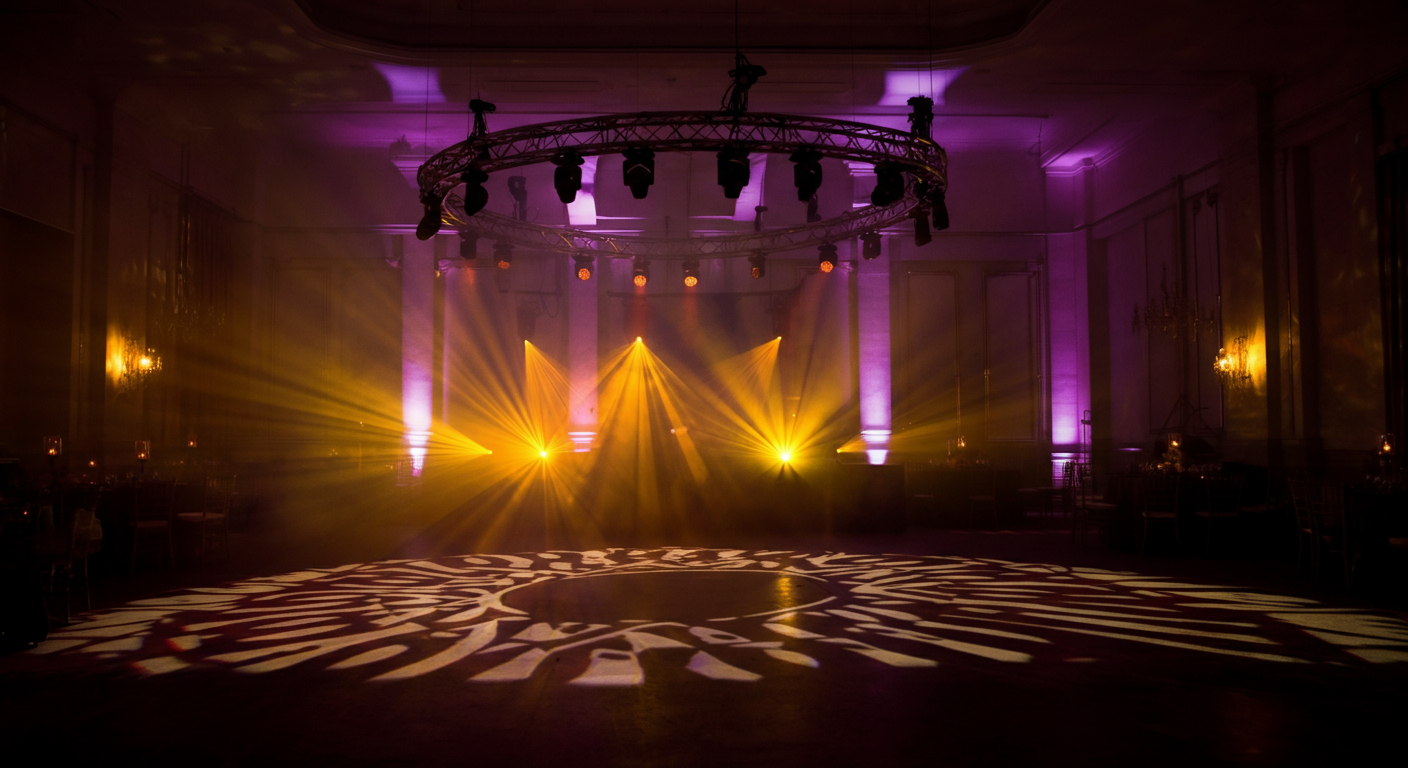
Lighting is the most underestimated element in event production, and the most transformative. A beautifully designed space with poor lighting feels flat, forgettable, and cheap. A simple space with masterful lighting feels cinematic, intentional, and alive. This is not opinion — it is physics, neuroscience, and decades of production experience distilled into a single truth: light shapes how humans perceive and emotionally respond to every environment they enter.
At GEO Events, we approach lighting design the way a cinematographer approaches a film — every fixture, every color temperature, every shadow is a deliberate creative choice serving a larger narrative. This guide breaks down that approach for event professionals seeking to elevate their production values from adequate to extraordinary.
Functional vs. Atmospheric Lighting: Two Distinct Disciplines
Event lighting serves two fundamentally different purposes, and confusing them is where most production plans go wrong.
Functional lighting ensures visibility, safety, and operational effectiveness. It includes stage wash for speakers, task lighting for catering stations, wayfinding illumination, and house lights for service periods. Functional lighting answers the question: can people see what they need to see?
Atmospheric lighting creates mood, directs attention, establishes spatial hierarchy, and triggers emotional responses. It includes accent uplighting, textured washes, color shifts, gobo projections, and dynamic effects. Atmospheric lighting answers the question: how do we want people to feel?
The most common mistake in event lighting is treating all lighting as functional — flooding a space with even, flat illumination that makes everything visible and nothing dramatic. The second most common mistake is treating all lighting as atmospheric — creating beautiful effects that leave speakers in shadow and guests unable to read their menus. Professional lighting design integrates both disciplines into a unified plan where every fixture serves a purpose.
Color Temperature: The Psychology of Kelvin
Color temperature, measured in Kelvin (K), is one of the most powerful and least understood tools in event lighting. It governs the warmth or coolness of light, and it has profound effects on human perception and behavior.
Warm light (2700K-3200K) creates intimacy, comfort, and relaxation. It flatters skin tones, softens architectural lines, and encourages lingering. Warm light is ideal for dining environments, cocktail receptions, lounges, and any setting where connection and conversation are priorities. Think candlelight, amber LEDs, and tungsten-balanced fixtures.
Neutral light (3500K-4500K) provides clarity without coldness. It is effective for transitional spaces, exhibition areas, and environments that need to feel professional without feeling clinical. Neutral light works well for product displays, registration areas, and sponsor activations where color accuracy matters.
Cool light (5000K-6500K) creates energy, alertness, and a sense of modernity. It is effective for keynote stages, technology presentations, and high-energy entertainment segments. Cool light can feel sterile if overused — deploy it strategically for emphasis rather than as a baseline.
The most sophisticated event lighting designs use color temperature shifts to guide the emotional arc of an evening. A gala might open with warm amber during the cocktail reception (3000K), shift to neutral for the dinner program (4000K), and transition to a cooler, more dynamic palette for entertainment and dancing (mixed temperatures with color washes). These shifts are subtle — most guests will not consciously notice them — but they profoundly influence the collective emotional experience.
Uplighting and Downlighting: Sculpting Space with Direction
The direction from which light strikes a surface determines how that surface is perceived. This is the fundamental principle of architectural lighting design, and it applies directly to event environments.
Uplighting — fixtures placed on the floor or at low level, projecting light upward — is the workhorse of event atmospheric lighting. Uplighting creates drama by illuminating surfaces from below, reversing the natural direction of light and creating a heightened, theatrical quality. LED uplighting along walls transforms a generic ballroom into a branded environment, adds depth to flat walls, and can shift color throughout the evening to mark programmatic transitions. For maximum impact, place uplighting fixtures every 8-10 feet along wall surfaces, angled to graze the surface rather than project directly upward.
Downlighting — fixtures mounted overhead, projecting light downward — is more natural and functional. It provides task lighting for dining, creates pools of light that define spatial zones, and when tightly focused, produces dramatic spotlighting effects. Pin spots on table centerpieces, for example, create luminous focal points that make floral arrangements appear to glow from within while keeping the surrounding environment moody and atmospheric. This single technique — pin-spotting centerpieces — is perhaps the highest-impact, lowest-cost upgrade available to any seated event.
Wash lighting covers broad areas with even illumination and is essential for stage visibility, dance floor activation, and general ambiance. LED wash fixtures offer color-mixing capability, allowing designers to shift the mood of an entire room without changing a single fixture position.
Gobos: Branded Light
A gobo (“goes before optics”) is a stencil placed inside a lighting fixture that projects a pattern or image onto a surface. Gobos are one of the most versatile tools in event lighting, capable of projecting logos, patterns, textures, and architectural elements onto walls, floors, ceilings, and scenic surfaces.
Custom gobos project company logos, event branding, or bespoke patterns. They are particularly effective on neutral surfaces like white walls or dance floors, where the projected image reads clearly. Custom steel gobos cost $50-$150 each; glass gobos with gradient or multi-tone capability run $150-$400.
Texture gobos — breakup patterns, leaf patterns, geometric abstractions — add visual complexity to otherwise plain surfaces. A bare white wall becomes interesting when textured with a subtle gobo pattern. A concrete floor gains character when dappled with projected light. Texture gobos work best at low intensity, creating subtle variation rather than overt patterns.
The most common gobo mistake is projecting a logo at maximum intensity on every available surface. This reads as branding, not design. The most effective gobo deployments are restrained — a single, elegantly positioned logo projection on a feature wall, or subtle texture patterns that add depth without demanding attention.
LED vs. Traditional Fixtures: The State of the Art
The LED revolution in event lighting is essentially complete. Modern LED fixtures match or exceed traditional tungsten and discharge fixtures in output, color quality, and reliability — while offering dramatically lower power consumption, heat output, and operational cost.
LED advantages: instant color mixing across the full RGB spectrum (and increasingly RGBA and RGBW for better color rendering), low heat output that reduces HVAC load, minimal power requirements that eliminate the need for supplemental generators at many venues, and silent operation. Modern LED fixtures also offer wireless DMX control, battery operation, and pixel-mapping capability for dynamic effects.
Where traditional fixtures still excel: high-output followspots for live entertainment, some theatrical applications requiring specific beam characteristics, and situations where the warmth of a true tungsten filament is desired for aesthetic reasons. Some lighting designers also prefer the dimming curve of tungsten — the way incandescent lights warm in color temperature as they dim, replicating sunset — which LED fixtures approximate but do not perfectly replicate.
For most corporate events, a full LED lighting package offers the best combination of creative flexibility, operational efficiency, and cost-effectiveness. A standard corporate gala lighting package might include 20-40 LED uplighting fixtures, 8-12 LED wash fixtures, 4-8 LED profile fixtures for gobo projection and spotlighting, 20-30 pin spots, and a DMX lighting console with a qualified operator.
DMX Control and Programming: The Invisible Conductor
DMX512 is the standard digital communication protocol that controls stage and event lighting. Through a DMX console, a lighting operator can individually control the intensity, color, position, and behavior of every fixture in an event environment — often hundreds of individual channels responding to pre-programmed cues or real-time adjustments.
For corporate events, DMX programming translates creative intent into executable lighting states and transitions. A well-programmed show might include a warm, low-intensity “pre-show” state for load-in and rehearsal, a “guest arrival” state with gradually increasing warmth and carefully positioned accent lighting, a “dinner” state with pin spots activated and house lights at 40%, a “program” state with stage wash elevated and house lights dimmed to 15%, a “transition” state with dramatic color shift marking the move to entertainment, and an “after-party” state with dynamic color effects and movement.
Each of these states involves dozens of individual fixture adjustments, and the transitions between them — timed to music, speeches, or production cues — are where lighting design becomes lighting artistry. A skilled programmer can make a 500-fixture lighting rig respond to a live event with the precision and emotional sensitivity of a musical instrument.
Lighting for Photography and Video
In 2026, every corporate event is a content production opportunity. The lighting design must serve not only the live audience but also the cameras — photo and video — that will extend the event’s reach and longevity through digital channels.
Key considerations for camera-friendly lighting include maintaining sufficient base light levels for clean video capture (minimum 30-50 lux on key subjects), avoiding mixed color temperatures in a single shot that create white-balance challenges, providing dedicated front lighting for speakers and VIPs on stage, ensuring uplighting colors do not create unflattering color casts on nearby faces, and coordinating with videographers on any moving light or strobe effects that could create problems on camera.
The tension between atmospheric event lighting (moody, dramatic, directional) and camera-friendly lighting (even, well-balanced, adequately bright) is real. The solution is not to compromise one for the other but to design both simultaneously — creating lighting states that feel dramatic to the live audience while providing the coverage that cameras need. This typically requires dedicated front light positions for cameras that supplement the atmospheric design without undermining it.
Budget Allocation: Where to Invest
Lighting budgets for corporate events typically range from 10-25% of total production spend. Within that allocation, the distribution matters as much as the total.
For events under $25,000 total production budget: Focus on uplighting (transformative at any budget level), pin spots for centerpieces, and adequate stage wash. A basic LED uplighting package with a qualified operator runs $2,000-$5,000 and delivers outsized impact.
For events at $50,000-$150,000 total production: Add gobo projections, architectural accent lighting, dedicated front light for video capture, and DMX programming with multiple pre-programmed cue states. Budget $8,000-$25,000 for lighting.
For events exceeding $150,000 total production: Full custom lighting design with a dedicated lighting designer, moving head fixtures for dynamic effects, extensive architectural and scenic lighting, pixel-mapped LED installations, and a dedicated lighting operator running the show from a production table. Budget $25,000-$75,000+ for lighting.
The single best investment at any budget level is a qualified lighting designer — not just a technician who sets up and operates fixtures, but a designer who understands how light creates emotion, directs attention, and transforms space. A great designer with a modest fixture inventory will always outperform a mediocre operator with unlimited gear.
The Cinematic Mindset
The best event lighting designers think like cinematographers. They understand that every scene in a film is lit with intention — that the emotional tenor of a moment is established not by dialogue or action but by the quality, direction, color, and intensity of the light that shapes it. They understand contrast ratios, the power of shadow, the intimacy of practical light sources, and the drama of a single focused beam cutting through darkness.
This cinematic mindset transforms event lighting from a technical service into a creative discipline. It means thinking about light not as illumination but as storytelling — asking not “is there enough light?” but “what is this light saying?” At GEO Events, this philosophy guides every production we design. Because in our experience, the difference between a good event and an unforgettable one is almost always the light.
Ready to bring a cinematic approach to your next event’s lighting design? Contact GEO Events to discuss how our production team can transform your vision into reality.