
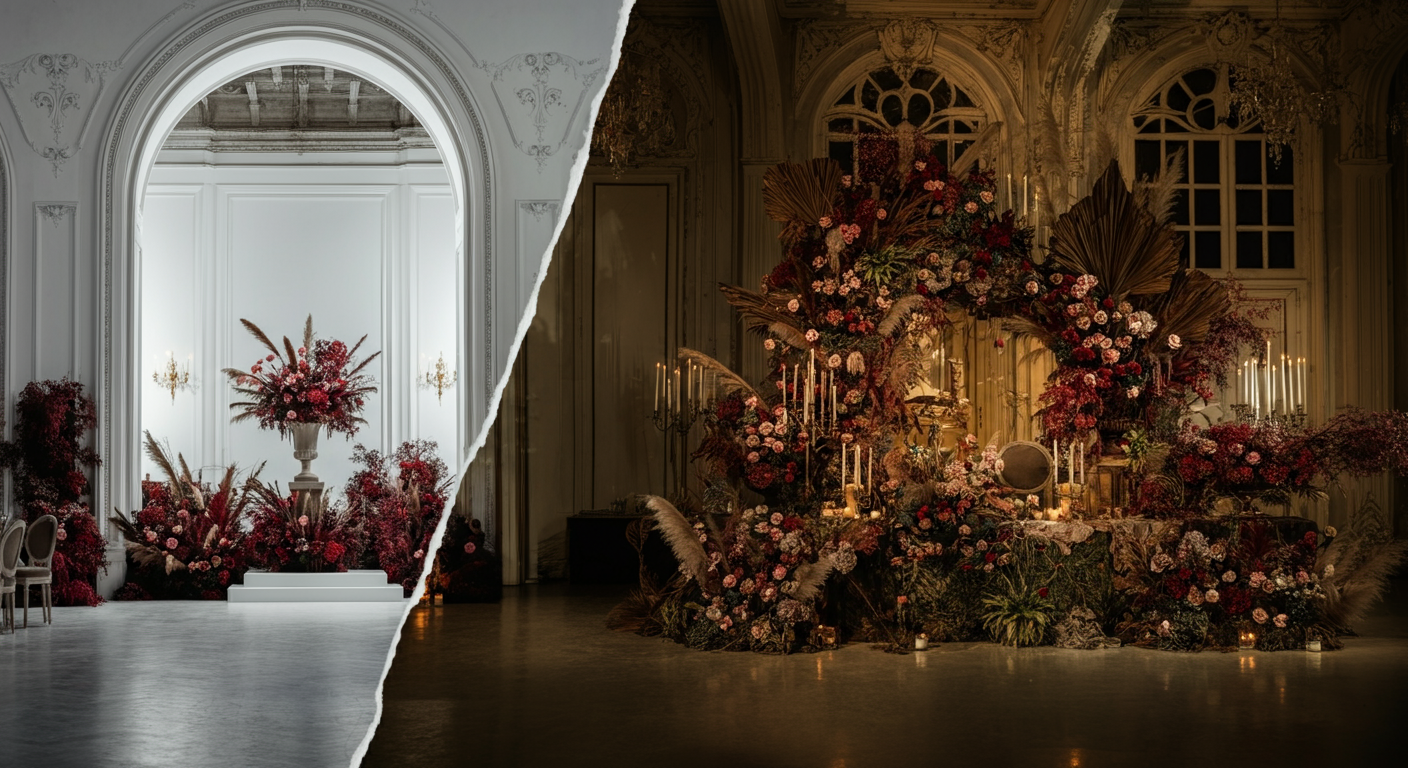
Every event makes an aesthetic argument. Whether the design team articulates it explicitly or not, the visual language of an event communicates values, priorities, and personality to every guest who walks through the door. The two dominant poles of contemporary event aesthetics, minimalism and maximalism, represent fundamentally different philosophies about what makes a space feel extraordinary. Understanding both approaches, and knowing when to deploy each, is essential for any design team serious about creating intentional experiences.
This is not merely an academic debate. The choice between these aesthetics has profound implications for budget, logistics, brand alignment, guest psychology, and the kind of memories an event creates. And increasingly, the most compelling events are finding a third path that draws from both traditions without fully committing to either.
Defining the Terms
Minimalism in Event Design
Minimalist event design is rooted in the principle that restraint is a form of luxury. It favors clean lines, monochromatic or limited color palettes, uncluttered surfaces, generous negative space, and a small number of high-impact design elements rather than an abundance of decorative detail.
The minimalist event space says: we are confident enough to let silence speak. Every element present has earned its place. Nothing is decorative for decoration’s sake. The beauty is in the proportion, the material quality, and the precision of execution.
Think of a dinner event in an industrial loft: long communal tables of raw blackened steel, single-stem floral in matte ceramic vessels, candlelight as the primary illumination, and nothing on the walls. The architecture of the space itself becomes the design, and the restraint communicates sophistication and intention.
Maximalism in Event Design
Maximalist event design operates on the opposite principle: abundance is generosity, and more is more. It embraces rich color, layered textures, pattern mixing, dramatic installations, and an overall density of visual information that rewards extended attention and repeated viewing.
The maximalist event space says: we have created an entire world for you. Every surface tells a story. Every corner holds a discovery. The experience is immersive because there is simply too much beauty to absorb in a single glance.
Imagine a gala transformed into a baroque fantasy: tables overflowing with cascading florals in deep jewel tones, gilded vessels, embroidered linens, dramatic uplighting in saturated colors, and suspended installations of thousands of paper flowers overhead. The cumulative effect is overwhelming in the best sense, a space that feels transported from another era or another world entirely.
The Case for Minimalism
Minimalism’s strengths in event design are substantial and often underappreciated.
Focus and Clarity
In a minimal environment, there is nowhere for the eye to hide. This makes minimalism exceptionally effective when the event has a clear focal point: a speaker, a product reveal, a performance. The spare environment directs all attention to the intended center of gravity without competing for visual bandwidth.
For corporate meetings and summits where content delivery is the primary objective, minimalist design removes visual noise that could distract from presentations and discussions. The environment supports rather than competes with the program.
Perceived Quality
When fewer elements are present, each one receives more scrutiny. This means that minimalist events demand exceptional quality in every detail: the weight of the glassware, the drape of the linen, the finish of the furniture. But when that quality is achieved, the result communicates a level of refinement that busier environments struggle to match.
Pro Tip: Minimalism does not mean minimal budget. In fact, achieving a compelling minimal aesthetic often costs more per element because cheap materials and imprecise execution are brutally exposed when there is nothing else to look at. Budget for fewer, better things rather than assuming minimalism is the economical option.
Photography and Social Media
Minimalist environments tend to photograph exceptionally well. Clean backgrounds, strong geometric compositions, and consistent color palettes create images that feel polished and professional. For events where social media documentation is important, minimalism provides a visual framework that makes almost any photo look intentional.
Limitations of Minimalism
Minimalism can feel cold, sterile, or unwelcoming if not executed with care. It can read as austere rather than sophisticated, especially for audiences unfamiliar with design culture. It offers fewer conversation starters and discovery moments. And for events that are meant to feel celebratory or lavish, minimalism can feel like deprivation dressed up as taste.
The Case for Maximalism
Maximalism’s strengths are equally compelling, though they serve different objectives.
Immersion and Escapism
Maximalist environments create a sense of total immersion that is difficult to achieve with spare design. When every surface, every sightline, and every detail has been designed, guests feel transported into a complete world. This is why maximalism dominates in theatrical, fantasy, and experiential contexts where the goal is to create an alternative reality.
For luxury private events like milestone celebrations, maximalist design creates the sense of extraordinary occasion that these moments demand. A fiftieth birthday or a wedding anniversary deserves an environment that feels lavish, generous, and unlike everyday life.
Emotional Warmth
Abundance communicates care and welcome. A table overflowing with food, flowers, and beautiful objects says “we thought of everything” in a way that a spare table with a single candle does not. For events where hospitality and generosity are the primary messages, maximalism delivers that emotional warmth powerfully.
Discovery and Engagement
Dense, layered environments reward exploration. Guests who wander through a maximalist space keep finding new details, new vignettes, new things to photograph and discuss. This creates natural engagement and extends the perceived duration of the experience. People linger longer in rich environments because there is always something more to see.
Limitations of Maximalism
Maximalism can feel chaotic, overwhelming, or visually fatiguing if not carefully curated. It risks looking cluttered rather than abundant, tacky rather than opulent. It typically requires a larger budget because filling a space with high-quality elements is expensive. And it can compete with event content for guest attention, making it less suitable for program-heavy events.
When Each Approach Works Best
Choose Minimalism When:
The event is content-driven, with speakers, presentations, or performances as the primary draw. The brand identity is clean, modern, and precision-oriented. The venue architecture is itself visually striking and needs room to breathe. The guest demographic skews toward design-savvy audiences who read restraint as sophistication. The event goals prioritize focus, clarity, and professional polish.
Choose Maximalism When:
The event is experience-driven, with the environment itself as the primary attraction. The brand identity is bold, expressive, and personality-forward. The venue is a blank canvas that needs significant transformation. The occasion is celebratory and calls for a sense of abundance and generosity. The event goals prioritize immersion, emotional impact, and social media content generation.
Brand Alignment: The Deciding Factor
More than personal taste or trend awareness, the choice between minimalism and maximalism should be driven by brand alignment. A technology company launching a precision-engineered product will likely be better served by minimalist design that mirrors the product’s own aesthetic values. A fashion brand known for bold prints and eclectic style will feel more authentic in a maximalist environment that reflects the brand’s DNA.
The danger lies in defaulting to one approach regardless of context. A design firm that always produces maximalist events will eventually create environments that feel like the firm’s aesthetic rather than the client’s brand. The best experiential event design teams are fluent in both languages and choose the right one for each project.
Budget Implications
Contrary to popular assumption, minimalism is not inherently cheaper than maximalism, nor is maximalism inherently more expensive. The budget dynamics of each approach differ in important ways.
Minimalist events concentrate budget on fewer elements at higher quality. A single dramatic lighting installation, bespoke furniture, and premium materials can easily match or exceed the cost of filling a space with abundant but more modestly specified decor. The cost structure is: fewer line items, higher unit cost.
Maximalist events distribute budget across many elements. The cumulative cost of florals, linens, tableware, scenic elements, and decorative details adds up quickly, but each individual item can be specified at a moderate price point because the cumulative effect provides the impact. The cost structure is: many line items, moderate unit cost.
Pro Tip: When budget is the primary constraint, maximalism often provides more perceived value per dollar because guests naturally equate visual abundance with investment. A room full of beautiful things at moderate quality is often perceived as more generous than a spare room with a few exquisite pieces that most guests lack the design literacy to appreciate.
The Third Path: Sophisticated Brutalism and the New Middle Ground
The most interesting work in contemporary event design is happening neither at the minimalist nor the maximalist extreme but in the territory between them. What we might call “sophisticated brutalism” or “curated intensity” draws from both traditions to create environments that are visually rich without being cluttered, restrained without being cold.
This approach typically features a minimalist structural framework, clean lines, dark monochromatic surfaces, and generous negative space, populated with carefully selected moments of maximalist intensity. A single, overwhelming floral installation against an otherwise bare concrete wall. A dramatically lit sculptural centerpiece on an otherwise stark table. Rich, layered texture in one zone contrasting with austere simplicity in the next.
The effect is a kind of controlled drama: the restraint of the background makes the featured elements feel more powerful, while the richness of the featured elements prevents the space from feeling sterile. It is, in essence, the curatorial approach applied to event design: not everything at maximum volume, but careful selection of what deserves amplification.
This middle ground also aligns well with contemporary aesthetic sensibilities that value both authenticity and spectacle, both restraint and generosity. It allows brands to communicate sophistication without appearing cold, and creativity without appearing chaotic.
Executing the Middle Ground
The practical challenge of the middle ground is that it requires exceptional curatorial judgment. Minimalism and maximalism are both relatively forgiving in their own ways: if everything is spare, consistency is easy; if everything is abundant, one more element rarely disrupts the whole. But in the middle ground, every addition and subtraction matters. One element too many and the space feels cluttered; one too few and it feels unfinished.
This is where experienced design partners earn their fee. The ability to know exactly when a space is complete, to resist the temptation to add one more thing and the fear of leaving too much empty, is a skill developed over hundreds of events and cannot be reduced to a formula.
Case Examples in Practice
Consider a corporate product launch. The minimalist approach might feature a white-on-white environment with the product displayed on a single pedestal under a perfect spotlight. The maximalist approach might create an immersive brand universe with themed rooms, interactive installations, and sensory overload. The middle ground might present the product within a striking architectural environment, perhaps dark concrete walls with a single dramatic water feature, where the restraint of the space amplifies the product while the boldness of the architecture makes the event feel significant.
For a milestone celebration, minimalism might deliver an elegant seated dinner with exquisite materials and perfect service. Maximalism might create a fantastical environment dripping with florals and theatrical lighting. The middle ground might combine the elegance of the former with a single maximalist gesture, a suspended installation of ten thousand hand-folded paper cranes above the dining space, that elevates the evening from refined to unforgettable.
Making the Decision
The choice between minimalism, maximalism, and the territory between them should be made deliberately and early in the design process. It should be driven by brand identity, event objectives, venue characteristics, guest demographics, and budget parameters, in roughly that order of priority.
Ask these questions at the outset: What is the single most important thing guests should feel in this space? What does the brand’s visual identity communicate, and how should the event environment reinforce or extend that communication? Is the event primarily a container for content or an experience in itself? What will guests photograph and share, and what story will those images tell?
The answers will point toward the right aesthetic direction. And the willingness to commit to that direction, rather than hedging with a noncommittal middle that is neither spare enough to be minimal nor rich enough to be maximal, is what separates good event design from great event design.
Whichever direction calls to you, the key is intentionality. Reach out to our design team to explore how the right aesthetic strategy can transform your next event from decorated space into designed experience.