
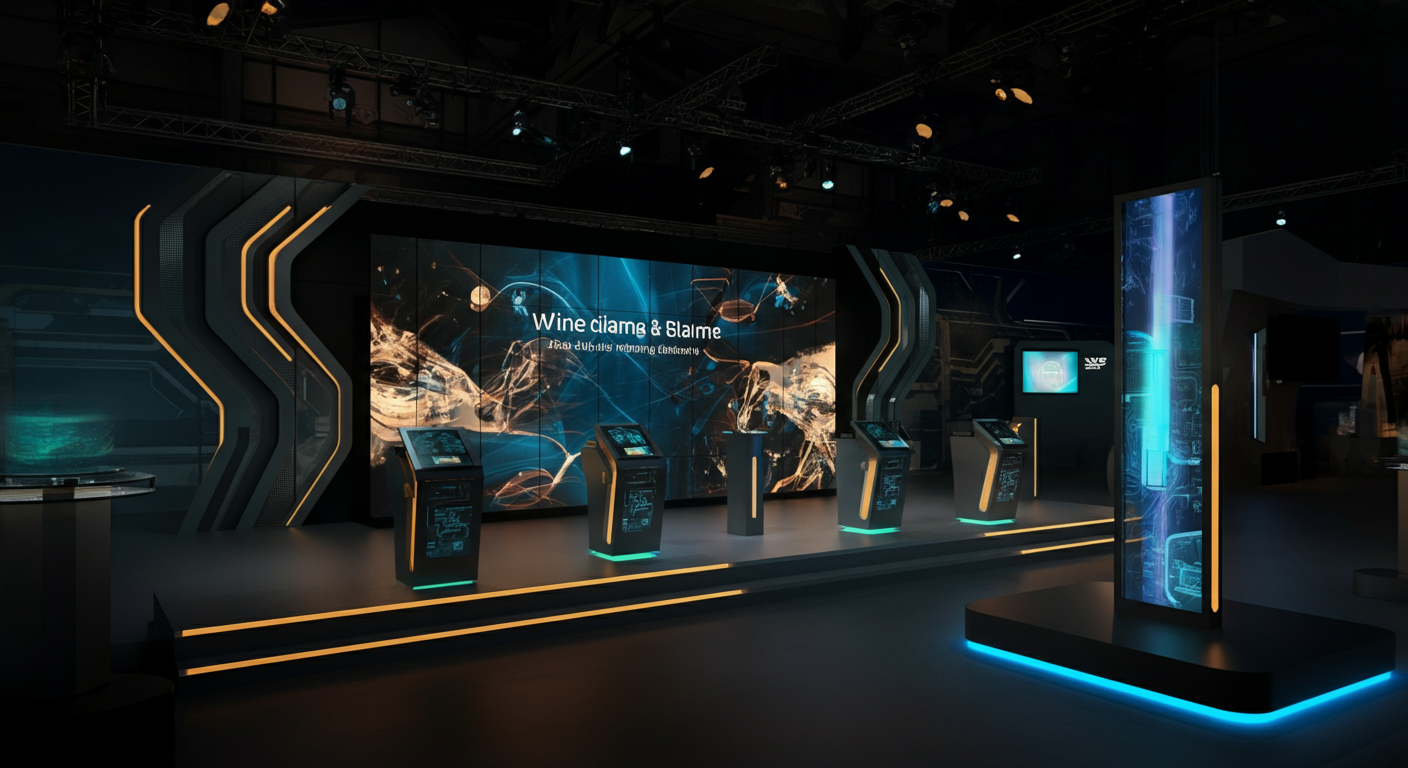
Technology is no longer a support function at live events. It has become a primary design material, as fundamental to the event experience as lighting, scenic elements, and spatial layout. The integration of artificial intelligence, extended reality, advanced LED systems, and data-driven personalization is reshaping what is possible in live experiences and redefining what audiences expect when they walk through the door.
This transformation is not about technology for its own sake. The most effective implementations are invisible, woven so seamlessly into the experience that guests never think about the engineering behind them. They simply feel that something extraordinary is happening.
Artificial Intelligence in Event Planning and Execution
AI’s impact on events extends across the entire lifecycle, from planning and design through execution and post-event analysis. What was speculative two years ago is now operational at scale.
AI-Powered Design and Visualization
Generative AI tools are transforming the early stages of event design. Design teams can now produce photorealistic renderings of proposed environments in minutes rather than days, exploring dozens of aesthetic directions before committing to a single concept. This acceleration of the ideation phase means clients see more options, make more informed decisions, and arrive at stronger final designs.
AI-assisted space planning tools analyze venue dimensions, guest counts, program requirements, and flow patterns to suggest optimal layouts. These systems can model crowd movement, identify potential bottlenecks, and recommend configurations that maximize both capacity and comfort. The human designer retains creative control but gains a computational partner that handles the analytical heavy lifting.
Intelligent Matchmaking and Networking
For corporate meetings and summits, AI-powered matchmaking represents one of the most valuable technological advances in recent years. These systems analyze attendee profiles, stated interests, professional backgrounds, and behavioral data to suggest meaningful connections and facilitate introductions.
The most sophisticated implementations go beyond simple profile matching. They analyze real-time engagement data, noting which sessions attendees visit, which exhibitors they spend time with, and which topics generate the most discussion, to refine recommendations throughout the event. A guest who attended a session on sustainability might receive a notification suggesting they connect with three other attendees who showed similar interests.
Pro Tip: AI matchmaking is only as good as the data it receives. Invest in a robust pre-event questionnaire and make it genuinely useful by asking about specific challenges, goals, and interests rather than generic demographic information. The richer the input data, the more valuable the connections the system will produce.
Augmented and Virtual Reality Integration
AR and VR have moved past the novelty phase in events. Early implementations were often gimmicky, headsets at a booth that guests tried once and moved on. Current applications are more integrated, more purposeful, and more impactful.
Augmented Reality Layers
AR overlays digital content onto the physical event environment, accessible through smartphones or lightweight glasses. In practice, this might mean guests can point their phones at a product display to see exploded-view animations of internal components. Or scan a name badge to see a visual summary of the wearer’s professional background. Or view a historical building’s original architecture superimposed over its current state during a heritage venue event.
For product launches and pop-up experiences, AR creates layers of discovery that reward engagement. A physical installation that looks striking on its own becomes extraordinary when an AR layer reveals hidden content, animations, or interactive elements. This dual-layer design approach ensures the experience is compelling for all guests while offering additional depth for those who engage with the technology.
Virtual Reality Experiences
VR at events works best in dedicated, designed spaces rather than as a casual add-on. A purpose-built VR lounge with comfortable seating, spatial audio, and atmospheric design that complements the virtual content creates a complete experience that justifies the time investment of putting on a headset.
Corporate applications include virtual facility tours, immersive data visualization, and simulated product experiences that would be impossible to create physically. A real estate developer can walk investors through a building that exists only as a digital model. An automotive brand can let guests experience a concept vehicle’s interior years before production. A nonprofit can transport donors to the communities their funding supports.
LED Walls and Advanced Display Technology
LED display technology has undergone a revolution in pixel pitch, color accuracy, brightness, and form factor that has transformed what is possible in event environments.
The Death of the Projection Screen
Traditional projection is rapidly being displaced by direct-view LED for all but the most budget-constrained applications. LED walls offer dramatically higher brightness, true blacks, wider viewing angles, and seamless scalability. A 40-foot LED wall in a brightly lit venue delivers impact that no projector can match.
More significantly, LED panels are no longer limited to flat, rectangular configurations. Curved walls, ceiling installations, floor surfaces, and three-dimensional sculptural forms are all achievable with current LED technology. This means the display surface itself becomes an architectural element, shaping the space rather than merely occupying a wall.
Immersive LED Environments
The convergence of high-resolution LED, real-time rendering engines like Unreal Engine and Disguise, and advanced media server technology has enabled fully immersive LED environments where walls, ceiling, and floor are all active display surfaces. Guests stand inside the content, surrounded by moving imagery that responds to the program in real time.
These environments are particularly effective for product reveals, where the room itself can transform from one branded world to another in seconds. Imagine a darkened room that gradually reveals a forest sunrise as a nature-inspired product is introduced, then shifts to an urban nightscape for a different product line, all without moving a single physical element.
Pro Tip: When specifying LED for events, resolution matters less than you think and brightness matters more than you think. In a well-lit event environment, a moderately high-resolution wall at high brightness will look dramatically better than an ultra-high-resolution wall that cannot compete with ambient light. Always specify and test under realistic lighting conditions.
Real-Time Data Dashboards and Analytics
The ability to capture, analyze, and act on data in real time during an event represents a fundamental shift in how events are managed and optimized.
Operational Dashboards
Event operations teams now have access to real-time dashboards showing room occupancy, queue lengths, catering consumption rates, temperature readings, and dozens of other operational metrics. This visibility enables proactive management: opening additional bars before lines form, adjusting HVAC before rooms become uncomfortable, and reallocating staff based on actual rather than predicted traffic patterns.
Engagement Analytics
Session attendance, dwell time at exhibits, app engagement, social media activity, and survey responses can all be tracked in real time and displayed on dashboards that help organizers understand what is working and what is not while there is still time to adjust. A keynote that is generating unusually high social media activity might warrant an extended Q&A session. An exhibit area with low traffic might need additional signage or a programmatic draw.
RFID, NFC, and Contactless Technology
Radio-frequency identification and near-field communication technologies have become standard infrastructure for large-scale events, enabling seamless experiences that eliminate friction at every touchpoint.
Frictionless Access and Transactions
RFID-enabled wristbands or badges replace tickets, cash, and credit cards with a single wearable device. Guests tap to enter, tap to pay for food and drinks, tap to exchange contact information, and tap to check into sessions. The elimination of queuing, fumbling for wallets, and exchanging business cards may seem like a modest convenience, but the cumulative effect on guest experience is significant.
Behavioral Data Collection
Every tap generates data. RFID and NFC systems create detailed maps of guest behavior: where they went, how long they stayed, what they purchased, and who they interacted with. This data is invaluable for post-event analysis and for improving future events. It also enables real-time personalization, with digital signage showing different content based on who is nearby, or push notifications triggered by proximity to specific areas.
App-Driven Personalized Experiences
Event apps have evolved from digital programs into personalization engines that shape each guest’s unique journey through the event.
Modern event apps build personalized agendas based on attendee interests, send contextual notifications based on location and time, facilitate networking through messaging and meeting scheduling, provide interactive maps with real-time wayfinding, and capture feedback through in-moment surveys rather than post-event emails that arrive when the experience has already faded.
The most effective apps are designed to enhance rather than replace the physical experience. They surface information and opportunities that help guests make better decisions about how to spend their time, without pulling attention away from the live experience and into a screen.
Drone Shows and Aerial Spectacle
Coordinated drone shows have emerged as a compelling alternative to fireworks for outdoor events, offering programmable three-dimensional aerial displays that can form logos, text, and complex animated sequences.
Current drone fleets can field hundreds of illuminated drones that move in precise formation, creating displays visible from miles away. The technology is quieter than fireworks, more environmentally friendly, and infinitely more customizable. A brand logo that assembles in the night sky, transforms into a product silhouette, and then disperses into a cascade of light is the kind of spectacle that stops social media scrolling and generates organic reach that no paid campaign can match.
Holographic Displays
True holographic technology remains limited, but pepper’s ghost illusions, transparent LED screens, and volumetric display systems create compelling holographic effects that can bring virtual presenters, product visualizations, and three-dimensional content to life on event stages.
A keynote speaker who appears to materialize on stage from thin air, or a product that seems to float and rotate in mid-air as its features are discussed, creates moments of genuine wonder that cut through the noise of conventional presentations. These technologies are particularly effective for product launches where the goal is to position a brand as innovative and forward-thinking.
Event Analytics and ROI Measurement
Perhaps the most transformative technology in events is not the most visually spectacular. Advanced analytics platforms now enable event organizers to measure outcomes with a precision that was impossible a decade ago.
Attribution modeling connects event attendance to downstream business outcomes: leads generated, deals closed, employee retention, and brand sentiment shifts. This data transforms the event budget conversation from “how much does this cost” to “what return does this generate,” which is a fundamentally more productive framework for event investment decisions.
Predictive Analytics
Machine learning models trained on historical event data can predict attendance patterns, identify at-risk registrants who are likely to no-show, forecast catering requirements with greater accuracy than rule-of-thumb estimates, and suggest optimal scheduling based on past engagement patterns. These predictions improve operational efficiency and reduce waste, making events both better and more cost-effective.
The Human Element Remains Central
For all of technology’s transformative power, the most important insight is that technology serves human connection rather than replacing it. The best technology implementations at events are the ones guests do not think about, the ones that remove friction, create wonder, and facilitate the human interactions that are the real reason people attend live events.
An AI matchmaking system is valuable because it leads to a meaningful conversation between two people. An LED wall is valuable because it creates an emotional response in a room full of human beings. A data dashboard is valuable because it helps an operations team ensure that every guest has a great experience.
The event professionals who will thrive in this technology-rich landscape are not those with the deepest technical expertise but those who maintain clarity about what technology is for: amplifying human experience, not substituting for it.
Exploring how technology can elevate your next event? Talk to our team about integrating cutting-edge solutions that serve your goals without overshadowing the human connections that make live events irreplaceable.